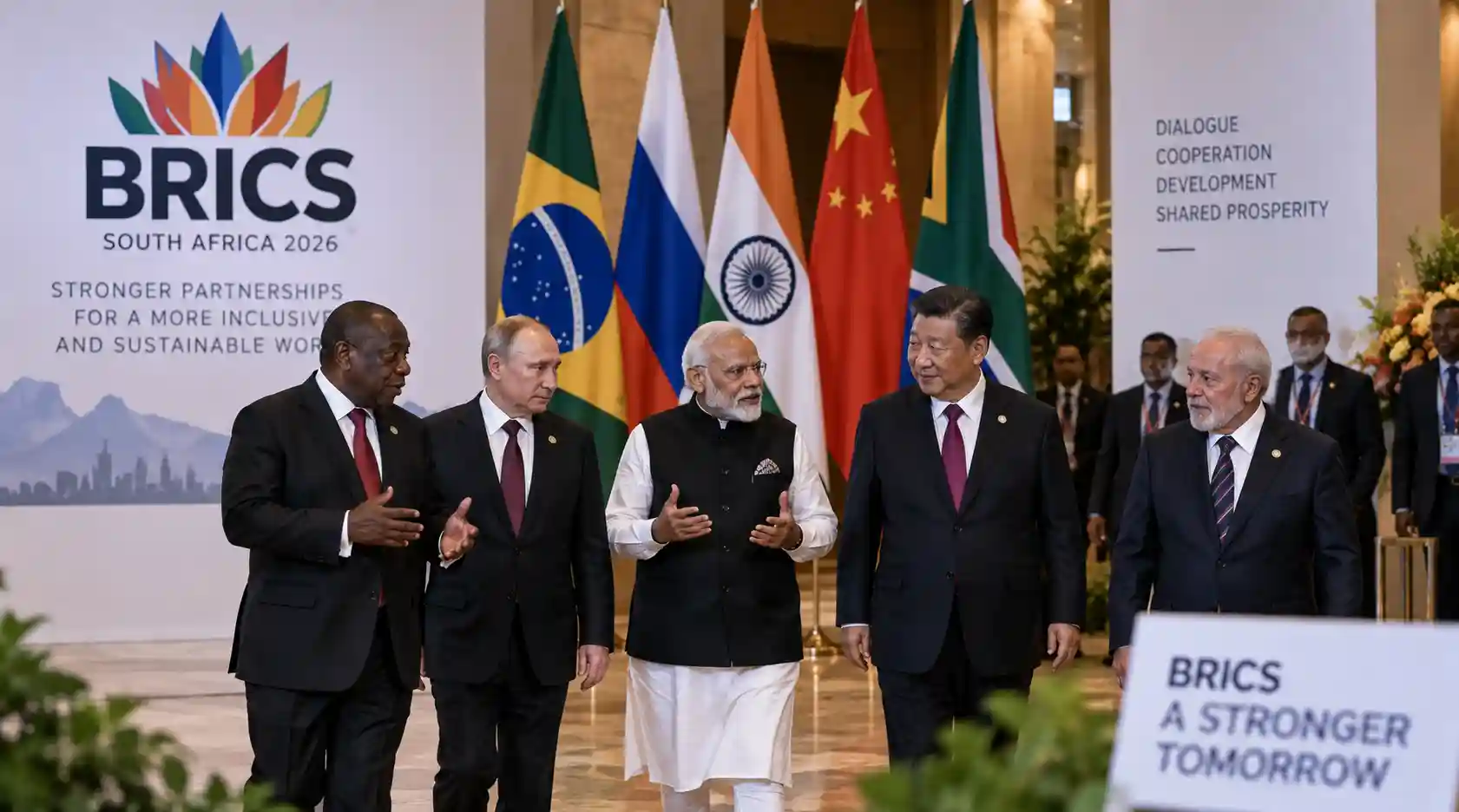

NEW DELHI, Sept. 10, 2026 — Leaders of the expanded BRICS grouping will meet in New Delhi this weekend for a two-day summit that will test whether the bloc can maintain a common position on global governance and economic cooperation while several of its members are divided by wars, trade tensions and competing geopolitical interests.
Prime Minister Narendra Modi will host the 18th BRICS Leaders’ Summit on September 12 and 13 at Bharat Mandapam, concluding India’s 2026 chairship of the grouping. India has organized its presidency around the theme “Building for Resilience, Innovation, Cooperation and Sustainability.”
The most politically important meeting comes first.
At 2:35 p.m. on Saturday, leaders of BRICS member states are scheduled to enter a closed session titled “Inclusive Global Governance and Strengthening Multilateralism.” Unlike the broader meeting with partner countries planned for Sunday, Saturday’s session is reserved for full BRICS members. The official programme then moves to a technology showcase, group photograph, tree planting and a gala dinner hosted by Modi.
The closed format gives leaders space to address subjects where reaching public agreement may be considerably harder than agreeing on development or trade initiatives.
Why the closed-door session matters
BRICS now consists of 11 full members: Brazil, Russia, India, China, South Africa, Egypt, Ethiopia, Indonesia, Iran, Saudi Arabia and the United Arab Emirates.
That expansion has increased the bloc’s economic and diplomatic weight, but it has also made consensus more difficult.
The summit comes during severe geopolitical strains.
The conflict involving the United States, Israel and Iran has placed a BRICS member directly at the centre of a major international crisis. Tensions have also affected relations between Iran and the UAE, while disruption around the Strait of Hormuz has affected energy markets and pushed oil prices higher. Russia’s war in Ukraine remains another source of international division.
Those issues are expected to influence the talks, but they should not be confused with the formally announced summit agenda. India has confirmed that the closed session is about inclusive global governance and stronger multilateralism. Specific language on Iran, Ukraine, sanctions or individual conflicts will depend on negotiations between leaders.
That distinction is important because BRICS operates largely by consensus.
A joint declaration becomes harder to produce when members disagree on how conflicts should be described, who should be blamed and what response the grouping should support.
South Africa, in outlining its participation, said the summit would take account of geopolitical tensions including the Middle East and Ukraine while seeking to preserve unity within the expanded bloc.
Xi, Putin and Pezeshkian among leaders heading to Delhi
The gathering will bring several of the world’s most consequential political leaders to India.
China formally confirmed that President Xi Jinping will attend at Modi’s invitation, making the visit especially significant as India and China cautiously rebuild high-level engagement after years of strained relations.
Russian President Vladimir Putin and Iranian President Masoud Pezeshkian are also expected to attend. The United Arab Emirates is expected to be represented by Crown Prince Sheikh Khaled bin Mohamed bin Zayed Al Nahyan.
South Africa has officially confirmed President Cyril Ramaphosa’s attendance. His government said BRICS leaders will discuss trade, investment, institutional cooperation and reform of the United Nations and international financial institutions.
The presence of Xi, Putin and Pezeshkian gives Modi an opportunity for bilateral diplomacy alongside the formal BRICS programme. The summit comes as India manages strategic relationships with Russia and the West, a difficult economic relationship with China and energy and connectivity interests across West Asia.
India wants BRICS to produce economic results
New Delhi has spent much of its presidency trying to ensure BRICS does not become only a forum for geopolitical declarations.
India’s trade agenda has focused on resilient and diversified global supply chains, stronger multilateral trade rules, greater access to finance for smaller businesses and easier cross-border delivery of digital services.
BRICS trade ministers have already advanced a 2026-2030 action plan on global value chains and discussed potential cooperation platforms involving pharmaceuticals and food security. They also made progress on the Strategy for BRICS Economic Partnership 2030, which covers digital economy, industry, innovation, technology, investment, finance and sustainable development.
That strategy is being forwarded to BRICS leaders for consideration.
India has also pushed startup cooperation.
At the BRICS Industry Ministers’ Meeting in August, New Delhi proposed a BRICS Incubator Network and BRICS Startup Innovation Fund, while ministers adopted measures covering MSMEs, logistics and industrial cooperation.
Technology has been another major pillar. India’s BRICS ICT programme has covered artificial intelligence, next-generation communications, digital public infrastructure, cybersecurity, digital skills and startup ecosystems. Science ministers have separately discussed AI, high-performance computing, quantum technologies, biotechnology and climate-related innovation.
India is therefore likely to push for a final summit outcome that combines political language on multilateralism with practical economic and technological cooperation.
Bharat Innovates, group photograph and tree planting
After Saturday’s closed-door discussions, leaders are scheduled at 4:25 p.m. to visit the Bharat Innovates Exhibition at Hall 14 of Bharat Mandapam.
A leaders’ family photograph is scheduled for 5:05 p.m., followed five minutes later by a joint tree-planting programme on the outside lawns.
Bharat Innovates is tied to India’s effort to showcase its deep-technology and startup ecosystem internationally. An earlier 2026 edition in France featured Indian innovations across artificial intelligence, semiconductors, biotechnology, healthcare, energy, advanced manufacturing, mobility and space technology.
Modi will then host a gala dinner at 7:30 p.m. on Saturday at Bharat Mandapam, bringing the first formal day to a close.
The dinner has no publicly announced negotiating agenda, but such gatherings give leaders additional opportunities for informal exchanges away from structured plenary sessions.
Sunday opens BRICS to partners and outreach countries
The second day broadens the conversation.
Leaders and heads of delegation from BRICS partner countries and outreach invitees are scheduled to arrive from 9:55 a.m. Sunday, followed by another group photograph.
At 10:50 a.m., Modi will chair an open session titled “Resilience, Innovation, Cooperation and Sustainability: Shaping the Future for Inclusive Global Growth.”
That session is expected to shift the emphasis toward development, economic resilience, technology cooperation and the relationship between BRICS and the wider Global South.
The expanded attendance also allows India to present BRICS as more than a closed political club of large powers.
What could come out of New Delhi
The clearest expected formal outcome is a New Delhi Declaration.
South Africa’s presidency has said the summit will conclude with adoption of the declaration, indicating that negotiators are working toward consensus text covering the leaders’ discussions and agreed priorities.
The final document could incorporate work already completed during India’s presidency on trade, resilient value chains, technology, sustainable development, institutional reform and cooperation among developing economies.
It may also address international conflicts and economic instability, although the strength and wording of those sections will reveal how much political consensus exists inside the expanded BRICS.
That is why Saturday’s closed meeting is the centre of the summit.
BRICS has become larger and more influential, but size alone does not produce unity.
For India, the test in New Delhi is whether it can use its presidency to bridge members that disagree on major geopolitical questions while still securing concrete agreements on trade, technology, supply chains and development.
A gala dinner and a family photograph will show the leaders together.
The New Delhi Declaration will show how much they actually agreed on.
Reader questions
Frequently asked questions
When is the 2026 BRICS Summit in New Delhi?
The 18th BRICS Leaders’ Summit is scheduled for September 12 and 13, 2026 in New Delhi.
Who is hosting the BRICS Summit 2026?
Prime Minister Narendra Modi is hosting the summit under India’s 2026 BRICS presidency.
What is the BRICS closed-door session about?
Saturday’s closed session is titled “Inclusive Global Governance and Strengthening Multilateralism” and is reserved for leaders of full BRICS member states.
Will Xi Jinping attend the BRICS Summit in India?
Yes. China’s Ministry of Foreign Affairs has officially confirmed President Xi Jinping’s attendance.
What is scheduled after the closed BRICS meeting on Saturday?
The programme includes the Bharat Innovates Exhibition, a leaders’ group photograph, a joint tree-planting event and a gala dinner hosted by Narendra Modi.
What is expected from the second day of the BRICS Summit?
Sunday includes partner and outreach countries and an open session focused on resilience, innovation, cooperation, sustainability and inclusive global growth.
What is the main expected outcome of the BRICS Summit?
Negotiators are working toward a New Delhi Declaration covering areas where BRICS members can reach consensus.
Nexuswild welcomes factual corrections. Email contact@nexuswild.com with evidence and the article URL.