
Laser Experiment Recreates a Possible Source of the Sun's Superheated Corona
Researchers in China used the Shenguang-II laser facility to drive magnetic reconnection in plasma and heat electrons to about 820,000 kelvin — roughly twice the temperature of a comparison experiment — offering laboratory evidence for one mechanism that may help explain why the Sun's outer atmosphere is so hot.
A laboratory experiment in China has recreated a process that may help explain why the Sun's outer atmosphere is far hotter than its visible surface. Using powerful laser beams and a specially textured plastic target, researchers generated plasma structures that brought oppositely directed magnetic fields together, allowing magnetic reconnection to release energy and heat electrons.
The findings, published in Physical Review Letters on October 20, 2026, provide experimental evidence for a possible mechanism involved in heating the solar corona. The research team used the Shenguang-II laser facility in Shanghai to investigate how large-scale plasma motion can create smaller regions where magnetic energy is converted into heat.
The experiment produced an estimated peak electron temperature of 70.8 electronvolts, with an uncertainty of 6.5 electronvolts. That corresponds to roughly 820,000 kelvin, or approximately the same numerical temperature in degrees Celsius at this scale. The result was about twice the electron temperature measured in the comparison experiment using a flat target.
Why is the Sun's corona so hot?
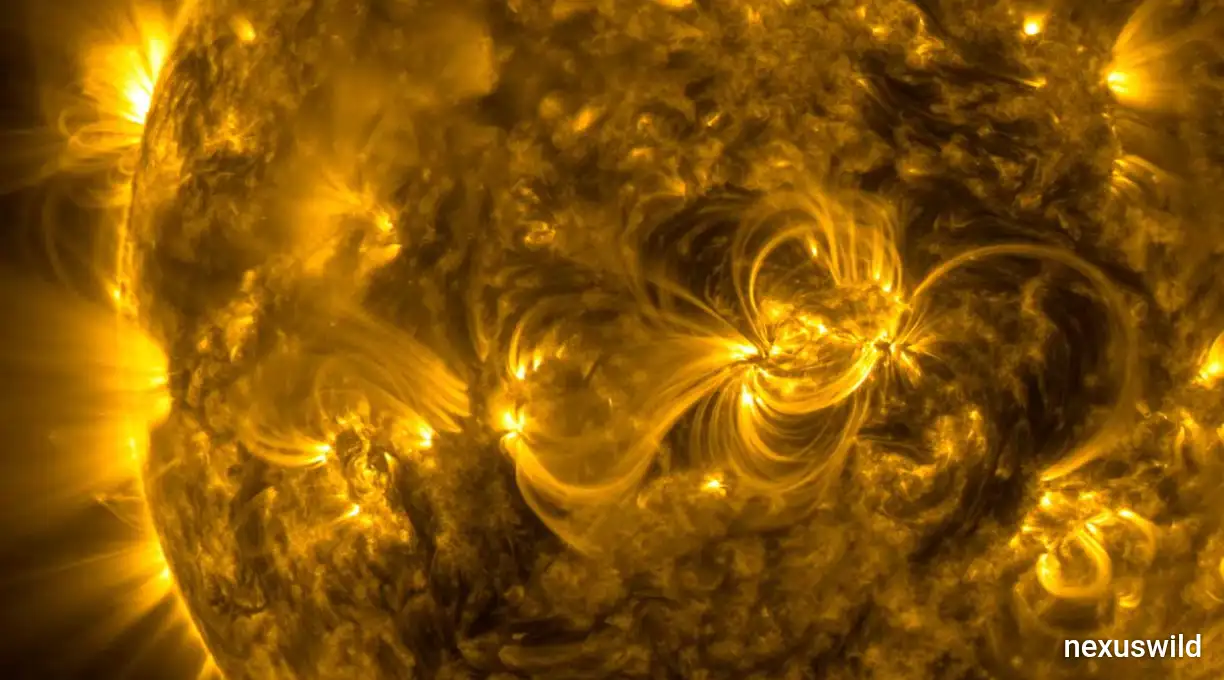
The solar corona is the Sun's outer atmosphere, extending millions of kilometres into space. Although it is much less dense than the visible surface, its temperature can reach more than a million degrees. The Sun's visible surface, known as the photosphere, is around 5,500°C.
This difference creates a long-standing puzzle in solar physics: how does the corona receive and retain enough energy to reach such high temperatures?
The Sun's magnetic field is central to many leading explanations. Solar plasma consists of charged particles that interact strongly with magnetic fields. As those fields move, twist and become stressed, they can store energy. Under suitable conditions, that energy can be released rapidly and transferred to particles in the surrounding plasma.
One proposed explanation involves nanoflares — small, short-lived energy-release events that may occur throughout the solar atmosphere. Individually, these events are far less powerful than the large solar flares that can disrupt radio communications and affect space-based technology. However, if numerous small events occur frequently enough, their combined energy could contribute to heating the corona.
Scientists continue to investigate how such events begin, how much energy they release and whether they supply a substantial fraction of the corona's total heating. The new laser experiment examines one possible way that magnetic reconnection can develop in plasma, rather than measuring the full heating budget of the Sun.
How the laser experiment worked
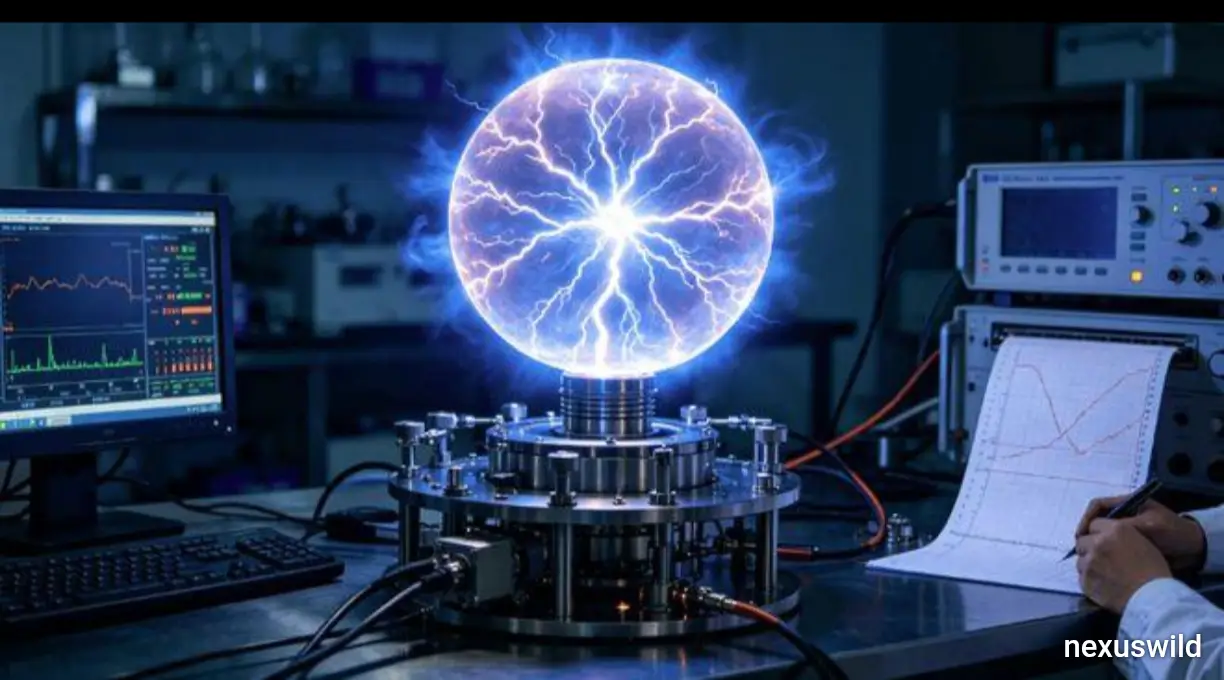
The research team fired four overlapping, high-power laser beams at a plastic target with a rippled surface. The short laser pulses heated and ablated the material, producing an expanding cloud of plasma.
As this plasma expanded and interacted with the surrounding lower-density material, its rippled boundary developed into finger-like and mushroom-shaped structures. These patterns are associated with the Rayleigh–Taylor instability, which can occur when a denser fluid or material accelerates into a less-dense region under appropriate conditions.
The developing structures generated magnetic fields around them. Neighbouring regions contained fields pointing in opposite directions, creating conditions in which magnetic reconnection could occur.
Magnetic reconnection happens when magnetic field lines change their connections. In doing so, they can release stored magnetic energy, which may be converted into particle motion, heat and other forms of energy. Reconnection is associated with a range of space and astrophysical phenomena, including solar flares and plasma jets.
In the experiment, the key result was that the plasma instability helped organise opposing magnetic fields into a configuration that enabled reconnection. This provides evidence for a possible route by which large-scale plasma motion can create the smaller-scale structures needed for rapid energy release.
The team also compared the rippled target with a flat plastic target. The flat-target experiment produced a smoother plasma flow and did not generate the same additional heating effect. That comparison helped researchers distinguish the heating associated with the instability-driven process from heating caused by other effects in the experiment.
What the temperature measurements showed
The researchers estimated the plasma's electron temperature by analysing X-rays emitted during the experiment. With the rippled target, the peak electron temperature reached approximately 70.8 electronvolts, with an uncertainty of 6.5 electronvolts. This is equivalent to about 820,000 kelvin.
The corresponding temperature in the flat-target comparison was roughly half as high. The difference suggests that the plasma structures and magnetic reconnection added an important source of heating under the experimental conditions.
Numerical simulations provided another check. When the simulations removed the magnetic fields, most of the supplementary heating effect disappeared. The researchers also found that Joule heating — the conversion of electromagnetic energy into heat through electrical resistance in the plasma — dominated over viscous dissipation in their simulated conditions.
Together, the temperature measurements, comparison experiment and simulations support the interpretation that magnetic reconnection contributed substantially to the extra heating. The findings do not mean the laboratory plasma reached the same physical state as the solar corona in every respect. The researchers instead used dimensionless physical parameters to compare aspects of the laboratory process with conditions thought to occur in the Sun's atmosphere.
How this relates to solar nanoflares
The experiment is relevant to the nanoflare hypothesis because it demonstrates one possible way to create magnetic reconnection without requiring magnetic structures to be assembled solely through a long sequence of large-scale surface motions.
The research team argues that the Rayleigh–Taylor instability can help self-organise opposing magnetic fields and create the conditions needed for reconnection. In the solar atmosphere, similar conditions may arise when relatively cool, dense plasma falls through hotter surrounding material. This phenomenon, known as coronal rain, can produce strong density differences and flows that may encourage instabilities.
The team used scaling relationships to compare key parameters of the laboratory plasma with those expected in coronal rain nanojets — small, rapid plasma outflows associated with the solar atmosphere. The comparison suggests that aspects of the experiment may be relevant to real solar processes, despite major differences in density, size, duration and total energy.
That qualification is important. A laser experiment lasts an extremely short time and operates under conditions that cannot reproduce the Sun's entire magnetic environment. It can isolate and test a physical mechanism, but it cannot by itself determine how frequently that mechanism operates on the Sun or how much of the corona's total energy it supplies.
The findings therefore support a possible contribution to coronal heating rather than establishing nanoflares as the only explanation. Other mechanisms, including the dissipation of waves and different forms of magnetic energy release, remain subjects of solar-physics research.
Why laboratory astrophysics matters
Researchers cannot reproduce the Sun inside a laboratory, but they can create controlled plasma conditions that resemble selected features of astrophysical environments. Laser facilities allow scientists to study processes that occur at scales too small or too fast to observe directly in the solar atmosphere.
By changing target geometry, laser conditions and other experimental parameters, researchers can test how plasma instabilities form and how magnetic energy is transferred. The resulting measurements can then be compared with numerical simulations and observations from solar telescopes and spacecraft.
The Shenguang-II result adds to a broader body of laboratory astrophysics research examining magnetic reconnection, plasma turbulence and the acceleration of charged particles. It also illustrates why experimental controls matter: comparing the rippled target with a flat one, and testing simulations without magnetic fields, helped isolate the role of the proposed mechanism.
The research may also provide useful methods and data for broader high-energy-density plasma studies. However, the experiment does not directly demonstrate improved fusion-reactor performance, more accurate space-weather forecasts or a commercial technology breakthrough. Any such applications would require additional research and evidence.
What scientists need to establish next
The next step is to determine how widely the mechanism applies to real solar conditions. Further experiments can explore how the instability behaves under different plasma parameters, while solar observations can investigate whether similar structures and magnetic configurations appear where coronal heating takes place.
Researchers also need to establish how often this type of reconnection occurs in the Sun's atmosphere and whether the energy released is sufficient to explain a meaningful share of the corona's extreme temperature. These questions require evidence beyond a single laboratory demonstration.
The study marks progress in testing one possible explanation for the Sun's hot corona. By showing that a plasma instability can help organise opposing magnetic fields and drive reconnection-related heating, the experiment gives scientists a controlled way to investigate a process that is difficult to isolate in space.
For now, the result offers a stronger experimental basis for one proposed heating mechanism — not a final solution to the coronal-heating problem. Continued laboratory work, numerical modelling and solar observations will be needed to determine how important the process is in the real Sun.
Nexuswild welcomes factual corrections. Email contact@nexuswild.com with evidence and the article URL.