
Hunter's Moon 2026: When It Peaked and How to See the October Full Moon
October's full Moon reached its peak at about 04:12 UTC on October 26, 2026 — a precise moment that many observers missed in daylight. The best view often came at moonrise, when haze and landscape made the Moon look larger and warmer in colour.
October's Hunter's Moon reached its full phase on Monday, October 26, 2026, giving skywatchers around the world an opportunity to observe one of the year's most recognisable lunar events. The Moon reached peak fullness at approximately 04:12 Coordinated Universal Time (UTC), equivalent to 9:42 a.m. Indian Standard Time and 12:12 a.m. Eastern Daylight Time in the United States.
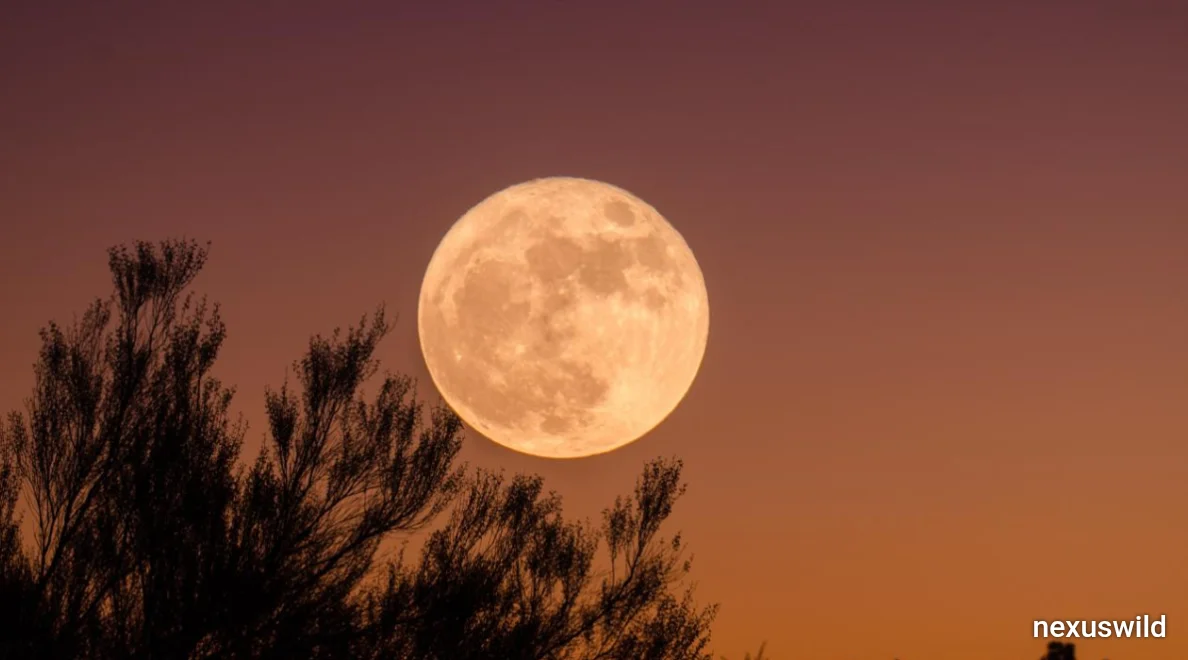
Although the exact full phase occurred at one specific moment, the Moon looked nearly full on surrounding evenings. For many observers, the most striking view came as it rose above the eastern horizon, when its position near the landscape could make it appear unusually large or take on a yellow-orange tint.
The October full Moon is traditionally known as the Hunter's Moon in the Northern Hemisphere. The name is linked to the period following the harvest, when cleared fields and bright moonlit evenings were associated with hunting and preparations for winter. The name is seasonal and cultural rather than a separate astronomical type of Moon.
When did the Hunter's Moon reach its peak?
The Moon reached the full phase at about 04:12 UTC on October 26. The same instant occurred at different local clock times around the world. In India, the peak was at approximately 9:42 a.m. IST, during daylight for many locations, so the precise moment was not necessarily the best time to see the Moon in the sky.
For observers in the eastern United States, the full phase occurred shortly after midnight. Across parts of North America farther west, it was still the evening of October 25. This explains why some skywatching guides highlighted Sunday night, October 25, while others listed Monday, October 26.
The Moon does not suddenly stop looking full as soon as the exact moment passes. Its appearance changes gradually, so casual observers can see a nearly round, brightly illuminated lunar disk over more than one night. Local moonrise and moonset times vary by location, and clouds, haze and nearby buildings or hills can affect the view.
In India, skywatchers looking for an evening view could check the local moonrise time for October 26 and look towards an unobstructed eastern horizon, weather permitting. A clear view of the horizon is often more useful than trying to observe at the exact moment of peak illumination.
Why is it called the Hunter's Moon?
The name Hunter's Moon comes from traditional seasonal naming in the Northern Hemisphere. It refers to the full Moon following the Harvest Moon, which is associated with the period around the autumn equinox.
Historically, the end of the harvest meant that many fields had been cleared, making animals easier to spot. Moonlight could also provide additional illumination after sunset, which was useful for people hunting game and preparing food for the colder months.
The name is part of a wider collection of traditional full-Moon names that reflect seasonal activities, natural changes and cultural practices. These names are not official scientific classifications, and traditions vary across communities. The Hunter's Moon should therefore be understood as a familiar seasonal name rather than a unique physical event.
The term also does not mean that the Moon is always full in October. The Hunter's Moon is defined by its relationship to the Harvest Moon, so its date depends on when that preceding full Moon occurs.
Why can the Moon look orange or unusually large?
Observers sometimes notice that a full Moon appears golden, orange or reddish when it is close to the horizon. This colour change is caused by Earth's atmosphere. When the Moon is low in the sky, its light passes through a longer path in the atmosphere before reaching an observer. Shorter blue wavelengths are scattered more strongly, allowing relatively more red and orange light to reach the eye.
Dust, smoke, haze and other atmospheric conditions can influence the colour and clarity of the Moon. As it rises higher, it may look more yellow or white. The colour is not evidence that the Moon itself has changed or that a special lunar event is taking place.
The Moon can also appear larger near the horizon than it does high overhead. This familiar perceptual effect is called the Moon illusion. The Moon's apparent size does not suddenly increase simply because it is rising. Viewing it near buildings, trees or distant hills can make the contrast especially noticeable.
For photographers, the rising Moon can provide an appealing composition when framed against a landscape or skyline. A stable tripod, manual exposure adjustments and a clear line of sight can help capture lunar detail. However, a special camera or expensive telephoto lens is not required to enjoy the event with the naked eye.
How to observe the Moon
The simplest way to watch a full Moon is to find a location with a clear view of the eastern horizon around local moonrise. Open spaces away from tall buildings can help observers see the Moon soon after it appears. Checking a reliable local moonrise forecast is important because the time differs from city to city.
Binoculars can reveal lunar maria — the broad, dark plains formed by ancient volcanic activity — and some of the Moon's brighter features. A telescope can show additional detail, although the full Moon's direct illumination produces relatively short shadows, making some craters and surface relief appear flatter than they do near the first-quarter phase.
Weather conditions remain a major factor. Clouds can obscure the Moon entirely, while humidity, dust and haze can reduce contrast. Observers should avoid looking directly at the Sun while setting up equipment before sunset, and they should choose a safe, accessible viewing location.
The full Moon is also an accessible way to introduce astronomy to children and first-time observers. It can help explain lunar phases, the difference between local moonrise and the exact full phase, and how Earth's atmosphere influences what people see.
What comes after October's full Moon?
After the full phase, the illuminated portion of the Moon visible from Earth gradually decreases, producing the waning gibbous phase. The Moon remains easy to recognise in the night sky, but it rises later on successive days and its shape changes as the lunar cycle continues.
The next full Moon is expected in November. Skywatchers can use a lunar calendar or an astronomy resource to plan future observations, taking into account local moonrise times and weather forecasts.
October's Hunter's Moon is a reminder that an astronomical event does not need a rare alignment or a telescope to be worth observing. The exact full phase is a precise moment in the lunar cycle, but its visual appeal stretches across several evenings. With a clear horizon and favourable weather, observers can appreciate the Moon's changing appearance while learning about the science and traditions behind its name.
Nexuswild welcomes factual corrections. Email contact@nexuswild.com with evidence and the article URL.