
Humanoid robots have become one of the closely watched areas of artificial intelligence and industrial automation. Technology companies are investing in machines designed to walk move objects interact with people and perform work in environments traditionally built for human employees.
The commercial opportunity is attracting attention from manufacturers, logistics companies and investors. Warehouses, factories and distribution centres contain tasks that can be physically demanding, difficult to staff and expensive to automate through conventional equipment.
However turning robots into a mainstream industrial business requires more than impressive demonstrations. Companies must prove that their machines can operate reliably perform work integrate with existing facilities and generate measurable financial returns.
One company preparing to test that opportunity in markets is Agility Robotics, the US-based developer of the Digit humanoid robot.
The company has agreed to combine with Churchill Capital Corp XI, a traded special purpose acquisition company in a transaction that would bring Agility onto Nasdaq under the proposed ticker symbol AGLT.
As of November 1 2026 the transaction is awaiting a shareholder vote scheduled for November 2. The companies expect the combination to close on November 4 and trading to begin on November 5 subject to shareholder approval and the satisfaction of closing conditions.
The proposed listing is significant because it would give public-market investors exposure to a business focused primarily on industrial humanoid robots. At the time it will place greater attention on whether Agility can turn customer interest and early deployments into repeatable commercial revenue.
Why Agility Robotics Is Attracting Attention From Investors
Agility Robotics is developing machines intended to work in commercial environments rather than serve primarily as consumer entertainment products.
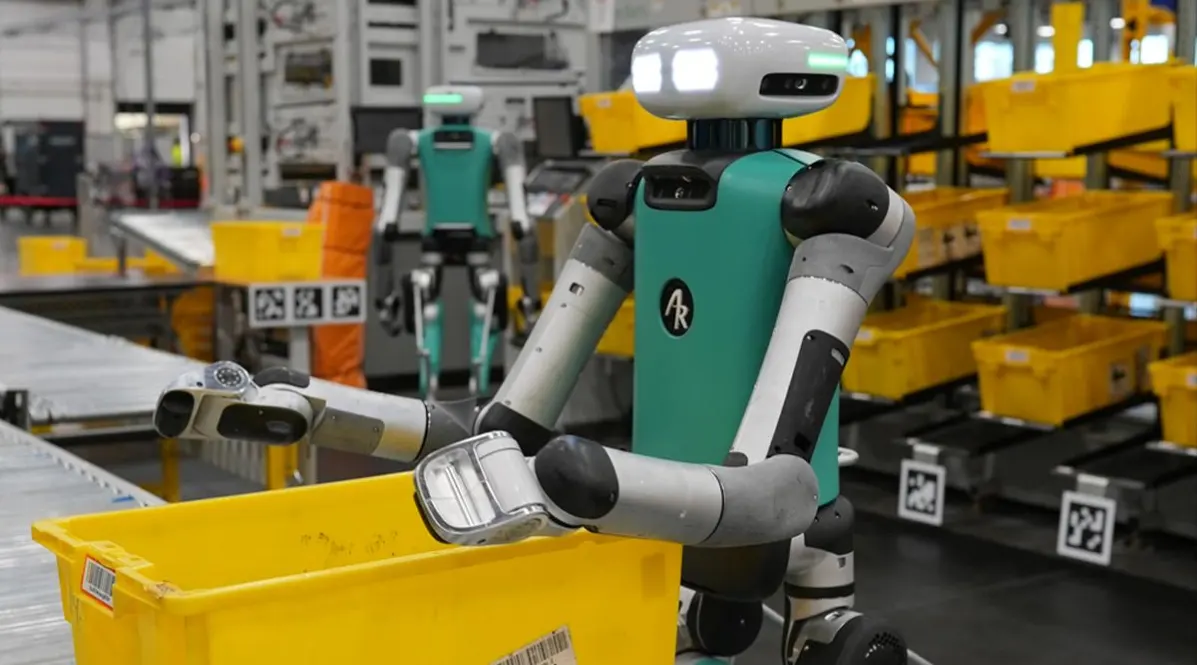
Its flagship platform, Digit is designed to perform demanding activities such as moving containers handling materials and supporting warehouse and manufacturing workflows.
The companys approach focuses on environments where existing infrastructure is already designed around people. A humanoid robot can potentially use spaces, equipment and workflows that may be difficult to automate with fixed industrial machines.
This creates a commercial advantage. Of requiring manufacturers to redesign an entire facility around a specialised robotic system a humanoid platform could potentially adapt to selected tasks within the existing workplace.
Agility has already established relationships with industrial customers, including GXO Logistics, Toyota Motor Manufacturing Canada and Schaeffler.
According to the company Digit has accumulated than 65,000 hours of real-world operation across its commercial deployments and customer programmes. The experience is being used to improve the robots performance, reliability and ability to handle workflows.
This operational experience distinguishes Agilitys business from companies whose humanoid systems remain largely at the demonstration or prototype stage. However world operating hours do not automatically establish that a robot can operate profitably at large scale.
The next challenge is to demonstrate that customers can deploy machines achieve consistent productivity and justify the cost over time.
The Nasdaq Deal Values Agility at $2.5 Billion
The proposed transaction with Churchill Capital Corp XI places a valuation on Agilitys industrial robotics business.
The merger agreement values Agility at a $2.5 billion -money equity valuation. This represents the agreed value of the company before accounting for the transaction capital and is not the same as the amount of money being raised.
The latest financing update, published on October 30 2026 revised the expected gross capital raise to $465 million before transaction expenses.
The amount comprises $164 million remaining in Churchill XIs trust account around $201 million from a common-stock private investment in public equity (PIPE) financing led by Foxconn and $100 million of equity funding already received following the initial announcement of the transaction.
This update is important because the initial transaction announcement referred to than $620 million in expected gross proceeds assuming approximately $420 million remained in the SPAC trust account. Following shareholder redemptions the revised expected amount is considerably lower.
The proposed funding is intended to support expansion, production capacity, customer deployments and further investment in robotics software and technology.
The PIPE investment led by Foxconn is particularly relevant because manufacturing capabilities will be essential if Agility intends to increase production beyond small-scale deployments.
The transaction also involves all existing Agility shareholders rolling their equity into the company with their shares subject to a 180-day lock-up following closing.
The distinction between the valuation and financing is important for investors. A $2.5 billion pre-money equity value does not mean Agility is receiving $2.5 billion in cash. The expected capital raise is a separate figure and actual funds available for operations will be affected by transaction expenses.
Digit 5 Is Central to the Companys Commercial Expansion Strategy
Agilitys generation humanoid robot, Digit 5 is expected to play an important role in its transition towards larger commercial deployments.
Introduced on September 15 2026 Digit 5 is designed to work in proximity to people and handle a broader range of industrial tasks.
The company says the upgraded design incorporates improvements intended to support lifting capability, battery performance, dexterity and cooperative safety.
Safety is particularly important because industrial facilities contain moving machinery employees, forklifts, uneven workflows and constantly changing conditions. Robots must be able to perform their assigned tasks without creating risks for human workers.
Digit 5 is being developed to operate in workplaces without relying on the physical safety barriers typically associated with some automation installations. However its practical safety performance will need to be demonstrated through customer deployments and operational testing.
Agility expects to begin early-access deliveries during the half of 2027 with general commercial availability targeted for the end of that year.
The company has also disclosed than $300 million in committed multi-year orders for Digit 5. It says these orders relate to 1,000 robots under a three-year Robots-as-a-Service arrangement.
This figure requires interpretation. The orders represent multi-year value subject to contractual milestones and product requirements. They are not equivalent to revenue already earned. The company has warned that they may not fully convert into realised revenue.
The success of Digit 5 will therefore depend on whether the company can move from commitments to completed deliveries and reliable customer operations.
Warehouse and Manufacturing Partnerships Provide Early Commercial Evidence
One of the arguments supporting industrial humanoid robotics is the potential to automate repetitive physical work.
Warehouses and manufacturing facilities frequently require employees to move containers transfer materials organise goods and support production lines. These tasks can involve repeated movements and physical effort making them candidates for automation.
GXO Logistics has been one of Agilitys commercial partners.
The companies began working in 2024 through a deployment at GXOs facility in Flowery Branch, Georgia. Under their expanded agreement announced on October 26 2026 Digit robots are expected to enter two GXO facilities in Statesville, North Carolina and Lebanon, Tennessee.
The new deployments are scheduled to begin in 2027 using Digit 4 with plans to transition to Digit 5 when the newer model becomes commercially available.
The initial use cases involve material-handling activities supporting e-commerce fulfilment.
GXO has reported that Digit has moved than 100,000 totes at its Georgia facility under the existing commercial arrangement. This provides an example of humanoid robots being used within an operating logistics environment rather than only in demonstrations.
Agility has also secured an agreement with Toyota Motor Manufacturing Canada following a successful pilot. The agreement uses a Robots-as-a-Service model to deploy Digit in manufacturing, supply-chain and logistics activities.
Schaeffler is another customer and investor involved in deploying Digit for automotive manufacturing applications. Meanwhile agricultural equipment manufacturer AGCO has entered an agreement for a manufacturing pilot expected to begin in 2027.
These relationships show that industrial customers are willing to evaluate humanoid robots for operational tasks.
However partnerships and pilot programmes should not be confused with adoption. The commercial test will be whether these deployments expand across facilities and create measurable productivity improvements.
Manufacturing Capacity Will Determine Whether Agility Can Scale
Building a successful humanoid robot is one part of creating a sustainable industrial business. Companies must also manufacture machines consistently deliver them to customers maintain them and provide support throughout their operating lives.
Agility has invested in manufacturing infrastructure to support its expansion.
Its RoboFab facility in Salem, Oregon covers 70,000 square feet and is designed to support annual production capacity of up to 10,000 robots.
That figure represents the facilitys designed capacity, not its production output.
The company is also developing Agility Arc, a cloud-based platform intended to manage robot fleets and integrate machines into customer operations.
These investments address a requirement for commercial robotics. Industrial buyers generally need more than a machine. They need deployment support, software integration, maintenance arrangements, performance monitoring and a reliable process for responding to problems.
A specialised service network may become as important as manufacturing itself. If robots frequently require repairs or technical intervention operating costs could. Customer confidence may weaken.
Agilitys challenge will be to increase production without sacrificing quality while also building the service infrastructure required to support a growing customer base.
Foxconns involvement in the proposed financing is notable in this context because the company has manufacturing and electronics production experience. Whether that relationship translates into production advantages remains to be seen.
Humanoid Robots Still Face a Commercial Business Case
Despite progress, in industrial deployments humanoid robotics remains an emerging market.
The biggest challenge is economic. Companies do not buy robots just because the technology is advanced. They look at whether a machine can do work at a cost that is better than human workers and existing automation systems.
The calculation includes the cost to buy or subscribe, electricity, maintenance, software, time when the machine is not working, integration costs and the help needed to run the machines.
A robot that looks like a person might be flexible because its design lets it work in places made for people.. That flexibility does not always mean it is the best choice financially.
For tasks that repeat in one place, a regular industrial robot or a moving belt might do work for less money.
Gartners forecast in January 2026 said that than 20 companies would likely use humanoid robots in large scale manufacturing and supply chain work by 2028. It also said that technology not being ready problems with combining the robot with systems, cost and short battery life could slow how fast they are used.
Research from the Capgemini Research Institute in 2026 found problems. Their survey said 72 percent of people said the technology was not ready 63 percent said it was too expensive and 62 percent said they did not know if they would get a return on their money.
These results show that interest from companies is growing faster than being ready for the market.
For Agility the money side depends on showing that Digit can do jobs over and over safely and in a way that makes sense financially. Successful work at GXO and Toyota is proof but more companies will need to see that they can get good returns.
Profitability is still one of the risks for the company.
Agilitys plan to go public will show more of its results to investors but the company is still growing.
Its papers with regulators say it is an early stage business that has had losses. The company has spent a lot on research and development making products and building its RoboFab factory.
The papers also say that Agility has not made money to cover its costs and expects to have big expenses and losses for a long time.
This is normal for a company making a kind of equipment but it is a big financial risk.
The company has to spend money on making hardware, building teams to put the robots out, software and help for customers before it can make money enough to pay for all that.
Its Robots-as-a-Service model might help customers spend upfront while giving Agility regular money. Under this setup customers pay to use the robots and related help of buying each one.
This model also means the company has to support the machines over time. Its profits depend on how much it costs to fix the robots how often they are used how long they last how many customers stay and how well the company can make the machines.
Agilitys own investor presentation says its money numbers are an example and depend on guesses about future costs, prices and size. The company also says that it might not reach its planned cost savings.
The $300 million order should be looked at with the companys risks not as proof that it is already making money.
Competition is getting stronger in the humanoid robotics field.
Agility is going public as other companies also work on making robots that look like people for factories and other places.
Tesla is working on its Optimus project while Figure AI, Apptronik, 1X Technologies, Boston Dynamics and Sanctuary AI are all making robot options.
Companies in China are also putting money into making robots adding more competition in building how much it costs and putting them to work.
This means Agilitys place in the market can't just be judged on making a working robot. It needs to show it is better in reliability, cost, safety, software and helping customers.
Its work with customers is a start. Others are also building relationships with big companies.
There is also competition from automation. Robots that do one thing, soft robots that work with people and robots that move on their own already have places in factories and warehouses.
Companies might choose these because their results are known and it is easier to see the money they save.
Agility needs to show where a robot that looks like a person is better than machines that do one task.
Its chance could be strongest in places where workers do different physical jobs and a flexible robot can help with several tasks.
What the Nasdaq Listing Could Mean for the Robotics Industry
A successful deal would let Agility get money from the public and create a company that is listed on the stock market and focused on making robots for industry.
The ticker symbol would be AGLT. The company expects to start trading on Nasdaq on November 5 2026 if everything goes through.
The listing could give investors a way to see how well a company that makes humanoid robots is doing.
It might also mean more people watch the companys promises how machines it makes how much it spends and how well it does financially.
For the robotics world the deal could be another sign of how much people value companies that use physical AI.
A public listing doesn't mean the technology is already widely used. It makes it easier to get money to grow. It also brings more rules more people watching and more pressure to show real progress.
The November 2 vote by shareholders and the steps to finish the deal are next steps. Until everything is approved and the conditions met the deal is still a plan.
What Comes Next?
The next step for Agility depends on turning interest into working robot use in factories.
The work with GXO the agreement with Toyota and the coming AGCO test offer chances to see how Digit works in situations.
The early access program for Digit 5 in the half of 2027 will be an important step, followed by the companys goal to have Digit available for everyone by the end of 2027.
Investors and companies will watch how many robots are made how well they work how many customers come back and how well the company turns orders into money.
How well Agility can make robots at RoboFab will also be important. The plan to make 10,000 a year is a goal but whether that is really needed depends on how many robots are actually made and how many customers want them.
The important thing will be whether companies can use these robots to do more work for a cost that makes sense.
Humanoid robots are moving from labs to warehouses and factories. Making them a common industrial tool is still a big challenge.
Agility Robotics is trying to become part of this market with its Digit robot deals with companies like GXO and Toyota and a plan to go public by merging with Churchill Capital Corp XI.
The $2.5 billion value before the deal and the expected $465 million in money from the deal show that people are interested in the companys plans. The more than $300 million in orders for Digit 5 also shows interest. Those orders are not yet real money.
The biggest test will be turning that interest into working robots, orders and making a profit.
Agilitys public listing could be a moment for robots that look like people.. The long-term success of the whole industry will depend less on shows and news than on whether these robots can do real work safely reliably and, for a good price.
The future of robots that look like people will not be decided by how human they look. By how much real value they bring into a real business.
Nexuswild welcomes factual corrections. Email contact@nexuswild.com with evidence and the article URL.