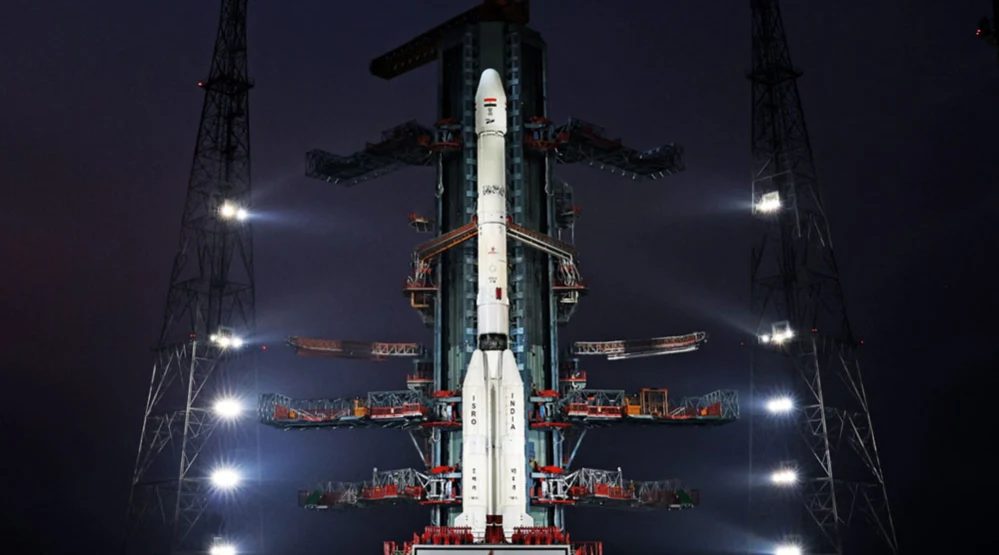

The Indian Space Research Organisation launched its NVS-03 navigation satellite on a GSLV-F18 rocket from Sriharikota at 11:51 pm IST on October 30, 2026. About 18 minutes later, the satellite separated and was injected into its intended geosynchronous transfer orbit, ISRO said.
ISRO Chairman V. Narayanan said the rocket injected the satellite with exceptionally high accuracy and called it one of the best orbital injection performances by a launch vehicle. It was the 20th flight of the GSLV. Mission director Thomas Kurian and Vikram Sarabhai Space Centre director U. P. Rajeev were among the officials at the post-launch briefing, Deccan Chronicle reported.
The satellite is in orbit but not yet in service
NVS-03 is the third of five planned second-generation satellites for NavIC, India's regional navigation system. It must still use its own propulsion to reach its final slot in geosynchronous orbit, at 32.5 degrees East, according to Business Standard. ISRO has not announced when it will be commissioned and start serving users.
That matters because of where NavIC stands. According to a July 2026 government statement in Parliament, only three satellites were providing positioning, navigation and timing services: IRNSS-1B, IRNSS-1I and NVS-01. Four are needed for standalone positioning, so NavIC could not offer it, although its timing services continued, India TV reported, citing AP. Some outlets say the launch restores NavIC to four satellites, but that depends on NVS-03 entering service. Narayanan said a full constellation needs seven satellites.
What NVS-03 carries
The NVS satellites add the L1 navigation signal to the L5 and S-band signals, which widens compatibility with receivers. NVS-03 is designed to cover India and a region about 1,500 km beyond its borders. It carries an indigenous atomic clock along with procured clocks. Narayanan told ANI that two indigenous clocks already work in orbit and that NVS-03 carries the third.
Reports give the satellite's mass as about 2,250 kg, citing the chairman, while Business Standard gives 2,232 kg.
ISRO sources told The Tribune in 2025 that the NVS series would gradually replace the remaining first-generation satellites launched between 2013 and 2015. NVS-01, launched in 2023, was the first to fly an indigenous atomic clock.
NavIC's uses include tracking rail locomotives, fishing-vessel safety and location services on some smartphones. India TV cited more than 10,400 locomotives, about 40,000 fishing vessels and over 60 handset models, though the underlying source for those figures was not accessed.
A fix for NVS-02's problem
The second NVS satellite, NVS-02, launched in January 2025 as ISRO's 100th launch from Sriharikota. It is not among the three satellites listed as providing services in July. Narayanan said ISRO kept three pyro valves open in NVS-03 to avoid a repeat of the problem encountered with NVS-02, after a technical assessment that included vibration and shock tests. Business Standard called this an unprecedented safety measure. The sources reviewed do not detail what went wrong with NVS-02.
The rocket's record
The GSLV Mk II has launched NVS-01 in 2023 and NVS-02 in January 2025, and it carried the NASA-ISRO NISAR satellite in July 2025. A 2021 GSLV flight with the EOS-03 satellite failed to reach orbit, according to a published list of GSLV launches. That history is background, and ISRO's own record page was not accessed.
Faster turnaround
Narayanan said the mission was completed with the shortest gap, 56 days, between successive GSLV missions. The sources reviewed do not give the date of the previous GSLV flight, so that comparison cannot be checked independently. The launch had been planned for earlier. One outlet reported a window of October 15 to 20 and said the schedule was revised after PSLV setbacks, while ISRO announced the October 30 date on October 22.
Prime Minister Narendra Modi congratulated ISRO's scientists and engineers, saying the mission would strengthen NavIC, according to ANI. Science and Technology Minister of State Jitendra Singh also congratulated the team.
What is known and unknown
What is known: the launch and orbit injection, the satellite's signals and clocks, and NavIC's status before launch. What is not yet known: the achieved orbit parameters, which the sources reviewed do not give, when NVS-03 reaches its final slot and enters service, whether that will restore standalone positioning, and when NVS-04 and NVS-05 will launch.
Nexuswild welcomes factual corrections. Email contact@nexuswild.com with evidence and the article URL.