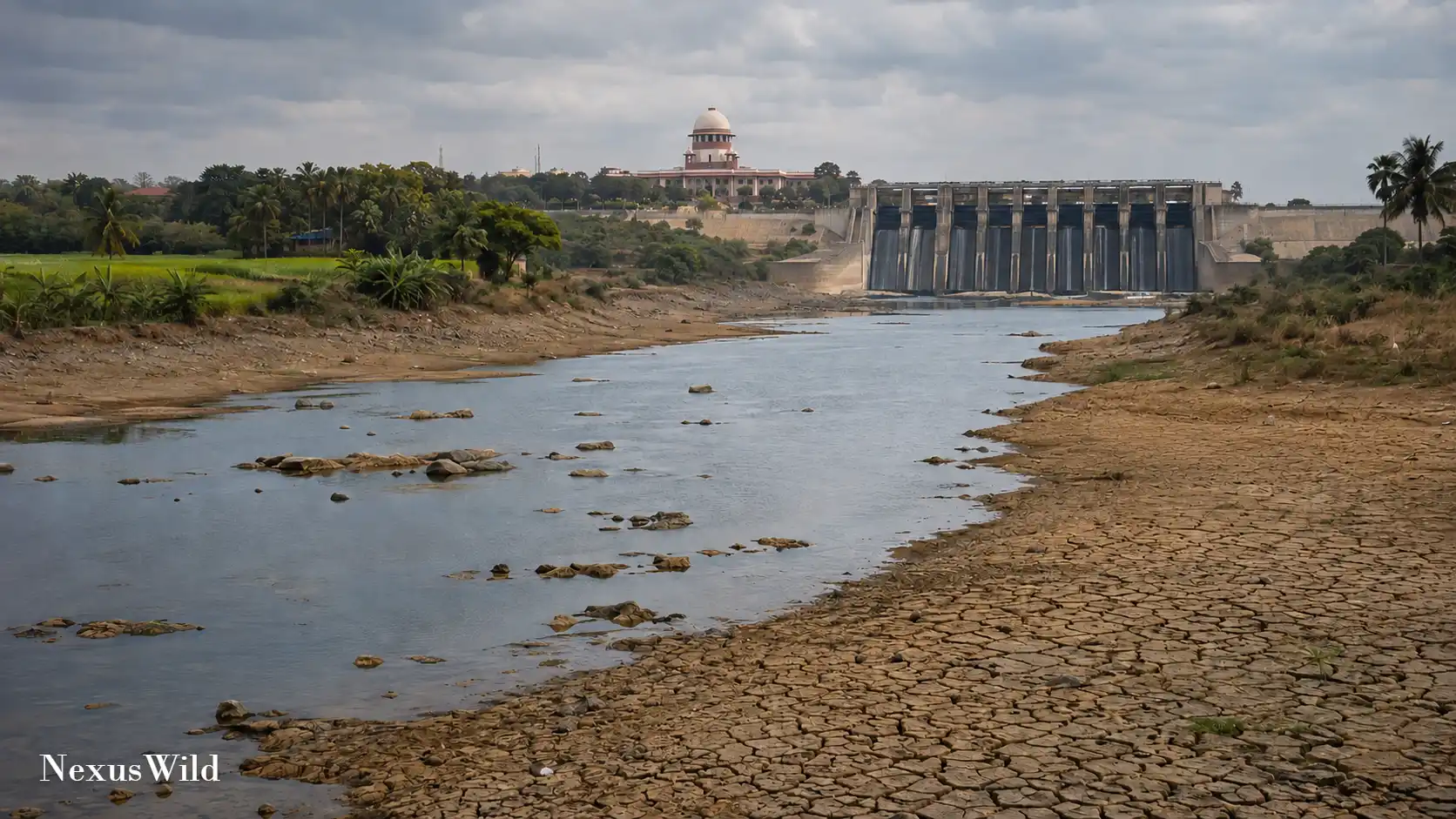

NEW DELHI — The Supreme Court on Monday, August 31, deferred to September 15 the long-running Cauvery water dispute between Tamil Nadu and Karnataka, after Tamil Nadu urged the court to direct Karnataka to clear an accumulated water-release backlog and Karnataka maintained it was already releasing more water than the Cauvery authorities had prescribed.
A bench of Justices Vikram Nath and Sandeep Mehta heard submissions from both states before posting the matter for further hearing later this month. Appearing for Tamil Nadu, senior advocate C S Vaidyanathan alleged that Karnataka had failed to clear the backlog in water releases despite the Cauvery Water Management Authority (CWMA) having itself recorded the shortfall, and urged the court to direct the authorities to reconsider the state's request for clearing the accumulated deficit. Vaidyanathan told the bench that nearly 24,700 acres of agricultural land in Tamil Nadu depended on Cauvery water, according to the state's submission. Karnataka's counsel responded that the state was currently releasing more than the stipulated 9,000 cusecs at Biligundulu, the interstate measuring point. The court has not, as of this hearing, ordered Karnataka to release any specific backlog quantity; the matter remains under judicial consideration ahead of the next hearing.
Tamil Nadu's Claimed 17.604 TMC Backlog
In its submissions around August 27, Tamil Nadu told the Supreme Court that Karnataka owed it an accumulated backlog of 17.604 thousand million cubic feet (tmcft, commonly shortened to TMC) of Cauvery water, calculated on a pro-rata sharing basis that adjusts normal-year entitlements to reflect this year's rain-deficient conditions. This figure represents Tamil Nadu's own calculation of the shortfall between what it says it was proportionately entitled to receive at Biligundulu and what has actually reached the state, and it has not been judicially confirmed or accepted by Karnataka. Tamil Nadu has argued that Cauvery Delta farmers are being severely affected by the shortfall, particularly during the ongoing Kuruvai cropping window, and has contended that the Cauvery Water Regulation Committee (CWRC) and CWMA have not adequately accounted for the accumulated deficit in their recent release directions.
What Tamil Nadu Is Demanding
Tamil Nadu's calculations, as presented to the courts and the Cauvery authorities over recent weeks, have evolved as the water year has progressed and as Karnataka has released varying quantities under successive CWRC and CWMA directions. Earlier this month, the state had separately pressed for a release of approximately 1.9 TMC per day, translating to roughly 22,000 cusecs, sustained over 15 days, arguing that this rate was necessary to both meet current requirements and begin addressing the accumulated shortfall. Tamil Nadu has argued that the CWRC's more recent recommendation of 9,000 cusecs, even sustained through mid-September, would not be sufficient to close the backlog it has calculated, since that rate is designed primarily to meet near-term requirements rather than retroactively compensate for the deficit built up earlier in the water year. Water reaching Biligundulu, the gauge station where flows from Karnataka's reservoirs are measured before entering Tamil Nadu, remains the reference point around which all of these calculations are built. It should be noted that these are Tamil Nadu's submissions and calculations, not figures independently verified or accepted by Karnataka or by the Supreme Court.
What CWRC and CWMA Decided
The Cauvery Water Regulation Committee, at its 141st meeting, directed Karnataka to release water from its reservoirs so as to ensure a continuous flow of approximately 9,000 cusecs at Biligundulu for 15 days, a schedule running from August 25 through September 8. The Cauvery Water Management Authority upheld this recommendation at its 56th meeting on August 25, held in Delhi under chairman S K Haldar, with representatives from Tamil Nadu, Karnataka, Puducherry, Andhra Pradesh and Kerala in attendance. At this rate, Tamil Nadu is expected to receive roughly 11.66 TMC over the period, water the CWRC said is intended to support Kuruvai cultivation and meet the state's drinking-water requirements. Karnataka had reportedly sought a reduction to 6,000 cusecs during these deliberations, while Tamil Nadu pressed for a substantially higher release reflecting what it considers its full proportionate share; the CWMA ultimately reiterated the CWRC's 9,000-cusec figure. This followed an earlier CWRC direction, upheld by CWMA, requiring 12,000 cusecs daily for 15 days from August 12.
Tamil Nadu has called the 9,000-cusec quantity inadequate, arguing before the CWMA that it does not reflect the state's calculated pro-rata entitlement once the accumulated backlog is factored in. Karnataka's reservoir conditions and inflows factor centrally into how these releases are set: the CWRC and CWMA base their recommendations on current storage levels in Karnataka's four major Cauvery basin reservoirs, Krishna Raja Sagar, Kabini, Harangi and Hemavathi, along with recent and projected inflows, and both bodies have generally sought to balance Tamil Nadu's requirements against Karnataka's own irrigation and drinking-water needs in what both sides describe as a distress year with below-normal monsoon rainfall in the basin.
Karnataka's Position
Karnataka has told the courts and the Cauvery authorities that it is complying with CWMA directions and, in the most recent hearing, said it was releasing more than the stipulated 9,000 cusecs. In an earlier hearing this month, Karnataka's senior advocate Shyam Divan submitted that the state's reservoirs held around 76% live storage at the time, and argued that Karnataka had not only met but exceeded the previous 3,500-cusec requirement during the control period in question, even though flows had briefly dipped below that level in the initial days. Karnataka has consistently argued that the Cauvery basin is facing extremely severe distress this water year, with a rainfall deficit affecting inflows into its reservoirs, and has maintained that the CWMA, as the expert regulatory body, has already factored these ground realities into its directions. Karnataka's counsel has also argued in past hearings that the pro-rata sharing formula is a threshold rule rather than a rigid mathematical entitlement, and that the final apportionment of water in a distress year should reflect equitable adjustment based on actual hydrological conditions rather than a strict percentage of the normal-year allocation. It should be noted that no court or regulatory authority has found Karnataka in violation of its release obligations; the dispute over compliance remains contested and under judicial consideration.
Why Cauvery Water Matters to Tamil Nadu Farmers
The Cauvery Delta, spanning districts including Thanjavur, Tiruvarur and Nagapattinam, is one of Tamil Nadu's most important paddy-growing regions and depends heavily on water released from Karnataka's reservoirs reaching the Mettur reservoir, from which it is distributed for irrigation. Cultivation in the delta follows two main seasonal cycles: Kuruvai, a short-duration crop typically sown in June and July using early monsoon releases, and Samba, a longer-duration crop sown later in the year that depends on sustained water availability into the winter months. Delays or shortfalls in Cauvery releases during these windows can compress planting schedules, affect the timing of transplantation, and constrain the area farmers are able to bring under cultivation in a given season, which is central to why Tamil Nadu has pressed for both timely and adequate releases this year.
How Cauvery Water Is Legally Shared
The current framework governing Cauvery water sharing stems from the Cauvery Water Disputes Tribunal's final award, later modified by the Supreme Court in its February 2018 judgment. Under that judgment, in a normal year Karnataka is required to ensure that 177.25 TMC of water reaches Tamil Nadu at Biligundulu annually, following a monthly release schedule set out by the tribunal and the court. According to figures cited in related filings, the stipulated flow for the June-to-September period alone is around 123.14 TMC, with roughly 44.11 TMC due between October and January. It is important to note that 177.25 TMC is a normal-year annual figure, not a quantity Karnataka is required to release immediately or in any single tranche; actual monthly and periodic release obligations are calculated against this annual baseline and adjusted during deficit years. The Cauvery Water Management Authority and the Cauvery Water Regulation Committee were constituted following the 2018 judgment to implement and monitor these releases, with the CWRC making technical recommendations that the CWMA then reviews and can uphold, modify or reject. During water-deficit or distress years, both bodies apply a pro-rata or distress-sharing approach that scales down the normal-year entitlement in proportion to the shortfall in actual inflows, though the two states frequently disagree on how that scaling should be calculated.
Why the 17.604 TMC Figure Is Contested
At the heart of the dispute is a distinction between several related but different measures:
- Scheduled Allocation: The monthly quantities set out under the tribunal's award and the 2018 judgment for a normal year.
- Actual Flows: The water volumes genuinely measured at Biligundulu, which can vary daily based on releases and natural catchment contributions.
- Pro-Rata Entitlement: A recalculated figure, applied in a distress year, that scales the normal-year schedule down according to the shortfall in inflows into Karnataka's reservoirs.
- Current Releases: What the CWRC and CWMA have most recently directed, such as the 9,000-cusec flow now in effect.
- Accumulated Backlog: The state's running calculation of the gap between its pro-rata entitlement and what has reached Biligundulu (claimed as 17.604 TMC by Tamil Nadu as of August 27).
- Reservoir Storage: The volume of water held in Karnataka's four Cauvery basin dams (KRS, Kabini, Harangi, Hemavathi).
Tamil Nadu's position rests on the argument that, once the season's shortfall is applied proportionately to both states under the distress-sharing formula, Karnataka still owes it 17.604 TMC that has not been released despite adequate storage. Karnataka disputes this calculation and the underlying method, arguing that pro-rata sharing is not a fixed formula but a threshold guide, and that actual releases must reflect real-time hydrological conditions, including Karnataka's own irrigation and drinking-water commitments, rather than a static percentage carried forward from earlier in the year.
What Happens Next
With the Supreme Court adjourning the matter to September 15, Karnataka has not been directed to release the full 17.604 TMC Tamil Nadu has claimed as outstanding. The CWRC and CWMA will continue to monitor releases under the existing 9,000-cusec direction through September 8, after which both bodies are expected to reassess the release schedule based on updated reservoir storage, inflow data and rainfall conditions in the basin. Any significant rainfall in Karnataka's catchment areas before the next hearing could materially alter both states' calculations, since additional inflows would ease the distress conditions cited by Karnataka while potentially supporting a higher pro-rata release to Tamil Nadu. For Tamil Nadu, the outcome will have a direct bearing on the remainder of its Kuruvai season and the timing of Samba cultivation, both of which depend on water reaching the delta through Mettur in the coming weeks.
Further reading and useful links
Reader questions
Frequently asked questions
What is the 17.604 TMC Cauvery backlog claimed by Tamil Nadu?
It is Tamil Nadu's calculated shortfall of water it was entitled to receive at Biligundulu under a pro-rata distress sharing formula compared to what actually reached the state during the current water year.
What did the Supreme Court decide on August 31, 2026?
A bench of Justices Vikram Nath and Sandeep Mehta deferred the hearing to September 15 without ordering Karnataka to release the specific claimed backlog, while Karnataka affirmed it is releasing over the mandated 9,000 cusecs.
What is the current water release direction from CWRC and CWMA?
The CWRC directed Karnataka to ensure a continuous flow of 9,000 cusecs at Biligundulu for 15 days from August 25 through September 8, an order upheld by the CWMA.
Nexuswild welcomes factual corrections. Email contact@nexuswild.com with evidence and the article URL.