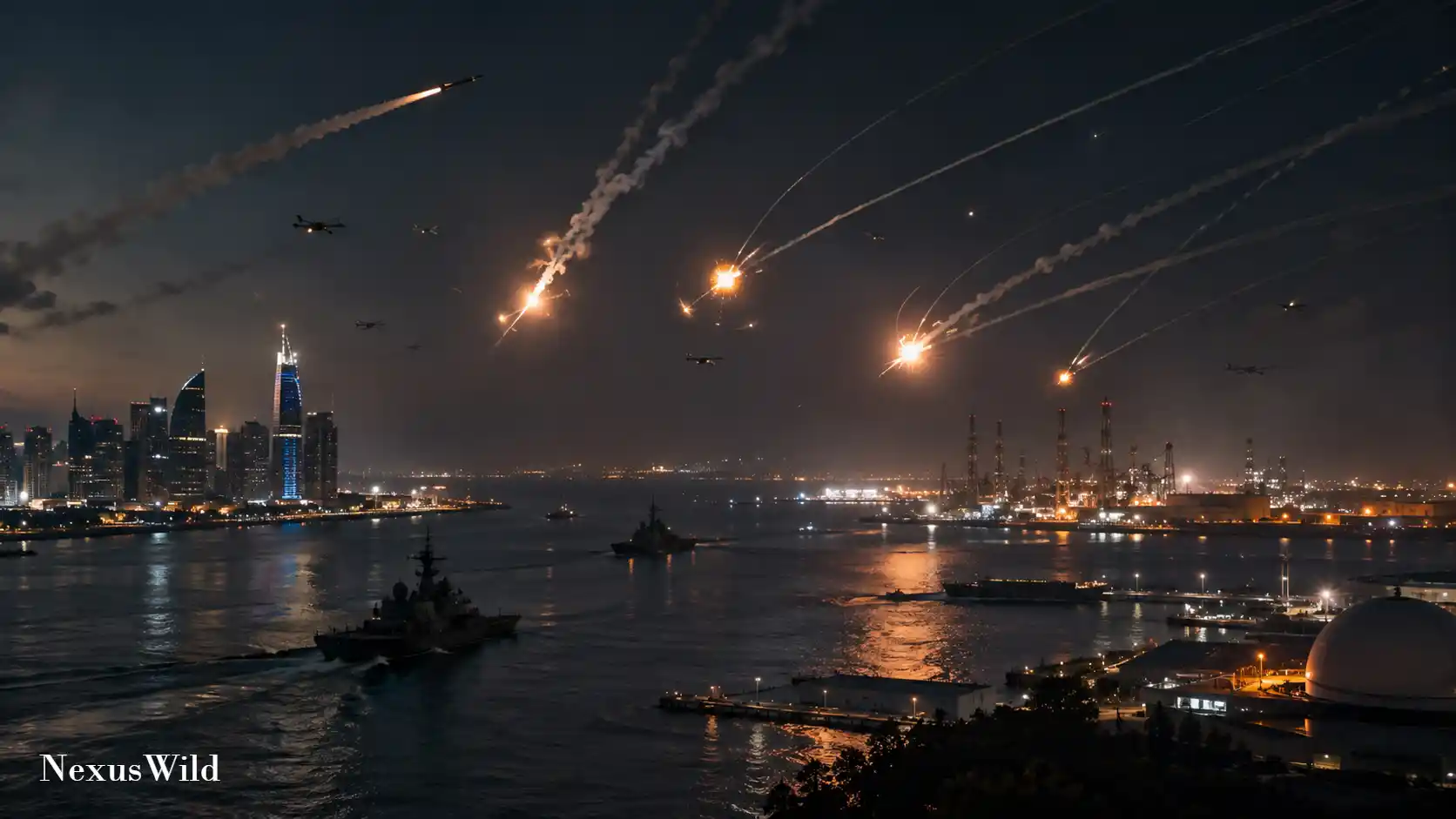

DUBAI / WASHINGTON — The United States and Iran exchanged their heaviest direct attacks since July, with Washington striking military targets along Iran’s southern coast and Tehran responding with missiles and drones aimed at U.S. military facilities across Bahrain, Kuwait, Jordan and northern Iraq.
The renewed fighting has again placed countries hosting American forces close to the conflict, while increasing risks to shipping through the Strait of Hormuz and disrupting regional aviation.
Wave of Strikes
U.S. Central Command said it completed a wave of strikes against Islamic Revolutionary Guard Corps targets on September 1. CENTCOM said the targets included air-defence sites, radar systems, maritime assets and facilities, mine-laying capabilities and communications sites, describing the operation as a response to attempted attacks against commercial shipping and U.S. personnel.
The escalation followed U.S. strikes on Sunday against Iranian rocket launchers on Larak Island near the Strait of Hormuz. Washington said the launchers could have been used to deploy mines into the strategic waterway. Iran subsequently fired missiles toward U.S. sites in Jordan.
Broadened Retaliation
Iran broadened its retaliation after Tuesday’s larger U.S. attack. Tehran said it struck U.S. assets in Bahrain, Kuwait, Jordan and Iraq. The incidents should not all be interpreted as deliberate attacks on those countries themselves, because Iranian statements described American military facilities as primary targets.
Jordan’s armed forces said 13 ballistic missiles entered its airspace. Air defences destroyed 10, while three fell in remote areas away from populated locations. Jordan reported no deaths or injuries. Iran’s Revolutionary Guard said it had targeted a U.S. military facility near Jordan’s Gulf of Aqaba coast.
Bahrain, home to the headquarters of the U.S. Navy’s Fifth Fleet, said its air-defence systems intercepted and destroyed incoming Iranian attacks. Iran said U.S. forces in Bahrain were among its targets.
In Kuwait, Iranian forces said they targeted the U.S. Ali Al Salem Air Base. Separately, Kuwait’s government communications centre said an Iranian drone struck a residential complex in Kuwait City at dawn, starting a fire that was brought under control. No casualties were reported. Kuwaiti air defences also intercepted other drones.
In northern Iraq, Iranian state media said U.S. facilities around Erbil were targeted. Kurdish authorities reported intercepting 10 explosive-laden drones in the Erbil area. Iran separately claimed damage and U.S. casualties at American facilities, but U.S. officials told Reuters that initial assessments showed no American casualties from the wider Iranian retaliation.
Disputed Casualties and Economic Impact
Civilian casualties inside Iran remain disputed. Reuters reported that Iranian authorities said at least 12 people were killed during the overnight U.S. strikes. Iranian reports said four people, including a four-year-old child, were killed at a home where a wedding was being celebrated near Sirik, while earlier accounts put the toll at five. As many as 68 people were reported wounded. Reuters said it could not independently verify the incident. CENTCOM said its strikes targeted military infrastructure and that it does not target civilians.
President Donald Trump warned Iran that continued retaliation could bring U.S. strikes at what he called a “much harder and higher level.”
The renewed fighting has increased pressure on the Strait of Hormuz without completely stopping traffic. Preliminary Kpler data showed only four commodity vessels crossed the strait on Tuesday, down from 10 on Monday and a recent 10-day average of about 13. Some vessels can disappear from tracking data when transponders are switched off.
Oil markets reacted sharply. Brent crude briefly reached $97.04 a barrel on Wednesday before retreating to about $94.22, after settling 4.6% higher at $94.65 on Tuesday.
Aviation and Diplomacy
Regional aviation also remains vulnerable. Some UAE flights were delayed or cancelled Wednesday, while European aviation authorities continue to advise airlines to avoid particularly exposed parts of Gulf airspace and Iran and Iraq.
Diplomatic channels have not disappeared. Iranian President Masoud Pezeshkian has said Tehran is prepared to return to the interim ceasefire arrangement if Washington honours its commitments, while mediator Pakistan said Wednesday that it remains engaged with both governments. For now, however, the renewed exchange has returned U.S. bases and neighbouring states to the centre of a conflict with direct consequences for regional security and global energy flows.
Further reading and useful links
Nexuswild welcomes factual corrections. Email contact@nexuswild.com with evidence and the article URL.