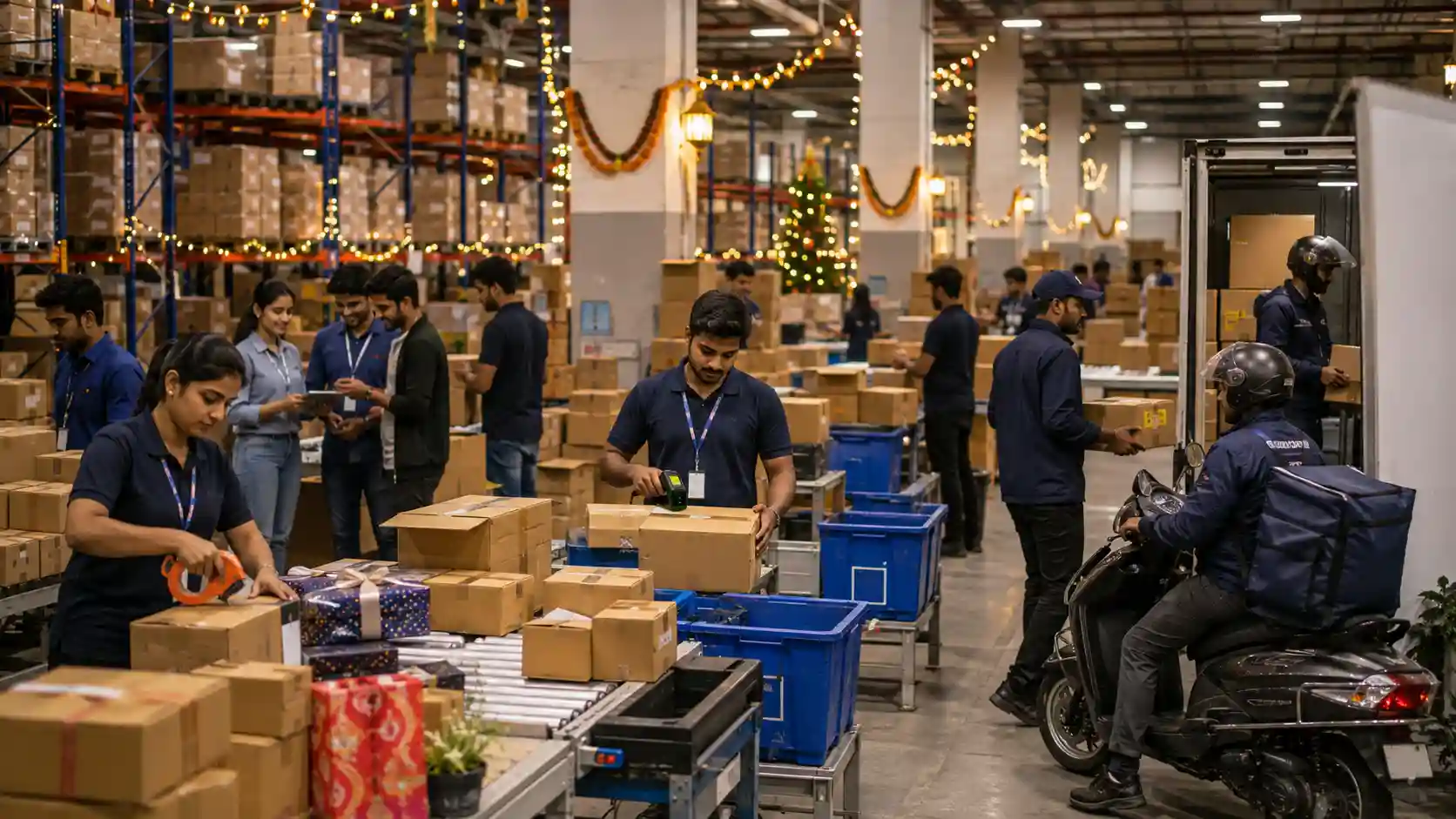

E-commerce, quick-commerce and logistics companies are expanding their seasonal workforces as the festive shopping cycle becomes longer, more geographically distributed and increasingly dependent on rapid fulfilment.
Hiring has started earlier than the traditional Diwali peak. Promotions and shopping demand began building around Independence Day and Raksha Bandhan in August and are expected to continue through Diwali, year-end sales and the winter wedding season. That longer calendar is forcing companies to plan staffing for months of elevated activity rather than a brief annual surge. TeamLease Services says employers are increasingly designing festive workforces for sustained execution as sale windows stretch from August through the year-end period.
Temporary and gig hiring across organised retail, e-commerce, quick commerce, logistics and other consumer-facing sectors is forecast to rise about 15-20% year on year in 2026. Adecco estimates that temporary staffing demand could generate roughly 250,000-270,000 jobs during the festive season across e-commerce, logistics, quick commerce, organised retail and BFSI. The estimate is a cross-sector forecast, not a count of jobs already filled and not a figure that should be added to individual company announcements. Adecco's comparison base was an estimated 216,000 organised-sector jobs in the previous festive period.
TeamLease Services independently expects temporary festive hiring to increase by a similar 15-20%, supported particularly by e-commerce, retail, logistics and quick commerce. Its Festive Season Workforce Report 2026 is based on anonymised employment records covering about 60,000 frontline associates across consumer durables, organised retail, e-commerce, quick commerce, logistics and FMCG.
Meesho expects more than 1 million ecosystem opportunities
Meesho is forecasting one of the largest seasonal employment effects, but its figure requires an important distinction. The company expects more than 1 million seasonal job opportunities to be enabled across its broader seller and logistics ecosystem. It is not directly hiring one million employees.
The company estimates nearly 650,000 opportunities across its seller network and about 375,000 across logistics. Around 130,000 sellers are expected to recruit temporary workers for packaging, manufacturing, production, warehousing and inventory management. On the logistics side, Meesho's Valmo platform and third-party logistics partners are expected to add capacity across delivery, sortation, delivery-centre operations and supervisory functions.
That distinction is important because marketplace employment spreads well beyond the platform company itself. A festive order can create work at a seller's production unit, packaging operation, warehouse, sorting centre, logistics contractor and last-mile delivery network. As a result, ecosystem estimates are broader than a company's direct payroll or contractual workforce.
Amazon creates more than 160,000 seasonal work opportunities
Amazon announced on September 2 that it has created more than 160,000 seasonal work opportunities across its national operations network, supporting both its e-commerce business and the expanding Amazon Now quick-commerce operation.
Amazon explicitly describes the figure as a combination of direct and indirect work opportunities across more than 400 cities. Seasonal associates are being deployed in functions including picking, packing, shipping and delivery, and the company said the majority had already been onboarded and were receiving training ahead of the peak season.
Amazon's scale also illustrates how quick commerce is becoming integrated with traditional e-commerce logistics. The company said tens of thousands of the seasonal opportunities are within its Amazon Now network. Separately, Amazon announced earlier in 2026 that Amazon Now was expanding with more than 1,000 micro-fulfilment centres across 100 cities and more than 100 specialised urban fulfilment centres.
The physical network behind that hiring includes fulfilment centres across 15 states, sortation centres in 19 states, close to 2,000 Amazon-operated and partner delivery stations, 28,000 Hub Delivery partners and thousands of Amazon Flex partners. That infrastructure helps explain why festive hiring now extends well beyond conventional warehouse jobs.
Quick commerce changes the festive workforce
Quick commerce is emerging as one of the fastest-growing sources of festive labour demand. Recruitment industry estimates cited in August put temporary quick-commerce hiring growth at roughly 35-40% year on year, driven by the expansion of product categories, dark stores and consumer demand for rapid delivery.
The result is a wider mix of frontline roles. Delivery associates, warehouse workers, pickers, packers, sortation workers and dark-store personnel remain central to the seasonal workforce, but companies increasingly need employees who can work with inventory systems, scanners, automated fulfilment equipment and tightly managed delivery workflows.
TeamLease identifies inventory and fulfilment coordinators, warehouse automation operators, quality-check staff and returns-management executives among the specialised operational roles gaining importance. Warehouse pickers, packers and dark-store personnel are still expected to form some of the largest hiring categories. Employers are therefore looking not only for available labour but for workers who can be trained and deployed quickly in increasingly technology-driven facilities.
Blue Dart adds front-end operations capacity
Logistics companies are making their own additions ahead of higher shipment volumes. Blue Dart expects to create around 3,000 front-end operations roles across its network during the festive period.
The company expects festive hiring to be around 7-8% higher than last year, with opportunities concentrated in delivery operations, hub and gateway handling, sorting and last-mile logistics. The 3,000 figure is Blue Dart's own network hiring expectation and should be treated separately from broader staffing-industry estimates.
Tier-II and Tier-III cities take a larger role
Seasonal employment is also becoming less concentrated in major metropolitan areas.
Apna chief executive Kartik Narayan said Tier-II and Tier-III cities now account for nearly 55% of gig opportunities listed on the platform, compared with about 39% two years earlier. Apna said gig opportunities in these cities were growing about 110% year on year, compared with roughly 86% in metros. E-commerce and parcel delivery remain major categories in smaller markets, while quick-commerce postings have been growing particularly rapidly.
Adecco's national festive outlook similarly estimates that around 45% of workforce demand could come from Tier-II and Tier-III cities. The two statistics measure different datasets and should not be treated as interchangeable. Apna's figure represents the geographical share of gig listings on its platform, while Adecco's is an estimate of festive workforce demand.
Smaller cities are becoming strategically important because online consumption, seller networks and organised retail are expanding beyond metros. Locating warehouses, delivery stations, dark stores and fulfilment capacity closer to customers lowers delivery distances and makes faster service possible. It also creates local employment around inventory movement, sorting and last-mile delivery instead of requiring all logistics activity to be concentrated in metropolitan hubs.
Pay rises, but increases are not uniform
Competition for seasonal workers is putting upward pressure on compensation, although no single pay increase applies to every worker or company.
TeamLease estimates that frontline salaries could rise 8-10% during the second half of 2026. It also notes that effective take-home increases could be smaller, at around 5-8% in some cases. The report says e-commerce, quick commerce and logistics continue to offer the highest average compensation among the frontline sectors it tracks.
Adecco separately estimates temporary wages could rise 12-15% in metro markets and 8-10% across Tier-II and Tier-III regions. These are market-level forecasts rather than guaranteed increases for individual employees. Employers are also using attendance bonuses, peak-sale surge pay, referral incentives, productivity-linked rewards, joining incentives and other targeted payments to attract and retain workers during periods of intense demand.
Availability and retention remain constraints
Adding workers rapidly remains difficult. Adecco says around 80% of employers surveyed are experiencing shortages in frontline and operational roles and estimates a 10-15% demand-supply gap during the festive peak. Requirements increasingly include digital literacy, adaptability, communication skills and the ability to become productive quickly after onboarding.
Retention is another problem because e-commerce, food delivery, logistics and quick-commerce platforms frequently compete for overlapping pools of gig and temporary labour. Businesses are responding by recruiting earlier, creating pre-assessed worker pools, digitising onboarding, using referral programmes and cross-training workers for multiple functions.
Festive recruitment is also becoming a route into longer employment. Adecco estimates that about 25% of seasonal associates could transition into longer-term assignments, as employers use the peak season to evaluate productivity, reliability and role fit in real operating conditions. Amazon similarly says many seasonal associates continue with its network beyond the festive period, while some return for successive peak seasons.
The larger shift is structural. The festive employment market is no longer driven only by extra delivery riders and warehouse workers recruited for a short holiday spike. Longer shopping calendars, large marketplace seller ecosystems, dark-store expansion, hyperlocal fulfilment and rising online consumption in smaller cities are creating a more distributed labour market.
Traditional delivery and warehouse jobs remain the foundation, but the operating model increasingly requires inventory specialists, automation-capable workers, returns staff, dark-store teams and digitally trained frontline employees. As e-commerce and rapid delivery networks spread deeper into emerging markets, festive employment is becoming both larger in scale and more closely integrated with the year-round logistics infrastructure that supports the online economy.
Further reading and useful links
Reader questions
Frequently asked questions
How many seasonal jobs are expected to be created for the 2026 festive season?
Temporary and gig hiring is forecast to rise by 15-20% year-on-year. Estimates from Adecco project roughly 250,000 to 270,000 jobs will be generated across e-commerce, logistics, quick commerce, and organized retail.
Are these seasonal jobs mostly concentrated in big cities?
No, Tier-II and Tier-III cities are playing a larger role this year. Platforms like Apna report that smaller cities now account for nearly 55% of their gig opportunities as companies push fulfillment centers closer to customers.
Is quick commerce changing the types of warehouse jobs available?
Yes. While traditional pickers and delivery associates remain vital, there is growing demand for workers who can operate inventory systems, scanners, automated fulfillment equipment, and manage fast-paced dark-store workflows.
Nexuswild welcomes factual corrections. Email contact@nexuswild.com with evidence and the article URL.