Starlink has moved far beyond the experimental satellite internet service SpaceX opened to early users in 2020.
By June 30, 2026, SpaceX reported 12.0 million Starlink subscriber lines, exactly double the 6.0 million reported one year earlier. That number should not be interpreted as 12 million people or households. SpaceX defines a subscriber as a unique service line. A household can share one line among several people, while one customer can hold multiple lines, such as Residential and Roam. The figure also excludes many managed enterprise and government contracts in aviation, maritime, land mobility and government services.
The network itself has reached unprecedented scale. SpaceX's official June 30 filing said its connectivity system was powered by more than 10,200 broadband and mobile satellites. Daily orbital tracking from KeepTrack placed the constellation at 11,093 satellites in orbit and 11,078 working satellites on September 2, 2026, versus 12,881 Starlink satellites launched historically. The distinction matters because satellites that have re-entered, failed or are still moving toward operational orbits should not be counted as active capacity.
Starlink has therefore established that low Earth orbit satellite broadband can work at a scale previously considered extremely difficult. The harder question is whether an architecture dependent on finite radio spectrum, shared satellite beams and continuous constellation replacement can expand from 12 million subscriber lines to tens of millions more without declining performance or unsustainable costs.
How Starlink Works
Traditional satellite internet typically relied on geostationary, or GEO, satellites orbiting about 35,786 kilometres above Earth. Signals must travel from the customer to space, back to a ground station and through the terrestrial internet, then repeat much of that trip for the response.
That distance produces a fundamental latency penalty. Independent Australian measurements, for example, recorded average latency of about 665 milliseconds for NBN Sky Muster GEO service, compared with around 30 milliseconds for Starlink in earlier measurements.
Starlink instead uses thousands of satellites in low Earth orbit. Current V1 and V2 broadband shells are being concentrated roughly 450 to 490 kilometres above Earth, according to SpaceX's space-safety documentation.
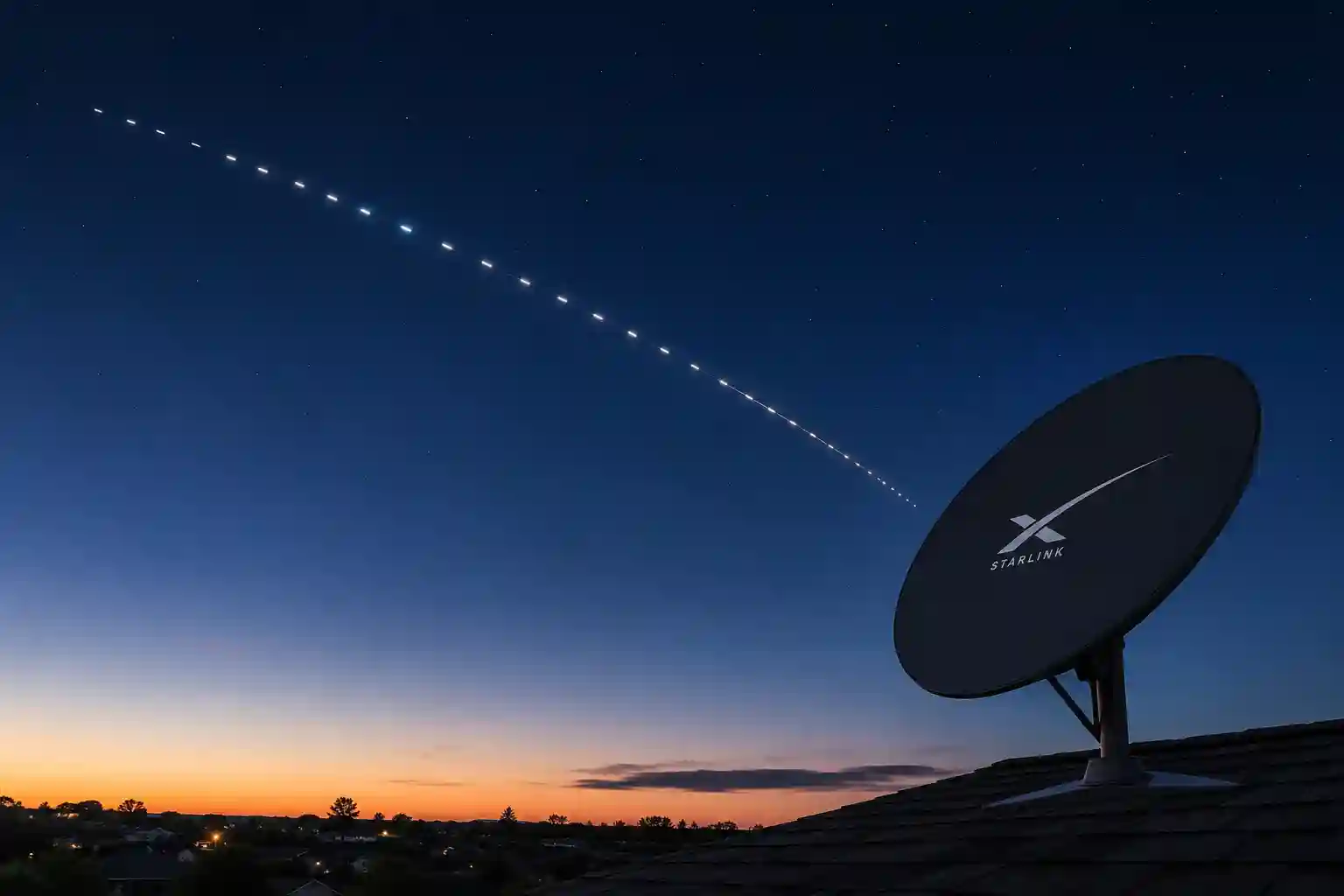
A Starlink dish is an electronically steered phased-array antenna. It tracks compatible satellites electronically rather than mechanically following one spacecraft across the sky.
Traffic generally follows this path: User terminal → Starlink satellite → ground gateway or other Starlink satellites → internet point of presence → terrestrial internet.
Optical inter-satellite links, commonly called space lasers, allow satellites to route data through other satellites before sending it to the ground. This is especially useful over oceans, polar regions and countries with limited gateway infrastructure.
Laser links reduce dependence on having a gateway immediately beside every user, but they do not eliminate terrestrial infrastructure. Internet traffic ultimately needs points of presence, backbone connections and gateways somewhere in the network.
From 4.4 Million to 12 Million Subscriber Lines
Starlink ended 2024 with roughly 4.4 million subscribers and 2025 with about 8.9 million, according to SpaceX's securities filings. Its 2025 Progress Report says more than 4.6 million new active customers were connected during that year and service expanded into 35 additional countries, territories and markets.
Growth accelerated again in 2026.
SpaceX reported 10.3 million subscriber lines on March 31 and 12.0 million on June 30, meaning approximately 1.7 million lines were added during the second quarter alone. The company reported service across 167 countries, territories and other markets by the end of Q2.
Deployment capability remains one of Starlink's largest competitive advantages. SpaceX completed 77 Falcon launches in the first half of 2026, including 60 classified as internal launches. Starlink remained a major component of that cadence. On September 2 alone, another Falcon 9 launched 27 Starlink satellites, with its first-stage booster completing its 35th flight. Newly launched satellites, however, should not automatically be added to the operational total before they become working spacecraft.
How Fast Is Starlink in the Real World?
SpaceX's own performance measurements are increasingly impressive.
Its 2025 Progress Report says global median peak-hour download performance increased by more than 50 percent during 2025, with median downloads averaging above 200 Mbps, typical uploads above 30 Mbps, and global median latency of approximately 26 ms. SpaceX subsequently reported a median peak-hour residential download speed of 225 Mbps and latency of roughly 25 ms as of March 31, 2026.
Those figures are company measurements. Independent testing shows a more complicated picture.
Ookla Speedtest Intelligence data for the second half of 2025 found U.S. Starlink users recording median speeds of approximately 133.8 Mbps download and 19.3 Mbps upload. Ookla's global Q3 2025 results also showed enormous geographic differences. Latvia recorded a median Starlink download speed of about 187 Mbps, while South Sudan was below 16 Mbps and Madagascar below 24 Mbps.
Australia's ACCC provides another strong independent benchmark because its testing used dedicated monitoring equipment in volunteer households rather than relying only on user-triggered tests. Its April 2026 report measured Starlink at 225.8 Mbps average download across all hours and 197.3 Mbps during busy hours, with uploads of 48.0 and 45.9 Mbps respectively. Latency remained in the mid-20-millisecond range.
Reliability was good but not equivalent to a claim of perfect availability. The same ACCC program recorded an average 0.34 outages per day, while 91 percent of monitored households experienced fewer than one outage per day.
Starlink's own legal specifications also provide a useful reality check. Depending on market and plan, published expectations can range from tens of megabits per second to more than 200 Mbps, and Starlink explicitly warns that speed and uninterrupted service are not guaranteed and that congestion can reduce performance.
Why Starlink Speeds Vary So Much
A Starlink connection is not a dedicated 200 Mbps pipe between one home and space.
Satellite capacity is shared.
Users inside a geographic area compete for capacity from the satellites and beams serving that region. Performance therefore depends on subscriber density, number of satellites visible, available spectrum, beam scheduling, service-plan priority, gateway and backbone capacity, obstructions, weather, Wi-Fi conditions and time of day.
Ookla's measurements show this directly. U.S. rural Starlink users frequently performed better than urban Starlink customers because the available satellite capacity was shared among fewer users.
Ground infrastructure matters too. Ookla observed that Starlink latency in Kenya fell dramatically after network infrastructure was moved closer to users, illustrating that putting a satellite overhead does not by itself guarantee low end-to-end latency. Internet routing after the satellite connection still matters.
Starlink vs Fiber, 5G, 4G and GEO Satellite
Starlink's strongest comparison is not against the best fiber network in a large city. It is against the infrastructure actually available at the user's location.
Modern fiber can deliver hundreds of megabits or multi-gigabit symmetrical connections with very low latency and enormous aggregate capacity. Once fiber is economically installed in a dense neighborhood, it is extremely difficult for a shared satellite network to match its capacity per square kilometre.
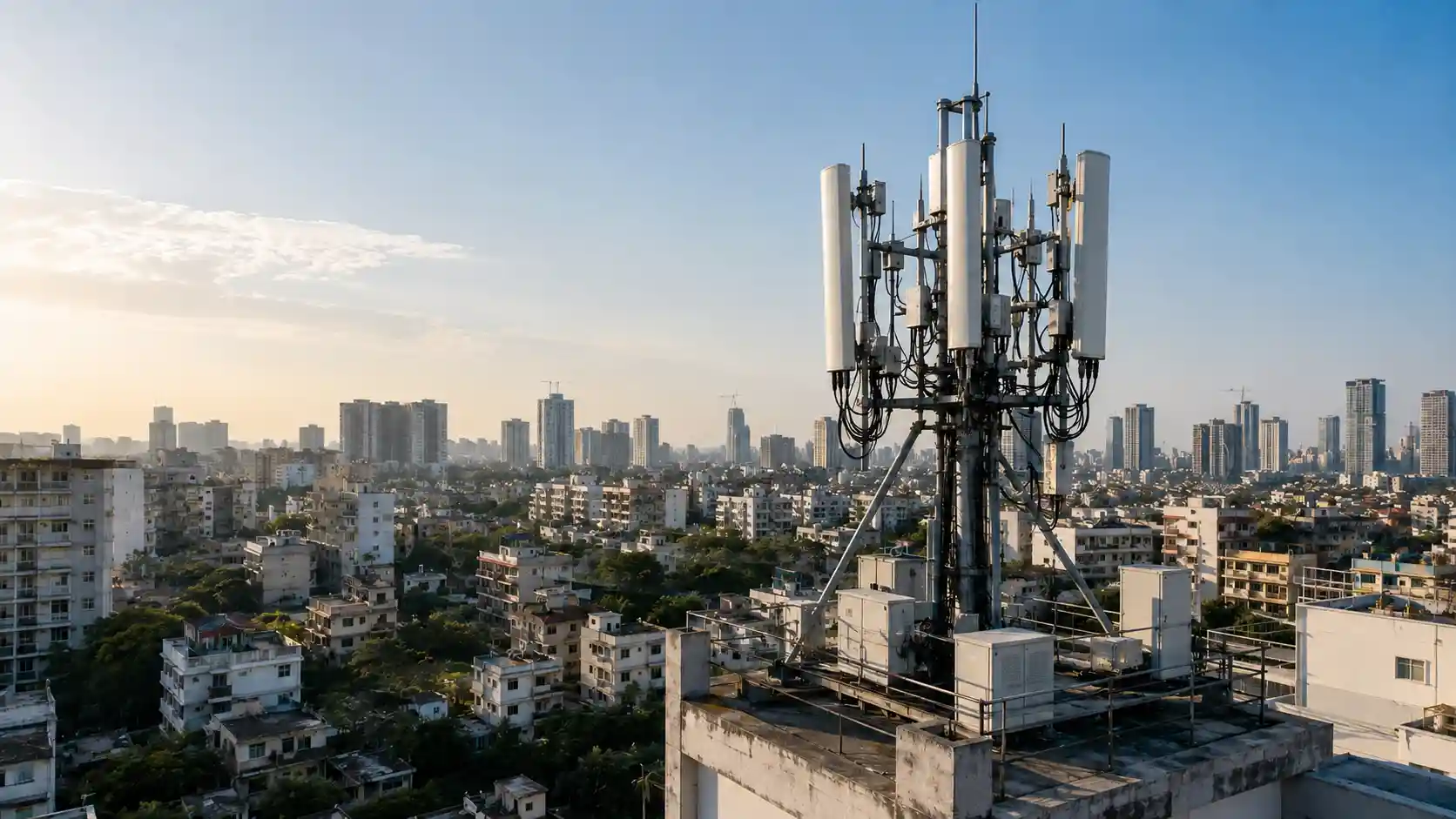
Fixed-wireless 5G can also deliver hundreds of megabits per second where strong spectrum, tower density and backhaul exist, although performance can fall with distance, obstructions and network congestion. 4G generally provides less capacity but benefits from an enormous existing terrestrial tower footprint.
Traditional GEO broadband has the opposite trade-off. A handful of satellites can cover enormous geographic areas, but the 35,786-kilometre altitude creates roughly 600 ms or greater network latency in real-world tests.
LEO systems such as Starlink dramatically reduce that propagation delay, but require thousands of moving satellites, continuous handovers and much more complicated network coordination.
The result is a clear division of strengths: fiber remains the superior high-capacity architecture for dense cities, while Starlink becomes unusually valuable where terrestrial infrastructure is sparse, damaged or prohibitively expensive.
What Starlink Costs Around the World
There is no meaningful single "global Starlink price." SpaceX increasingly uses country-specific pricing, multiple speed tiers, hardware subsidies and capacity-dependent offers.
As of September 2, official Starlink pages showed:
- United States: Residential 100 Mbps from $55/month, Residential 200 at $85, and Residential Max from $130. Roam costs $55 for 100 GB, $80 for 300 GB and $175 for Unlimited. The Starlink Mini kit starts at $199, while some Residential locations receive no-upfront-hardware offers. Local Priority business service starts at $55 and Global Priority at $250.
- United Kingdom: Residential tiers are £40, £60 and £80 per month, while Roam is £55 for 100 GB or £100 Unlimited. Starlink advertises no upfront hardware cost in selected areas rather than one universal UK hardware price.
- Australia: Residential costs A$75, A$110 or A$150 per month. Roam is A$85 or A$210, with Roam hardware starting at A$399 in selected areas. Business service starts at A$84 with A$399 hardware.
- Germany: Residential tiers start at €35, €55 and €75 per month, with no-upfront-hardware offers in selected areas.
- Nigeria: Residential service starts at NGN57,000 per month and hardware at NGN318,000 in selected areas.
- Kenya: Residential Lite starts at KES4,000, standard Residential at KES6,500, and hardware at KES6,750 in selected areas. Roam 50 GB is KES6,500.
- Brazil: Residential 100 starts at R$189, Residential Max at R$249, Roam 100 GB at R$339 and Unlimited at R$619. Starlink's indexed Brazilian page still displayed a R$499 hardware promotion ending July 31, so that figure should not be represented as a verified September nationwide hardware price.
- India: Remains different. The Department of Telecommunications confirmed Starlink had received a Unified Licence with GMPCS authorization. But that license does not itself assign satellite spectrum, and Reuters reported on August 20 that Starlink had reapplied to IN-SPACe for satellite-network approval. A current officially launched Indian retail price therefore should not be invented or inferred from prices reported in other countries.
Starlink's Economics Are Changing
International price reductions are visible in SpaceX's financial results.
Starlink subscriber ARPU fell from $85 per month in the first half of 2025 to $66 in the first half of 2026. SpaceX attributed the decline primarily to international expansion and the addition of lower-priced service plans. Yet the subscriber base roughly doubled year over year.
Connectivity revenue reached $7.548 billion during the first six months of 2026, including $4.633 billion from consumer connectivity and $2.915 billion from enterprise and government business. Q2 alone generated $4.291 billion in Connectivity revenue.
This is why estimating Starlink revenue by multiplying 12 million subscribers by an American subscription price is fundamentally wrong. Connectivity revenue also includes Starlink kits, enterprise contracts, government activity, aviation, maritime and mobile services, while the company's subscriber metric excludes some managed customers.
Costs are also substantial. During the first half of 2026, Connectivity cost of revenue rose by about $1.1 billion year over year. SpaceX attributed part of that increase to $503 million of additional depreciation associated mainly with capitalized satellite and launch costs, higher ground operations, installation and customer support expenses, and $219 million of additional Starlink Kit production spending.
SpaceX does not disclose a reliable current manufacturing cost for one Starlink satellite, so assigning a precise per-satellite cost would be speculative.
Can Starlink Really Scale Globally?
This is the most important limitation to understand: global geographic coverage and global network capacity are not the same thing.
A satellite can see a large region of Earth, but the radio spectrum and power available in each spot beam are finite. Thousands of customers concentrated within the same coverage area cannot each receive the satellite's full capacity simultaneously.
Starlink increases capacity through several mechanisms: more satellites overhead, smaller and more numerous beams, frequency reuse between geographically separated beams, additional gateways, better antennas, more efficient software and optical routing.
But radio spectrum cannot be multiplied indefinitely.
This explains why connecting another million households distributed across rural Africa, North America, Australia and Latin America is very different from connecting a million households concentrated in London, Mumbai or New York.
Sparse rural demand lets Starlink monetize capacity that would otherwise pass over relatively empty territory. In a dense city, hundreds or thousands of nearby users can compete for the same radio resources. Fiber solves this problem differently by bringing dedicated physical capacity progressively closer to neighborhoods, buildings and individual premises.
Gateways create another constraint. Ofcom's July 2026 approval of two additional Starlink gateways in Britain explicitly said the facilities would improve network capacity and resilience. Laser links can route traffic around the planet and reduce dependence on nearby gateways, but they cannot eliminate the limited capacity of the radio link between the satellite and customer.
Starlink therefore can scale much further globally, particularly across low-density and underserved regions, but its architecture does not support the idea that one satellite network should replace the world's fiber infrastructure.
V2 Today, V3 Tomorrow
V2-generation satellites already form an important part of the operational network. The next major capacity step is Starlink V3.
SpaceX has told investors that V3 is designed for approximately 1 Tbps of downlink capacity per satellite, with Starship eventually capable of carrying as many as 60 per launch. SpaceX says this could deploy around 20 times as much Starlink downlink capacity per launch as Falcon 9. These are design targets, not current network capacity.
The distinction became especially important in July 2026.
Starship Flight 13 released the first 20 V3 spacecraft on July 24. The mission was suborbital. The satellites briefly communicated with the network and then re-entered as planned. They are not part of today's operational Starlink constellation. Reuters confirmed that the spacecraft burned up following the test.
As of September 2, Starship had not yet put operational V3 satellites into orbit. Its next flight was expected to attempt the transition to orbital V3 deployment.
SpaceX also intends to operate V3 broadband satellites around 330 to 370 kilometres, lower than the principal V1 and V2 broadband shells. Lower altitude can reduce propagation delay and shrink coverage footprints, potentially helping frequency reuse, but it also requires a denser constellation and continuing replenishment.
Direct-to-Cell Is a Different Network
Starlink Mobile, previously commonly described as Direct-to-Cell, should not be confused with ordinary Starlink broadband.
Compatible Starlink satellites carry cellular equipment that acts similarly to an LTE cell tower in space. Ordinary supported LTE smartphones can connect without a Starlink dish when they have a sufficiently clear view of the sky and are using frequencies provided through a participating mobile operator. The Direct-to-Cell satellites connect back into Starlink using laser links.
SpaceX says approximately 650 satellites support the current Starlink Mobile constellation. Data is available through more than 40 apps on more than 100 devices, messaging is operational, and voice is available through apps. Native phone calling and broader broadband-like mobile functionality remain future capabilities.
Partners include T-Mobile in the United States, Optus and Telstra in Australia, Rogers in Canada, One NZ, KDDI in Japan and operators across Europe, Africa and Latin America.
Direct-to-Cell is fundamentally spectrum-dependent. SpaceX must work with terrestrial mobile operators and regulators to use licensed cellular bands without causing harmful interference.
It also should not be presented as dish-level Starlink broadband delivered to a smartphone. Current capacity per phone is far more constrained.
Starlink's Competition Is Growing, but Remains Far Smaller
No competing LEO broadband constellation currently approaches Starlink's deployed scale.
Eutelsat OneWeb operates a first-generation constellation of 654 satellites at approximately 1,200 kilometres, primarily serving governments, enterprises, telecommunications companies and mobility customers rather than competing with Starlink's consumer model on identical terms.
Amazon Leo, formerly Project Kuiper, reached 394 functioning satellites by July 2, 2026. Amazon expects initial commercial service during 2026, but its operational constellation remains a fraction of Starlink's.
China is simultaneously building multiple systems. China's Ministry of Industry and Information Technology reported 238 Qianfan satellites launched by July 2026, while China's state-backed Guowang system had reached roughly 195 spacecraft in orbit by mid-August, including satellites still moving toward operational positions. These are meaningful deployments, but still far below their announced long-term constellation sizes and Starlink's operational capacity.
The relevant comparison is therefore deployed and functioning infrastructure, not announcements describing thousands of future satellites.
The Environmental and Orbital Cost of Scale
Operating more than 11,000 working spacecraft creates responsibilities that do not exist at the same scale for traditional satellite operators.
SpaceX's latest FCC reporting showed more than 355,000 Starlink collision-avoidance manoeuvres over a 12-month period through May 2026. High manoeuvre counts do not mean collisions are imminent, but they demonstrate how actively a constellation of this density must be managed.
SpaceX is lowering its broadband constellation below 500 kilometres and says the change can reduce passive orbital-decay times dramatically if propulsion fails. Its satellites are designed for operational lives of five years or more before controlled deorbit. Lower altitude therefore reduces long-term debris persistence but increases the importance of continuous satellite replacement and launch capability.
Astronomical concerns are also measurable. Research published in Nature Astronomy documented unintended radio emissions from Starlink satellites in frequencies important to radio astronomy, while optical satellite trails remain a problem for wide-field telescopes. These are genuine scientific issues requiring coordination and mitigation, but they should not be portrayed as evidence that astronomy has become impossible.
Frequent re-entry also introduces satellite materials into the upper atmosphere. The long-term atmospheric effects of megaconstellation-scale re-entry remain an active research question rather than a settled quantified environmental impact.
Who Actually Needs Starlink?
The strongest economic case for Starlink remains places where terrestrial infrastructure performs poorly or costs too much to build.
That includes rural households, mines, farms, offshore platforms, ships, aircraft, construction projects, isolated businesses, emergency responders and communities affected by hurricanes, earthquakes, floods, wildfires or wars that disable terrestrial communication.
It is also valuable as a backup connection for businesses whose primary terrestrial network cannot afford prolonged downtime.
The argument becomes weaker where inexpensive fiber, cable or high-quality 5G already exists. A city apartment with reliable gigabit fiber normally does not need a satellite to travel hundreds of kilometres into space and back for ordinary internet access.
The Scalability Verdict
Starlink has already answered one major question. LEO satellite internet can provide broadband-class service to millions of customers while achieving latency far below traditional GEO systems.
The next question is harder.
Going from 12 million subscriber lines to 20 million, 30 million or more is technically plausible because SpaceX continues to add satellites, gateways, spectrum efficiency, laser routing and launch capacity. Falling international prices also allow Starlink to monetize network capacity in markets where an American-style subscription price would be unaffordable.
V3 could materially change the equation if its promised capacity is successfully deployed at scale using an operational Starship. But as of September 2, 2026, that capacity remains future infrastructure, not capacity customers are using today.
The limiting resource is not simply the number of satellites. It is usable radio capacity in the place and at the time customers demand it.
That makes Starlink extraordinarily scalable across geographically dispersed demand, especially in rural and infrastructure-poor regions. It is considerably harder to scale the same architecture inside extremely dense metropolitan areas.
Starlink therefore does not need to replace global fiber to become one of the world's most important communications networks. Its more realistic role is complementary: fiber and dense terrestrial wireless networks handle concentrated traffic efficiently, while Starlink extends broadband, mobility and emergency connectivity to places terrestrial infrastructure cannot economically or reliably reach.
At 12 million subscriber lines and more than 11,000 working satellites, that model is no longer theoretical. Whether it can multiply several times again without degrading service will depend less on headline satellite counts than on SpaceX's ability to keep increasing capacity per square kilometre faster than demand grows.
Further reading and useful links
Reader questions
Frequently asked questions
How many subscriber lines does Starlink have as of mid-2026?
SpaceX reported 12.0 million Starlink subscriber lines as of June 30, 2026, exactly double the 6.0 million reported one year earlier.
What are real-world speeds and latency like for Starlink users?
Independent testing by bodies like Australia's ACCC shows average download speeds exceeding 225 Mbps and latencies in the mid-20-millisecond range, though performance varies significantly depending on regional congestion, infrastructure, and user density.
Can Starlink replace global fiber-optic networks in dense cities?
No. While Starlink is exceptionally scalable across rural and infrastructure-poor regions, finite shared radio spectrum limits its ability to compete with dedicated fiber-optic infrastructure in ultra-dense metropolitan areas.
NexusWild welcomes factual corrections. Email [email protected] with evidence and the article URL.