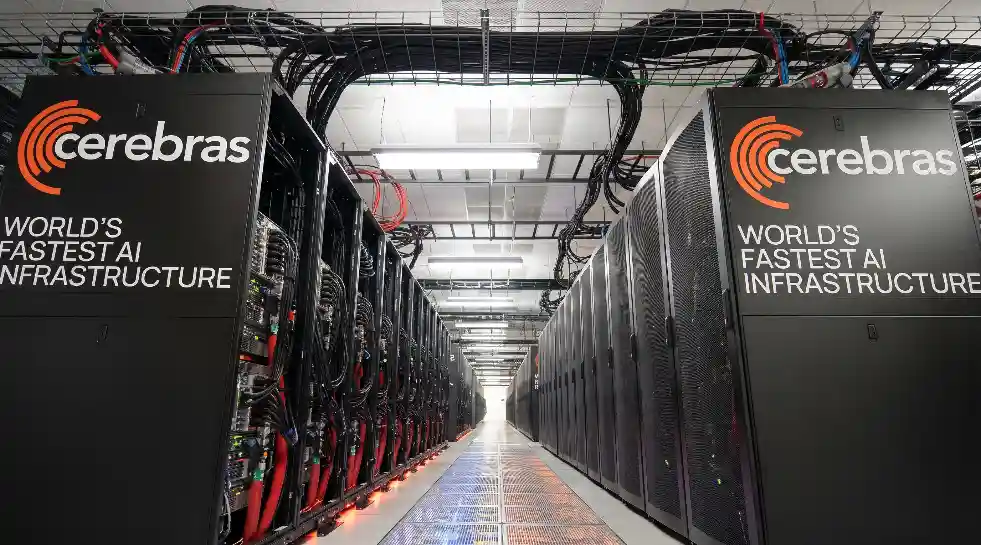

The growth of artificial intelligence is changing the global semiconductor and cloud computing industries creating strong competition among chip makers, technology companies and big cloud providers. As companies use advanced AI models the need for strong computing systems that can handle huge amounts of information is increasing.
At the center of this change is Cerebras Systems, a US-based intelligence infrastructure company making special processors to speed up AI workloads. Its wafer-scale computing technology is getting attention as big technology companies build their semiconductor abilities and fight to control the infrastructure for new AI applications.
Cerebras latest financial report, announced on November 12 2026 shows how important this market is becoming. The company said it had record revenue grew relationships with big cloud providers and told about commercial wins with two new hyperscalers.
The company also increased its full-year revenue prediction showing demand for fast AI inference.
At the time Amazon Web Services, Microsoft, Google and other big companies are spending a lot on their own AI accelerators to lower computing costs get better performance and have more control over their cloud systems.
This makes a situation where companies like Cerebras can be important technology partners while also challenging the usual ways of doing AI computing.
The competition is not about making faster processors anymore. It is also about controlling the computing system, including chips, networking, data centers, cloud platforms, energy systems and AI software.
Cerebras Expands Its Role in AI Computing
Cerebras Systems was started in 2016 and is based in Sunnyvale, California. It has created a way to do AI computing with its Wafer-Scale Engine technology.
Traditional AI accelerators usually use small processors connected through high-speed networks. These setups need a lot of communication between chips when dealing with workloads.
Cerebras does it differently by making a big processor on a single silicon wafer. Its Wafer-Scale Engine includes computing parts and memory in a processing system designed to reduce data movement and communication delays.
This setup is very useful for AI inference, the process where trained AI models make responses, predictions and other results.
As AI applications become more interactive speed is more important. Chatbots coding help tools, self-driving agents and real-time apps need to respond for a good user experience.
Cerebras thinks its design can help in tasks where fast response and low delay're key.
The company sells its technology through hardware sales, its own cloud system and partnerships with other cloud providers.
This way of doing business lets customers use computing power without buying and running full systems themselves.
Its newest CS-4 accelerator, launched in August 2026 is another step in this plan. Cerebras says the system can be up to 30 times faster for inference than GPU alternatives in some cases. These results are from the company. Depend on the workload, setup and testing conditions.
With product work and business deals Cerebras is trying to become a key choice in the growing AI market.
Strong Third-Quarter Results Show AI Demand
Cerebras third-quarter 2026 financial results show its business is growing.
For the quarter that ended on September 30 2026 the company said it had record GAAP revenue of $210.8 million up 55% from the time in 2025.
Its adjusted Core revenue, which is not GAAP reached $230.9 million up 70% compared to the period last year.
Cloud and other services have become a part of its growth.
GAAP cloud and other services revenue reached $141.9 million up 265% from the quarter last year. Core cloud and services revenue was $144.9 million, up 272%.
These numbers show that more people want cloud-based AI inference and that big customers are contributing more to the business.
Its Core gross margin went up to 41% while its Core operating margin was still negative at 14%.
Its GAAP gross margin was 20%. Its GAAP operating margin was negative 106%. The difference shows the adjustments between the companys GAAP and Core financial reports.
Cerebras also increased its year 2026 Core revenue forecast to between $940 million and $960 million.
For the quarter it expects Core revenue between $310 million and $330 million.
The company has $7.8 billion in cash, cash equivalents restricted cash and short-term investments along with $850 million in debt capacity.
These results show that Cerebras is growing fast. It will still need to work on making a profit as it keeps investing in hardware and data center systems.
Microsoft Becomes a Big Business Customer
One of the important things about Cerebras is its growing work with Microsoft.
On November 12 2026 Cerebras said it made a cloud deal with a big company. Reuters then said Microsoft signed an agreement to be a Cerebras customer.
The companies have not said the details, money or schedule of the deal.
Cerebras filing also says it made a deal with Microsoft in the half of 2026 for cloud inference services.
The deal includes some steps that need to be done before the services start.
This relationship is important because Microsoft is not a cloud customer. It is also making its AI chips through the Azure Maia project.
This deal shows a trend in the AI industry: big cloud companies make their own computing technology and buy special systems from others when it helps their tasks.
For Microsoft using Cerebras tech could be another choice for AI inference.
For Cerebras the deal is a chance to be part of one of the cloud systems, in the world.
The money it makes will depend on doing the work well customer interest and meeting the agreement steps.
AWS Partnership Demonstrates the Changing Competitive Landscape Amazon Web Services represents another important part of Cerebras' expansion strategy.
In March 2026, AWS and Cerebras announced a collaboration to combine Amazon's Trainium AI processors with Cerebras CS-3 systems.
The partnership introduces a specialised architecture known as disaggregated inference.
Under this approach, AI inference is divided into two main stages:
By assigning different computing tasks to specialised processors, the companies aim to improve inference speed and computing efficiency.
- Prefill: Processes the initial user prompt and prepares information for the AI model. AWS Trainium is designed to handle this stage.
- Decode: Generates the response token by token. Cerebras CS-3 is designed to accelerate this stage.
The solution is designed to operate within AWS data centres and become accessible through Amazon Bedrock.
The partnership is particularly interesting because Amazon is simultaneously developing its own Trainium processor family to reduce dependence on external AI chips.
Cerebras' participation demonstrates that hyperscalers do not necessarily need to choose between internal chip development and external partnerships. They can combine proprietary processors with specialised hardware to optimise particular workloads.
However, the agreement also creates commercial dependencies. Cerebras disclosed in its regulatory filing that the AWS arrangement includes a multi-year system lease, procurement options, pricing commitments, exclusivity provisions and manufacturing capacity guarantees.
The company has also acknowledged that these terms could restrict its ability to satisfy certain demands from other customers.
For Cerebras, the AWS relationship offers access to a substantial cloud distribution platform but also requires careful management of commercial commitments. Oracle Expands Access to Cerebras Infrastructure Another important development involves Oracle and its growing artificial intelligence infrastructure business.
On October 27, 2026, Oracle and Cerebras announced plans to make Cerebras inference technology available through Oracle Cloud Infrastructure.
The planned service will give AI developers, enterprises and research organisations another computing option for applications requiring low latency.
This is particularly relevant for agentic AI systems, which perform multiple tasks through repeated interactions with AI models.
For example, an autonomous software agent may need to analyse information, generate a plan, execute an action and evaluate the resulting output. Each additional model interaction requires computing resources.
Reducing inference latency can improve the responsiveness of these applications.
Oracle already provides AI computing services through its cloud infrastructure, and the integration of Cerebras technology is expected to expand its hardware choices.
The service is planned for availability during 2027.
For Cerebras, Oracle represents an additional distribution channel beyond its own cloud platform and direct hardware business.
The relationship also illustrates how specialised AI chip companies can benefit from partnerships with established cloud providers rather than competing exclusively to build complete cloud infrastructure networks. Hyperscalers Accelerate Development of Their Own AI Chips While Cerebras expands its commercial relationships, the largest technology companies are investing heavily in proprietary AI semiconductor platforms.
Their objective is to reduce computing costs, improve performance and maintain greater control over the infrastructure supporting their AI services.
Google: Google has continued expanding its Tensor Processing Unit portfolio. On November 9, 2026, the company introduced TPU 8tx and TPU 8i Max, extending its eighth-generation TPU systems. The new configurations target confidential inference and workloads requiring larger context windows and higher computing density. Google says its TPU technology is used by nearly 100 customers.
Microsoft: Microsoft has expanded its Azure Maia programme. Its Maia 200 accelerator is already serving production workloads, including Microsoft Copilot, while Maia 300 is expected in 2027. The company has outlined plans for multi-gigawatt deployment of its Maia systems beginning in 2027.
Amazon: AWS continues developing its Trainium processors for AI training and inference. Its Trainium3 systems are designed to support large-scale generative AI workloads while improving computing economics for cloud customers.
Meta: Meta is expanding its Meta Training and Inference Accelerator programme through multiple generations of custom silicon. In March 2026, it announced plans to develop and deploy four new MTIA chip generations within two years, with increased attention to generative AI inference.
These developments demonstrate that the AI infrastructure market is becoming increasingly competitive.
Instead of depending entirely on commercially available processors, hyperscalers are designing specialised hardware tailored to their own workloads.
This creates pressure on independent semiconductor developers to demonstrate measurable advantages in performance, energy consumption and total operating costs.
At the same time, specialised processors can remain valuable when they offer capabilities that general-purpose accelerators or proprietary cloud chips do not efficiently provide.
For Cerebras, the opportunity lies in becoming an important part of a diversified computing ecosystem.
NVIDIA and AMD Remain Important Participants in the AI Chip Market
The competitive landscape extends beyond Cerebras and cloud providers.
NVIDIA remains a major force in AI computing, supported by its GPU products, networking technologies and established software ecosystem.
Its processors are widely used for AI model training, inference and high-performance computing.
AMD is also strengthening its position through its Instinct accelerator family and integrated rack-scale infrastructure.
In July 2026, AMD and Cerebras announced a technical collaboration combining AMD Helios systems with Cerebras Wafer-Scale Engine technology.
The proposed architecture combines AMD Instinct GPUs, which handle high-throughput computing tasks, with Cerebras processors designed for rapid token generation.
The objective is to improve computing performance through workload specialisation.
This cooperation demonstrates that the competitive structure of the AI industry is not simply a battle between individual chip manufacturers.
Companies are increasingly developing partnerships that combine different processing architectures to serve more demanding AI applications.
For customers, this could create more choices when selecting hardware for specific workloads.
However, software compatibility, networking requirements and integration costs will remain important factors in determining which platforms achieve widespread adoption.
Data-Centre Capacity Becomes a Major Growth Constraint
One of the biggest challenges facing Cerebras is the availability of physical infrastructure.
Manufacturing advanced processors is only one part of building an AI computing business. Companies also require data-centre facilities, electricity, cooling systems, networking equipment and reliable supply chains.
Cerebras reported that it had secured approximately 700 gross megawatts of data-centre capacity for delivery by the end of 2027.
It also announced additional capacity agreements in Norway and Finland, expanding its European infrastructure network.
The company's manufacturing operations are being expanded through partnerships with Flex and Sanmina. Cerebras expects to exit 2026 with more than ten times its manufacturing capacity compared with the beginning of the year.
These investments are important because growing customer demand cannot generate revenue unless sufficient computing systems and infrastructure are available for deployment.
Its OpenAI agreement provides another illustration of the scale of required infrastructure.
Under an agreement signed in December 2025, Cerebras is contractually committed to provide 750 megawatts of AI inference computing capacity to OpenAI over a multiyear period.
OpenAI also has an option to purchase an additional 1.25 gigawatts, potentially increasing total capacity under the arrangement to 2 gigawatts.
As of September 30, 2026, Cerebras reported $26.1 billion in remaining performance obligations, a significant portion of which was associated with the OpenAI agreement.
This figure represents contracted revenue obligations that remain to be recognised, including estimated variable consideration and data-centre pass-through costs. It should not be treated as immediately available revenue or guaranteed profit.
The company expects approximately 33% of the reported remaining performance obligations to be recognised during the initial 24 months ending September 2028.
The scale of these commitments demonstrates the significant infrastructure investment required to support the next generation of AI services.
Financial Opportunities and Risks for Cerebras
Cerebras' expansion presents substantial opportunities, but the company also faces important financial and operational risks.
Its improved revenue outlook reflects growing demand, while its large contractual commitments provide visibility into potential future business.
However, the company is still investing heavily in data centres, manufacturing capacity and product development.
Its third-quarter Core operating margin remained negative at 14%, demonstrating that revenue growth has not yet translated into sustained operating profitability.
Customer concentration is another concern.
The company's regulatory filing indicates that a substantial portion of its business remains dependent on a relatively small number of large customers.
For example, two customers accounted for 80% of its accounts receivable balance at September 30, 2026.
This creates exposure if a major customer delays payments, changes purchasing plans or reduces its infrastructure requirements.
Commercial agreements with hyperscalers also contain preferential terms and specific delivery obligations. Cerebras must meet these requirements while continuing to serve its wider customer base.
Competition from established semiconductor manufacturers and proprietary cloud chips could also put pressure on pricing.
The company therefore needs to demonstrate that its specialised architecture can deliver sustainable commercial advantages rather than relying solely on initial customer interest.
Future Outlook: The Next Phase of AI Infrastructure Competition
The next stage of the AI computing market is likely to be shaped by three major developments: specialised processors, integrated cloud ecosystems and the economics of inference.
As AI systems become more widely deployed, the cost of generating responses and operating autonomous agents will become increasingly important.
This creates opportunities for processors designed to handle specific stages of AI workloads efficiently.
Cerebras is positioning itself around fast inference and low-latency computing, while hyperscalers continue expanding their internal chip development programmes.
The company expects to introduce further improvements to its computing architecture, expand manufacturing capacity and increase the availability of its cloud services.
It has also previewed the next-generation CS-5 system, targeted for early summer 2027, with a company-stated ambition of reaching up to 10,000 tokens per second per user.
Meanwhile, cloud providers are expected to continue offering different combinations of GPUs, proprietary accelerators and specialised processors.
For enterprise customers, the main consideration will increasingly be selecting the right architecture for each application rather than relying on a single processor category.
The winners in this market will likely be companies capable of combining processing performance, cost efficiency, software compatibility and reliable infrastructure at scale.
Conclusion
Cerebras and the world's largest cloud providers are intensifying competition in the global AI computing infrastructure market as demand for specialised processors and high-speed inference continues to expand.
Cerebras' latest financial results, its commercial relationships with Microsoft, AWS and Oracle, and its growing data-centre commitments demonstrate its ambition to become a significant participant in the AI infrastructure ecosystem.
At the same time, Google, Microsoft, Amazon and Meta are strengthening their proprietary chip programmes to improve computing economics and reduce dependence on external hardware suppliers.
Nexuswild welcomes factual corrections. Email contact@nexuswild.com with evidence and the article URL.