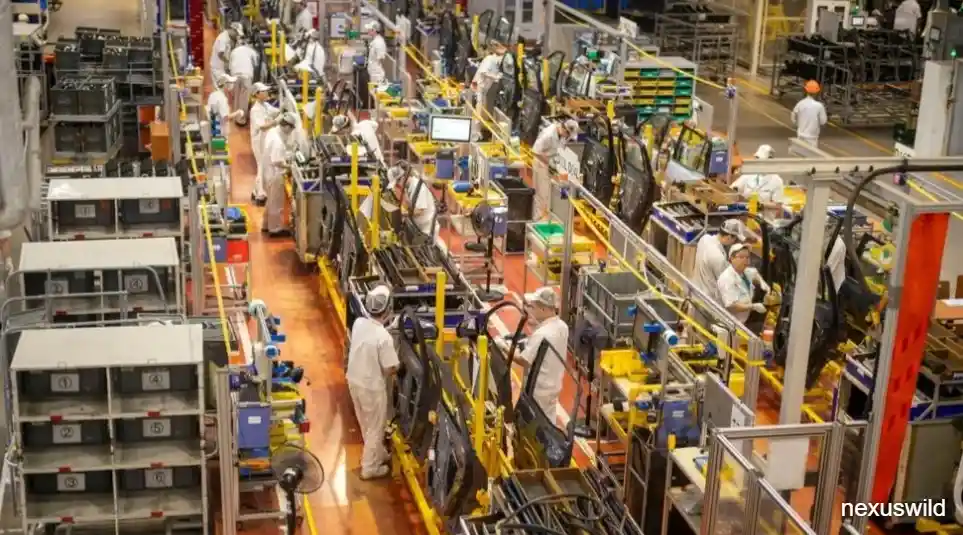

China's manufacturing sector returned to contraction in October 2026, highlighting renewed pressure on the world's second-largest economy as domestic demand remained subdued and international orders weakened. The official manufacturing Purchasing Managers' Index (PMI) fell to 49.3 from 50.1 in September, moving below the critical 50-point threshold that separates expansion from contraction.
The October reading, released by China's National Bureau of Statistics (NBS) on October 31, was weaker than market expectations. Economists surveyed by Reuters had forecast a reading of approximately 50.0, while a Bloomberg survey cited by other reporting placed the median forecast at 49.9. The actual result therefore indicated a sharper deterioration in factory business conditions than many market participants had anticipated.
Several components of the survey also weakened. The new export orders index dropped to 48.7 from 50.0 in September, while the production index declined to 49.8 from 51.7. The broader new-orders index slipped to 49.4 from 50.5, indicating that manufacturers were experiencing pressure from both domestic and overseas demand.
The latest figures have raised concerns about China's industrial momentum heading into the final quarter of the year. They also add to questions about the strength of the country's economic recovery, the outlook for international trade and the possibility of further government support.
Manufacturing Activity Falls Back Into Contraction
The official manufacturing PMI is a monthly survey indicator that measures changes in business conditions across China's manufacturing sector. A reading above 50 indicates that activity is generally expanding compared with the previous month, while a reading below 50 indicates that conditions are deteriorating.
October's decline to 49.3 reversed September's return to expansion, when the index reached 50.1. The latest reading suggests that the improvement recorded during the previous month was not sustained.
The result is particularly important because manufacturing remains a major component of China's economic structure. The sector supports employment, industrial investment, domestic distribution networks and international trade. It also provides demand for raw materials, energy, machinery and intermediate goods supplied by businesses across Asia and other regions.
A contraction in the PMI does not necessarily mean that China's total industrial output has fallen by the same amount. Instead, it indicates that surveyed businesses reporting weaker conditions outnumbered those reporting improvement. Nevertheless, a sustained period of readings below 50 can signal that manufacturers are facing persistent difficulties in securing orders, maintaining production schedules and managing inventories.
The October survey also showed that the deterioration was not limited to one part of the manufacturing process. Production, new orders and export orders all moved into contraction territory. This combination suggests that factories were dealing with both weaker demand and reduced momentum in output.
Domestic Demand Remains a Major Challenge
Weak domestic demand continues to weigh on China's manufacturing outlook. Businesses need consistent orders from households, construction companies, retailers and other industrial customers to maintain production and investment. When domestic consumption remains subdued, manufacturers may find it difficult to increase output even when they have sufficient production capacity.
China's prolonged property-sector downturn has contributed to this environment. A weaker property market can affect household confidence and spending decisions, while also reducing demand for construction materials, furniture, household equipment, machinery and other industrial products.
The impact extends beyond property developers. Suppliers, logistics companies, construction contractors and local businesses connected to the property market can all experience reduced activity when investment and building demand weaken.
Households facing uncertainty about property values and future income may also become more cautious about major purchases. This can affect manufacturers producing consumer electronics, appliances, vehicles, furniture and other discretionary goods.
For manufacturers, the result is a more difficult demand environment. Companies may respond by limiting production, reducing purchases of raw materials, delaying investment or competing more aggressively on price.
The October PMI does not identify a single cause for the deterioration, but the weakness in the new-orders index is consistent with broader concerns about the strength of demand across the economy.
Export Orders Weaken as Trade Conditions Become More Complicated
The decline in new export orders to 48.7 from 50.0 in September is another important signal from the October survey.
Chinese manufacturers have increasingly relied on overseas markets to support sales when domestic demand is insufficient. Export activity has helped many industrial businesses maintain production and secure revenue, particularly in sectors where China's manufacturing capacity remains highly competitive.
However, international trade conditions are becoming more complicated. Trading partners have raised concerns about trade imbalances, industrial competition and the impact of lower-priced Chinese products on domestic manufacturers.
The European Union, for example, has been debating ways to address its trade relationship with China, including concerns about the competitiveness of domestic industries and imports of Chinese goods. These issues add to the uncertainty facing exporters that depend on stable access to overseas customers.
The United States and China also remain important participants in global trade negotiations. Tariff policies, market-access restrictions and broader geopolitical disagreements can influence business decisions even when individual companies are not directly affected by new measures.
The October export-orders reading suggests that demand from overseas customers weakened compared with September. It should not, however, be interpreted as evidence that China's total exports necessarily declined during the month. PMI export orders measure the direction of new business reported by surveyed manufacturers, rather than the value of goods that actually crossed international borders.
The distinction is important because shipments can remain strong even when new orders begin to weaken. Manufacturers may continue fulfilling previously secured contracts, while the pipeline of future business becomes less certain.
If the decline in new export orders continues, the effects could become more visible in factory schedules, inventory management and demand for imported components and raw materials.
Production Weakens Across the Manufacturing Sector
The production index declined to 49.8 in October from 51.7 in September, moving just below the expansion threshold.
The change suggests that the improvement in manufacturing production reported in September was not sustained. Factories may be responding to weaker order books by adjusting operating schedules, controlling inventories and reducing purchases of inputs.
Production decisions are closely connected to expectations about future sales. When manufacturers receive fewer new orders, they may become reluctant to increase output because producing goods without confirmed demand can create inventory and financing pressures.
This is particularly important for smaller manufacturers, which may have less access to affordable credit and fewer opportunities to diversify their customer base.
October reporting indicated that smaller and medium-sized manufacturers experienced weaker conditions than large enterprises. The high-tech manufacturing PMI remained in expansion territory at 51.3, while the broader manufacturing index contracted. This suggests that the slowdown was not evenly distributed across the industrial economy.
The contrast between high-tech and traditional manufacturing is significant. China's advanced manufacturing sectors include industries connected to electronics, equipment, aerospace and other technology-intensive activities. These businesses may benefit from investment in industrial upgrading and demand for specialised products.
Traditional manufacturers, by comparison, can be more exposed to property investment, consumer demand and price competition. Their performance may therefore remain weaker when construction activity and household spending are subdued.
Smaller Manufacturers Face Greater Pressure
The October figures also highlighted differences between businesses of different sizes.
Large manufacturers remained in expansion territory, with their PMI at approximately 50.2. Medium-sized businesses recorded a reading of 48.4, while small manufacturers fell to 47.5.
This divide indicates that smaller businesses may be experiencing greater pressure than larger industrial groups. Large manufacturers generally have stronger access to financing, established distribution networks and the ability to serve multiple markets. Smaller suppliers may depend on a limited number of customers and have less flexibility when orders decline.
Smaller companies can also be more sensitive to rising input costs, delayed customer payments and changes in financing conditions. When demand weakens, they may have limited resources to maintain production while waiting for new contracts.
The situation creates a policy challenge because smaller manufacturers are important employers and suppliers within China's industrial ecosystem. Supporting them can help protect jobs and maintain supply-chain relationships, but broad credit expansion alone may not solve the underlying problem if customers are not placing enough orders.
Measures that improve consumer demand, support private investment and strengthen access to finance could therefore play a role in stabilising business conditions.
Wider Economic Activity Also Loses Momentum
The slowdown was not limited to manufacturing. China's official non-manufacturing PMI, which covers services and construction, fell to 49.7 in October from 50.2 in September.
This reading placed the broader measure below the expansion threshold and suggested that economic momentum weakened across more than one major sector.
The construction component experienced a particularly sharp decline, falling to 48.0 from 50.3. Service activity eased to 50.0 from 50.2, indicating that the services sector was close to stagnation rather than recording a strong expansion.
The figures add to concerns about the breadth of the slowdown. Manufacturing weakness can affect transport, logistics, wholesale trade and business services, while weaker construction can reduce demand for materials, machinery and industrial equipment.
A simultaneous loss of momentum in manufacturing, construction and services makes the policy challenge more complicated. Measures designed to support factories may not be sufficient if households remain cautious and private investment remains weak.
At the same time, the PMI readings do not establish that every sector is contracting. The figures represent survey-based measures of monthly direction, and individual industries can continue expanding even when the aggregate index falls below 50.
Implications for Global Supply Chains
China occupies a central position in global manufacturing supply chains. Its factories produce machinery, electronic components, industrial equipment, chemicals, textiles, consumer goods and numerous intermediate products used by manufacturers in other countries.
A prolonged slowdown could affect overseas suppliers and customers through several channels.
First, weaker factory production could reduce demand for imported components, industrial materials and specialist equipment. Businesses supplying Chinese factories may experience slower orders if manufacturers reduce operating schedules or postpone expansion plans.
Second, softer industrial activity could influence global freight and logistics demand. Lower volumes of manufactured goods and industrial inputs can affect shipping, warehousing and transportation businesses, although the impact would depend on the duration and breadth of the slowdown.
Third, multinational manufacturers that rely on Chinese suppliers may need to monitor production schedules more closely. A weaker domestic industrial environment does not automatically mean supply shortages. In some cases, lower demand may reduce pressure on capacity. However, individual suppliers facing financial stress could create delivery and continuity risks.
The October PMI therefore provides an early warning indicator for businesses with significant exposure to Chinese industrial demand. It is not sufficient on its own to establish a broad global supply-chain disruption.
Commodity Markets Face Demand Uncertainty
China is one of the world's most important consumers of industrial raw materials. Its manufacturing, construction and infrastructure sectors generate demand for metals, energy products and other commodities.
A sustained slowdown in factory activity could therefore create downside risks for commodity demand, particularly if it is accompanied by weaker construction investment and industrial spending.
Copper, aluminium, steel-related inputs and energy products are among the materials whose demand can be influenced by manufacturing and infrastructure activity. Suppliers and commodity traders may pay close attention to changes in China's factory orders, production levels and purchasing activity.
However, the relationship between PMI readings and commodity prices is not automatic. Prices also depend on global supply, inventories, geopolitical developments, weather conditions, mining disruptions and demand from other major economies.
The October manufacturing contraction should consequently be treated as a signal of potential demand weakness rather than proof that commodity prices will decline.
For exporters of industrial materials, the next several months will be important in determining whether the weaker survey reflects a temporary adjustment or a more persistent reduction in Chinese purchasing activity.
Policy Support Expectations Increase
The weaker PMI reading may increase expectations that Beijing will introduce additional measures to stabilise economic activity.
China has already been using targeted support policies to strengthen business financing, encourage household spending and support investment. Measures reported in October included additional credit support for smaller businesses and consumers, mortgage-interest subsidies for some home buyers and further bond financing capacity for local governments.
Infrastructure investment is another potential channel for supporting economic activity. Government-backed projects can generate demand for steel, cement, machinery, construction services and transport equipment.
However, the effectiveness of infrastructure-led stimulus depends on project quality, financing conditions and the ability to generate sustainable economic returns. Additional spending may support short-term activity, but it cannot fully replace stronger household consumption and private-sector confidence.
Consumer support could therefore become increasingly important. Measures that encourage households to spend, reduce financial uncertainty and improve confidence may help generate demand across a wider range of industries.
The October PMI does not confirm that a new large-scale stimulus package will be announced. Policymakers may prefer targeted interventions and additional monitoring before committing to broader measures.
The key question is whether the slowdown continues into November and December or whether activity stabilises after the October decline.
What Businesses and Investors Should Monitor
The latest figures give international businesses several indicators to follow.
New orders: A sustained recovery in the new-orders index would suggest that demand is improving. Continued weakness could point to further pressure on factory production.
Export demand: The new export-orders index will be important for manufacturers dependent on international customers. Its recovery could signal stronger overseas demand, while further deterioration may indicate a weaker order pipeline.
Small-business conditions: The gap between large and small manufacturers deserves attention because smaller suppliers can be more vulnerable to financing and demand shocks.
Construction and services: The decline in the non-manufacturing PMI suggests that businesses should monitor activity beyond factories, particularly construction and domestic services.
Policy announcements: Additional consumer support, credit measures and infrastructure financing could influence demand expectations, but their impact will depend on implementation and actual spending.
Investors should also distinguish between survey indicators and official production, trade and investment data. PMI readings can provide an early indication of changes in business conditions, but they should be assessed alongside other economic releases before drawing conclusions about China's overall growth outlook.
Outlook: A Weaker Start to the Fourth Quarter
China's October manufacturing PMI has interrupted the improvement recorded in September and highlighted the continuing challenges facing the country's industrial economy.
The decline to 49.3, combined with weaker export orders and production, indicates that manufacturers entered the final quarter of 2026 with less favourable business conditions. The deterioration in the non-manufacturing index also suggests that the loss of momentum extended into construction and services.
Nevertheless, the figures do not establish that China's economy is entering a broad recession. Advanced manufacturing remained in expansion, and large manufacturers continued to report conditions above the 50-point threshold. The country also retains significant industrial capacity and an extensive export network.
The central challenge is to strengthen domestic demand while maintaining the competitiveness of Chinese manufacturers in an increasingly complicated international trade environment.
For global businesses, the October data are a reminder that China's industrial performance remains an important influence on international supply chains, commodity demand and trade flows. For policymakers in Beijing, the figures reinforce the need to support sustainable demand rather than relying exclusively on production capacity and exports.
The next PMI release will help determine whether October represented a temporary setback or the beginning of a more persistent manufacturing slowdown.
Nexuswild welcomes factual corrections. Email contact@nexuswild.com with evidence and the article URL.