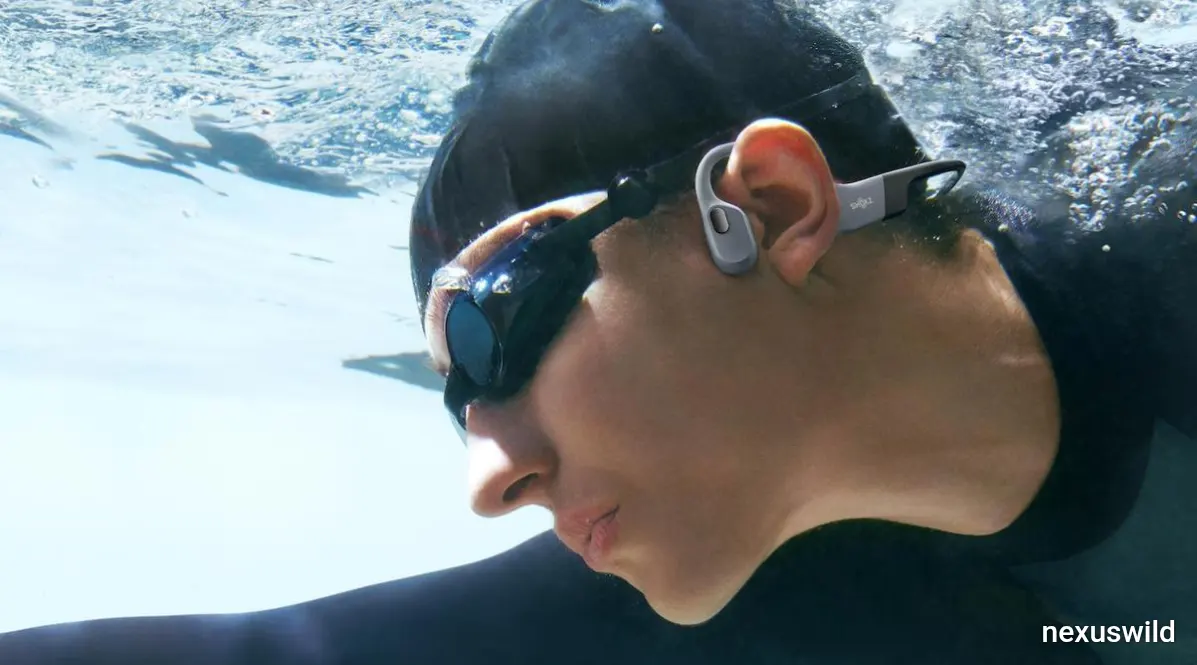

Swimming's Long-Standing Audio Problem
Music has become a familiar part of running, cycling, gym workouts and everyday exercise. Wireless earbuds allow people to listen to playlists, podcasts and training instructions without carrying additional equipment. Swimming, however, has remained an exception.
Water creates a difficult environment for conventional wireless audio technology. A smartphone placed beside a swimming pool cannot reliably transmit music to ordinary Bluetooth earbuds once the listener moves underwater. Even waterproof earbuds designed for other activities may not support continuous underwater audio streaming.
For swimmers, this has meant choosing between exercising without music, using a dedicated waterproof audio player or stopping frequently to access a device above the surface.
The limitation is particularly noticeable during longer swimming sessions. Lap swimmers may spend considerable time repeating the same movements, while triathletes often combine swimming with cycling and running. Music and spoken coaching can make training more engaging, but the technology must work without interrupting movement.
Manufacturers have responded by developing products specifically for aquatic environments. Rather than simply making conventional wireless earbuds waterproof, these companies are redesigning how audio is stored, transmitted and delivered to the listener.
The result is a growing category of swimming headphones that combines waterproof engineering with bone conduction and alternative connectivity systems.
Why Ordinary Bluetooth Does Not Work Reliably Underwater
Bluetooth technology generally operates in the 2.4 GHz radio-frequency band. It is designed for short-range communication between devices such as smartphones, headphones, laptops and smartwatches.
Air provides a suitable environment for these signals, but water behaves very differently.
When radio-frequency signals enter water, their energy is absorbed and their strength decreases rapidly. The extent of signal loss depends on factors including frequency, water conductivity and the distance travelled.
A research study published in Sensors examined the behaviour of 2.4 GHz electromagnetic signals in underwater environments. It found substantial absorption losses, with the problem becoming more significant as water conductivity increased. The study also highlighted the additional difficulties of transmitting radio signals through seawater.
This explains why ordinary Bluetooth connections become unreliable when headphones and a smartphone are separated by pool water. Even a relatively short underwater distance can interrupt communication.
The problem is not simply a lack of waterproofing. Waterproofing protects electronic components from water damage, but it does not make conventional Bluetooth signals travel effectively through water.
Consequently, making ordinary wireless earbuds waterproof does not automatically make them suitable for swimming.
Manufacturers must instead use a different approach, such as storing audio directly on the headphones or transmitting it through a specialised system designed for underwater communication.
Source: "Scientific study on radio-frequency absorption in underwater wireless networks" (https://www.mdpi.com/1424-8220/16/6/890).
Bone Conduction Provides a Different Way to Hear Sound
One of the most important technologies behind modern swimming headphones is bone conduction.
Conventional headphones deliver sound through air. Speakers produce sound waves that travel through the ear canal, vibrate the eardrum and pass through the middle ear before reaching the cochlea in the inner ear.
Bone conduction follows another route.
Instead of relying entirely on sound travelling through the ear canal, a small transducer produces mechanical vibrations that pass through the bones of the skull towards the cochlea. The inner ear processes these vibrations and the brain interprets them as sound.
In swimming headphones, the transducers are commonly positioned against the cheekbones, just in front of the ears. This allows the device to deliver audio without requiring conventional speakers inside the ear canals.
The design offers practical advantages for swimmers. The ear canal can remain open, reducing the need to insert conventional earbuds. Some models also include swimming earplugs, which can help keep water out of the ears and improve perceived audio clarity.
Bone conduction is not a new medical concept. It is also used in hearing assessment and specialised hearing devices. Its application in consumer electronics has expanded the possibilities for sports headphones and open-ear audio products.
However, bone conduction has limitations. Sound quality can differ from conventional headphones, particularly in bass reproduction. The positioning of the transducers also matters, and users may experience vibration against the skin at higher volume levels.
The technology therefore represents a practical compromise: it offers a way to deliver audio in environments where conventional in-ear designs are difficult to use, but it does not necessarily reproduce the same listening experience as premium wireless earbuds.
Sources: "NCBI Bookshelf: Bone Conduction Evaluation" (https://www.ncbi.nlm.nih.gov/books/NBK578177/) and "South Tees Hospitals NHS Foundation Trust: Bone Conduction Hearing Devices" (https://www.southtees.nhs.uk/resources/bone-conduction-hearing-devices-and-implants-bchds-and-bchis/).
Hybrid Headphones Combine Bluetooth With Offline Audio
A major development in swimming headphones is the introduction of hybrid audio systems.
These products combine two different ways of listening. Bluetooth allows the headphones to connect to a smartphone or other compatible device when the user is above water. Built-in storage allows music and other audio files to play independently when the headphones are submerged.
This arrangement solves the main limitation of conventional Bluetooth without requiring users to abandon wireless connectivity altogether.
Before swimming, users transfer compatible audio files to the headphones through a charging or data cable. Once in the pool, the device switches to its internal playback mode. When the swimmer returns to land, Bluetooth can be used again.
The distinction is important because Bluetooth streaming and offline playback are not the same thing.
Bluetooth streaming sends audio continuously from a connected smartphone or other source. It is convenient above water but cannot be relied upon through pool water.
Offline MP3 playback uses audio files stored directly on the headphones. The device does not need a continuous connection to a smartphone, making it suitable for underwater listening.
Transmitter-based systems use a separate device to convert or relay audio through a transmission method designed for underwater communication. This can allow a swimmer to receive live audio without relying on ordinary Bluetooth transmission through water.
Hybrid products are particularly useful because they combine the convenience of everyday wireless headphones with the reliability of locally stored audio during swimming.
However, users still need to consider supported file formats, storage limits and the method used to transfer music. Access to a streaming service on a smartphone does not automatically mean that its entire library can be played offline through swimming headphones.
Shokz Brings Larger Storage to Swimming Headphones
<escape> </escape>One of the most visible examples of hybrid swimming audio is the Shokz OpenSwim Pro.
The product combines Bluetooth 5.4 connectivity with 32GB of internal storage. According to Shokz, the device can store more than 8,000 regular-quality songs, although the actual number depends on file size and available storage.
Its design uses bone conduction and a flexible headband that sits around the back of the head. The device has an IP68 rating and is designed for submersion in fresh water up to two metres under the manufacturer's stated conditions.
Shokz specifies up to nine hours of battery life in Bluetooth mode and up to six hours in MP3 mode. The company also supports several audio formats, including MP3, FLAC, WAV, AAC, M4A, APE and WMA.
The key point is that Bluetooth is intended for use above water. Underwater listening relies on the built-in MP3 mode because water disrupts the Bluetooth signal.
Shokz also includes swimming earplugs and a swimming-focused audio setting. The company says these help improve the listening experience underwater.
Independent testing has identified comfort, battery performance and the combination of Bluetooth with offline playback as important strengths. TechRadar's review also noted limitations around music streaming convenience and the lack of USB-C data transfer.
The OpenSwim Pro demonstrates how manufacturers are turning swimming headphones into multi-purpose wearable devices rather than treating them as simple waterproof MP3 players.
Sources: "Shokz OpenSwim Pro official specifications" (https://shokz.com/products/openswimpro) and "TechRadar independent review" (https://www.techradar.com/health-fitness/fitness-headphones/shokz-openswim-pro-review).
H2O Audio Focuses on Multi-Sport Listening
H2O Audio has developed a different approach aimed at swimmers and athletes who move between multiple sports.
Its TRI 2 PRO Multi-Sport headphones combine bone conduction, Bluetooth connectivity and 8GB of built-in storage. The product also features Playlist+, a system that allows users to capture audio from a Bluetooth source and save it for offline playback.
This is different from simply transferring music files to the headphones. A user can play audio from a connected source and use Playlist+ to record it into the device's internal storage for later listening.
The company lists an IPX8 waterproof rating, with protection specified for submersion up to 3.6 metres. Its product comparison also lists Bluetooth 5.3 connectivity for the TRI 2 PRO.
H2O Audio's product range includes other designs, such as the SONAR 2 PRO, which is built around swimming use and offers Playlist+ functionality.
Independent testing has highlighted both the advantages and compromises of this approach.
Tom's Guide found that the TRI 2 PRO provided a comfortable fit and useful offline playback, but reported limitations in sound quality and the convenience of recording audio. TechRadar's testing also identified the value of Playlist+ for athletes who want to use streaming services before entering the water, while noting that the device's controls and audio performance have room for improvement.
These findings illustrate an important commercial challenge: adding more features does not automatically produce a better user experience. The process of transferring or capturing audio needs to be simple enough for swimmers to use regularly.
Sources: "H2O Audio product comparison" (https://h2oaudio.com/pages/product-comparison), "Tom's Guide review" (https://www.tomsguide.com/wellness/fitness/h2o-audio-tri-2-pro-review) and "TechRadar review" (https://www.techradar.com/health-fitness/fitness-headphones/h2o-audio-tri-2-pro-multi-sport-review).
FINIS Shows the Continuing Value of Dedicated MP3 Players
Not every swimming headphone needs Bluetooth connectivity.
FINIS has taken a more traditional approach through its Duo underwater MP3 player. The product uses bone conduction and a clip-based design that attaches to swimming goggle straps, positioning the transducers against the cheekbones.
According to FINIS, the Duo includes 4GB of internal storage, supports MP3 and WMA audio formats and provides up to seven hours of battery life.
The manufacturer specifies an IPX8 rating and says the device has been tested for use at a depth of three metres for 30 minutes.
Unlike newer hybrid models, the Duo does not combine Bluetooth streaming with offline playback. It is designed primarily as a dedicated underwater audio player.
This approach demonstrates that a product does not need the latest wireless features to address a specific consumer requirement.
For swimmers who simply want music during pool sessions, a dedicated player may provide a straightforward experience without the additional complexity of switching between connectivity modes.
However, the absence of Bluetooth means it is less versatile for everyday listening outside the pool.
FINIS therefore represents a different segment of the market: specialist swimming equipment designed around a particular activity rather than a multi-purpose audio accessory.
Source: "FINIS Duo official product specifications" (https://www.finisswim.sg/products/duo-underwater-mp3-player).
Zygo Uses a Transmitter to Deliver Live Audio Underwater
While Shokz, H2O Audio and FINIS rely primarily on onboard storage for underwater playback, Zygo has developed a different model.
Its Z2 swimming headset uses a dedicated transmitter system to deliver audio from a smartphone to a swimmer.
The smartphone connects to the transmitter through Bluetooth above water. The transmitter then uses a different radio-frequency system to communicate with the underwater headset.
This distinction is important. Zygo is not demonstrating that ordinary Bluetooth can travel through pool water. Instead, it uses a separate transmission method designed for underwater use.
The system can support live audio delivery, including coaching instructions, without requiring users to preload every audio file.
Zygo also connects its hardware to a wider fitness platform. Its companion app offers guided swimming workouts, a tempo trainer, lap counting and one-way communication that allows a coach to send instructions to a swimmer.
According to the company's FAQ, the app includes more than 500 guided audio workouts. Some advanced features, including saved workout history and walkie-talkie functionality, require a subscription.
Independent testing by TechRadar described the Z2 as a premium swimming audio system with a transmitter-based design, but highlighted its relatively high price and limited availability. The review listed a price of $329 and up to three hours of headset battery life, with additional charging capacity provided by its case.
Zygo's approach is particularly interesting for coaching and connected fitness. Rather than focusing only on music playback, it attempts to make the pool a more interactive training environment.
However, it requires swimmers to carry and position the transmitter system, making it a different proposition from self-contained headphones.
Sources: "Zygo Z2 official product information" (https://discover.shopzygo.com/new-z2/), "Zygo product FAQ" (https://shopzygo.com/pages/faq) and "TechRadar independent Z2 review" (https://www.techradar.com/health-fitness/fitness-headphones/zygo-z2-review).
How Different Technologies Are Competing for Swimmers
The swimming audio market is developing around several competing approaches.
Company and product| Audio approach| Storage or transmission| Main focus Shokz OpenSwim Pro| Bone conduction| 32GB storage and Bluetooth above water| Multi-sport listening H2O Audio TRI 2 PRO| Bone conduction| 8GB storage, Bluetooth and Playlist+| Swimming, running and cycling FINIS Duo| Bone conduction| 4GB offline MP3 player| Dedicated pool use Zygo Z2| Bone conduction| Dedicated transmitter for live audio| Coaching and connected swimming
These specifications are based on manufacturer information and published product testing. Waterproof ratings and battery figures are not directly comparable because manufacturers may use different test conditions and immersion limits.
The competition also reflects different customer priorities.
Some swimmers want a simple device that plays a stored playlist. Others want to use their headphones during several types of exercise. More serious athletes may value real-time coaching, guided sessions and training information.
This creates opportunities for companies to compete through product design, software services, audio quality and specialist features rather than relying exclusively on hardware specifications.
Music Can Change the Swimming Experience
The appeal of underwater audio extends beyond entertainment.
For lap swimmers, music can make repetitive training sessions more engaging. Listening to familiar playlists or podcasts may help some users maintain motivation during longer workouts.
Triathletes can benefit from devices that work both in and out of the water. A single pair of multi-sport headphones can reduce the need to carry separate audio equipment for swimming, cycling and running.
Fitness enthusiasts may also find guided audio sessions useful when learning new routines or following structured workouts.
Coaching is another potential area of development. Swimming technique involves coordination, breathing, body position and timing. Instructions delivered while a swimmer is training could help coaches communicate without requiring athletes to stop after every length.
However, the usefulness of music and coaching depends on the type of session. Some swimmers prefer to focus on breathing, stroke technique and their surroundings without audio distractions.
Audio devices should also be used responsibly. Swimmers need to remain aware of other people, lane activity, pool announcements and safety instructions. Headphones should not replace supervision or communication with lifeguards and coaches.
Business Opportunities in Sports Technology and Wearable Electronics
The development of swimming headphones is part of a broader opportunity in specialist wearable technology.
The wider headphone market is highly competitive, with manufacturers selling products across multiple price categories. Swimming creates a more specialised market because devices must withstand repeated exposure to water while maintaining stable performance.
This gives specialist manufacturers an opportunity to compete through engineering and activity-specific features.
Hardware differentiation is one growth area. Better waterproofing, more efficient batteries, improved bone conduction transducers and easier controls can make products more attractive to consumers.
Connected fitness services offer another opportunity. Subscription-based coaching, guided swimming programmes, training plans and performance records can create recurring revenue beyond the original hardware sale.
Zygo's combination of a transmitter, headset and app demonstrates how a company can build a service around a physical product. H2O Audio's Playlist+ feature similarly shows how software can make a traditional offline player more compatible with modern streaming habits.
Multi-sport compatibility could also expand the potential customer base. Products that work for swimming, running and cycling may appeal to triathletes and fitness enthusiasts who prefer one device for several activities.
There may also be opportunities in partnerships with swimming clubs, fitness centres, sports academies and professional coaching services.
For businesses, the challenge will be to establish whether consumers are willing to pay more for specialised aquatic audio compared with conventional wireless headphones.
Remaining Challenges Could Limit Wider Adoption
Despite technological progress, swimming headphones still face several practical limitations.
Battery life remains important because swimming sessions can last several hours, particularly for endurance athletes. Battery performance also varies depending on audio volume, connection mode and operating conditions. Manufacturer figures should be treated as estimates under specified test conditions rather than guaranteed real-world results.
Sound quality is another challenge. Bone conduction products can struggle to reproduce the bass and audio depth associated with conventional in-ear headphones. Water conditions, earplug use and the positioning of the transducers can also influence the listening experience.
Waterproofing requires careful attention. IPX8 and IP68 ratings describe protection under defined testing conditions, but they do not mean that every device can be used at any depth or for unlimited periods. Users should follow the manufacturer's stated limits and maintenance instructions.
Storage and compatibility also affect convenience. Some devices support a broad range of audio formats, while others have smaller storage capacities or specific transfer requirements. Streaming-service restrictions can make it difficult to transfer protected music directly to an MP3 player.
Affordability may be a barrier for occasional swimmers. A specialised headset and transmitter system can cost substantially more than standard wireless earbuds. Consumers must decide whether the additional waterproofing and training features justify the price.
Finally, charging connectors and proprietary accessories can create inconvenience. Magnetic charging cables may improve waterproofing, but losing or damaging a specialised cable can make the device difficult to use until a replacement is obtained.
What Comes Next for Underwater Audio?
The next generation of swimming audio systems may focus less on simply playing music and more on connecting audio with training information.
Improved coaching systems could deliver instructions based on swimming pace, distance and workout structure. A swimmer following a structured session might receive reminders when to change intensity, adjust stroke timing or begin another interval.
More advanced lap tracking and workout analytics could also become standard features. Devices with motion sensors may be able to record swimming activity and share selected information with fitness applications.
Better battery efficiency and improved underwater transmission systems could make real-time audio more practical. Companies may also work towards easier integration with smartphones, smartwatches and training platforms.
However, wider adoption will depend on reliability. Swimmers need devices that work consistently in real pool conditions, not just under controlled laboratory tests.
The future may involve a combination of local storage, specialised wireless transmission and connected fitness software rather than one technology replacing all others.
For manufacturers, the commercial opportunity lies in making underwater listening more convenient without adding unnecessary complexity.
Conclusion
The swim audio revolution is transforming a long-standing limitation of aquatic fitness into an emerging opportunity for consumer technology companies.
Ordinary Bluetooth cannot provide reliable underwater streaming, but bone conduction, internal audio storage and specialised transmitter systems are offering practical alternatives.
Shokz and H2O Audio are combining Bluetooth with offline playback, FINIS continues to serve swimmers through dedicated MP3 technology, and Zygo is exploring real-time audio delivery and connected coaching.
These different approaches demonstrate that underwater audio is becoming more than a niche music accessory. It is developing into a specialised part of the sports technology and wearable electronics market.
The next stage of innovation will depend on making swimming audio more reliable, affordable and useful for training. If manufacturers can improve sound quality, battery performance and coaching integration, underwater headphones could become a more familiar part of the modern swimming experience.
Nexuswild welcomes factual corrections. Email contact@nexuswild.com with evidence and the article URL.