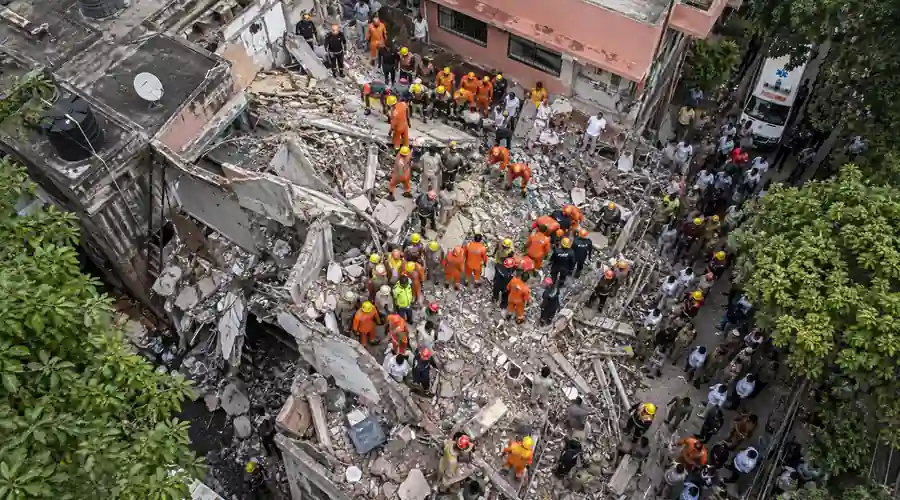

NEW DELHI, Sept. 7, 2026 - The Cockroach Janta Party has demanded a city-wide safety audit of paying guest accommodations in Delhi and called for accountability after a five-storey hostel building collapsed in Satya Niketan near Delhi University’s South Campus, leaving five people dead and several others trapped.
CJP founder and convenor Abhijeet Dipke said the collapse exposed a broader failure in student housing and educational infrastructure, arguing that young people should not be expected to live in buildings where basic structural safety is uncertain.
The party’s intervention focused on three demands: an immediate inquiry into the collapse, stronger municipal oversight of student accommodation, and safety inspections of PG hostels across the capital.
The statement comes as rescue teams and local residents continued working at the site of the collapsed building, known as Hostel Daze.
CJP calls for accountability beyond the immediate rescue
Dipke framed the incident as more than a single-building failure.
He questioned whether student housing in Delhi was being subjected to adequate inspections, particularly in neighbourhoods where residential properties have increasingly been converted into PG accommodation for university students.
The party said authorities should establish whether construction or repair activity, building permissions, structural conditions or enforcement failures contributed to the collapse.
That question is especially important in areas around major universities, where demand for affordable housing has encouraged the rapid conversion of older residential buildings into high-density student accommodation.
A building originally designed for a family can face very different loads and usage patterns once multiple rooms are occupied by two or three students each.
That does not automatically make such properties unsafe.
But it does increase the importance of fire compliance, structural inspections, access routes, emergency exits, ventilation and enforcement of building rules.
Party volunteers joined rescue efforts
A CJP team led by organisation co-in-charge and north zone lead Deepak Baliyan and national joint secretary Balakrishna Shukla reached the site and joined residents and emergency personnel during the rescue operation.
The party said its volunteers would remain in the area to assist families and monitor rescue efforts until all students were accounted for.
Residents had reportedly begun searching through debris before emergency services fully arrived.
That detail has added to the political pressure around the incident because it raises questions not only about building regulation, but also about emergency preparedness in dense student neighbourhoods.
Dipke questions government priorities
Dipke also used the incident to criticise the government’s priorities on educational infrastructure.
He argued that political investment and institutional expansion cannot be separated from the basic obligation to ensure that students have safe places to study and live.
His criticism was directed at Prime Minister Narendra Modi after the Prime Minister had visited Delhi University a day earlier.
Dipke questioned whether enough political attention was being paid to the condition of hostels, classrooms and student accommodation.
The broader argument advanced by CJP is that student safety should be treated as core public infrastructure rather than as a secondary municipal issue.
That framing is politically significant because accommodation for university students in Delhi often falls into a regulatory grey zone involving landlords, municipal authorities, police registration requirements, fire norms and educational institutions that may not directly own or manage the buildings.
The building reportedly housed students from several states
Local accounts indicated that the collapsed building had around 15 rooms, with two to three students staying in many of them.
Many residents were students from Kerala, Haryana and Uttar Pradesh enrolled at nearby colleges including Motilal Nehru College, Atma Ram Sanatan Dharm College and Sri Venkateswara College.
Construction or repair work was reportedly under way in the basement.
The precise cause of the collapse had not been established at the time of the initial political statements.
That distinction matters.
Basement work, structural alterations, poor maintenance, illegal construction, overloading and foundation failure are all possible factors in building collapses, but responsibility should be determined by engineering assessment and investigation rather than political assumption.
CJP’s demand is therefore strongest when framed around inspection and accountability rather than a predetermined conclusion about the cause.
A Delhi-wide PG audit could become a larger policy question
The party’s call for a safety audit of PG hostels across Delhi could have consequences far beyond Satya Niketan.
Student housing around Delhi University, coaching districts and other educational centres frequently operates through private rental markets rather than purpose-built institutional housing.
That creates affordability and flexibility for students, but it can also produce inconsistent safety standards.
A meaningful audit would need to examine more than visible cracks or building age.
It could include sanctioned building plans, structural modifications, basement use, occupancy levels, fire exits, electrical safety, emergency access and whether properties are being used in ways inconsistent with their approvals.
It could also require coordination across multiple agencies.
Without that coordination, audits risk becoming short-term inspection drives that identify violations without fixing the underlying regulatory system.
CJP links the collapse to a wider student-safety argument
Dipke also connected the Delhi incident to student safety problems elsewhere in India.
He argued that students in tribal regions and those in the national capital should not face preventable risks because of weak infrastructure or lack of institutional oversight.
The comparison is political, but the underlying policy point is broader.
Educational access does not end when a student receives admission.
Transport, accommodation, sanitation, food safety, healthcare and emergency response all affect whether students can actually participate safely in education.
For students living away from home, accommodation is often the largest and most consequential part of that infrastructure.
The party also criticised spending priorities
CJP contrasted expenditure on political buildings with what it described as inadequate attention to student accommodation and educational infrastructure.
Dipke argued that safe schools, functional hostels and basic student facilities should receive priority over highly visible political projects.
That criticism is part of a wider political debate about how governments allocate capital expenditure and what counts as essential public infrastructure.
The comparison is inherently political and does not by itself establish that funding for one type of project directly caused underinvestment in another.
But it reflects the message CJP is trying to build around the collapse: that student safety failures should be treated as a governance issue, not only as a local accident.
Accountability now depends on the investigation
The strongest evidence will come from the technical and administrative investigation into the building.
Investigators will need to establish what work was being carried out, whether it had approval, what condition the structure was in before the collapse, whether inspections had occurred and whether any previous warnings had been ignored.
Those findings will determine whether responsibility lies with building owners, contractors, engineers, municipal authorities or a combination of actors.
For the families affected, that process is more important than the political argument around the incident.
For policymakers, however, the larger issue will remain after the rescue operation ends.
If large numbers of students across Delhi are living in converted buildings with weak oversight, the problem is systemic.
If the Satya Niketan collapse proves to be an isolated case, that too needs to be established through evidence.
CJP has chosen to argue that the incident should trigger a wider review.
Whether that demand results in a formal city-wide audit will depend on how Delhi authorities respond in the days ahead.
Reader questions
Frequently asked questions
What has CJP demanded after the Satya Niketan hostel collapse?
CJP has demanded accountability, an inquiry into municipal oversight and a safety audit of paying guest hostels across Delhi.
Who made the CJP statement?
CJP founder and convenor Abhijeet Dipke publicly raised the issue of student safety and educational infrastructure after the collapse.
Where did the building collapse happen?
The building collapsed in Satya Niketan near Delhi University’s South Campus in New Delhi.
Has the cause of the collapse been established?
The precise cause had not been established at the time of the initial statements. A technical and administrative investigation is required to determine responsibility.
Why is CJP asking for a Delhi-wide PG audit?
The party argues that the collapse raises broader questions about the structural safety, occupancy and municipal oversight of private student accommodation across Delhi.
Nexuswild welcomes factual corrections. Email [email protected] with evidence and the article URL.