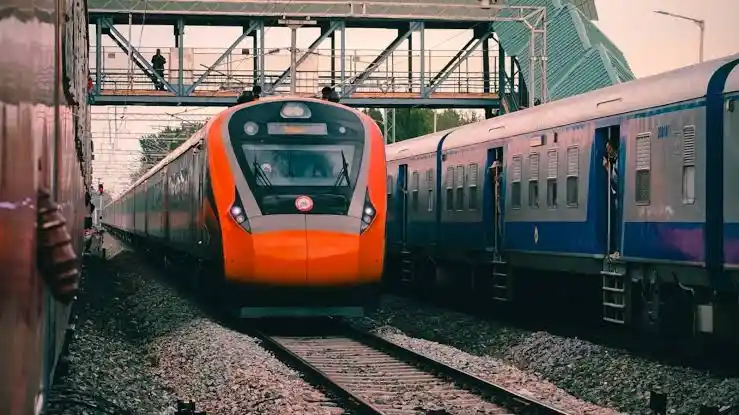

India's first Vande Bharat Freight EMU, a purpose-built high-speed freight train derived from the Vande Bharat passenger train platform, reached a speed of 130 kilometres per hour during a trial run on the Ahmedabad-Vadodara-Mumbai Central section of Western Railway in September 2026. The trial, conducted by the Research Designs and Standards Organisation, marks a further step in Indian Railways' effort to introduce faster, more reliable rail freight services for time-sensitive cargo, building on an earlier round of trials the same rake had completed weeks before on a different stretch of track in central India.
What Is the Vande Bharat Freight Train
The Vande Bharat Freight EMU is a 16-coach electric multiple unit train, manufactured at the Integral Coach Factory in Chennai, designed specifically to carry high-value, time-sensitive cargo such as e-commerce parcels and pharmaceuticals rather than the bulk commodities typically hauled by conventional Indian freight trains. Unlike traditional Indian Railways freight services, which rely on a locomotive hauling a set of wagons and often operate at comparatively low average speeds due to the mixed traffic and infrastructure constraints of the general rail network, the Vande Bharat Freight EMU uses a self-propelled, distributed power design similar to the passenger Vande Bharat trains it is derived from. This design is intended to allow faster acceleration, higher operating speeds and more predictable transit times than conventional freight consists.
According to reporting on the train's design, the Vande Bharat Freight EMU includes features such as automatic doors, roller floors to speed up loading and unloading, and cold-chain facilities intended to support temperature-sensitive cargo such as pharmaceuticals and perishable goods. The train is intended to operate on passenger rail routes, offering faster logistics services that complement, rather than replace, the freight capacity being built through India's Dedicated Freight Corridor network, which is designed primarily for heavier bulk freight movement on separate, dedicated tracks.
Trial-Run Details: Ahmedabad to Mumbai Central
The September 2026 trial that produced the 130 kmph result was carried out on the Ahmedabad-Vadodara-Mumbai Central section of Western Railway, under the supervision of the Research Designs and Standards Organisation, the technical wing of Indian Railways responsible for certifying new rolling stock and infrastructure. According to reporting on the trial, the rake was prepared at the Inland Container Depot at Sabarmati and departed Ahmedabad for Mumbai Central at 9 a.m. on September 12, 2026. A return trial from Mumbai Central back to Ahmedabad was completed successfully the following day, September 13, 2026.
During the test, the rake operated carrying a 50 percent payload, with an axle load of 20.32 tonnes, and railway personnel monitored the train's performance against prescribed permanent and temporary speed restrictions along the route. The test was formally classified as a Confirmatory Oscillograph Car Run, a standard railway testing procedure in which instrumented rail cars record data on a train's stability, vibration and dynamic behaviour while running at target speeds, allowing engineers to confirm that a train performs safely and predictably under real operating conditions before it is cleared for wider use.
It is important to note that the 130 kmph achieved on this particular trial does not represent the train's maximum design capability. The Vande Bharat Freight EMU has a design speed of 160 kmph, and the same rake had previously reached a higher speed of 145 kmph while running empty during earlier trials conducted in the Kota Division of West Central Railway. The Ahmedabad-Mumbai trial, by contrast, was conducted under load, with the train carrying 50 percent payload, which is a more representative test of how the train would perform in actual freight operations, even though it did not push the train to its top design speed.
Earlier Trials in the Kota Division
Before the Ahmedabad-Mumbai trial, the same prototype rake underwent an earlier and more detailed round of technical trials on the Kota-Rohal Khurd stretch of West Central Railway, in the presence of teams from both the Research Designs and Standards Organisation and the Integral Coach Factory. According to a report by Metro Rail News, that trial was completed successfully in mid-August 2026, with the train also reaching 130 kmph on that occasion.
These Kota Division trials were more explicitly focused on detailed technical evaluation of the train's various systems rather than solely establishing speed capability. According to Saurabh Jain, Senior Divisional Commercial Manager of Kota Division, the trials included a regenerative energy test, which measured how effectively the train recovers electrical power during braking, and a thermal capacity test, which assessed how well the train's electrical and propulsion systems held up while operating at high speed. Traction and braking runs were also used to evaluate the rake's hauling and stopping ability, while separate jerk tests examined how smoothly the train accelerated and decelerated while carrying a load, an important factor for cargo that may be sensitive to sudden movement.
A railway official quoted in that report described the purpose of the Kota Division trials directly: "The objective of these technical trials in the Kota Division is to conduct a detailed assessment of the functionality, reliability, and performance of the rake's various systems at high speeds. Upon the successful completion of these trials, this rake could play a significant role in enabling fast, safe, and punctual parcel and logistics transportation within Indian Railways."
Taken together, the Kota Division and Ahmedabad-Mumbai trials represent two distinct phases of testing on different sections of track, each contributing data toward the train's eventual certification, rather than a single, one-off test.
Train Technology and Design
The Vande Bharat Freight EMU's core technical distinction from conventional Indian freight trains lies in its use of an electric multiple unit configuration, in which propulsion is distributed across multiple coaches rather than concentrated in a single locomotive. This design, borrowed directly from the passenger Vande Bharat Express platform that has been in service on Indian Railways since 2019, allows for faster acceleration and deceleration, since traction power is applied more evenly along the length of the train rather than relying on a single locomotive to pull the full weight of the consist.
The 16-coach configuration used in the freight variant is designed to balance cargo capacity with the performance characteristics needed for higher-speed operation. The axle load of 20.32 tonnes recorded during the Ahmedabad-Mumbai trial under 50 percent payload gives an indication of the train's loading characteristics, though full details of its maximum rated payload capacity under full load conditions were not specified in the available reporting on these trials.
Automatic doors and roller floors are intended to reduce the time needed for loading and unloading cargo at terminals, which is a significant factor in how quickly a high-speed freight service can turn around and how much of its overall transit-time advantage is preserved once loading and unloading time is factored in. Cold-chain facilities built into the train are intended to allow it to carry temperature-sensitive goods, such as certain pharmaceuticals and perishable food products, that require consistent refrigeration throughout transit, a capability not typically integrated directly into conventional Indian Railways freight wagons.
The Vande Bharat Freight EMU is part of a broader family of trains built on variations of the same underlying platform. Indian Railways has separately developed a Vande Bharat sleeper variant intended for long-distance overnight passenger travel, which reached a peak speed of 180 kmph during its own trials in the Kota-Bundi area of Rajasthan around the start of 2025, according to reporting at the time. While the sleeper and freight variants serve entirely different purposes, both draw on the same core Vande Bharat design philosophy of higher speeds and improved ride characteristics relative to older Indian Railways rolling stock.
Significance for Freight Transport and Logistics
The development of a higher-speed freight option on the Indian Railways network is significant primarily because of the persistent gap between freight and passenger train speeds on India's shared rail infrastructure. Conventional Indian freight trains have historically operated at considerably lower average speeds than passenger services, a consequence of heavier axle loads, longer consist lengths, and the priority typically given to passenger trains when scheduling paths on shared track. This speed differential has been a longstanding constraint on the competitiveness of rail freight against road transport for goods where delivery time matters, particularly for e-commerce parcels, pharmaceuticals and other high-value or time-sensitive cargo.
A freight train capable of running at speeds closer to those of passenger services, while still built to accommodate cargo rather than passengers, could in principle narrow this gap for specific categories of goods that do not require the very large bulk-carrying capacity of conventional freight consists but do require significantly faster and more predictable transit times than those consists typically offer. This is consistent with the stated purpose of the Vande Bharat Freight EMU as a vehicle for high-value, time-sensitive cargo rather than a replacement for bulk freight movement, which continues to rely on conventional freight trains and the Dedicated Freight Corridor network.
For India's e-commerce and pharmaceutical logistics sectors specifically, a dedicated high-speed rail freight option, if it enters regular service, could offer an alternative to road transport for inter-city parcel and time-sensitive goods movement, potentially reducing dependence on road freight for these categories, though the extent of any such shift would depend on factors including route coverage, service frequency, pricing and terminal infrastructure that have not yet been finalized or disclosed for this train.
Potential Economic Impact
The broader economic case for faster rail freight services in India rests on the country's continuing effort to reduce logistics costs as a share of GDP, an area where India has historically lagged some international peers due to a combination of infrastructure gaps, modal imbalance favouring road transport, and inefficiencies in freight handling and transit times. Faster, more reliable rail options for time-sensitive cargo could, in principle, support this broader goal by offering shippers an alternative that combines some of the speed advantages of road transport with the lower per-unit cost typically associated with rail movement over longer distances.
However, it is important to note that these are general, structural considerations about the potential value of faster rail freight services rather than specific, confirmed projections for the Vande Bharat Freight EMU itself. No official cost, pricing, route network or projected service frequency has been disclosed in connection with these trials, and this article does not speculate on what economic impact the train might have once, or if, it enters commercial service.
Distinguishing Trial Performance From Commercial Operations
It bears emphasizing that both the Ahmedabad-Mumbai and Kota Division trials described here were technical evaluation exercises, not demonstrations of a service that is currently available for commercial freight bookings. According to Metro Rail News' reporting on the Kota Division trial, the train has not been launched for commercial service, and further technical checks and safety certifications are required before regular operations can begin.
The commercial launch of the Vande Bharat Freight EMU is expected only after the Research Designs and Standards Organisation completes its full assessment of the trial data gathered across these test runs, a process that, based on standard Indian Railways certification procedures for new rolling stock, would typically also involve final evaluation and sign-off from the Railway Safety Commissioner before a new train type is certified for regular passenger or freight service. Until that process is complete, the 130 kmph and 145 kmph speeds recorded in these trials should be understood as evidence of the train's technical capability under specific, controlled test conditions, rather than confirmation of the speeds or schedules it will operate at once commercial service begins.
Challenges Facing High-Speed Freight Operations
Several practical challenges are likely to shape how quickly and extensively high-speed freight services of this kind can be deployed across the Indian Railways network, based on the general operating characteristics described in relation to these trials.
First, operating a higher-speed freight service on shared track with existing passenger and conventional freight traffic requires careful timetabling to avoid conflicts, particularly since Indian Railways' network in many corridors already operates close to capacity. Second, the permanent and temporary speed restrictions that railway personnel specifically monitored during the Ahmedabad-Mumbai trial reflect the reality that achieving a train's design speed in practice depends heavily on the condition and configuration of the specific track sections it operates over, meaning actual achievable speeds may vary considerably by route even for a train with a 160 kmph design capability. Third, terminal infrastructure, including loading and unloading facilities compatible with the train's automatic doors and roller floor systems, and cold-chain handling capacity at both origin and destination points, would need to be developed or adapted to fully realize the transit-time advantages the train's onboard technology is designed to offer.
Finally, as with any new rolling stock introduction, the certification process itself, including the kind of detailed systems testing carried out in the Kota Division trials covering regenerative braking, thermal performance, traction and jerk characteristics, is designed specifically to surface any technical issues before a train enters regular service, meaning the current trial phase is an expected and necessary part of bringing a new train type into operation rather than an indication of the technology already being close to final deployment.
Conclusion
India's first Vande Bharat Freight EMU has now completed two rounds of trials, in the Kota Division of West Central Railway in mid-August 2026 and on the Ahmedabad-Vadodara-Mumbai Central section of Western Railway in September 2026, both reaching a tested speed of 130 kmph, alongside an earlier, faster run of 145 kmph achieved while running empty. These trials, supervised by the Research Designs and Standards Organisation and the Integral Coach Factory, represent incremental but concrete steps toward introducing a higher-speed freight option for high-value, time-sensitive cargo on the Indian Railways network, distinct from the bulk freight capacity being developed through the Dedicated Freight Corridor. With a design speed of 160 kmph and further technical assessment and safety certification still required, the Vande Bharat Freight EMU remains in a testing phase, with its eventual commercial launch, and the specific routes, schedules and pricing that would accompany it, still to be determined by Indian Railways.
Further reading and useful links
Reader questions
Frequently asked questions
What is the Vande Bharat Freight train?
The Vande Bharat Freight EMU is a 16-coach electric multiple unit train designed specifically to carry high-value, time-sensitive cargo such as e-commerce parcels and pharmaceuticals.
What speed did the Vande Bharat Freight train reach during its recent trial?
The train reached a speed of 130 kmph while carrying a 50 percent payload during its trial on the Ahmedabad-Vadodara-Mumbai Central route.
Will the Vande Bharat Freight train replace traditional goods trains?
No, it is intended to complement existing freight services and the Dedicated Freight Corridor by offering a faster transit alternative specifically for time-sensitive cargo.
Nexuswild welcomes factual corrections. Email [email protected] with evidence and the article URL.