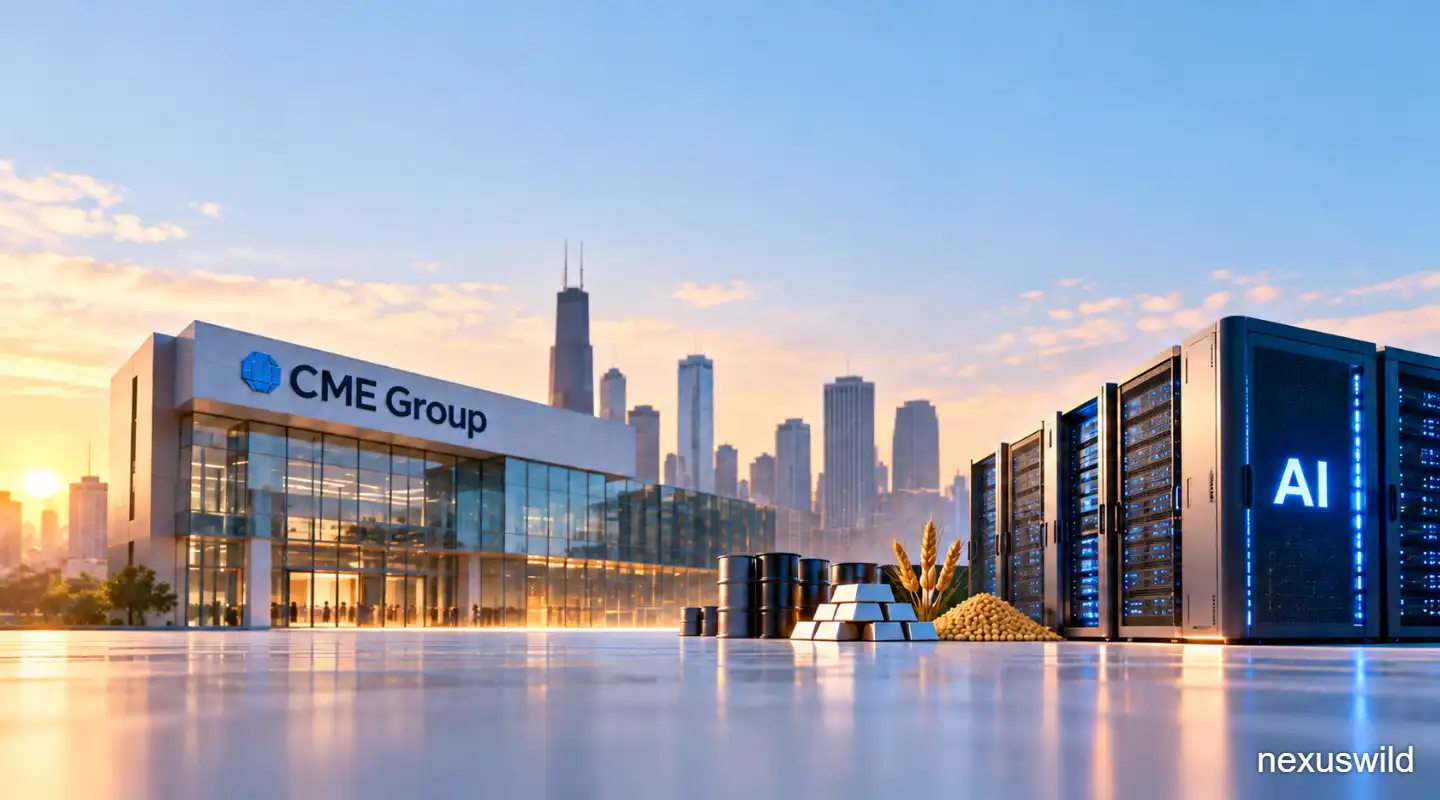

CME Group is preparing to bring one of artificial intelligence's fastest-growing expenses into the derivatives market, with futures contracts designed to track the cost of renting high-end Nvidia computing capacity.
The exchange operator and GPU-market data company Silicon Data plan to launch two compute futures contracts on October 5, 2026, subject to completion of regulatory review. As of October 3, the contracts are not yet trading.
The products would create standardised financial contracts around the hourly rental price of Nvidia's H100 and Blackwell B200 graphics processors, two chips widely used for training and running advanced AI systems.
If the market develops sufficient liquidity, it could give AI developers, cloud-computing companies, data-center operators and financial institutions a new way to manage a cost that until recently was largely negotiated through private contracts.
CME Plans Two Nvidia-Based Compute Futures
CME has announced two initial products: Silicon Data H100 Rental Index Futures and Silicon Data B200 Rental Index Futures.
The first will track Silicon Data's daily benchmark for Nvidia H100 rental prices, while the second will reference its B200 benchmark.
CME says both underlying benchmarks measure hourly, on-demand GPU rental costs in the neocloud market, meaning specialised cloud-computing providers rather than the largest hyperscale cloud platforms.
Each futures contract will represent 730 GPU-hours, which CME describes as approximately one month of continuous capacity for a single GPU.
The products are designed to be financially settled, so traders would not receive physical GPUs or actual server capacity when a contract expires. Instead, settlement would be based on the value of the underlying rental-price index. CME plans to list monthly contracts extending as far as 36 months.
The contracts are scheduled to trade through CME Globex and be available for clearing through CME ClearPort under NYMEX rules, provided the remaining regulatory process is completed.
Turning Fragmented GPU Prices Into a Benchmark
Creating a futures market requires something that the compute industry has historically lacked: a reasonably standard reference price.
GPU rental costs can vary considerably between providers because of contract duration, geography, hardware configuration, networking, CPU platform and the exact version of a GPU being offered.
Silicon Data attempts to reduce those differences by converting rental observations into a common per-GPU, per-hour rate.
Its methodology then adjusts observations for factors such as rental type, location, CPU platform and GPU variant before combining provider-level prices into a benchmark. The company says its indices are calculated daily.
That standardisation is central to CME's plan.
A futures contract cannot efficiently hedge a business expense if market participants cannot agree on what underlying price it represents. By linking the contracts to specific H100 and B200 benchmarks, CME is trying to establish a reference point for AI-compute costs in much the same way commodity and electricity derivatives rely on defined delivery points or price indices.
It will still not eliminate every pricing difference. A company renting thousands of GPUs under a long-term private agreement may pay a different price from Silicon Data's on-demand benchmark.
That creates what financial markets call basis risk: the possibility that the price being hedged and the futures benchmark do not move exactly together.
How AI Companies Could Hedge Compute Costs
For AI companies, GPU rental capacity can be a substantial operating expense.
A developer expecting to need large amounts of H100 or B200 capacity several months from now could face the risk that rental prices rise before that capacity is purchased.
In principle, a company exposed to higher future prices could use a long futures position to offset part of that risk. If GPU rental prices increased and the futures contract rose with them, gains on the hedge could help compensate for higher real-world compute expenses.
The opposite exposure could exist for infrastructure providers.
A data-center or GPU-cloud operator worried that rental prices might fall could potentially use futures to reduce some of the financial impact of declining market rates.
These are potential risk-management applications rather than guarantees that a hedge will work perfectly. Actual results would depend on liquidity, contract pricing and how closely a company's real costs or revenues track the Silicon Data indices.
CME specifically says the contracts are intended to help AI builders, cloud providers and other businesses manage volatility in compute costs.
Why AI Compute Is Becoming a Financial Risk
The proposal reflects a broader change in the economics of artificial intelligence.
Companies once treated computing largely as a predictable technology expense. The AI infrastructure boom has made access to advanced GPUs far more strategically important.
Training frontier models and serving large volumes of AI inference can require substantial clusters of high-end accelerators. Demand can shift quickly when new models, chips or data centers come online, while supply is constrained by semiconductor manufacturing, advanced packaging, networking equipment and power availability.
That combination has made compute capacity more exposed to price swings.
CME first announced its partnership with Silicon Data in May, saying it intended to establish a futures market based on daily GPU rental benchmarks. In August, the companies specified the H100 and B200 products and the planned October 5 launch date.
The progression from a broad proposal to defined contract specifications shows that the initiative has advanced beyond an exploratory concept.
But the market itself has not yet been tested.
A Futures Market Could Add Price Transparency
A functioning futures curve could do more than provide hedging.
If enough buyers and sellers participate, prices for contracts expiring several months or years ahead could provide a market-based indication of expectations for future GPU rental costs.
That could be useful for companies planning data-center capacity, AI-training budgets or financing arrangements.
For example, infrastructure developers trying to estimate revenue from GPU capacity could compare their assumptions with prices implied by futures markets. AI companies might use the same curve when budgeting future workloads.
However, a listed contract does not automatically become a widely used benchmark.
New derivatives markets require enough participants, trading volume and confidence in the underlying index to create reliable price discovery.
It is therefore too early to know whether compute futures will develop the liquidity of established commodity or power markets.
Nvidia Chips Provide a Starting Point, Not a Universal Compute Price
CME's initial focus on the Nvidia H100 and B200 also illustrates one limitation of standardising AI compute.
Different accelerators have different performance, memory, power consumption and software ecosystems. A GPU-hour on one chip is not necessarily economically equivalent to an hour on another.
Even within the Nvidia ecosystem, newer generations can alter the economics of older hardware.
CME is therefore not creating a universal price for all AI computing.
It is creating separate futures contracts linked to rental benchmarks for two specific Nvidia GPU models.
Silicon Data itself maintains benchmarks for several other accelerators, including H200, B300, A100 and AMD's MI300X, but CME has not announced futures contracts for those products as part of the October launch.
Any expansion beyond H100 and B200 should therefore be treated as a future possibility rather than a confirmed plan.
Conclusion
CME Group's planned compute futures represent an attempt to apply traditional financial risk management to one of the AI economy's newest major expenses.
Subject to regulatory review, the exchange intends to begin listing H100 and B200 GPU rental-price futures on October 5, using daily Silicon Data benchmarks for on-demand neocloud rental costs. Each financially settled contract will represent 730 GPU-hours, with monthly maturities extending as far as three years.
For AI developers and infrastructure providers, the potential attraction is straightforward: a way to manage exposure to changes in compute prices instead of carrying all of that risk through private rental agreements.
The larger question is whether the industry is sufficiently standardised to support a deep derivatives market.
As of October 3, that remains untested. The contracts are scheduled for launch but have not begun trading, meaning there is not yet a live CME market from which to judge liquidity, adoption or the quality of price discovery.
What is confirmed is that AI compute is moving closer to being treated not only as technology infrastructure, but also as a measurable financial cost that businesses may be able to hedge.
Nexuswild welcomes factual corrections. Email contact@nexuswild.com with evidence and the article URL.