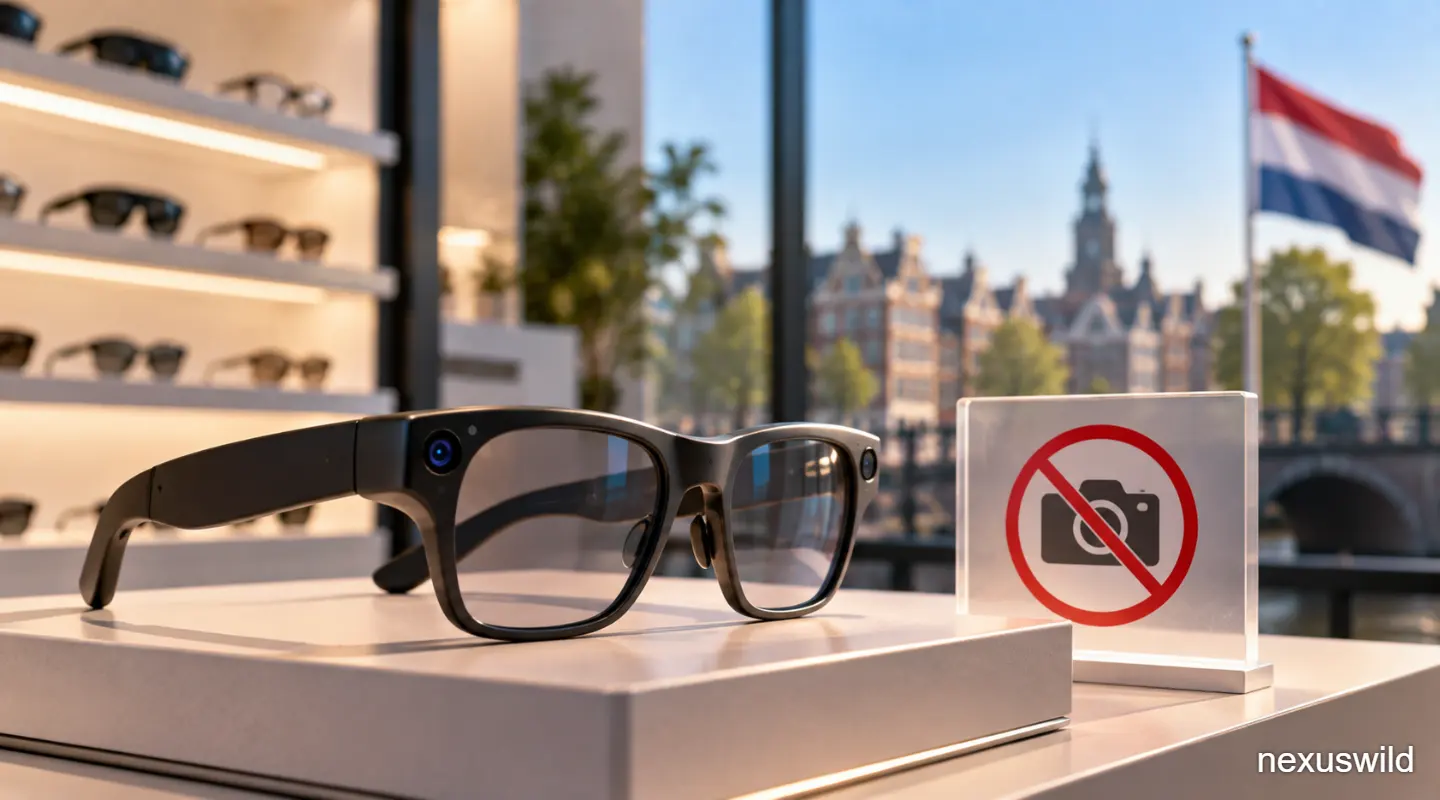

Dutch eyewear chain Hans Anders has suspended sales of Meta's camera-equipped smart glasses in the Netherlands and Belgium as public and regulatory scrutiny grows around the privacy implications of wearable cameras.
The retailer confirmed the decision on October 2, 2026, saying the suspension followed an ongoing public and political discussion about smart glasses and questions over the circumstances in which the technology should be used. The products have been removed from Hans Anders stores and its online shop while the company waits for greater clarity.
The move is a retailer decision, not a government ban or regulatory finding that Meta's glasses are illegal. Other sellers can continue offering the devices, and the Dutch Data Protection Authority, known as the Autoriteit Persoonsgegevens or AP, has so far issued privacy guidance rather than ordering the product off the market.
Hans Anders Says It Is Waiting for Greater Clarity
Hans Anders said the pause reflects questions arising from the broader debate over camera-equipped eyewear.
The company described the number of glasses it had sold as limited and said it would reconsider the product's place in its range once there was more clarity around the issue.
The retailer is part of Nexeye, an optical-retail group with hundreds of stores across Europe. Hans Anders was selling Meta's smart glasses in the Netherlands and Belgium when the suspension was announced.
The decision therefore affects those sales channels specifically. It should not be interpreted as a Europe-wide withdrawal of Meta smart glasses.
Why Smart Glasses Raise Different Privacy Questions
Meta's Ray-Ban smart glasses combine features that would ordinarily be found in several separate consumer devices.
They can take photographs and record video hands-free, contain built-in microphones, support calls and voice interaction, and provide access to Meta's AI features. Current models include a front-facing camera and multiple microphones.
The privacy issue is not simply that the glasses have a camera. Smartphones do too.
The concern is that smart glasses can resemble conventional eyewear and capture a wearer's point of view without requiring them to hold up a phone or camera. That can make it less obvious to people nearby that recording equipment is present.
Audio adds another dimension. Meta's smart-glasses systems use microphones for calls, voice commands and other functions, while video capture can include audio. Meta itself advises users to be mindful of nearby private conversations when using voice and recording functions.
Those characteristics have placed greater attention on the privacy rights of people who may appear in recordings even though they are not using the product themselves.
Meta Uses a Capture Light to Signal Recording
Meta says its glasses include safeguards designed to make camera use visible.
A white capture LED on the front of the glasses flashes when a photo is taken and continues blinking while video is being recorded. Meta says the light has no user-accessible off switch.
The company also says that, on newer generations, attempting to cover the light disables the camera. Meta has additionally introduced detection intended to disable camera use if the indicator has been physically tampered with.
In its latest response to the Dutch controversy, Meta defended those safeguards, saying the front light signals photography or recording and that the camera is disabled when tampering with the indicator is detected.
Meta's own guidance nevertheless tells users to ask permission from people around them before capturing photos or videos and to avoid using the glasses in sensitive locations or places where people would reasonably expect privacy.
The existence of the indicator therefore does not by itself settle the legal question of whether a particular recording or later use of that recording is permitted.
Dutch Privacy Regulator Warns About Bystander Rights
The Dutch Data Protection Authority issued specific guidance on camera glasses on September 22, 2026, shortly before Hans Anders suspended sales.
The regulator said people who are recognisable in photographs or videos have privacy rights even when they only happen to appear in the background.
Under the EU's General Data Protection Regulation, identifiable images can constitute personal data. Where the GDPR applies, processing such material requires a valid legal basis and people generally must be informed about how their data are being used.
The rules are not as simple as saying that every private photo of another person violates the GDPR.
European law contains a personal or household-use exemption. The Dutch regulator says that people taking pictures or videos solely for themselves, or sharing them only within a very limited private circle, can fall outside the GDPR.
The position changes when footage is used more broadly.
The AP says recognisable images generally cannot simply be published, widely shared or used for other purposes without an appropriate legal basis. In public settings, obtaining meaningful consent from every identifiable bystander may be impractical.
That is one reason wearable cameras present a difficult regulatory problem: the people captured may have no relationship with the device owner.
No Dutch Ban Has Been Announced
The distinction between regulatory concern and regulation is important.
The Dutch privacy authority has warned users about the legal responsibilities associated with camera glasses and has advised organisations to consider restricting their use through house rules where necessary. It has also said it is examining whether stronger measures concerning camera-equipped wearables may be appropriate.
That is not the same as a prohibition on selling or owning Meta's glasses.
As of October 3, no Dutch privacy authority had announced a nationwide sales ban on the product.
Hans Anders' decision is therefore precautionary and commercial. The retailer has chosen to stop selling the glasses while the public and regulatory discussion develops.
The Debate Extends Beyond the Camera
Smart-glasses privacy also involves what happens after information is captured.
Meta says photos and videos recorded for a user's gallery are stored on the glasses until the user chooses to import them to a phone. Users can then decide whether to keep, share or use that media with Meta AI.
Hans Anders' own product information had previously advised customers that the retailer itself did not process personal data created through recordings, while Meta's associated app could collect information depending on how the product was used and configured.
That creates two related but distinct privacy questions.
One concerns bystanders being photographed or recorded.
The other concerns how data generated through the glasses and connected services are subsequently processed, stored or shared.
Both are relevant to wearable technology, but they are governed by different circumstances and should not be treated as evidence that every use of the product violates privacy law.
Meta Continues to Develop and Sell AI Glasses
Meta has shown no indication that it is abandoning the product category.
The company has continued expanding its AI-glasses range and says millions of people use its glasses for functions including music, calls, photography, video and AI assistance.
It also continues to add camera, microphone and AI capabilities to newer models while presenting the capture indicator and anti-tampering measures as core privacy safeguards.
The Dutch sales pause therefore represents a challenge around social acceptance and distribution rather than an official end to Meta's smart-glasses business.
Conclusion
Hans Anders' decision shows how privacy concerns surrounding wearable technology can affect retail distribution even before regulators impose formal restrictions.
The Dutch eyewear chain suspended Meta smart-glasses sales in the Netherlands and Belgium on October 2, citing the unresolved public and political debate over how camera-equipped glasses should be used.
Dutch privacy authorities have separately warned that recognisable people captured by wearable cameras retain rights over their personal data, particularly when recordings move beyond strictly private or household use.
Meta argues that its products include safeguards, including a visible recording light and automatic camera disabling when the indicator is blocked or tampered with.
For now, the situation is best described as a retailer pause amid heightened privacy scrutiny, not a regulatory ban on Meta smart glasses.
The broader question for wearable-camera makers is whether technical indicators and user controls are enough to reassure not only the people wearing the devices, but also the people who may unknowingly appear in front of them.
Nexuswild welcomes factual corrections. Email contact@nexuswild.com with evidence and the article URL.