
Generalist AI's new model, GEN-1.5, claims to pick up physical tasks from a few seconds of demonstration, without retraining. Independent verification is still thin, but if the underlying claim holds up, it could change how robots are deployed in factories, warehouses, and eventually homes.
What Generalist AI Just Announced
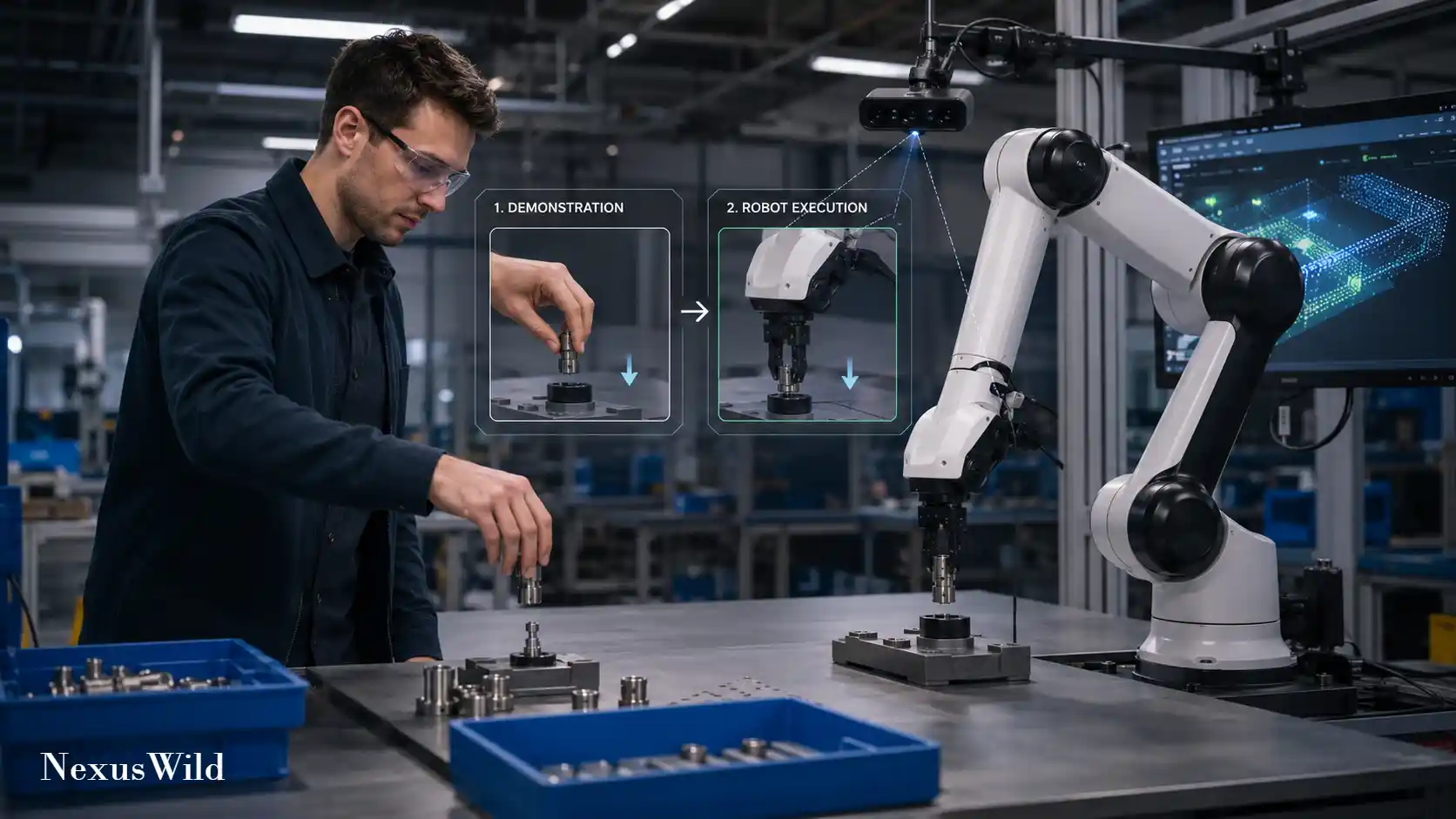
On August 19, 2026, robotics startup Generalist AI unveiled GEN-1.5, the latest in its GEN series of "embodied foundation models," AI systems trained to control robots across a range of bodies and tools rather than one specific machine. The company says that when shown a 3-to-12-second physical demonstration of a task, such as a human or robot hand opening a pouch or pouring bolts, GEN-1.5 can attempt the same task immediately, without any additional training or weight updates.
Generalist reports an average one-shot success rate of 59% across ten short manipulation tasks. When given roughly five minutes of demonstration data and ten additional training updates, that figure reportedly rose to 83%. These numbers come directly from the company's own technical announcement and have not yet been independently replicated by outside researchers, so they should be read as company-reported results rather than confirmed benchmarks.
Founded in 2024, Generalist AI is not building its own humanoid robot. Instead, it develops the underlying AI model that can, in principle, be ported to different robotic arms and grippers built by other manufacturers. The company has publicly demonstrated its models running on hardware from Universal Robots, Flexiv, and Elite Robots.
What Makes GEN-1.5 Different
Generalist's model line has evolved quickly. GEN-0, released in late 2025, was a research proof that performance scales predictably with more physical training data. GEN-1, released in April 2026, focused on reliability and speed, with the company reporting a 99% average success rate on selected tasks.
GEN-1.5 shifts the focus toward adaptability. Rather than needing an hour of task-specific data to master a new job, GEN-1.5 is designed to infer a task from a short example and generalize immediately. Generalist calls this technique "Physical Prompting," drawing a direct comparison to how large language models like GPT-3 could perform new tasks from a handful of text examples without retraining.
Tasks and Applications
Public demonstrations show the model handling short, contained manipulation tasks: placing objects into containers, unzipping pouches, removing items from bags, opening bottle caps, and using tools. In some demonstrations, the model reportedly improvised with unfamiliar tools—using a banana as a makeshift pushing tool or a dustpan to scoop objects—after being shown a similar task. These are short, single-step tasks performed on a fixed dual-arm setup in controlled settings, not long, multi-stage jobs.
If the underlying capability holds up under wider testing, generalist robot models like GEN-1.5 could significantly impact:
- Manufacturing and logistics: Shrinking the weeks or months currently spent programming robots for each new task, which matters most for smaller manufacturers doing varied, low-volume production runs.
- Laboratory and research automation: Faster task adaptation could make automation viable for handling delicate lab equipment and reagents.
- Everyday and home robotics: While a long-term goal, tasks like folding laundry or packing items are future ambitions, though home environments remain unpredictable and safety-sensitive.
The Data Advantage and Open Questions
Robotics has lagged behind language AI largely because there is no equivalent of "the internet" for physical experience. Generalist has built its strategy around collecting this data cheaply using handheld gripper devices, reporting over 500,000 hours of manipulation data as of mid-2026. This approach has attracted major backing, with the startup raising over $500 million from investors including NVIDIA's investment arm, Radical Ventures, and AI researcher Fei-Fei Li.
Several caveats matter here. First, a 59% one-shot success rate is a research milestone, not something ready for unsupervised deployment. Second, nearly all performance figures come directly from Generalist, with limited third-party replication so far. Third, a robot that improvises mid-task is harder to guarantee safe than one that follows fixed, pre-programmed movements. Finally, GEN-1.5 has not yet been tested on humanoid or mobile robot platforms; current demonstrations rely on a fixed, non-mobile dual-arm setup.
For now, GEN-1.5 is best understood as a genuinely interesting research result with real commercial ambition behind it, not a finished product. Whether it becomes a turning point for physical AI will depend on independent testing, real-world deployments, and a track record beyond company-run demonstrations.
Further reading and useful links
Reader questions
Frequently asked questions
What is GEN-1.5 by Generalist AI?
GEN-1.5 is an 'embodied foundation model' developed by Generalist AI that allows robotic systems to learn and execute new physical manipulation tasks after watching just a 3-to-12-second demonstration, without requiring extensive reprogramming.
Does Generalist AI build its own robots?
No. Generalist AI develops the underlying software and artificial intelligence models, which are designed to be ported onto different robotic arms, grippers, and hardware built by other manufacturers like Universal Robots and Flexiv.
How accurate is the GEN-1.5 model at learning new tasks?
According to the company's own unverified benchmarks, GEN-1.5 achieved an average one-shot success rate of 59% across ten short manipulation tasks. When given about five minutes of demonstration data, that success rate reportedly rose to 83%.
Nexuswild welcomes factual corrections. Email contact@nexuswild.com with evidence and the article URL.