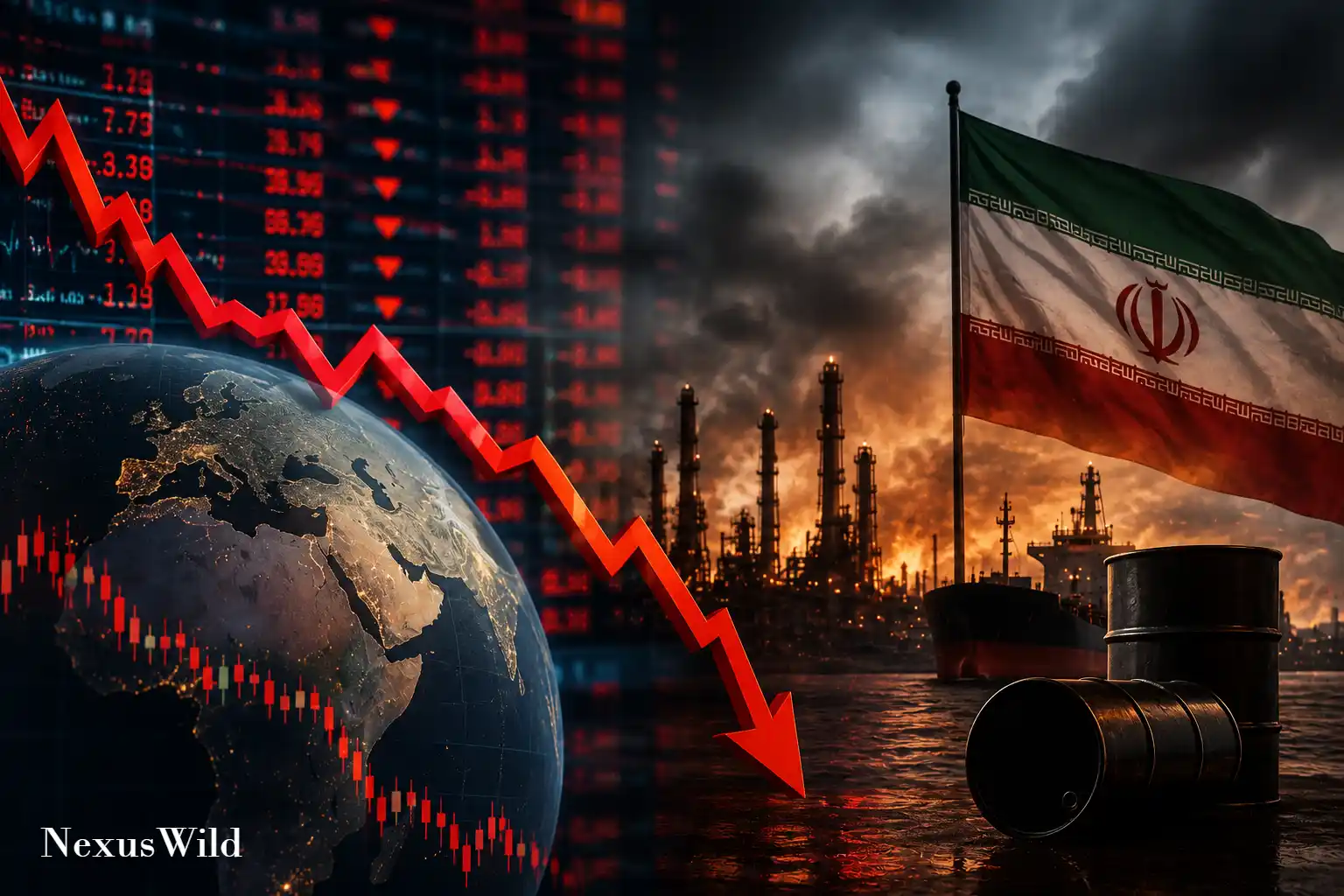

NEW YORK/LONDON, August 24, 2026: Global equities weakened on Monday as investors awaited details of expected new U.S. sanctions on Iran and assessed the risk of further disruption to energy shipments through the Strait of Hormuz.
The market response remained mixed rather than a broad geopolitical sell-off. Iran-related uncertainty restrained risk appetite, while technology-sector weakness, company-specific developments and expectations for U.S. monetary policy also influenced trading.
At 11:14 a.m. Eastern time, the S&P 500 was down 0.37% at 7,645.71 and the Nasdaq Composite had fallen 0.71% to 25,993.69. The Dow Jones Industrial Average rose 0.17% to 53,361.60. Technology shares led the declines as investors prepared for Nvidia’s quarterly results and reassessed valuations across the artificial-intelligence sector. Reuters market data showed MSCI’s global equity index falling 0.44%.
European markets were nearly unchanged, with the STOXX 600 down 0.01% in later trading. In Asia, Japan’s Nikkei closed 0.7% lower, while South Korea’s KOSPI lost more than 3%. Much of the Korean decline followed disappointment over Samsung Electronics’ shareholder-return plan, demonstrating that Iran was not the only factor pressuring regional markets.
The immediate geopolitical focus was Washington’s plan to broaden secondary sanctions against companies, financial institutions and countries maintaining business ties with Iran. The U.S. Department of the Treasury measures were expected to target additional Iran-related activities and sanctions-evasion networks.
Iran separately said it had blacklisted 45 tankers for allegedly violating its Strait of Hormuz transit rules, warning that listed vessels could face fines, detention or cargo confiscation. Fewer than 20 commodity vessels crossed the strait during the weekend, according to shipping data cited by Reuters. Before the conflict disrupted traffic, Gulf exports accounted for about 20% of globally traded crude oil and liquefied natural gas.
Oil prices nevertheless fell as traders took profits following recent gains. Brent crude declined 1.83% to $92.65 a barrel, while U.S. West Texas Intermediate fell 2.37% to $85.00.
Spot gold rose 1.53% to $4,673.16 an ounce, reaching its highest level in more than three months. The gain also reflected Treasury-market developments and positioning before U.S. inflation data and the Jackson Hole symposium.
In India, the Nifty 50 fell about 0.3%, while the rupee closed at 95.7450 per dollar. Investors are watching the final sanctions package, Iran’s response, Hormuz shipping flows, U.S. inflation data, Nvidia’s results and Federal Reserve Chair Kevin Warsh’s Jackson Hole address.
Further reading and useful links
Reader questions
Frequently asked questions
Why did global stocks fall on August 24, 2026?
Global equities weakened due to a mix of geopolitical risks, including anticipated U.S. sanctions on Iran and threats to the Strait of Hormuz, along with tech-sector weakness ahead of major corporate earnings.
How are tensions in the Strait of Hormuz affecting the market?
Iran blacklisted 45 tankers, threatening fines and confiscation, leading to a sharp drop in shipping traffic. However, despite the potential disruptions to global energy supplies, oil prices actually fell as traders took profits following recent gains.
What other factors are investors currently watching?
Beyond geopolitical developments in the Middle East, investors are closely monitoring upcoming U.S. inflation data, Nvidia's quarterly results, and Federal Reserve Chair Kevin Warsh’s Jackson Hole address.
Nexuswild welcomes factual corrections. Email contact@nexuswild.com with evidence and the article URL.