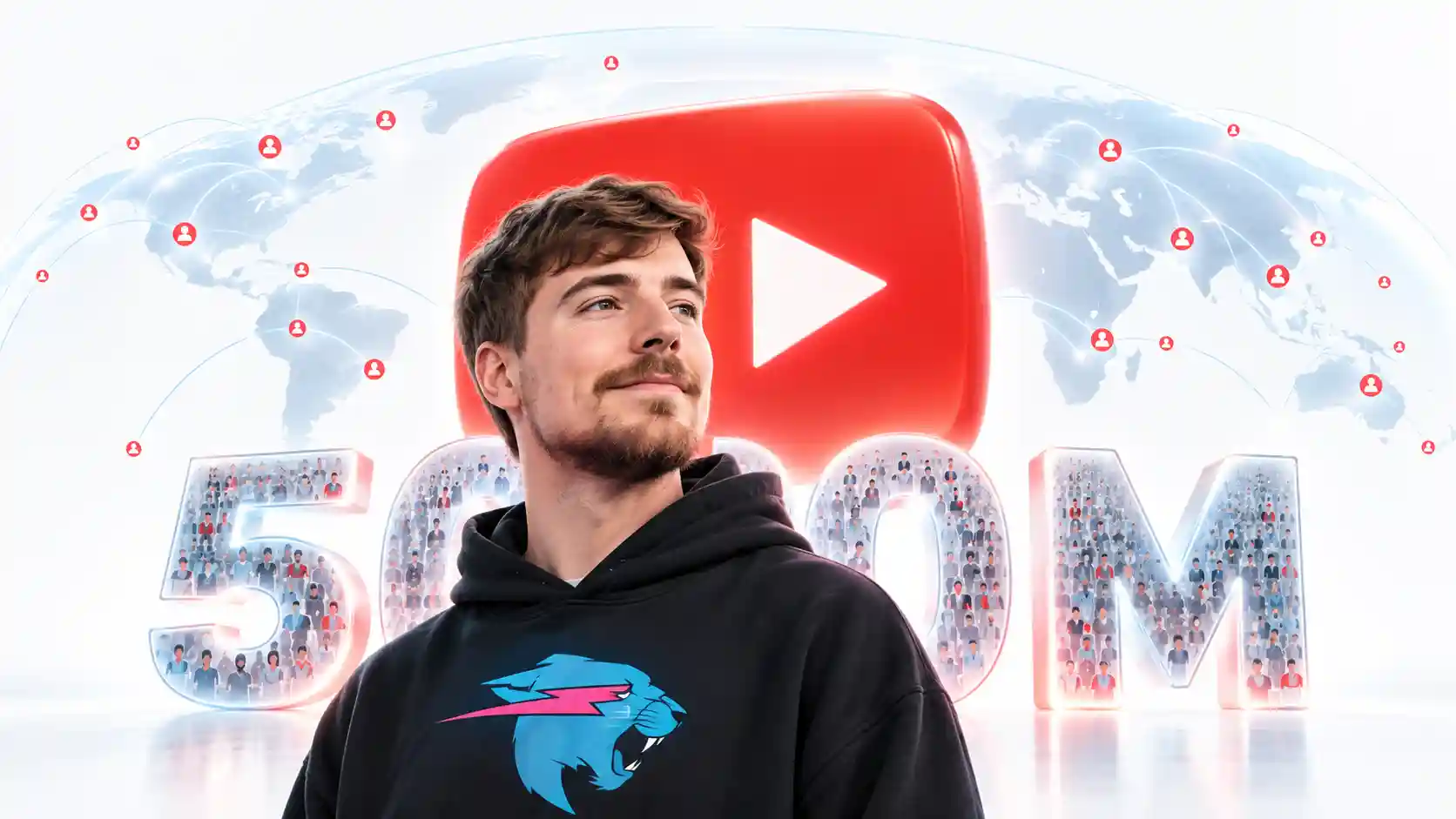

Half a billion subscribers changes what it means to be a creator
Jimmy Donaldson, better known as MrBeast, reached a milestone that would have appeared almost impossible during YouTube's early years.
On June 12, 2026, his main channel became the first run by an individual creator to reach 500 million subscribers.
YouTube officially confirmed the milestone as Donaldson livestreamed the final moments of the climb.
By late September, the channel had already moved considerably beyond the threshold. Social Blade was tracking approximately 518 million subscribers, roughly 141 billion lifetime views and just over 1,000 uploaded videos.
Those numbers are extraordinary on their own.
But the larger significance is not simply that one YouTuber accumulated a very large audience.
MrBeast increasingly demonstrates that an individual creator can become the center of a global media and consumer-business ecosystem.
The channel is no longer merely a distribution outlet for videos.
It is an audience engine capable of supporting advertising, sponsorships, streaming programmes, consumer products, software, licensing and new financial ventures.
That makes the 500 million milestone a useful marker for how far the creator economy has moved beyond its origins.
The milestone arrived on June 12
YouTube says MrBeast officially crossed 500 million subscribers on June 12, 2026.
He marked the event with a dedicated livestream on his main channel.
The stream drew more than 600,000 simultaneous viewers at one stage, according to reporting by TheWrap.
The milestone extended a rapid sequence of growth.
MrBeast became YouTube's most-subscribed individual creator in November 2022.
He passed T-Series to become the platform's most-subscribed channel overall in June 2024.
His channel then reached 400 million subscribers on June 1, 2025.
Just over a year later, it reached 500 million.
That represents another 100 million subscribers added in approximately twelve months.
Five hundred million subscribers is not the same as 500 million active viewers
The scale needs an important qualification.
A YouTube subscription is not the same thing as a verified unique person who watches every upload.
Some subscribers may be inactive.
A person can operate multiple Google or YouTube accounts.
The same viewer can subscribe to several MrBeast-related channels.
Subscribers should therefore not be interpreted as a direct population count or as guaranteed video reach.
What the figure does measure is accumulated channel distribution at a scale no individual creator had previously achieved on YouTube.
Actual video performance still varies significantly from upload to upload.
MrBeast added roughly 100 million subscribers in a year
The speed of the final climb illustrates the global reach of the format.
The channel hit 400 million subscribers on June 1, 2025 and 500 million on June 12, 2026.
That means approximately 100 million net new subscriptions were added over a little more than one year.
Growth at that scale cannot come from one domestic market alone.
MrBeast's content is intentionally designed to travel across borders.
Large visual challenges, competitions, prizes and simple narrative structures can be understood even by viewers with limited English.
Language localization then expands the addressable audience further.
Multilingual distribution became part of the growth model
MrBeast was an early participant in YouTube's multi-language audio programme.
YouTube said in 2023 that he had already dubbed popular videos into 11 languages while testing the company's multi-language audio system.
The approach allowed different-language audio tracks to sit inside one primary video rather than forcing creators to maintain separate channels for every market.
By 2025, YouTube said creators using multi-language audio were receiving more than 25% of their watch time, on average, from viewers listening in languages other than the video's primary language.
MrBeast was specifically identified by YouTube as one of the creators reaching millions of additional viewers through that model.
YouTube has since expanded automated dubbing to 27 languages.
The technology effectively lowers one of the largest historical barriers to global media distribution.
A creator can produce one piece of content and increasingly distribute localized versions around the world almost immediately.
The traditional media model worked in the opposite direction
Global entertainment historically required expensive distribution infrastructure.
A television studio produced a programme.
Networks licensed it territory by territory.
Broadcasters controlled access to viewers.
Localization required separate dubbing and distribution relationships.
International expansion could take months or years.
A global YouTube channel reverses much of that architecture.
The creator uploads once.
YouTube handles global video delivery.
Recommendation systems find potential audiences.
Subtitles and dubbing reduce language barriers.
Analytics show creators which countries are responding.
A channel can therefore become a global entertainment network without owning television stations in every country.
MrBeast turned reinvestment into a content advantage
One of the defining features of Donaldson's strategy has been unusually aggressive reinvestment into future productions.
Successive videos became larger and more expensive.
Prize pools grew.
Sets became more elaborate.
Challenges involved more participants.
Production increasingly resembled large unscripted television rather than conventional creator content.
That created a feedback loop.
Large videos attracted large audiences.
Large audiences generated advertising and sponsorship revenue.
Revenue financed more expensive videos.
Those videos generated additional subscribers and commercial leverage.
Few creators can reproduce this strategy at MrBeast's scale because the capital requirements themselves become a competitive barrier.
YouTube highlighted the $456,000 Squid Game video as a turning point
YouTube's own announcement of the 500 million milestone singled out Donaldson's real-world Squid Game recreation as an important demonstration of what creator-led production could become.
The video has moved toward one billion views.
The significance was not only audience size.
It looked more like a major television production than the low-budget individual videos historically associated with YouTube.
That blurred the boundary between creator content and conventional entertainment production.
The creator was no longer simply a presenter filming videos.
He had become a producer coordinating sets, contestants, employees, logistics and significant production budgets.
Beast Industries turns attention into businesses
The evolution is even clearer outside YouTube.
Forbes describes Beast Industries as a multi-product company spanning media, Feastables, Lunchly, Viewstats, merchandise and licensing businesses.
It has also expanded into streaming entertainment and financial technology.
This is one of the most important changes in the creator economy.
Audience is increasingly being treated as distribution infrastructure.
A traditional consumer-products company first develops a product and then spends heavily to build awareness.
A major creator begins with awareness.
The commercial problem becomes finding products that the audience is willing to buy repeatedly.
That can dramatically alter customer-acquisition economics when the creator's distribution remains strong.
Chocolate shows how creator attention can move into physical products
Feastables is one of the clearest examples.
Investor documents reported by Bloomberg showed the chocolate company generated about $250 million in sales in 2024 and more than $20 million in profit.
The media operation generated a similar amount of sales during that period but lost almost $80 million, according to those documents.
That contrast demonstrates an important aspect of the creator-business model.
Media can function as the attention engine even when content production itself has weak economics.
Profitable consumer businesses can then monetize the audience elsewhere.
This resembles older media conglomerates that used entertainment intellectual property to sell merchandise, theme-park visits or licensing rights.
The difference is that the underlying franchise begins with one creator rather than a studio-owned character or television network.
The model increasingly resembles a vertically integrated media company
MrBeast controls several layers that creators once outsourced.
Content is produced internally.
Audience distribution happens through major platforms.
Advertising and sponsorship monetize attention directly.
Consumer brands convert viewers into customers.
Analytics products create additional businesses around creator expertise.
Streaming partnerships extend the brand beyond YouTube.
This makes Beast Industries increasingly difficult to classify as simply a YouTube business.
It sits somewhere between a production studio, consumer-products company, advertising platform, talent brand and technology company.
Forbes estimates creator earnings at $300 million in 2026
Forbes ranked MrBeast first on its 2026 Top Creators list and estimated annual creator earnings at approximately $300 million.
That is a Forbes estimate rather than audited personal income.
It also should not be confused with Beast Industries' corporate revenue.
Forbes said Donaldson's channels collectively exceeded 640 million subscriptions and generated more than five billion views annually.
The difference between 500 million on the main channel and more than 640 million across multiple channels also requires caution because the audiences overlap.
A single fan can subscribe to several MrBeast properties.
Still, the figures illustrate the commercial scale now possible around one creator-led brand.
Investors have begun valuing creator companies like major media businesses
Bloomberg reported in 2025 that Beast Industries was seeking new capital at a valuation of approximately $5 billion.
Forbes' 2026 profile says the company has reportedly taken venture investment at a valuation around that level.
A $5 billion valuation for a company originating from a YouTube channel illustrates how investors increasingly treat leading creator businesses as standalone corporate assets.
The valuation should not be interpreted as cash Donaldson personally possesses.
Private-company valuations depend on funding terms, growth assumptions and investor expectations and can change substantially.
But the comparison with traditional media is still striking.
One creator's audience has become the foundation for a private company valued on the scale historically associated with established entertainment groups.
The company has also moved onto Amazon Prime Video
Beast Games extends the strategy beyond YouTube.
The large-scale competition series moved MrBeast's entertainment format into Amazon's Prime Video ecosystem.
Forbes reported that the second season had debuted by June 2026 and that a third season was already in production.
The arrangement demonstrates that creator-led media and traditional streaming are no longer separate worlds.
Streaming platforms increasingly want creators because creators already bring audiences.
Creators want streaming distribution because it can extend their format into premium long-form entertainment and potentially reach households beyond their core social audiences.
The flow of talent is therefore becoming two-directional.
Creators no longer need Hollywood only to become famous.
Hollywood increasingly wants creators who arrive famous already.
YouTube itself has become a vast economic infrastructure
MrBeast's rise is occurring inside a much larger creator market.
YouTube says more than three million channels are now part of the YouTube Partner Program.
The company says it paid more than $100 billion to creators, artists and media companies during the four years preceding 2026.
YouTube also estimates that its ecosystem contributed approximately $55 billion to U.S. GDP in 2024 and supported more than 490,000 full-time-equivalent jobs.
These numbers extend well beyond individual influencers.
Creator businesses employ editors, camera operators, designers, writers, engineers, accountants, managers, salespeople and production crews.
The economic unit is increasingly the company surrounding the creator rather than the creator working alone.
YouTube is also increasingly a television platform
The distribution environment itself continues changing.
YouTube said in August 2026 that users were watching more than one billion hours of YouTube on televisions every day.
That moves creator content directly onto the largest screen in the home.
The distinction between television and internet video therefore becomes less useful.
A viewer watching MrBeast on a smart TV is technically using YouTube but behaviorally may be consuming entertainment in a way that looks similar to traditional television.
This shift allows creators to compete for the same leisure time historically dominated by broadcasters and streaming services.
Shorts creates a second distribution engine
At the opposite end of the format spectrum, YouTube says Shorts now generates more than 200 billion daily views.
Creators can therefore operate simultaneously across short-form discovery, long-form entertainment, livestreaming and connected television.
The same personality can reach viewers through several consumption modes inside one platform ecosystem.
This is another advantage compared with earlier media structures, where short clips, television programmes and live broadcasts often belonged to separate distribution systems.
Creator monetization is moving beyond advertising
Advertising remains important, but modern creators can monetize audiences through many additional channels.
YouTube subscriptions generate revenue share.
Brands pay for sponsorships.
Fans buy memberships or send payments during live streams.
YouTube Shopping connects content directly with commerce.
Creators sell their own products.
Licensing creates another income stream.
Major creators can build companies or raise outside capital.
YouTube said more than 500,000 creators were enrolled in YouTube Shopping by mid-2025, while gross merchandise value through the programme had increased fivefold year over year.
The platform is increasingly trying to turn video attention directly into commercial transactions.
The creator economy could approach half a trillion dollars
Goldman Sachs Research estimated in 2023 that the global creator economy could grow from approximately $250 billion at the time to roughly $480 billion by 2027.
That was a forecast rather than a measurement of today's actual market size.
But MrBeast's development illustrates the forces behind the projection.
Creators are earning from more sources.
Brands are shifting advertising budgets toward creator partnerships.
Platforms are adding commerce infrastructure.
Technology lowers production and localization costs.
And individual creators increasingly build companies around their audiences.
MrBeast also demonstrates how attention can become bargaining power
A creator with hundreds of millions of subscribers does not approach advertisers from the same position as a conventional small media publisher.
The creator controls direct access to an audience that brands want to reach.
That strengthens negotiating power for sponsorships, partnerships and new ventures.
It also makes the creator valuable to platforms themselves.
YouTube benefits when major creators attract viewers.
Amazon benefits when a creator brings fans to a streaming programme.
Consumer retailers benefit when creator-branded products drive store traffic.
The audience therefore becomes an asset that can be moved between business models.
Global distribution is the real competitive advantage
The 500 million milestone also shows why the largest creators can scale faster than traditional national media companies.
A television broadcaster is often strongest in one country.
A newspaper is tied partly to language and geography.
A creator can build an audience that is globally distributed from the beginning.
MrBeast's use of multilingual audio helped push this model earlier than many other major channels.
YouTube said creators using multilingual audio tracks were receiving more than a quarter of watch time from non-primary languages on average by 2025.
Once production costs are paid, showing the same underlying video to another million viewers in another country is comparatively inexpensive.
That creates powerful economics for content capable of travelling internationally.
Subscriber leadership does not mean dominance of every metric
MrBeast is the largest YouTube channel by subscribers, but subscribers are only one measure of platform power.
T-Series remains extraordinarily strong in total viewing.
Tubefilter reported that the Indian music company generated about 985 million YouTube views in a single week during the third week of September 2026 and remained YouTube's most-watched channel of all time by cumulative views.
That distinction matters.
A creator can dominate subscriber rankings while music labels, children's channels and television libraries dominate other forms of viewing.
The YouTube economy supports several different kinds of scale.
There is also enormous key-person risk
Creator-led companies have a structural weakness that conventional corporations often try to avoid.
The brand can depend heavily on one human being.
Recent reporting on Beast Industries has highlighted concern about how dependent parts of the business remain on Donaldson's personal identity and creative involvement.
A consumer company can theoretically replace its chief executive without destroying its main product.
Replacing the personality at the center of MrBeast would be much more difficult.
This creates what investors call key-person risk.
The larger Beast Industries becomes, the more important it becomes to develop brands, intellectual property and management systems capable of operating without requiring Donaldson's direct presence in every decision.
Creator businesses also inherit the risks of celebrity brands
Audience attention can accelerate product adoption.
It can also create concentration risk.
If public perception of a creator changes, the commercial businesses attached to the creator can be affected simultaneously.
A conventional conglomerate may operate dozens of brands that consumers do not associate with one executive.
A creator-led empire deliberately makes the founder highly visible.
That visibility is the distribution advantage.
It is also the vulnerability.
The cost of maintaining attention is rising
MrBeast's model also shows that massive digital reach is not necessarily inexpensive.
The largest productions require enormous budgets.
Bloomberg reported that Beast Industries' media operation produced roughly similar 2024 sales to Feastables but lost almost $80 million, while the chocolate company was profitable.
That suggests attention itself can be costly to manufacture even when the audience is enormous.
The commercial model works when that attention creates sufficient value elsewhere.
In other words, a video does not necessarily need to maximize its own accounting profit if it strengthens a broader ecosystem of sponsorships, products and intellectual property.
Traditional media companies have used similar logic for decades.
The creator economy is now applying it around personal brands.
Five hundred million also changes the definition of celebrity
Traditional celebrity was historically produced by scarce media distribution.
Movie studios controlled which actors appeared in theatres.
Television networks controlled prime-time access.
Record labels controlled music distribution.
Digital platforms weaken that bottleneck.
A creator can build direct audience relationships without first receiving permission from a traditional gatekeeper.
At 500 million subscribers, that audience can exceed the direct distribution of almost any conventional personality-led entertainment franchise.
The result is a new category of celebrity whose power comes not merely from fame but from owning recurring access to followers.
The creator increasingly owns the customer relationship
This distinction is economically important.
An actor may be famous because a movie studio successfully distributed a film.
A creator builds an audience around their own channel.
That audience can then follow the creator into another product category.
A new chocolate bar can be promoted directly.
A streaming series can be introduced directly.
A software product can be demonstrated directly.
The creator becomes both the talent and part of the distribution system.
That combination can radically lower the cost of launching new businesses when audience trust transfers successfully.
But subscribers do not guarantee consumer loyalty
Digital attention is powerful, but it is not equivalent to repeat commercial demand.
A viewer may watch every video and never buy a chocolate bar.
A subscriber may have little interest in financial products.
A successful sponsorship does not automatically create a durable consumer brand.
This is why the next phase of the creator economy will increasingly be about product quality rather than follower count.
Once creators enter packaged food, finance, software or retail, they compete with established companies on price, reliability, regulation and customer satisfaction.
Attention can open the door.
It cannot guarantee that customers remain.
MrBeast is becoming a test case for whether creator businesses can outlive creator attention
That may ultimately be more important than reaching 600 million or 700 million subscribers.
Can Feastables become a durable consumer company independent of constant promotion?
Can Beast Industries create entertainment franchises that work without Donaldson appearing in every episode?
Can the company launch financial or technology products while protecting the trust created by the original entertainment brand?
Can professional management scale the business without weakening the creative instincts responsible for its growth?
Those questions will determine whether creator-led companies become enduring institutions or remain highly valuable businesses tied to the popularity cycle of one individual.
MrBeast has already changed YouTube's perception of scale
When Donaldson started uploading in 2012, YouTube was still widely perceived as an alternative to traditional media.
A successful YouTuber could become famous online, but television and film were still viewed as the larger stages.
That hierarchy is increasingly difficult to defend.
The world's largest creators now command audiences large enough to support nine-figure businesses, premium streaming productions and multinational consumer brands.
YouTube itself pays more than $100 billion to its wider creator, artist and media ecosystem over a four-year period.
The economics have moved well beyond hobbyist content.
The next creator economy may look more like corporate formation
The phrase creator economy can make the sector sound like millions of individuals earning advertising income from posts.
That remains part of it.
But the upper end is evolving into something different.
Creators are building holding companies.
They employ professional executives.
They raise venture capital.
They acquire companies.
They launch consumer brands.
They license intellectual property.
They produce programmes for global streaming platforms.
They can eventually pursue public-market listings.
The creator becomes the founder of a media-driven corporation.
MrBeast is currently the largest demonstration of that model.
Half a billion subscribers is therefore more than a platform record
The number itself will eventually be surpassed.
MrBeast's channel had already moved to approximately 518 million subscribers by late September.
What lasts longer is what the milestone demonstrates.
One person can now build global distribution at a scale once reserved for multinational media institutions.
That distribution can be converted into advertising revenue, consumer brands, streaming franchises, software, licensing and potentially entirely new businesses.
The economic value no longer comes only from the video being watched.
It comes from everything the audience makes possible afterwards.
That is the deeper meaning of MrBeast reaching 500 million subscribers.
The creator economy is no longer simply competing with traditional media for attention.
At its highest level, it is beginning to produce a new generation of global media companies of its own.
Reader questions
Frequently asked questions
When did MrBeast reach 500 million YouTube subscribers?
MrBeast officially reached 500 million subscribers on June 12, 2026.
Was MrBeast the first YouTuber to reach 500 million subscribers?
YouTube describes him as the first individual creator to reach the milestone.
How many YouTube subscribers does MrBeast have now?
Social Blade was tracking approximately 518 million subscribers on the main MrBeast channel in late September 2026. Subscriber counts continue changing.
When did MrBeast reach 400 million subscribers?
The main channel crossed 400 million subscribers on June 1, 2025.
How long did it take MrBeast to go from 400 million to 500 million subscribers?
A little over one year, from June 1, 2025 to June 12, 2026.
When did MrBeast become YouTube's largest channel?
YouTube says he became its most-subscribed individual creator in November 2022 and its most-subscribed channel overall in June 2024.
Does 500 million subscribers mean 500 million people watch every MrBeast video?
No. Subscriber counts are not the same as active unique viewers. Some accounts may be inactive, viewers can have multiple accounts and video audiences vary.
How many lifetime views does MrBeast have?
Social Blade was tracking approximately 141 billion lifetime views on the main channel in late September 2026.
How does MrBeast reach viewers around the world?
His videos use highly visual formats and multilingual audio. MrBeast was an early participant in YouTube's multi-language audio programme.
What is Beast Industries?
Beast Industries is the company built around MrBeast's media and commercial businesses, including content production, Feastables, Lunchly, Viewstats and other ventures.
How much is Beast Industries worth?
Forbes says the company has reportedly taken venture investments at a valuation around $5 billion. Private-company valuations can change and are not equivalent to cash value.
How much does MrBeast earn?
Forbes estimated his 2026 creator earnings at approximately $300 million. This is an estimate and should not be confused with Beast Industries' corporate revenue or Donaldson's personal cash holdings.
What is Feastables?
Feastables is MrBeast's consumer-snack business. Bloomberg reported approximately $250 million in 2024 sales and more than $20 million in profit.
Is MrBeast only a YouTube business?
No. The wider business now spans online media, physical consumer products, streaming entertainment, analytics, licensing and newer financial-services initiatives.
What is Beast Games?
Beast Games is MrBeast's large-scale competition series distributed through Amazon Prime Video.
How large is YouTube's creator economy?
YouTube says more than three million channels participate in its Partner Program and that it paid more than $100 billion to creators, artists and media companies over four years.
How large could the global creator economy become?
Goldman Sachs forecast in 2023 that the total creator-economy opportunity could approach $480 billion by 2027. That remains a forecast rather than a direct measurement of current market size.
Why is the 500 million milestone important for the creator economy?
It demonstrates that an individual creator can build global distribution large enough to support media, streaming, consumer products and other businesses at a scale previously associated mainly with major media companies.
What is the biggest risk to creator-led businesses like Beast Industries?
One important risk is dependence on the creator's personal brand. As these companies scale, they need products, management teams and intellectual property capable of remaining valuable even without constant founder involvement.
Nexuswild welcomes factual corrections. Email contact@nexuswild.com with evidence and the article URL.