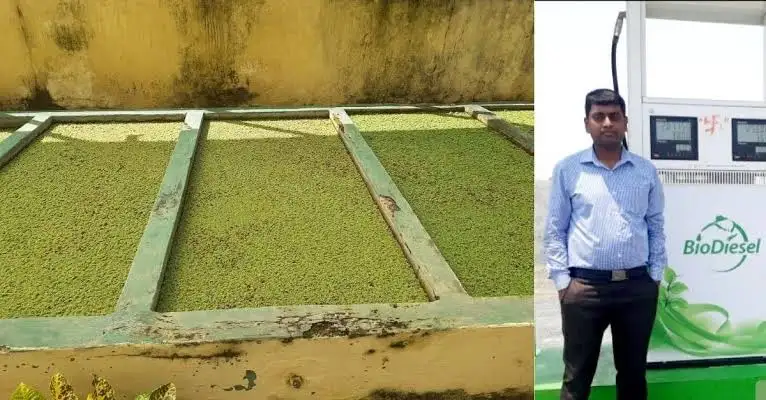

To most people, the thick, green layer of algae floating on a stagnant pond is little more than an eyesore. But to Vishal Prasad Gupta, a Jharkhand-based engineer, it represents an untapped reservoir of clean energy. As global industries frantically search for sustainable alternatives to imported fossil fuels, Gupta is proving that third-generation biofuels do not need to rely on massive agricultural plantations. Instead, the solution might be growing quietly in local water bodies.
Through his startup, More Mileage, Gupta has developed a localized process to convert indigenous microalgae into biofuel. By harvesting this aquatic biomass and extracting its natural oils, his initiative in Ranchi is demonstrating a highly innovative approach to India's energy transition. While the technology faces significant economic and scaling challenges before it can replace conventional petroleum globally, this algae-based fuel is turning heads across the Indian renewable energy sector.
Who Is Vishal Prasad Gupta?
Gupta's journey into renewable energy is rooted in a surprising background: the traditional oil industry. Born into a family that had been involved in the petroleum trading business for over a century, Gupta initially followed the established path. He graduated with an engineering degree from the Birla Institute of Technology (BIT) Mesra and subsequently joined the international energy giant Total France.
However, his deep exposure to conventional fossil fuels and growing concerns over urban air and water pollution prompted a massive career pivot. Seeking a more sustainable path, Gupta began exploring the potential of alternative energy. The specific inspiration struck during the COVID-19 lockdowns. While watching his mother skim cream from milk, he began to think deeply about biological energy conversion and how similar principles could be applied to extracting energy-dense oils from organic matter.
How Pond Algae Became a Fuel Source
The biofuel industry is generally categorized into distinct "generations." First-generation biofuels are derived from food crops like corn or sugarcane, a practice that has drawn intense criticism for competing with global food supplies and driving deforestation. Second-generation fuels use non-food biomass or agricultural waste, but still require complex supply chains. Gupta bypassed these entirely and focused on the third generation: microalgae.
Microalgae are microscopic, single-celled organisms that thrive in aquatic environments. Like terrestrial plants, they use photosynthesis to absorb carbon dioxide and sunlight, converting them into energy. Crucially, certain strains of microalgae store this energy in the form of lipids, or natural oils. Recognizing that Jharkhand’s local ponds were rich with these native microalgae species, Gupta set out to harvest them as a highly renewable, local feedstock.
More Mileage and the Biofuel Project
To commercialize his research, Gupta founded the startup More Mileage. His ambition was not just to create a small-scale laboratory prototype, but to establish a tangible, consumer-facing energy business.
In 2020, the project achieved a significant regulatory and commercial milestone when Gupta received approval from the Union Ministry of Petroleum and Natural Gas to set up his own eco-friendly fuel pump in Ranchi, Jharkhand. Following this approval, he established a manufacturing plant in the nearby Namkum area, taking over a facility that had previously processed other oils. Operating with a dedicated team of around 35 employees, the plant processes biological raw materials into usable fuel.
Gupta’s innovative extraction process has drawn official recognition across state lines. The Kerala Development and Innovation Strategic Council (K-DISC) has officially noted his work as a vital development in the utilization of algal biomass for cleaner energy alternatives.
How Algae-Based Biofuel Works
The process of turning pond scum into combustible fuel is complex but biologically elegant. The production begins with harvesting the microalgae directly from stagnant water bodies, where the organisms naturally form small organic compounds that float on the surface.
Once collected, the wet biomass must be processed to extract the valuable lipids hidden inside the cellular walls. In Gupta’s operational model, the harvested algae are ground up and converted into solid pellets. These pellets are then processed—often utilizing expeller presses—to squeeze out the bio-oil. Currently, mechanical expellers typically yield about 20% to 30% of the oil.
Once the raw algal oil is extracted, it undergoes a standard chemical process known as transesterification. This refines the thick raw oil into a thinner, cleaner-burning biodiesel that can be used in standard diesel engines and modified vehicles without requiring massive mechanical overhauls.
Why Researchers Are Interested in Algae
The global interest in algae biofuel is driven by its exceptional environmental potential. Unlike traditional biofuel crops like soybeans or palm, algae do not require fertile arable land or fresh drinking water; they can be cultivated in wastewater, municipal dams, or non-arable open ponds.
Furthermore, algae act as incredibly efficient carbon sinks. Because they rely entirely on photosynthesis, they actively draw ambient carbon dioxide out of the atmosphere as they grow. Gupta notes that cultivating algae can act as a natural filter for CO2 emissions, providing a cooling effect on the immediate surrounding microclimate. While burning the resulting biofuel releases CO2 back into the air, the net carbon footprint is theoretically much lower than extracting and burning deeply buried fossil fuels. Researchers also note that algae grow exponentially faster than terrestrial plants, potentially yielding substantially more oil per acre than any traditional crop.
Environmental and Economic Questions
Despite the theoretical benefits, moving from a local pond to a commercial fuel pump involves rigorous economic realities. Gupta has reported that his localized algae fuel can be produced at a lower cost than imported, highly taxed retail petrol and diesel. This localized production model removes the heavy financial and carbon costs associated with international crude oil shipping, offshore drilling, and massive centralized refineries.
However, independent lifecycle assessments of algae biofuel generally indicate that the overall energy balance remains a steep hurdle. Pumping water, drying the wet algae (dewatering), and extracting the oil require substantial energy inputs. For the fuel to be truly economically and environmentally superior on a large scale, the entire processing chain must be meticulously optimized to ensure that it does not consume more power than the final fuel provides.
Challenges to Scaling the Technology
While More Mileage has proven the concept locally in Ranchi, scaling the technology to meaningfully disrupt the petroleum industry remains the sector's greatest challenge.
- Biomass Availability: Cultivating enough algae to replace millions of barrels of crude oil requires massive, controlled aquatic infrastructure. Gupta has engaged in discussions with the Ranchi Municipal Corporation to utilize city dams for larger-scale cultivation, highlighting the absolute necessity for expansive water surfaces to grow the biomass.
- Extraction Costs: Dewatering wet microalgae is highly energy-intensive. Finding low-energy, highly efficient extraction methods is critical to keeping the final price of the biodiesel competitive.
- Fuel Standards: Before algae biofuel can be widely adopted by commercial trucking fleets or national aviation, it must consistently meet stringent international fuel-quality standards across varying climates and engine temperatures.
Expert and Researcher Views
The Indian government’s evolving biofuel policies have created a highly supportive framework for innovators like Gupta. National policies actively encourage the development of alternative, organic fuels to reduce the country’s heavy reliance on imported crude oil, increase energy security, and mitigate severe urban air pollution.
Biofuel researchers applaud the localized approach of projects like More Mileage. While massive multinational energy companies often struggle to make algae biofuels profitable at a global, centralized scale, hyper-local models—where the fuel is grown, processed, and consumed within the same municipality—show immense promise. By utilizing local ponds and creating regional employment, the project aligns perfectly with India’s broader goals of rural economic empowerment and energy independence.
What Comes Next
Looking ahead, the primary focus for More Mileage is on expanding its raw cultivation capacity. Securing official memorandums of understanding (MoUs) to utilize larger bodies of water, such as municipal dams, will be critical to ramping up daily production volumes. If Gupta can successfully scale the algae harvesting operations without exponentially increasing his energy costs, the Ranchi facility could serve as a replicable, sustainable blueprint for other land-locked, water-rich districts across India.
Vishal Prasad Gupta’s personal transition from the legacy petroleum industry to pioneering third-generation biofuels highlights a critical shift in how we view our natural resources. By looking at indigenous pond algae not as a nuisance, but as a biological battery, More Mileage is actively pushing the boundaries of clean energy innovation. While the global algae biofuel industry still faces steep technical and economic challenges, grassroots engineering projects in Jharkhand are proving that the first steps toward a post-fossil-fuel economy are already underway—right in our own backyards.
Watch the Story: To hear directly from the innovator himself, you can watch this TEDx talk where Vishal Prasad Gupta details his journey from the petroleum industry to developing algae-based biofuel: Story of India's Algae Biofuel Mastermind.
Further reading and useful links
Reader questions
Frequently asked questions
Who is Vishal Prasad Gupta?
Vishal Prasad Gupta is a BIT Mesra engineering graduate and former Total France employee from Jharkhand who founded the biofuel startup More Mileage.
How does More Mileage produce biofuel?
The startup harvests indigenous pond microalgae, processes the biomass into solid pellets, extracts raw bio-oil via mechanical expellers, and refines it through transesterification into biodiesel.
What official backing has the startup received?
Gupta received approval from the Union Ministry of Petroleum and Natural Gas to establish an eco-friendly fuel pump in Ranchi, and his work has been officially noted by K-DISC.
Why are third-generation biofuels from microalgae advantageous?
Microalgae do not compete with food crops or require arable land, grow exponentially faster than terrestrial plants, and actively absorb carbon dioxide through photosynthesis.
Nexuswild welcomes factual corrections. Email contact@nexuswild.com with evidence and the article URL.