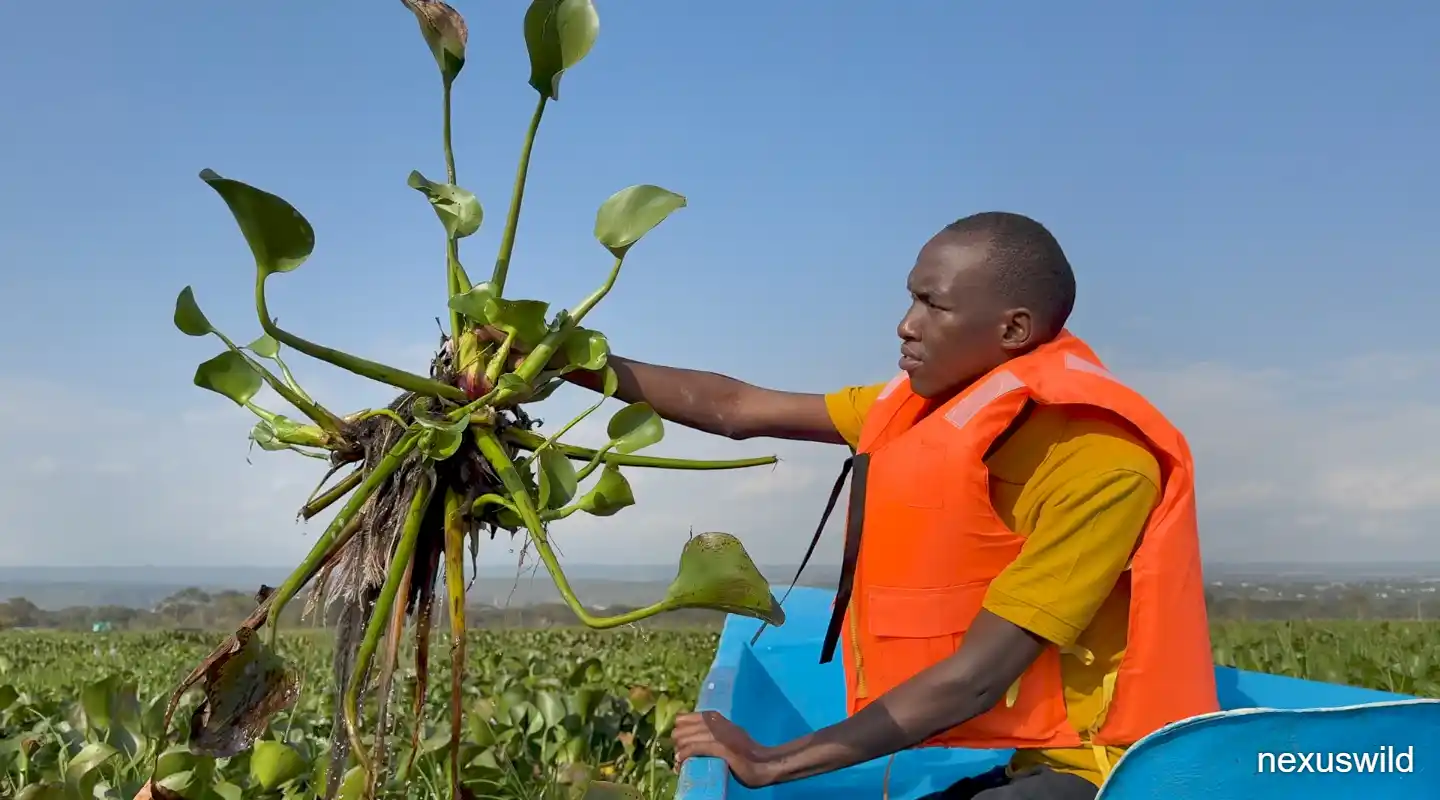

On Lake Naivasha in Kenya, water hyacinth can turn an ordinary boat journey into a struggle.
The floating plant grows into dense mats capable of blocking waterways, interfering with fishing and making it difficult for boats to move through parts of the lake. For communities that depend on the water for their livelihoods, the weed is more than an ecological problem.
For Kenyan engineer Joseph Nguthiru, an encounter with the plant also became the starting point for a business.
Nguthiru was studying at Egerton University when a university trip to Lake Naivasha left him and other students trapped in water hyacinth for several hours. Egerton University says the experience helped inspire a class project that eventually developed into HyaPak, a Kenyan startup working to transform the invasive plant into biodegradable packaging.
The company now uses water hyacinth collected from Kenyan lakes as feedstock for products including seedling bags, parcel packaging and carton liners.
The concept connects two environmental problems that are normally treated separately. Removing water hyacinth can help clear affected waterways, while turning that biomass into packaging creates a possible alternative to some single-use plastic products.
The model is still developing, and it is far too early to suggest that HyaPak can eliminate either problem on its own. But the company has moved beyond a university experiment. UNEP says HyaPak has cleared eight hectares of water hyacinth from Lake Naivasha and created dozens of green jobs for community members affected by the weed.
A Business Idea That Began on Lake Naivasha
HyaPak's founding story is unusually direct.
Nguthiru studied water and environmental engineering at Egerton University in Kenya. UNEP identifies him as the founder and chief executive of HyaPak, while university records describe the company as an outgrowth of work he began while still a student.
According to Egerton University and HyaPak, Nguthiru and fellow engineering students were on Lake Naivasha when their boat became trapped in a thick concentration of water hyacinth.
HyaPak's current account says the group spent about five hours caught in the vegetation. A newsletter from the Kenya Industrial Research and Development Institute, or KIRDI, which later supported Nguthiru as an incubatee, recounts the same five-hour episode.
The experience gave the students an immediate view of what an invasive aquatic plant could do to a working lake.
Instead of treating the collected vegetation only as waste, Nguthiru began examining whether its plant fibre could become a raw material.
Egerton University says HyaPak began as a class assignment. Nguthiru later described it as his final-year research project before it developed into a startup. Nature Biotechnology dates the company's birth to 2022.
That university connection remained important in the project's early development.
A 2022 Kenya News Agency report said Nguthiru was working with Egerton University under the mentorship of Professor Japheth Onyando and alongside fellow students as the team developed biodegradable alternatives from water hyacinth.
KIRDI later described Nguthiru as a 2022 Egerton University graduate and one of its small-business incubatees.
Why Water Hyacinth Is More Than an Unwanted Weed
Water hyacinth is an aquatic plant native to South America that has become invasive in water bodies around the world.
Once established, it can form dense floating mats across the water's surface.
UNEP's reporting from Lake Naivasha describes hyacinth blocking sunlight, reducing oxygen in the water, affecting biodiversity and making it harder for fishers to navigate.
The problem is also longstanding in the wider Lake Victoria basin.
UNEP documentation on Lake Victoria records the weed's effects on fishing, water transport, water abstraction and aquatic habitats. Thick mats can alter near-shore ecosystems and contribute to oxygen-poor conditions beneath the vegetation.
The consequences are therefore ecological and economic at the same time.
For fishing communities, a clogged lake can mean more difficult journeys, damaged equipment and reduced access to fishing grounds.
That connection helps explain why HyaPak's sourcing model is built around people living near affected lakes.
The company says it currently obtains water hyacinth from Lake Naivasha and Lake Victoria, working with fishermen, fisherwomen and other community members to collect the vegetation. HyaPak pays for harvested and dried material, providing another potential income source in communities where the same weed can interfere with fishing.
The company should not be interpreted as having solved the infestation.
Water hyacinth can regenerate rapidly, and its management has challenged governments and researchers for decades.
Nature Biotechnology noted in 2025 that mechanical removal, herbicides and biological controls have all been attempted against the plant, with limited success in controlling it permanently.
More recently, Nguthiru has himself emphasized that continuing to manage the plant is more realistic than suggesting it has been permanently removed from affected lakes.
From Lake Weed to Packaging Material
The basic HyaPak process begins at the lake.
Community members harvest water hyacinth from affected areas. The biomass is then taken onto land and dried before further processing.
Current HyaPak material describes a four-stage process: harvesting, sun-drying and preparation, conversion into a proprietary plant-based material, and moulding that material into finished products.
The company does not publicly disclose every detail of its current material formulation, so descriptions of the manufacturing process should not go beyond what has been verified.
Earlier versions of the university project were documented in greater detail.
Kenya News Agency reported in 2022 that harvested water hyacinth was collected manually, chopped, dried in the sun and then crushed using a pulping machine. The material was mixed with water as part of a pulp-forming process.
That early method should not automatically be assumed to be identical to HyaPak's current commercial process.
The company now describes its formulation as proprietary and says the prepared biomass is converted into a plant-based material that can be shaped for different packaging applications.
This distinction is important because university prototypes and commercial manufacturing processes often evolve as companies improve durability, consistency and production methods.
Seedling Bags Became the Flagship Product
One of HyaPak's most developed applications is a biodegradable bag or wrapper used for tree seedlings.
Conventional nursery seedlings are commonly grown in small plastic bags. Before planting the tree, the plastic normally has to be removed and disposed of.
HyaPak's approach is different.
Its seedling bag is designed to be planted in the ground together with the seedling and then decompose in the soil.
UNEP confirms that seedling bags are among HyaPak's products and describes them as bags that decompose directly in the soil.
HyaPak currently says its seedling wrapper takes approximately six months to break down, although degradation time can vary across its wider product range. The company gives a broader stated biodegradation range of three to 12 months for different materials and applications. Those figures come from HyaPak and should therefore be treated as company-reported performance rather than as a universal result for all environmental conditions.
The seedling application is particularly relevant in Kenya because planting projects can themselves generate plastic waste when conventional nursery bags are discarded.
HyaPak has positioned its wrapper as a way of avoiding that specific waste stream while simultaneously creating demand for harvested hyacinth.
The idea also illustrates an important feature of circular-economy businesses: waste reduction can occur at both ends of the product.
The raw material comes from an unwanted invasive plant, and the finished product is designed to avoid leaving a long-lived plastic bag after use.
HyaPak Is Expanding Beyond Agriculture
The startup is no longer working only on seedling bags.
UNEP lists parcel packaging for courier services and carton linings among HyaPak's other products. UNEP says the carton liners are designed to help keep food fresh without cold storage.
HyaPak's current catalogue also lists parcel mailers, carton liners, floral wrapping and custom-moulded products.
Not every application appears to be at the same commercial stage.
The company's product information describes parcel packaging as moving into pilot use on routes within Kenya. That is different from saying it has already replaced conventional courier packaging at large scale.
Likewise, statements about carton liners reducing refrigeration requirements or extending produce life should be treated carefully.
UNEP does identify carton linings that keep food fresh without cold storage as a HyaPak application, but broader claims about precise shelf-life improvements, energy savings or emissions reductions would require application-specific independent testing.
The distinction matters for an early-stage materials company.
A technically workable material does not automatically mean every possible packaging application has reached large-scale commercial deployment.
Eight Hectares Cleared and Dozens of Green Jobs
Environmental startups often describe potential impact in very large terms.
HyaPak has some measurable results, but the verified figures are more useful when presented at their actual scale.
UNEP reported when naming Nguthiru a 2025 Young Champion of the Earth that HyaPak had cleared eight hectares of water hyacinth from Lake Naivasha. The UN agency also said the company had created dozens of green jobs for community members whose livelihoods had been affected by the plant.
Nature Africa reported in July 2026 that HyaPak's work had helped remove water hyacinth from more than eight hectares of Lake Naivasha, broadly confirming the scale reported by UNEP.
Those figures should not be expanded into assumptions about entire lakes.
Eight hectares is evidence that the collection-and-manufacturing model is operating, not evidence that HyaPak has brought the wider infestation under control.
The same applies to employment.
Providing paid harvesting work can create useful supplementary income for lakeside households, particularly when the raw material itself interferes with fishing. But UNEP's description of “dozens” of green jobs does not support claims that the company has created employment at the scale of entire lake economies.
The most defensible conclusion is narrower: HyaPak has demonstrated that an invasive plant can become a purchased raw material and that some community members can earn income through its removal.
One Environmental Problem Used Against Another
The business model brings together two separate waste streams.
The first is water hyacinth.
Removing the plant from navigation channels or heavily affected shorelines can provide immediate local benefits, particularly where mats interfere with boats and fishing.
The second is conventional single-use plastic.
When water-hyacinth-derived material is successfully substituted for a plastic seedling bag, parcel wrapper or liner, the application can potentially avoid some demand for fossil-based disposable packaging.
That is the logic behind HyaPak's description of using one environmental problem to address another.
But the environmental balance should not be overstated.
Whether an alternative material produces lower overall environmental impacts depends on factors including manufacturing energy, additional ingredients, transport, durability, disposal conditions and the product it replaces.
Publicly available sources reviewed for this article do not establish a complete independently verified life-cycle assessment for every HyaPak product.
It is therefore safer to say the company aims to reduce reliance on particular single-use plastics, rather than claiming that every HyaPak item automatically has a lower total environmental footprint in every situation.
Scaling Is the Difficult Part
The original HyaPak idea emerged from a university research project.
Building an industrial packaging company is a considerably larger challenge.
The company needs a dependable supply of harvested biomass, consistent material properties, manufacturing capacity, quality control, product certification and customers willing to adopt an unfamiliar packaging material.
Nguthiru told Nature Africa in 2026 that moving from research into business required him to learn manufacturing, finance, partnerships and product development as the project grew beyond the university.
There is also an unusual supply problem.
HyaPak depends on the existence of the very invasive plant it is attempting to manage.
Water hyacinth grows rapidly and can return after removal, which means harvesting can provide continuing raw material but also demonstrates why commercial utilization by itself should not be presented as eradication.
Independent reporting on Lake Naivasha has similarly noted that initiatives such as HyaPak need much greater scale before they could materially affect the overall spread of the weed.
That makes HyaPak's current position relatively clear.
It has moved from laboratory research into a functioning circular-economy startup, but its ability to manufacture and sell packaging is still small compared with the geographic scale of invasive water hyacinth or the wider plastic-waste problem.
Recognition Has Brought the Project Beyond the University
HyaPak's work has received increasing attention outside Kenya.
Egerton University reported that the project received recognition through Prototypes for Humanity during COP28 in Dubai in 2023.
In 2025, UNEP selected Nguthiru as one of its Young Champions of the Earth, identifying him as founder and chief executive of HyaPak.
The recognition gives the startup visibility, but awards are not the same as proving commercial scale.
The more important test will be whether HyaPak can manufacture its materials consistently, find applications where they perform reliably, pay communities enough to make harvesting worthwhile and compete with existing packaging on cost and convenience.
Those are commercial questions as much as environmental ones.
Conclusion
HyaPak began with a problem Joseph Nguthiru encountered directly.
As an engineering student at Egerton University, he experienced how dense water hyacinth could obstruct movement on Lake Naivasha. What began as a university project evolved into a startup founded around the idea that the invasive vegetation could become a manufacturing resource rather than simply material to be removed and discarded.
Today, HyaPak collects water hyacinth from Lake Naivasha and Lake Victoria and converts the biomass into plant-based packaging products. Its applications include biodegradable seedling bags, parcel packaging and carton liners, with other formats under development or in pilot use.
The company has also produced measurable results. UNEP reports that HyaPak has cleared eight hectares of hyacinth from Lake Naivasha and created dozens of green jobs for members of affected communities.
Those achievements are meaningful, but they should not be confused with solving Kenya's invasive-water-hyacinth problem or eliminating plastic packaging.
Water hyacinth continues to spread and regenerate, while scaling alternative packaging requires manufacturing investment, reliable performance and sustained demand.
For HyaPak, the opportunity lies in making those two problems economically connected.
If invasive vegetation has a buyer, communities have a reason to collect it. If the resulting material can reliably replace plastic in selected applications, the same supply chain can potentially reduce another source of waste.
That makes HyaPak less a story about turning a weed into a miracle material and more a practical experiment in circular entrepreneurship: finding economic value in something a community already needs removed.
Nexuswild welcomes factual corrections. Email contact@nexuswild.com with evidence and the article URL.