
NEW DELHI — India is reportedly set to raise the permitted electromagnetic field (EMF) power density for 5G base transceiver stations (BTS) from 5 watts per square metre to 10 watts per square metre, according to the Economic Times and Business Standard, which cite people familiar with the matter. The revised norms are expected to take effect next month. As of this writing, the Department of Telecommunications had not issued a public notification confirming the change, so the figures remain based on media reporting rather than an official order.
Aligning With International Standards
The reported move would mark the second relaxation of India's 5G EMF ceiling in under two years. India initially applied a limit of 1 W/m², well below international guidance, before raising it to 5 W/m² effective February 2025. The next step to 10 W/m² would bring India in line with the level recommended by the International Commission on Non-Ionizing Radiation Protection (ICNIRP), which advises the World Health Organization on EMF exposure guidelines, and with standards followed in roughly 137 countries, including the UK, Australia, Japan, South Korea and Singapore.
India's EMF limits are set relative to ICNIRP's frequency-specific reference levels rather than a single figure applying uniformly across all bands, so the widely cited 5 and 10 W/m² figures function as general benchmarks rather than one universal cap.
Mobile networks, including 5G, operate using non-ionizing radio-frequency EMF, which is physically distinct from ionizing radiation such as X-rays and does not carry enough energy to damage DNA directly. The WHO has said that, based on current evidence, radio-frequency exposure within international guideline limits has not been established as causing adverse health effects, though research continues.
Impact on Telecom Operators
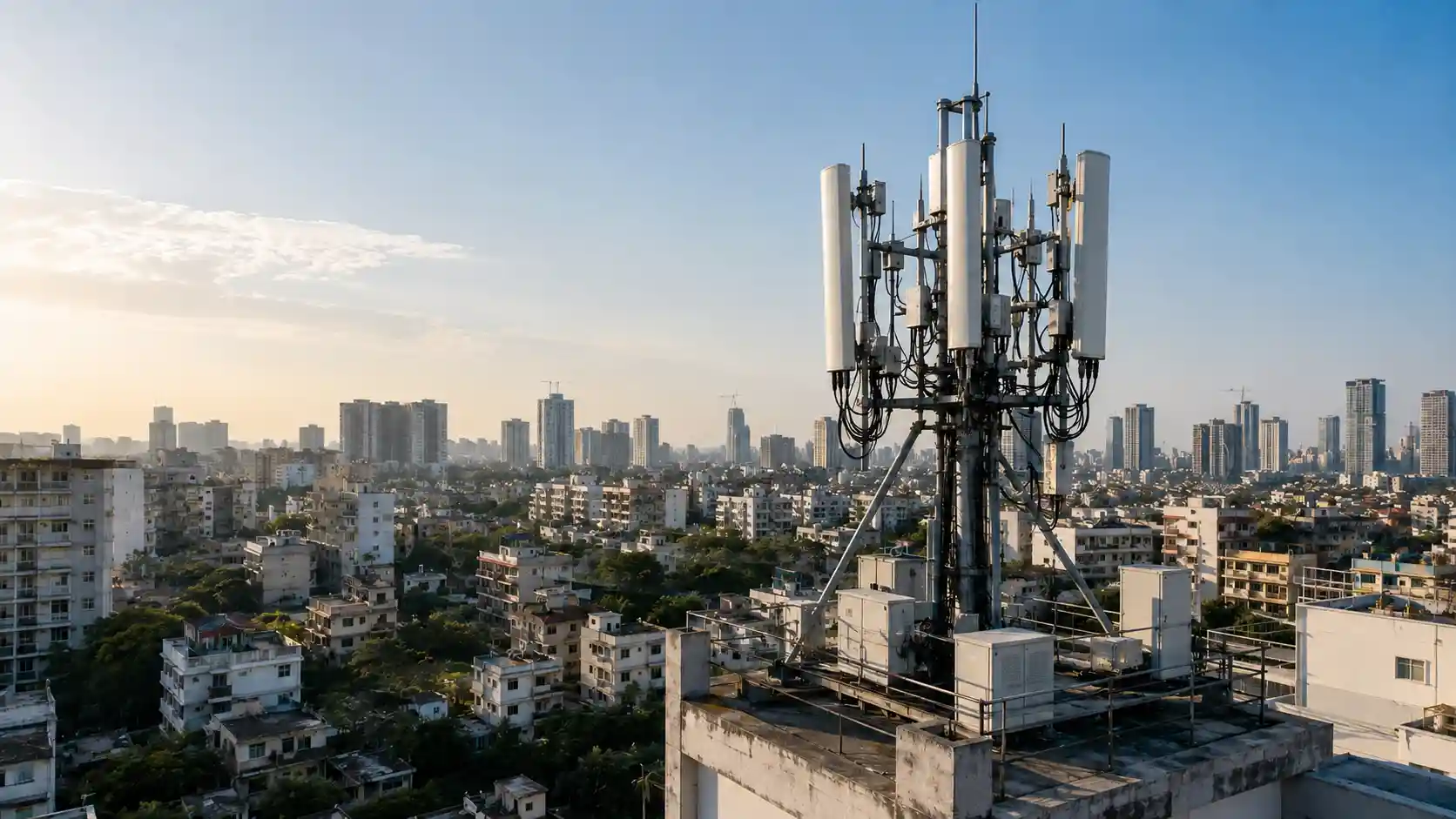
The telecom industry has argued that India's earlier, stricter limits made 5G expansion costlier because higher-frequency 5G signals attenuate faster than older mobile technologies, requiring more sites to maintain coverage. A higher permitted power density could allow individual towers to transmit over greater distances, potentially letting operators cover larger areas per site and reduce how many additional towers are needed for network expansion, according to industry expectations reported by the Economic Times.
These are stated industry rationales and anticipated outcomes, not demonstrated results, and actual coverage gains or cost savings have not been quantified by either the government or operators. The change is expected to particularly help Vodafone Idea, which is rolling out 5G later than rivals, while Reliance Jio and Bharti Airtel, which have already built out much of their networks, may see lower incremental capital costs.
India had 562,971 5G BTS as of June 30, 2026, with 5G available in 99.9% of districts, according to the latest official government data.
Real-World Exposure and Compliance
Raising the regulatory ceiling does not mean towers will operate continuously at 10 W/m². Actual transmission power varies with network traffic and distance from a device, and real-world public exposure is typically well below the permitted maximum.
Telecom operators are required to self-certify each BTS's EMF compliance through the DoT's Tarang Sanchar portal, while DoT field units conduct random physical audits of a sample of sites and test towers flagged by public complaints; individuals can also request a paid measurement at a specific site.
Further reading and useful links
Reader questions
Frequently asked questions
What is the new EMF power density limit for 5G towers in India?
According to reports, India is set to raise the permitted electromagnetic field (EMF) power density limit for 5G base transceiver stations from 5 watts per square metre to 10 watts per square metre, taking effect in September 2026.
Why is the telecom industry in favor of raising the EMF limit?
Telecom operators argue that higher permitted power density will allow 5G signals to travel further from a single tower. This could improve coverage and reduce network expansion costs by lowering the number of additional towers required.
Are these new 5G radiation limits safe?
The new 10 W/m² limit aligns with the guidelines recommended by the International Commission on Non-Ionizing Radiation Protection (ICNIRP), which advises the World Health Organization. The WHO maintains that radio-frequency exposure within these international limits has not been established as causing adverse health effects.
Nexuswild welcomes factual corrections. Email contact@nexuswild.com with evidence and the article URL.