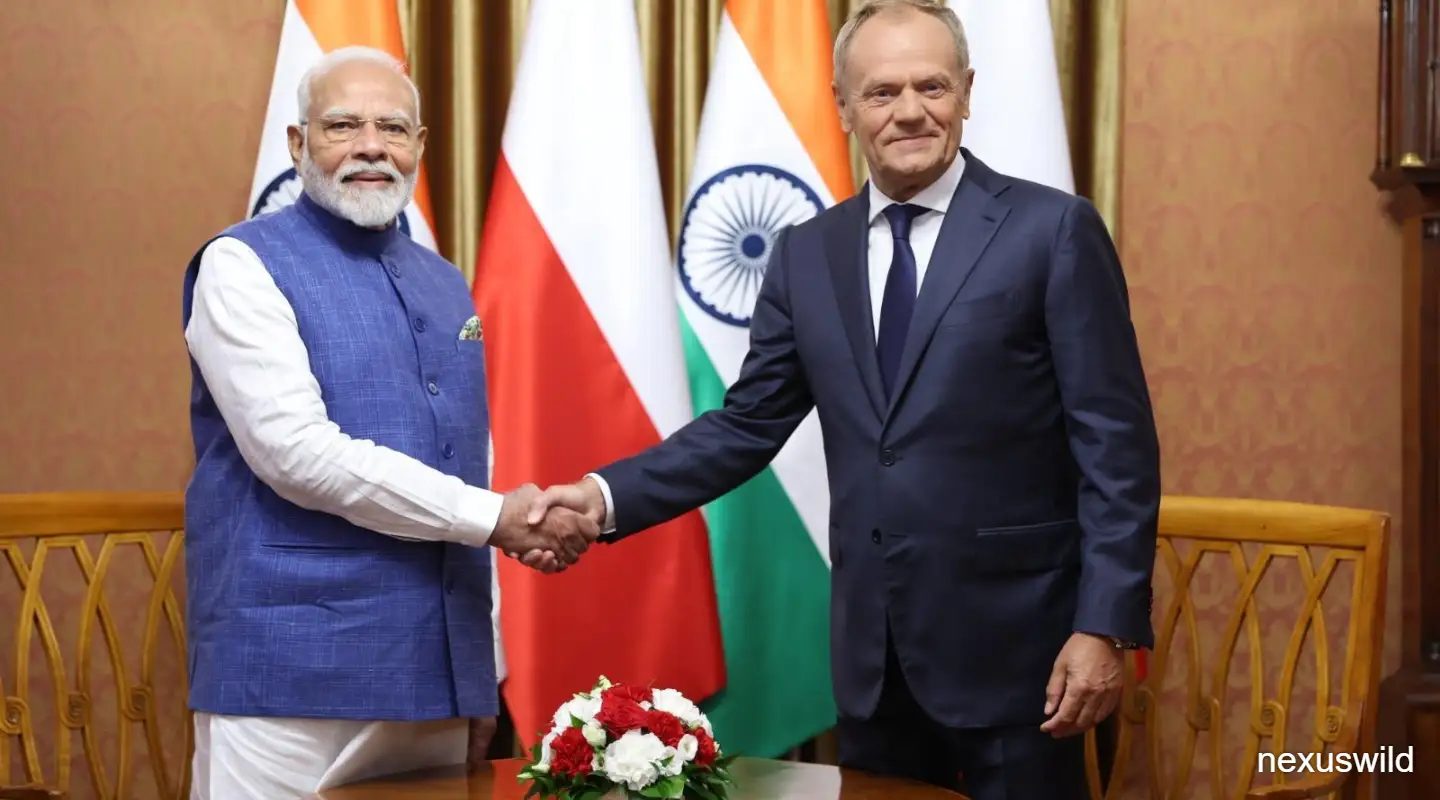

India and Poland have agreed to strengthen cooperation in defence, space and nuclear energy following talks between Indian Prime Minister Narendra Modi and Polish Prime Minister Donald Tusk on October 22, 2026. The discussions reflect efforts by both countries to expand their relationship beyond traditional diplomatic and commercial engagement into strategic and technology-driven sectors.
According to reports on the meeting, the two leaders discussed opportunities to deepen bilateral ties amid international security and economic uncertainties. They also reaffirmed the importance of closer cooperation on global issues, including peace and stability in conflict-affected regions.
The latest engagement builds on the strategic partnership established in August 2024, when Modi visited Poland and the two governments adopted a Joint Action Plan covering the 2024–2028 period.
Defence Cooperation Moves Towards Industrial Collaboration
Defence is an important area of the expanding partnership. India and Poland have been exploring opportunities for closer engagement between their defence industries, including joint development, co-production, technology exchange and cooperation between their armed forces.
Momentum has increased through formal government-level discussions. At the eighth India–Poland Joint Working Group meeting on Defence Cooperation, held in Warsaw in September 2026, officials focused on industrial collaboration and opportunities for Indian and Polish defence companies to work together.
The delegations also visited Poland's state-owned defence group, Polska Grupa Zbrojeniowa, to discuss domestic capabilities and potential business-to-business cooperation.
For India, greater defence-industrial engagement could support its efforts to expand domestic manufacturing and diversify international partnerships. For Poland, cooperation offers opportunities to develop industrial links with a major Asian economy.
However, the discussions should not be interpreted as confirmation of specific new weapons purchases or production contracts unless individual agreements are formally announced.
Space Cooperation Offers Scope for Technology Partnerships
Space is another area identified by the two governments for deeper cooperation. India has developed capabilities in satellite launches, spacecraft, remote sensing and space applications, while Poland has expertise across parts of the European space research and technology ecosystem.
Potential areas for collaboration include satellite applications, scientific research, space technology development and exchanges between research institutions and companies. Cooperation could also create opportunities for commercial partnerships in areas such as Earth observation, telecommunications and data services.
Any future projects will depend on the agreements, technical arrangements and regulatory approvals established by the two countries. The latest announcement signals an intention to strengthen engagement, rather than confirmation that a specific joint space mission has been approved.
Nuclear Energy in Focus as Countries Explore Energy Cooperation
Nuclear energy has also emerged as a priority in the latest discussions. For India, nuclear power is part of its broader effort to diversify electricity generation and expand reliable, low-carbon energy sources. Poland, meanwhile, is working to develop nuclear power as part of its long-term energy transition.
Closer engagement could provide a basis for technical dialogue, research partnerships and exchanges of expertise on nuclear technologies and energy planning. Any concrete cooperation would need to address safety standards, regulatory requirements, financing and the relevant legal frameworks.
The inclusion of nuclear energy alongside defence and space demonstrates the breadth of the areas the two governments want to explore. It does not, by itself, establish that a nuclear power plant project, technology-transfer deal or supply agreement has been finalised.
Trade Expansion Remains a Parallel Priority
Economic ties provide another foundation for the relationship. India's Ministry of External Affairs reports that bilateral trade between India and Poland reached approximately $6.36 billion in 2025, up from $1.95 billion in 2013.
The two countries have also used their Joint Commission for Economic Cooperation to examine opportunities in sectors such as digital technology, energy, manufacturing, pharmaceuticals, mining and green technologies.
Reports on the October 22 meeting indicate that the leaders want to double bilateral trade by 2030. Achieving that goal would require sustained growth in commercial exchanges, stronger business links and progress in reducing practical barriers to market access.
Defence, space and nuclear energy could add new areas for investment and technology collaboration, although their contribution to trade would depend on the projects and commercial arrangements that emerge.
A Strategic Partnership With Wider European Links
India and Poland elevated their relationship to a strategic partnership in 2024, marking a new phase in ties that date back to the establishment of diplomatic relations in 1954.
Poland is India's largest trading and investment partner in Central and Eastern Europe, according to the Indian Embassy in Warsaw. Its position within the European Union also makes it a potential partner for Indian companies seeking to develop commercial relationships across European markets.
For Poland, stronger engagement with India offers opportunities to broaden economic and diplomatic relations in Asia. For India, cooperation with Poland can support engagement with Central and Eastern Europe in areas ranging from manufacturing to emerging technologies.
The latest talks add momentum to that relationship. The next stage will depend on how the two governments translate their stated priorities into formal agreements, joint projects and measurable commercial outcomes.
Nexuswild welcomes factual corrections. Email contact@nexuswild.com with evidence and the article URL.