
BRUSSELS, Sept. 24, 2026 - Europe’s security problem is increasingly extending beyond the conventional military front.
European governments, the European Union and NATO say they are confronting a growing pattern of cyber intrusions, sabotage attempts, drone incidents, information operations, airspace violations and activity around critical infrastructure. Several incidents have been formally attributed to Russia. Others remain under investigation or cannot be publicly attributed with the same level of confidence.
That distinction is essential.
Europe is not dealing with one single category of attack. It is dealing with a spectrum of activity that often falls below the threshold of conventional armed conflict while still creating economic, political and security costs.
The emerging target map is broad: undersea data cables, energy infrastructure, airports, rail and logistics networks, government computer systems, telecommunications, navigation systems, and other civilian infrastructure that modern economies depend on.
The strategic problem is that these systems are highly connected. Damage to one layer can create effects in another.
A cable failure can disrupt communications. A cyber intrusion can affect public services. A transport interruption can slow civilian commerce and military mobility. A drone incident at an airport can close airspace or trigger security responses without a conventional military strike ever taking place.
This is why European security policy is increasingly using the language of resilience rather than only defence.
The Leipzig incident changed the debate in Germany
The clearest recent example is Leipzig/Halle Airport.
Germany’s federal government formally attributed the attempted hybrid attack at the airport on August 4, 2026 to Russia.
German authorities said the incident involved an explosive-equipped drone and described it as a serious security event.
The German government convened its National Security Council on August 7 and later publicly assigned responsibility to Russia after reviewing the incident.
Berlin said it intended to respond in a determined, proportionate and non-escalatory manner while coordinating with NATO and EU partners.
That combination is important.
A government can attribute an act of sabotage without treating the incident as the beginning of conventional war.
The practical response can include intelligence cooperation, sanctions, law enforcement, counter-drone systems, infrastructure security and diplomatic measures.
The gray-zone problem sits precisely in that space.
Europe says the pattern has intensified since 2022
The European Union’s diplomatic service says hybrid activity targeting Europe has increased since Russia’s full-scale invasion of Ukraine in 2022.
The EU uses the term hybrid threat for coordinated harmful activity that combines different methods and is intended to weaken a state or institution.
Its current threat picture includes cyberattacks, sabotage, disruption of critical infrastructure, foreign information manipulation, incendiary devices, airspace violations, interference with democratic processes and damage to undersea infrastructure.
The EU attributes a broader coordinated campaign to Russia, while also noting that Russia is not the only actor capable of hybrid operations.
That nuance matters.
A rise in suspicious infrastructure incidents does not mean every cable break, cyberattack or transport disruption is automatically a Russian operation.
Attribution requires evidence.
Weather, equipment failure, commercial accidents, criminal activity and unrelated state actors can produce similar effects.
The security challenge is therefore not only preventing attacks.
It is determining what actually happened.
Cyber activity is one of the most firmly documented parts
In July 2026, the European Union publicly denounced what it described as Russia’s malicious cyber ecosystem.
The EU said the 16th Centre of Russia’s Federal Security Service controlled several cyber threat groups, including TURLA.
According to the EU statement, malicious activity linked to that ecosystem had targeted France, Germany, Poland, Cyprus, the Netherlands, Austria, Slovakia, Romania and Finland.
The activity included infiltration of government networks and attacks affecting critical infrastructure.
The EU simultaneously adopted what it described as its largest cyber-sanctions package to date.
This is different from anonymous criminal ransomware.
The EU’s assessment is that state intelligence services, cybercriminal groups, hacktivists, private companies and other proxies can operate inside a wider ecosystem that serves strategic objectives.
That creates a difficult defensive environment because the attacker may not always appear to be the state itself.
Critical infrastructure is attractive because modern Europe is interconnected
Europe’s infrastructure has become more efficient and more interconnected over decades.
That is economically useful.
It also creates dependencies.
Electricity crosses borders.
Telecommunications traffic travels through submarine cables.
Cloud services depend on data centres and backbone networks.
Manufacturers depend on synchronized logistics.
Railways, ports and roads carry both civilian cargo and military equipment.
Navigation increasingly depends on satellite-based systems.
A disruption does not have to destroy a system permanently to have value for an adversary.
Temporary uncertainty can be enough.
If authorities have to inspect cables, close an airport, reroute logistics, mobilize police or take networks offline while investigating a cyber intrusion, the disruption itself creates cost.
Gray-zone pressure is therefore partly about forcing the defender to spend more time and money protecting everything.
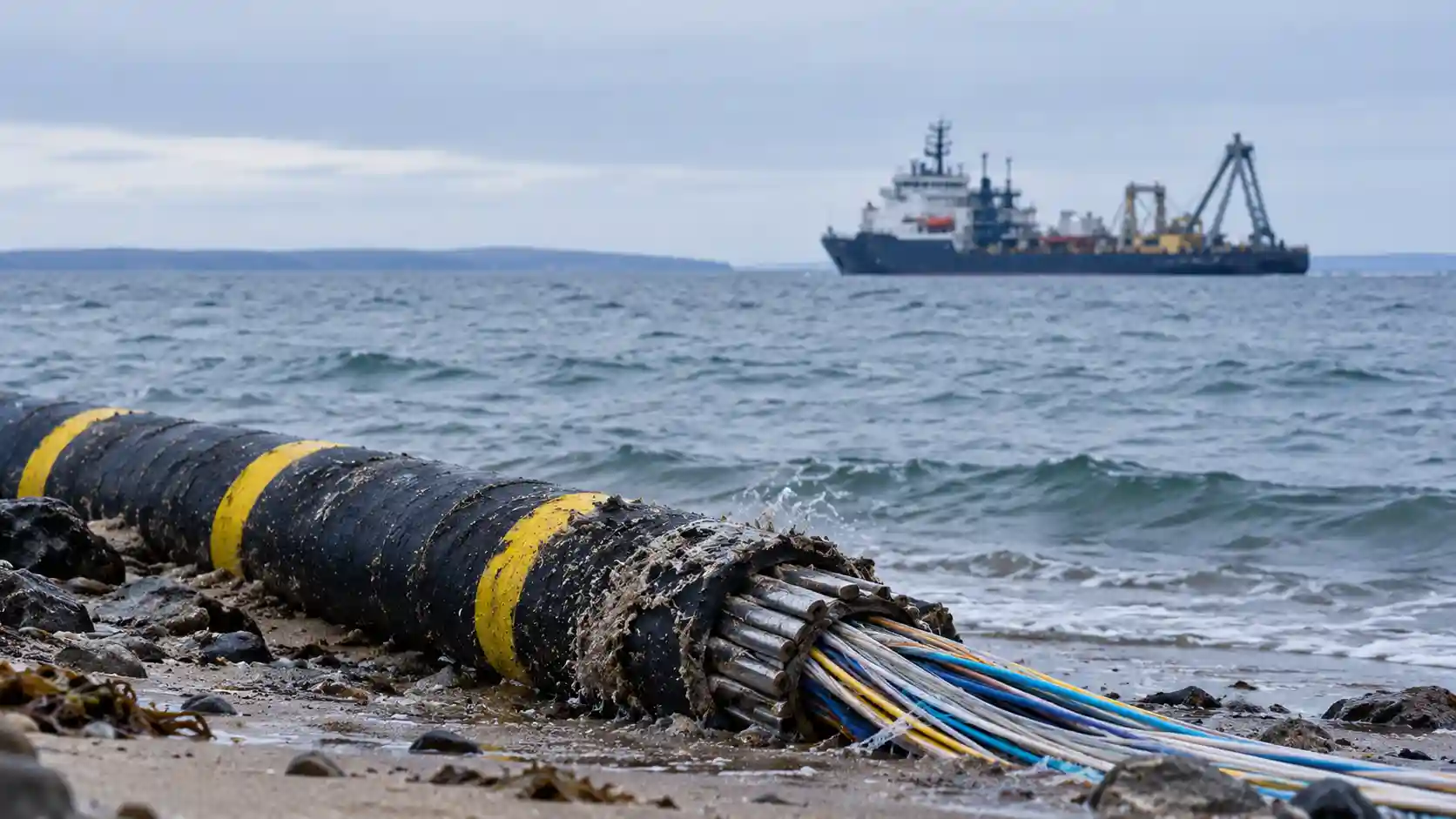
Undersea cables are one of Europe’s most exposed systems
Submarine communications cables carry about 99% of intercontinental internet traffic.
They are the physical infrastructure beneath what users experience as digital connectivity.
Power cables are also increasingly important because European electricity markets are becoming more interconnected and offshore renewable generation depends on undersea links.
Cable infrastructure is difficult to protect continuously.
Thousands of kilometres can lie across seabeds far from shore.
Commercial ships operate nearby.
Anchors and fishing equipment can cause accidental damage.
A hostile actor can therefore benefit from ambiguity because sabotage can initially resemble an accident.
The EU has responded by moving cable security from a specialist engineering issue into mainstream security policy.
Europe is spending hundreds of millions on cable resilience
In February 2026, the European Commission introduced a new Cable Security Toolbox and announced €347 million for strategic submarine-cable projects.
That includes investment intended to increase redundancy, strengthen monitoring and improve repair capacity.
A separate €20 million call was launched to support adaptable cable-repair modules that can be positioned at ports or shipyards.
The larger policy framework is built around four stages: prevention, detection, response and recovery, and deterrence.
The EU is also developing a reserve of cable vessels to shorten repair times.
This is a significant shift in thinking.
A cable cannot always be made impossible to attack.
But a system with more routes, faster detection and rapid repair can make an attack less useful.
Resilience therefore becomes part of deterrence.
NATO has moved naval assets into the problem
NATO created Baltic Sentry in January 2025 after a series of incidents involving pipelines and internet cables in the Baltic Sea.
The mission uses frigates, maritime patrol aircraft, national surveillance assets and naval drones to improve detection around critical undersea infrastructure.
NATO has also increased cooperation with private infrastructure operators.
This is necessary because much critical infrastructure is commercially owned.
Governments and militaries may provide surveillance or intelligence, but telecom operators, energy companies and cable owners control significant parts of the physical network.
The public and private sectors therefore have to share information quickly when suspicious activity occurs.
The Atlantic is another area of concern
The United Kingdom disclosed in April 2026 that its armed forces, working with Norway and other allies, had tracked increased Russian submarine activity north of the UK.
British officials said the operation involved a Russian Akula-class submarine and specialized vessels associated with Russia’s Main Directorate for Deep-Sea Research.
The UK described those specialist units as capable of surveying undersea infrastructure in peacetime and sabotaging it during conflict.
During the response, British aircraft flew more than 450 hours, a frigate covered several thousand nautical miles and about 500 personnel were involved.
The public disclosure was itself part of the response.
Exposing the activity removes some of the value of operating covertly.
It also signals that seabed infrastructure is being monitored.
Railways, roads and logistics are strategic infrastructure too
European resilience planning increasingly includes civilian transport.
NATO’s September 2026 resilience requirements explicitly call for transport infrastructure and services to withstand and recover from hybrid threats, cyberattacks and other disruptions.
That is not only about civilian convenience.
In a crisis, military forces depend on the same roads, bridges, railways, ports and border crossings used by commercial traffic.
A railway control system attacked by malware can become a defence problem.
A damaged bridge can become a military-mobility problem.
A border system taken offline can slow reinforcement.
The boundary between civilian infrastructure and defence infrastructure has therefore become less clear.
Cyberattacks can produce physical consequences
A cyber operation does not need to destroy data to become strategically significant.
An attacker can disrupt energy distribution, interfere with transport systems, manipulate industrial control systems or disable public services.
The EU says malicious cyber activity linked to Russian actors has included infiltration of government networks and sabotage of critical infrastructure.
NATO’s 2026 resilience framework similarly warns that more frequent and damaging cyberattacks can cripple essential services and weaken civilian support to military operations.
This is one reason governments are increasingly treating cybersecurity as civil defence.
A hospital network, electricity distributor or telecom provider may be privately operated.
Its resilience can still become a national-security issue.
GPS interference adds another layer
European security officials are also concerned about electronic interference, including disruption of satellite navigation.
GNSS signals are used for aviation, shipping, logistics, telecommunications timing, agriculture and many other systems.
Jamming makes a signal unavailable.
Spoofing can make a receiver calculate a false position.
Both can create operational disruption without physically damaging infrastructure.
NATO’s resilience requirements specifically identify vulnerabilities associated with GNSS and next-generation communications networks.
The strategic lesson is similar to the cable problem.
Modern economies rely heavily on invisible infrastructure that works reliably until it does not.
Drones make the boundary even harder to define
Small unmanned aircraft are now part of the hybrid-security problem.
They can collect intelligence.
They can disrupt airports.
They can test air-defence responses.
They can carry payloads.
And because commercial drones are widely available, identifying an operator can be difficult.
The Leipzig/Halle case is especially significant because Germany formally attributed the attempted attack to Russia.
Elsewhere, European authorities have investigated drone incidents without always making the same public attribution.
That difference should be preserved.
Security policy becomes weaker, not stronger, if every unexplained drone is automatically assigned to a geopolitical adversary.
The goal may be disruption rather than destruction
Gray-zone campaigns can produce strategic effects without causing catastrophic damage.
Repeated incidents can force governments to spend more on surveillance, police, cybersecurity, spare capacity, redundancy and repair.
They can make businesses reassess insurance or investment.
They can create public anxiety.
They can test how quickly governments coordinate.
They can expose gaps between civilian agencies and military organizations.
They can also create political disagreement about attribution and response.
From an attacker’s perspective, ambiguity can be useful.
If an incident is serious enough to impose cost but uncertain enough to complicate retaliation, it occupies a difficult space for the defender.
Europe’s response is shifting toward resilience
NATO publicly released updated resilience baseline requirements in September 2026.
They cover continuity of government, energy supplies, movement of forces, transport, food, water, communications and health systems.
The Alliance specifically identifies sabotage, cyberattack and disruption of critical infrastructure as risks that governments must be able to absorb and recover from.
The European Union is moving in the same direction.
Its cable-security policy emphasizes redundancy and repair.
Its cyber policy uses sanctions and attribution.
Its hybrid toolbox is intended to coordinate diplomatic, economic, cyber and security responses.
The approach is becoming less about preventing every incident and more about ensuring that a single incident cannot create strategic paralysis.
Attribution remains the hardest political problem
The most difficult decision often comes before retaliation.
Who did it?
Physical sabotage can leave limited evidence.
Cyber operations can route through infrastructure in multiple countries.
A proxy may act on behalf of a state without wearing a uniform.
A commercial vessel may be involved in an incident that could be accidental or deliberate.
Governments therefore have to combine intelligence, forensic evidence, surveillance and diplomatic assessment.
Sometimes they will make a public attribution, as Germany did over Leipzig.
Sometimes they will not.
This uncertainty is not a weakness unique to Europe.
It is a defining feature of gray-zone competition.
A conventional NATO attack is a different category
Hybrid incidents should not be confused with a conventional military assault on NATO territory.
NATO continues to maintain conventional deterrence and Article 5 collective-defence commitments.
Hybrid activity instead tests the space below that threshold.
That does not make it harmless.
It means the response toolkit is broader.
Police, intelligence agencies, regulators, cybersecurity teams, infrastructure companies, navies, sanctions authorities and diplomats can all become part of the response.
The security problem is therefore simultaneously military and civilian.
The economic cost can grow even without a major attack
The most important long-term effect may be higher resilience spending.
Telecom networks need redundant routes.
Energy systems need backup capacity.
Ports and airports need better drone detection.
Companies need stronger cyber defences.
Governments need repair vessels, surveillance aircraft and intelligence capacity.
Critical suppliers need contingency plans.
These investments reduce vulnerability.
They also increase the cost of operating modern infrastructure.
For Europe, that cost is increasingly being treated as part of national security rather than optional insurance.
The strict conclusion
Europe’s emerging gray-zone conflict is not defined by one spectacular event.
It is defined by accumulation.
A formally attributed attempted sabotage at an airport.
Cyber operations against government networks.
Military activity around undersea infrastructure.
Cable incidents.
Drone incursions.
Electronic interference.
Attempts to disrupt systems that societies normally assume will remain invisible and reliable.
European institutions and NATO assess that Russia has intensified hybrid activity against Europe since 2022, while individual incidents still require evidence before attribution.
That distinction should remain central.
The strategic contest is therefore not only about identifying the next target.
It is about reducing the value of attacking any target at all.
A cable network with redundant routes is harder to coerce.
A railway system with strong cyber recovery is harder to paralyse.
An airport with effective counter-drone systems is harder to disrupt.
A government that can attribute attacks quickly and coordinate sanctions, law enforcement and military surveillance is harder to intimidate.
Europe’s response is increasingly built around that logic.
The gray zone cannot be eliminated.
But it can be made less profitable.
Reader questions
Frequently asked questions
What is a gray-zone or hybrid attack?
A hybrid attack uses tools such as sabotage, cyber operations, information manipulation, drones, economic pressure or infrastructure disruption to create strategic effects without necessarily becoming a conventional military attack.
Has Germany formally blamed Russia for the Leipzig/Halle airport incident?
Yes. Germany’s federal government formally attributed the attempted hybrid attack at Leipzig/Halle Airport on August 4, 2026 to Russia.
Why are undersea cables important to European security?
Submarine communications cables carry about 99% of intercontinental internet traffic, while undersea electricity cables increasingly connect power markets and offshore energy projects.
What is NATO doing to protect undersea infrastructure?
NATO launched Baltic Sentry and uses assets including frigates, maritime patrol aircraft, surveillance systems and naval drones to improve monitoring and protection of critical undersea infrastructure.
Are all cable breaks and cyberattacks in Europe attributed to Russia?
No. Some incidents have been formally attributed by governments or EU institutions, while others remain under investigation or may have accidental, criminal or unrelated causes. Attribution requires evidence.
What cyber activity has the EU attributed to Russia?
In July 2026, the EU said Russia’s FSB-linked cyber ecosystem had conducted malicious operations affecting multiple European countries, including government-network infiltration and attacks involving critical infrastructure.
How much is the EU spending on submarine-cable security?
The European Commission announced €347 million in 2026 for strategic submarine-cable projects, including measures to improve redundancy, monitoring and repair capacity.
Does hybrid activity automatically trigger NATO Article 5?
No. Hybrid incidents can range widely in severity and are assessed individually. NATO maintains collective-defence commitments while also using resilience, cybersecurity, intelligence, policing and infrastructure protection to respond below the threshold of conventional armed attack.
Nexuswild welcomes factual corrections. Email [email protected] with evidence and the article URL.