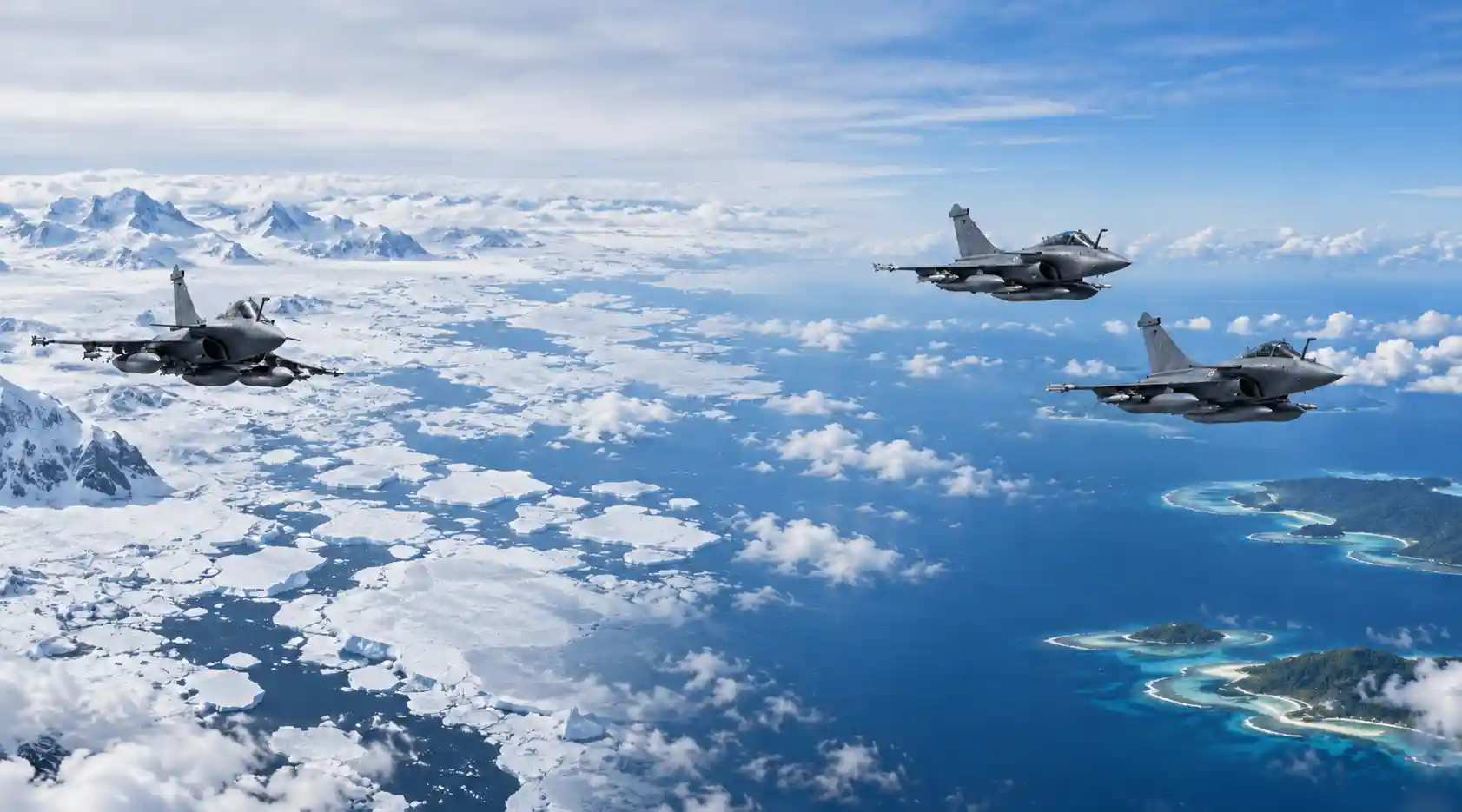

PARIS, Sept. 12, 2026 - France has begun a 40-day long-range air deployment that will take Rafale fighters more than 40,000 kilometres from Europe through the Arctic, across the Indo-Pacific and onward to the Middle East before returning through Egypt.
The mission, called PEGASE 26, is being led by the French Air and Space Force. It is designed to test far more than aircraft range. France is examining whether it can move a combat-capable air package across multiple regions, sustain it with aerial refuelling and transport, operate from partner bases, integrate with foreign air forces and keep the force connected to command structures thousands of kilometres away.
The core force consists of four Rafale F4 fighters, three A330 MRTT Phénix tanker-transports, two A400M Atlas transport aircraft and about 300 personnel. The deployment runs from September 8 to October 15 and includes nine principal stopovers across a route linking Greenland, Canada, Alaska, Japan, South Korea, Indonesia, India, La Réunion, Qatar and Egypt.
The opening leg has already shown the scale of the logistics involved. On September 8, four Rafales left Istres in southern France for Alaska. French defence authorities said the fighters required six aerial refuellings during an approximately 11-hour flight before reaching Eielson Air Force Base.
That first movement alone was a test of strategic reach.
Why France is sending Rafales around the world
PEGASE is not a new concept. France began the series in 2018 to practise long-range air-power projection and strengthen operational relationships with partners far from metropolitan France.
PEGASE 26 is the seventh edition.
What is different in 2026 is the route.
For the first time in the PEGASE series, France is opening a northern route toward the Indo-Pacific through the Arctic. Previous French long-range deployments toward the region largely used a southern axis through the Middle East.
This year, the force is moving through Greenland, Canada and Alaska before crossing toward Asia.
That matters because military mobility depends on routes, access and support points. An air force with only one practical path to a distant theatre has less flexibility than one with several tested corridors.
France is therefore not only moving aircraft. It is validating an alternative pathway.
The first challenge: reaching Alaska
The opening phase shows why tankers are central to modern air power.
A fighter such as the Rafale can cover long distances, but transcontinental deployment requires repeated refuelling, maintenance planning, weather monitoring, alternate airfields and transport support.
French authorities said an A400M left Orléans on September 7 for Kangerlussuaq in Greenland. After an approximately six-hour flight, it continued toward Pituffik Space Base and then Eielson Air Force Base in Alaska.
On September 8, the Rafales, MRTT tankers and another A400M departed France.
The French Air and Space Force said five A330 MRTTs supported the opening movement from Istres, even though the core PEGASE 26 package is described as three MRTTs for the broader mission.
The Rafales were refuelled six times in flight before reaching Alaska after roughly 11 hours.
The aircraft are only one part of the system. Without tankers, transport aircraft, ground crews, spare parts, communications, mission planning and diplomatic access, long-range fighter projection does not work.
What the Rafale F4 brings
The fighters deployed on PEGASE 26 are Rafale F4-standard aircraft.
The F4 standard is the latest major operational evolution of France’s Rafale fleet and places greater emphasis on connectivity, sensors, electronic warfare and collaborative combat.
For a mission like PEGASE, connectivity matters almost as much as range.
A fighter operating far from home has to exchange information with tankers, command centres, partner aircraft and ground infrastructure.
France presents the deployment around a three-aircraft combination: Rafale for combat power, A330 MRTT for refuelling and strategic transport, and A400M for personnel, equipment and logistical support.
The real capability is the system formed by all three.
Why the Arctic route matters
The Arctic is gaining strategic importance as geography, infrastructure and military planning change.
For France, the northern route also provides a practical alternative to the traditional path through the Middle East.
The first phase runs through Greenland and North America before heading toward the Pacific.
French officials have explicitly described the route as a way to establish a new pathway to the Indo-Pacific.
That does not mean France is replacing its southern route. The value comes from having another tested option.
Military mobility is partly about redundancy.
If access becomes difficult in one region because of conflict, airspace restrictions or political conditions, another established route can become strategically important.
Why the Indo-Pacific matters to France
France is not simply visiting the Indo-Pacific.
It is a sovereign state in the region because of its overseas territories in the Indian and Pacific oceans.
According to France’s updated Indo-Pacific strategy, about 1.8 million French citizens live in its territories in the region.
Those territories account for more than 90% of France’s exclusive economic zone.
France says its total exclusive economic zone is about 10.2 million square kilometres, the second largest in the world.
That makes the Indo-Pacific a direct sovereignty issue for Paris.
France has territory, citizens, maritime zones and military responsibilities there.
A deployment through Japan, South Korea, Indonesia, India and La Réunion is therefore connected to France’s ability to reinforce its own interests and territories in the region.
Japan and South Korea
After the North American phase, PEGASE 26 moves into Northeast Asia.
Japan and South Korea are important because France wants operational relationships with advanced air and space forces far from Europe.
French forces have trained with Japanese aircraft during previous PEGASE missions.
This year, France has also highlighted cooperation in the space domain with Japan and South Korea.
The military logic is interoperability.
Aircraft from different countries must be able to communicate, follow common procedures, understand each other’s command structures and operate safely together.
Those skills cannot be improvised during a crisis.
Indonesia and India
Indonesia and India are particularly relevant because both operate, or are acquiring, French-built combat aircraft.
India already operates Rafale fighters in its air force and has selected Rafale Marine aircraft for naval service.
Indonesia has also ordered Rafales.
That creates another layer of interoperability because crews and support teams can work around familiar aircraft families, even when national configurations differ.
In India, PEGASE 26 is scheduled to connect with the multinational TARANG SHAKTI exercise.
France says the exercise will be used to deepen cooperation between the French and Indian air forces.
The significance is not simply that the Rafales pass through India.
The force is expected to train along the route.
La Réunion is more than a stopover
La Réunion is French territory.
A stop there tests France’s ability to connect metropolitan forces with one of its own Indo-Pacific territories after operating through several partner countries.
That is a direct reinforcement scenario.
The broader strategic question is whether France can move credible military power from Europe to its overseas territories rapidly and repeatedly.
PEGASE provides a practical test.
The answer depends on fighter performance, but also on tanker availability, transport capacity, maintenance resilience, command-and-control continuity and access agreements.
Qatar and Egypt close the arc
After roughly 26 days in the Indo-Pacific, the mission is scheduled to move toward the Middle East.
France plans stops in Qatar and Egypt, with the final phase including the bilateral AMUN exercise in Egypt.
This gives the deployment three major strategic zones: the Arctic, the Indo-Pacific and the Middle East.
Each presents different operating conditions.
Cold-weather operations in the north test crews and equipment differently from tropical or desert environments.
France has emphasized that PEGASE 26 is designed to expose personnel to polar, tropical and desert conditions within one deployment.
What “power projection” really means
Power projection is the ability to move useful combat capability to a distant location and keep it operational.
Flying four fighters abroad is only the visible part.
A credible deployment requires fuel, maintenance, technicians, secure communications, spare parts, mission planning, diplomatic clearances, airfield access and command support.
PEGASE is therefore a logistics test as much as a fighter mission.
The 300 personnel involved are as important as the aircraft.
France is showing that it can package combat aircraft with the support system needed to move them across continents.
The A330 MRTT is the range multiplier
The A330 MRTT Phénix is central because it allows the Rafales to remain airborne far beyond their unrefuelled deployment radius.
The opening flight to Alaska required six aerial refuellings.
Each transfer has to be coordinated precisely.
The tanker and fighter must rendezvous in the correct airspace, at the right altitude and time, while weather, fuel state and diversion options are continuously monitored.
Long-range deployments also create cascading risk.
A tanker technical problem can affect several fighters.
A weather diversion can alter fuel planning.
A closed airfield can disrupt the entire movement sequence.
Repeated deployments build experience that cannot be created only in simulators.
The A400M carries the support system
The A400M Atlas provides another essential part of the mission.
It moves personnel, equipment and support material between airfields and can operate from locations that do not offer the same infrastructure as major international hubs.
For PEGASE 26, the A400M helps carry the logistical package that makes the fighter deployment possible.
That includes technicians, tools, spare components and mission-support equipment.
A fighter force without its maintenance chain quickly loses operational value.
The deployment also sends an industrial signal
France openly acknowledges another dimension of PEGASE.
The mission showcases French aerospace equipment internationally.
Several countries on the route already operate French systems. Others may evaluate them in the future.
That does not turn PEGASE into a simple sales tour. The military training objectives are real.
But defence diplomacy and industrial strategy overlap.
A 40,000-kilometre deployment gives partner governments a live demonstration of how French fighters, tankers and transport aircraft operate together.
Operational credibility matters in defence exports.
What PEGASE 26 does not prove
A deployment of four Rafales is not the same as sustaining a large air campaign.
It does not demonstrate that France could independently deploy dozens of fighters indefinitely across the same route.
It does not remove dependence on partner access.
And it does not guarantee that every stopover would remain available during a major conflict.
The mission is a test of reach, readiness and interoperability.
It is not evidence of unlimited global capacity.
Long-range air power remains constrained by tanker fleets, transport aircraft, maintenance personnel, spare parts, munitions and political access.
PEGASE exercises those systems. It does not make the constraints disappear.
Why the mission still matters
The strategic value comes from practising before a crisis.
France now has more experience moving Rafales through an Arctic corridor.
Its crews are accumulating long-duration flight and repeated-refuelling experience.
Its planners are testing bases and transit arrangements.
Its air force is working with partners across several regions.
Those lessons become operational knowledge.
If France ever needs to reinforce the Indo-Pacific rapidly, having flown the route before is materially different from planning it for the first time during an emergency.
The strict conclusion
PEGASE 26 is best understood as a test of France’s entire long-range air-power system.
The headline numbers are significant: four Rafale F4 fighters, roughly 300 personnel, more than 40,000 kilometres and around 40 days.
But the more important facts sit underneath them.
The first major leg to Alaska required six aerial refuellings and about 11 hours of flight.
The deployment is opening a new Arctic route toward the Indo-Pacific.
It will train with partners including Japan, South Korea, Indonesia and India before returning through the Middle East.
And it connects directly to France’s responsibility for 1.8 million citizens and vast maritime territory in the Indo-Pacific.
The mission is not simply about proving that Rafales can fly far.
It is about proving that France can move, support, connect and operate a combat-capable force across a global chain of air bases.
That is the real measure of military reach.
Reader questions
Frequently asked questions
What is PEGASE 26?
PEGASE 26 is the seventh long-range air-power projection mission conducted by the French Air and Space Force since the series began in 2018.
How far will the French Rafales travel during PEGASE 26?
The overall deployment is planned to cover more than 40,000 kilometres over roughly 40 days between September 8 and October 15, 2026.
How many Rafale fighters are participating?
The core PEGASE 26 force includes four Rafale F4 fighters.
What other aircraft support the Rafales?
The core deployment includes three A330 MRTT Phénix tanker-transports and two A400M Atlas transport aircraft, supported by about 300 personnel.
Why is the Arctic route important?
France is using the route through Greenland, Canada and Alaska to validate an additional pathway for projecting air power toward the Indo-Pacific rather than relying only on the traditional southern route through the Middle East.
How many aerial refuellings were needed to reach Alaska?
French defence authorities said the Rafales required six aerial refuellings during the approximately 11-hour opening flight to Eielson Air Force Base in Alaska.
Why is France active in the Indo-Pacific?
France has sovereign territories in the Indian and Pacific oceans. About 1.8 million French citizens live in its Indo-Pacific territories, which account for more than 90% of France’s exclusive economic zone.
Will the French force train with India?
Yes. France says PEGASE 26 will connect with India’s multinational TARANG SHAKTI exercise to strengthen air-force interoperability.
Nexuswild welcomes factual corrections. Email [email protected] with evidence and the article URL.