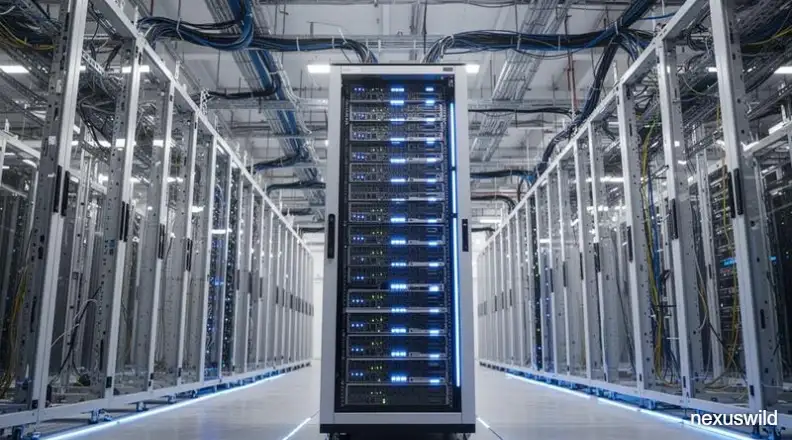

Marvell Technology has agreed to acquire Lumentum Holdings in an all-stock deal valued at about $115 billion in enterprise terms. This move marks a step in the consolidation of the semiconductor and optical connectivity sectors. The companies are responding to the rising need for infrastructure to support artificial intelligence. The announcement came on November 2 2026.
The deal combines Marvell’s strength in semiconductor design and electrical connectivity with Lumentum’s expertise in components, laser technology and specialized manufacturing. Together they aim to build an integrated platform for the complex networks used in AI data centres.
The acquisition reflects a trend in the industry: the growing importance of fast and efficient data movement between processors, servers and computing systems. As artificial intelligence grows so does the need for high-speed connections and systems that use energy.
Under the terms of the agreement Lumentum shareholders will get 4.500 shares of Marvell stock for each Lumentum share they own. This exchange ratio is subject to the details of the transaction.
The $115 billion figure is the enterprise value. This includes not the value of the shares but also the company’s debt and other financial obligations. In contrast the equity value of Lumentum is $102.5 billion.
After the deal closes Marvell’s current shareholders are expected to own 67% of the combined company. Lumentum shareholders will hold the remaining 33% assuming dilution.
The boards of both companies have approved the merger.. The deal still needs approval from shareholders of both firms, government regulators and other standard closing conditions.
The companies plan to complete the acquisition in the half of 2028.
Marvell and Lumentum work in areas of the tech supply chain. Marvell makes semiconductor chips and connectivity solutions for data centres, networking and custom computing systems. Its products include AI- chips, switches and electrical interconnects.
Lumentum provides photonic components such as lasers and parts used in high-speed communication networks. It also has manufacturing capabilities, including indium phosphide-based technologies used in many optical systems.
By joining forces the two companies could develop optical components together. This could lead to seamless systems and reduce the complexity of building data-centre infrastructure from separate parts.
The goal is to create an offering for AI infrastructure especially as data-centre networks demand more bandwidth, better performance and lower energy use.
Optical connectivity is becoming crucial for AI data centres. These facilities use processors working in parallel. That means large amounts of data must move quickly both within and between server racks.
While copper-based electrical connections are still common they face limits as data speeds rise. Issues like signal loss, power use, heat and system complexity become harder to manage.
Optical technologies use light to transmit data. They can carry information over longer distances with less power and heat. This makes them ideal for high-performance environments.
One promising area is -packaged optics or CPO. This approach places components close to the main processor or switch. It can help overcome some of the bottlenecks caused by electrical wires.
Optical connectivity is not replacing copper everywhere. Different technologies will remain in use depending on distance, cost and performance needs. Still the rise of AI clusters is increasing the role of optical solutions.
Marvell’s experience with systems and Lumentum’s optical expertise could help the merged company offer better-integrated solutions.
The combined business is expected to serve a market worth about $550 billion in emerging AI connectivity applications. That figure represents a market not confirmed sales.
The companies also see than $1 billion in annual cost savings. These are expected to come from lowering production costs and improving operational efficiency.
Marvell believes the acquisition will boost its -GAAP earnings per share in the year after the deal closes. That is a projection, not a guarantee.
They also expect long-term revenue growth and improved gross and operating margins.. These outcomes depend on many factors: how well the companies integrate, customer demand, production success and the ability to deliver on cost savings.
The market reaction to the deal was negative. Marvell’s stock dropped than 10%. Lumentum’s shares fell by over 15% in the trading session after the announcement.
Investors were concerned about the price the dilution of Marvell shares and the risks involved in merging two large companies. They also noted how much investment is already happening in AI infrastructure.
Because it is an all-stock deal Marvell will issue a lot of shares to Lumentum shareholders. This increases the number of shares outstanding. As a result existing Marvell shareholders will own a portion of the company.
Some investors worry that the deal could disrupt customer relationships slow down product development or affect manufacturing.
The expected closing date in 2028 adds uncertainty. Both companies must keep performing during the approval process and while preparing to combine their operations.
Next steps include shareholder votes, regulatory reviews and planning for integration. Investors will be watching the companies’ results and updates on cost savings.
For the semiconductor industry this deal shows that competition in AI infrastructure is expanding beyond processors and memory. Optical components, lasers, networking systems and high-speed interconnects are now central to the story.
If the merger succeeds Marvell could gain a position across both electrical and optical parts of the connectivity chain.
Its long-term success will depend on how it integrates the two businesses, how quickly customers adopt new products and how well it turns the $550 billion market opportunity into real revenue.
So the deal is. A big bet on the future of AI infrastructure and a major financial investment. Its outcome will be closely watched by everyone, from investors to industry analysts.
Nexuswild welcomes factual corrections. Email contact@nexuswild.com with evidence and the article URL.