
Microsoft Unveils Maia 300 AI Chip to Cut Costs and Boost Efficiency
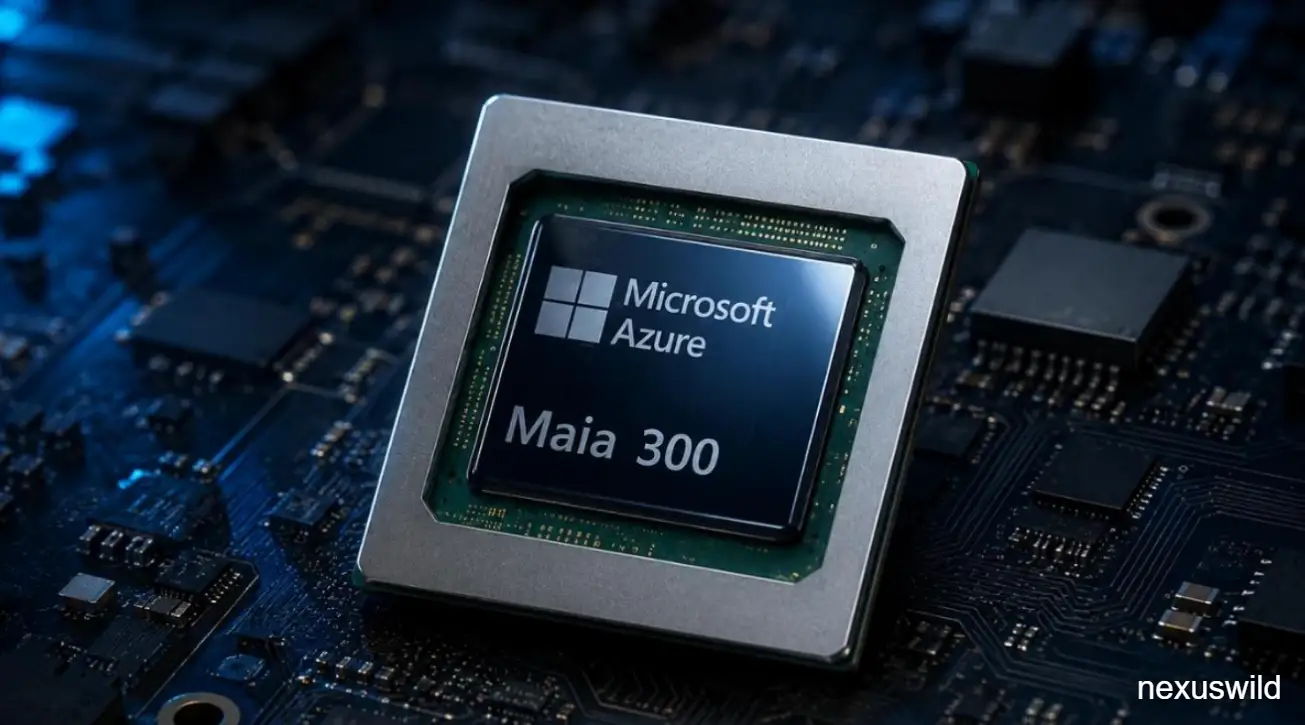
Microsoft has announced Maia 300, its third-generation in-house artificial intelligence chip, as the company prepares to expand its custom AI infrastructure across its cloud and software services from 2027.
The chip is designed to become the primary inference system for Microsoft products and services, supporting AI tasks such as generating responses, processing long documents and running multi-step AI agents. The announcement, made on October 12, marks another step in Microsoft's effort to design more of the hardware behind its AI services rather than relying entirely on processors supplied by companies such as Nvidia and AMD.
Microsoft says Maia 300 is expected to deliver 40% more tokens per megawatt than leading GPU-based systems. In a full rack configuration containing 96 accelerators, the company also expects up to seven times the token throughput of its previous-generation Maia 200 system. These are Microsoft's stated expectations; real-world performance will depend on workloads, deployment conditions and the systems used for comparison.
Why Microsoft is building its own AI chips
The rapid expansion of generative AI has increased demand for computing infrastructure. AI models require large amounts of processing power to train, but they also need substantial resources when serving millions of requests from users.
That second stage, known as inference, is central to products such as AI assistants, coding tools and enterprise applications. Every question answered, document summarised or software task completed requires computing resources. As usage grows, the cost and electricity needed to run those services become increasingly important.
Microsoft operates a large cloud computing business through Azure and offers AI features across products including Copilot and GitHub Copilot. Developing specialised chips gives the company more control over how its data centres handle these workloads.
Custom silicon does not automatically eliminate the need for third-party processors. Different AI models and computing tasks have different hardware requirements, and chip design, manufacturing capacity and software compatibility all influence deployment. Microsoft's announcement instead signals a plan to make its own Maia systems a much more important part of its AI infrastructure.
The company says it plans multi-gigawatt deployments of the Azure Maia family beginning in 2027. That is a statement of planned infrastructure scale, not confirmation that the full deployment is already operational.
What is different about Maia 300?
One of the central design choices is a chiplet architecture. Rather than treating every part of the processor as one uniform design, this approach separates key functions, including computing, memory control and input/output.
Microsoft says Maia 300 uses TSMC's N2P manufacturing process for its design. Separating functions allows different parts of the chip to be designed around their specific needs, with the goal of dedicating more silicon area to computing performance while selecting suitable technologies for other functions.
The architecture is intended to address newer AI workloads, including long-context reasoning and agentic systems that carry out a series of connected tasks rather than responding to a single instruction. These workloads can place different demands on memory, processing and data movement compared with simpler AI requests.
Microsoft's efficiency claims also matter because data centres face practical limits on electricity supply and cooling. Improving the amount of useful AI processing delivered for a given amount of power could allow operators to serve more requests without increasing energy consumption at the same rate. The actual benefit will depend on how the chips perform in production and how efficiently the surrounding systems are designed.
Maia 200 provides the foundation
Maia 300 follows Maia 200, which Microsoft says is already running production workloads across its services. Those deployments include Microsoft Copilot and the company's own AI models, with further integrations across its AI development and cloud platforms planned.
Experience with the previous generation gives Microsoft a basis for designing the next chip around workloads it operates itself. The company can coordinate hardware decisions with its software, AI models and data-centre systems rather than optimising each layer separately.
This approach, often described as full-stack optimisation, is becoming an important strategy among large technology companies. The goal is not simply to build a faster processor but to improve the performance, energy use and cost of an entire computing system.
Microsoft AI chief Mustafa Suleyman has described control over the underlying platform as important to the company's model-development efforts. Maia 300 is therefore both an infrastructure project and part of Microsoft's wider attempt to strengthen its position in the AI market.
Implications for Nvidia and AMD
Nvidia has become a major supplier of accelerators used to develop and run advanced AI models. AMD also competes in the market for data-centre processors. Microsoft's investment in its own chips adds to pressure on suppliers to demonstrate that their products offer compelling performance, availability and overall operating costs.
However, the announcement does not mean Microsoft is ending its use of Nvidia or AMD hardware. Large cloud platforms typically use a mix of processors to meet different technical and commercial requirements. Maia's long-term significance will depend on how quickly Microsoft can manufacture, deploy and support its systems at scale, as well as how they compare with alternatives in real workloads.
The wider trend extends beyond Microsoft. Major cloud and technology companies have invested in custom silicon to tailor computing systems to their services. These efforts can give operators more control over design priorities, but they also require substantial investment in engineering, software and manufacturing partnerships.
What to watch next
The next important milestone is the planned rollout of Maia 300 to production workloads in 2027. Evidence from actual deployments will help establish whether the announced efficiency and throughput improvements translate into lower costs and better service performance.
Manufacturing capacity will also matter. Building a capable chip is only one part of the challenge; deploying it at the scale required by global AI services demands reliable supply, compatible software and data centres able to support the associated power and cooling requirements.
For Microsoft, Maia 300 represents a longer-term effort to align AI hardware with its own products and models. For the industry, it adds another sign that competition in artificial intelligence is increasingly about the entire computing platform — from chips and energy to cloud infrastructure and software — rather than AI models alone.
Nexuswild welcomes factual corrections. Email contact@nexuswild.com with evidence and the article URL.