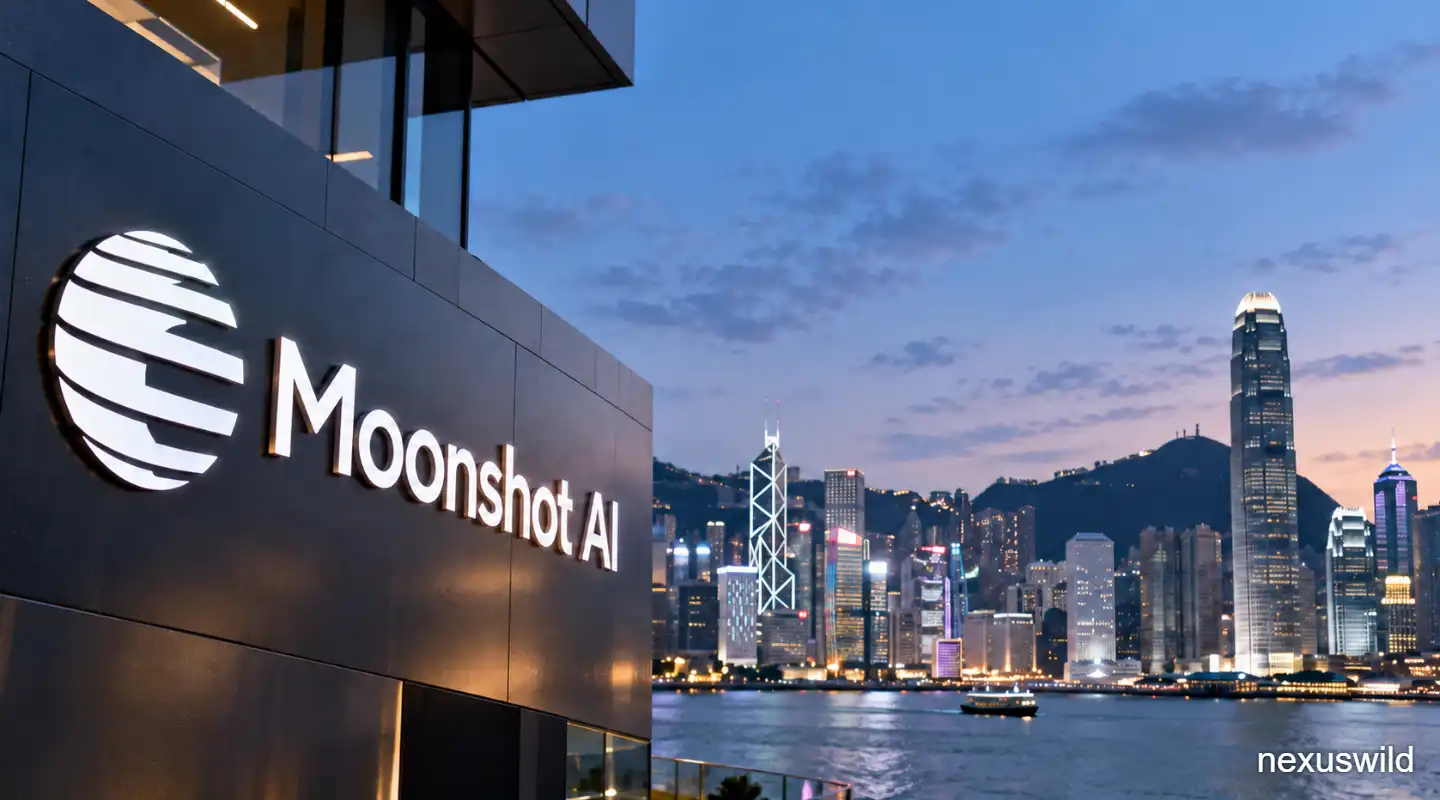

Chinese artificial-intelligence startup Moonshot AI is preparing for a possible Hong Kong stock-market debut in the first quarter of 2027 after completing its final private funding round at a valuation of about $50 billion, according to people familiar with the plans.
The Beijing-based company, best known for its Kimi family of AI models, has begun preparing early meetings with prospective investors and could start gauging market demand as soon as October, Bloomberg reported on October 6.
Moonshot is considering raising as much as $5 billion in the IPO, although the size, valuation and timing of any offering remain subject to market conditions and regulatory approvals.
The plans represent another step in Moonshot’s rapid rise from a young Chinese AI laboratory into one of the country’s most highly valued private technology companies.
Valuation Reaches About $50 Billion
Moonshot has reportedly completed its final private financing at a valuation of approximately $50 billion.
That represents a substantial increase from only a few months earlier.
In July, the company closed a $3.5 billion fundraising round at a valuation of about $35 billion, significantly exceeding its original goal of raising between $1 billion and $2 billion. China’s National Artificial Intelligence Industry Investment Fund was among the lead investors in that financing, according to Bloomberg.
At that stage, Moonshot had already begun contacting investors about another round at a $50 billion pre-money valuation before pursuing a public listing.
The latest reporting indicates that the company has now achieved roughly that valuation in its final private round.
Private valuations are negotiated between companies and investors and should not be treated as equivalent to the market capitalization Moonshot would receive after an IPO.
Hong Kong Listing Could Come in First Quarter of 2027
Moonshot is now targeting a Hong Kong IPO during the first quarter of 2027, according to Bloomberg reporting based on people familiar with the matter.
The company is expected to begin early-look meetings with institutional investors before formally marketing the offering.
These preliminary meetings allow banks and issuers to assess investor demand, valuation expectations and concerns before establishing final IPO terms.
The timetable remains provisional.
Regulatory approval, equity-market conditions and investor demand could all affect when the listing ultimately takes place.
Moonshot Had Already Filed Confidentially
The IPO preparations did not begin this week.
Reuters reported on September 3 that Moonshot had confidentially filed for a Hong Kong IPO, citing sources familiar with the process. At that time, the company was considering raising about $3 billion.
The more recent Bloomberg report says Moonshot is now considering raising as much as $5 billion.
Those figures are not necessarily contradictory. IPO sizes commonly change during the preparation process as companies assess market conditions and investor appetite.
Neither figure should be treated as the final offering size until Moonshot publishes formal prospectus terms.
Goldman Sachs, CICC and Deutsche Bank Reportedly Involved
Reuters previously reported that Moonshot was working with Goldman Sachs, China International Capital Corporation and Deutsche Bank on its potential Hong Kong listing.
A successful flotation would provide Moonshot with additional capital to fund model development, computing infrastructure and international expansion.
AI companies require significant spending on graphics processors, data centers, electricity, engineering talent and model training.
Access to public capital markets could therefore give Moonshot another source of financing as competition intensifies among Chinese and international AI developers.
Kimi K3 Helped Accelerate Investor Interest
Much of the recent increase in Moonshot’s valuation followed the release of Kimi K3 in July.
The open-weight model attracted international attention after Moonshot said it performed competitively with some leading systems from OpenAI and Anthropic across a number of benchmarks.
Bloomberg reported that the model’s release helped drive demand for Moonshot’s July financing and contributed to the jump in its private-market valuation.
Benchmark results should be interpreted carefully because performance can vary significantly depending on the test, configuration and task.
They nevertheless helped raise Moonshot’s profile outside China.
Moonshot Was Founded Only in 2023
Moonshot AI was founded in 2023 by artificial-intelligence researcher Yang Zhilin.
Yang previously conducted AI research associated with institutions including Carnegie Mellon University and worked in research environments linked to Google Brain and Meta AI before founding Moonshot.
The company quickly became one of China’s best-funded independent AI laboratories.
Its backers have included Alibaba, Tencent, HongShan, IDG Capital, ZhenFund, 5Y Capital and China Mobile, according to funding reports.
Moonshot has raised billions of dollars as it attempts to compete with Chinese technology groups such as Alibaba and ByteDance as well as independent laboratories including DeepSeek and Z.ai.
Revenue Has Also Been Rising
Investor enthusiasm has not been based solely on model benchmarks.
Bloomberg reported earlier this year that Moonshot’s annual recurring revenue had reached approximately $300 million in June, up sharply from earlier in 2026.
TechCrunch separately reported that annual recurring revenue had surpassed $200 million in April, supported by paid subscriptions and API usage.
Annual recurring revenue is a run-rate measure rather than audited full-year sales.
Moonshot has not publicly released comprehensive financial statements showing its net profit, operating cash flow or total annual expenses.
Those figures will become particularly important if the company moves ahead with a public listing.
$50 Billion Valuation Raises Expectations
A $50 billion private valuation places substantial expectations on Moonshot’s future growth.
The figure is roughly 43% higher than the $35 billion valuation reported after its July financing.
Such rapid increases in AI-company valuations have become common as investors compete for exposure to companies developing frontier models.
But public-market investors typically receive more detailed financial information than private funding participants and may apply different valuation standards.
The eventual IPO price could therefore be higher or lower than Moonshot’s latest private valuation.
Hong Kong Has Become a Major AI Listing Venue
Moonshot’s plans come amid growing activity among Chinese AI companies seeking listings in Hong Kong.
Several technology developers have turned to the exchange as they seek large pools of capital for model development and infrastructure.
Reuters reported in September that Hong Kong technology listings had already raised about $41.2 billion by mid-August 2026, reflecting a revival in the city's equity capital markets.
A multibillion-dollar Moonshot offering would add to that momentum.
It could also provide public-market investors with direct exposure to one of China’s best-known independent generative-AI developers.
Moonshot Competes in an Increasingly Crowded Chinese AI Market
China's AI sector has become highly competitive.
Moonshot competes with DeepSeek, Alibaba's Qwen, ByteDance, Z.ai and other domestic model developers, while its products are also compared with systems produced by OpenAI, Anthropic and Google.
DeepSeek is itself pursuing major financing, with Reuters reporting on October 6 that it is set to raise more than 80 billion yuan, approximately $11.9 billion, at a targeted valuation of about $74 billion.
The simultaneous fundraising efforts illustrate the enormous amount of capital now required to compete at the frontier of AI development.
U.S. Cloud Companies Have Also Shown Interest
Reuters previously reported that Moonshot had been in talks with Microsoft, Amazon and Google about potentially hosting Kimi models through their cloud platforms under revenue-sharing arrangements.
If completed, such agreements could provide Moonshot with a broader international distribution channel.
The discussions had not resulted in publicly confirmed final agreements at the time of that reporting.
They should therefore be treated as negotiations rather than established commercial partnerships.
Regulatory Risks Remain
Moonshot’s global expansion is also exposed to geopolitical and regulatory risks.
Advanced AI chips remain a major point of tension between the United States and China, with Washington imposing export restrictions on certain high-performance processors.
Chinese AI developers have consequently been investing in more efficient models and domestic computing alternatives.
Reuters has also reported scrutiny from U.S. officials over the use of advanced chips and model-training practices by Chinese AI companies, including Moonshot. The company has disputed some allegations regarding its training methods.
Those issues could affect international partnerships even if Moonshot successfully completes its IPO.
An IPO Is Not Yet Guaranteed
Despite the advanced preparations, Moonshot has not yet completed a Hong Kong listing.
The latest reports describe a targeted first-quarter 2027 timetable.
Final execution will depend on regulatory approval, investor demand and financial-market conditions.
The amount Moonshot ultimately raises could also differ materially from the reported maximum of $5 billion.
Until formal prospectus documents specify the terms, the IPO size and pricing remain provisional.
Conclusion
Moonshot AI is moving closer to the public markets after reportedly completing its final private funding round at a valuation of approximately $50 billion.
The Beijing-based developer is targeting a Hong Kong IPO in the first quarter of 2027 and may seek to raise as much as $5 billion, although the final amount remains undecided.
The prospective listing follows an exceptionally rapid increase in Moonshot’s valuation. The company was valued at about $35 billion in July after raising $3.5 billion, before securing additional capital at the higher valuation.
Strong investor interest in its Kimi models, rising recurring revenue and continued demand for Chinese AI exposure have helped propel that growth.
The key distinction for investors is that the $50 billion valuation is tied to Moonshot’s latest private financing, while the valuation it receives in an eventual Hong Kong IPO has not yet been determined.
Nexuswild welcomes factual corrections. Email contact@nexuswild.com with evidence and the article URL.