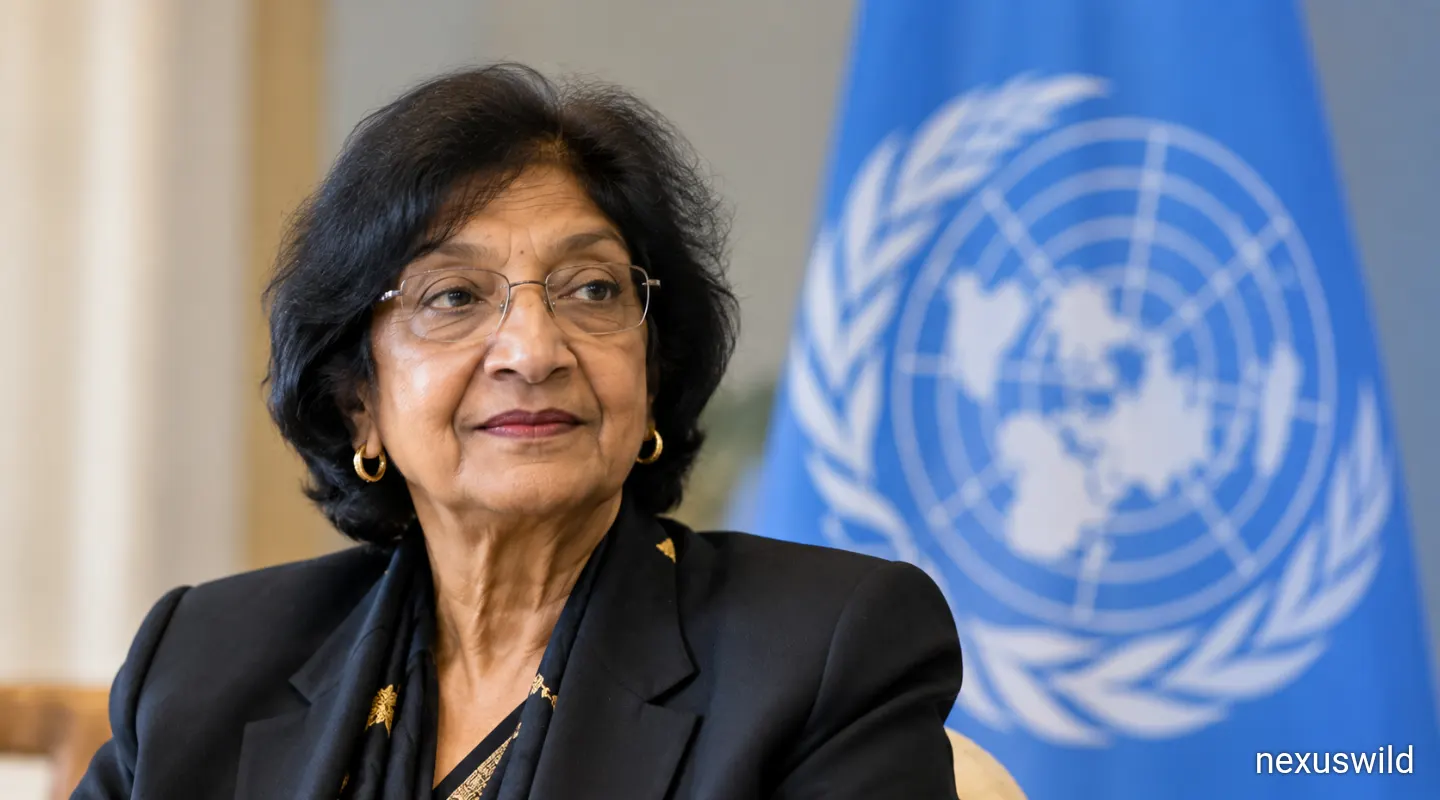

South African jurist Navanethem “Navi” Pillay has won the 2026 Nobel Peace Prize for her efforts to promote peace and international law, the Norwegian Nobel Committee announced on October 9. The committee recognised her decades-long contribution to strengthening legal institutions and ensuring that war crimes, crimes against humanity and genocide can be prosecuted.
The award highlights the role of international justice in preventing violence and resolving conflicts through legal mechanisms rather than force. According to the committee, Pillay’s career demonstrates how courts and international legal frameworks can help hold individuals and states accountable for serious violations.
Who Is Navi Pillay?
Born in Durban, South Africa, in 1941, Pillay grew up during apartheid in a family of Indian Tamil origin. She became a lawyer during a period when racial discrimination shaped access to education, employment and public institutions.
In 1967, she established her own law practice in Natal, becoming the first woman to do so in the province. She later became the first non-white woman appointed to South Africa’s High Court after the end of apartheid.
Her early legal career included defending people who challenged the apartheid system, including Nelson Mandela and other anti-apartheid activists. Those experiences helped shape her long-standing focus on equality, accountability and the protection of human rights.
A Career Spanning International Courts and the United Nations
Pillay’s work expanded from South African law into international justice. She served as a judge and president of the International Criminal Tribunal for Rwanda, where proceedings helped establish important precedents concerning sexual violence and the use ofp propaganda in connection with genocide.
She subsequently served as a judge at the International Criminal Court, which prosecutes individuals accused of serious international crimes under its jurisdiction.
From 2008 to 2014, Pillay was the United Nations High Commissioner for Human Rights. In that position, she worked on issues involving civil liberties, discrimination, conflict and the protection of vulnerable communities.
She also chaired the UN Independent International Commission of Inquiry on the Occupied Palestinian Territory from 2021 to 2025. Since 2019, she has served as an ad hoc judge at the International Court of Justice in proceedings concerning allegations of genocide against Myanmar.
Why the 2026 Nobel Peace Prize Matters
The Nobel Committee said Pillay’s work reflects the importance of maintaining an international legal order at a time when courts and legal institutions face increasing political pressure.
Its announcement stressed that the rule of law is essential to peaceful coexistence and the non-violent resolution of disputes. The award therefore recognises not only Pillay’s individual career but also the wider role of international institutions in investigating atrocities, establishing responsibility and supporting victims seeking justice.
The prize comes amid continuing international debates over the enforcement of humanitarian law and the ability of global institutions to hold powerful actors accountable. Pillay’s work has involved several major international legal questions, including accountability for atrocities in Rwanda and proceedings concerning Myanmar.
Her work on the occupied Palestinian territory has also attracted significant political controversy. The UN commission she chaired concluded in 2025 that Israel had committed genocide in Gaza, a finding Israel has strongly rejected. These contested issues form part of the broader international legal landscape in which Pillay has worked.
A Legacy of Human Rights and Accountability
The 2026 award adds Pillay to the list of South Africans recognised with the Nobel Peace Prize, following recipients including Albert Luthuli, Desmond Tutu, Nelson Mandela and F.W. de Klerk.
The Nobel Peace Prize carries an award of 12 million Swedish kronor. The ceremony is scheduled for December 10 in Oslo, Norway, the anniversary of Alfred Nobel’s death.
Pillay’s recognition places renewed attention on the relationship between justice and peace. Her career, spanning domestic courts, international tribunals and the United Nations, has focused on the principle that serious abuses should be investigated and addressed through established legal processes. The committee’s decision underscores the continuing importance of international law in efforts to protect human dignity and prevent future atrocities.
Nexuswild welcomes factual corrections. Email contact@nexuswild.com with evidence and the article URL.