
Is "BIA Computing" a Real Scientific Term?
No. A search of peer-reviewed journals, university publications, government research databases, and official statements from the companies working in this field turns up no formal use of "BIA Computing" as a scientific or industry term. The only place the phrase appears with a definition attached is on a small number of general web content sites, one of which expands it as "Bio-Integrated AI computing" and pairs that definition with an unverifiable market-size projection. Neither claim traces back to a credible source, and no university, journal, or company reviewed for this article uses "BIA Computing" to describe its own work.
The actual, recognized field goes by several established names, and the choice of term usually reflects who is speaking. Researchers at Johns Hopkins University coined "organoid intelligence" (OI) in 2023 to describe biological computing built from lab-grown brain tissue. The broader academic and industry term is "biological computing" or "biocomputing." The Swiss company FinalSpark calls its approach "wetware computing." The Australian company Cortical Labs uses "Synthetic Biological Intelligence" (SBI) as a brand term for the same underlying idea. This article uses these established terms throughout and explains how they relate to one another.
What Biological Computing Is and How It Works
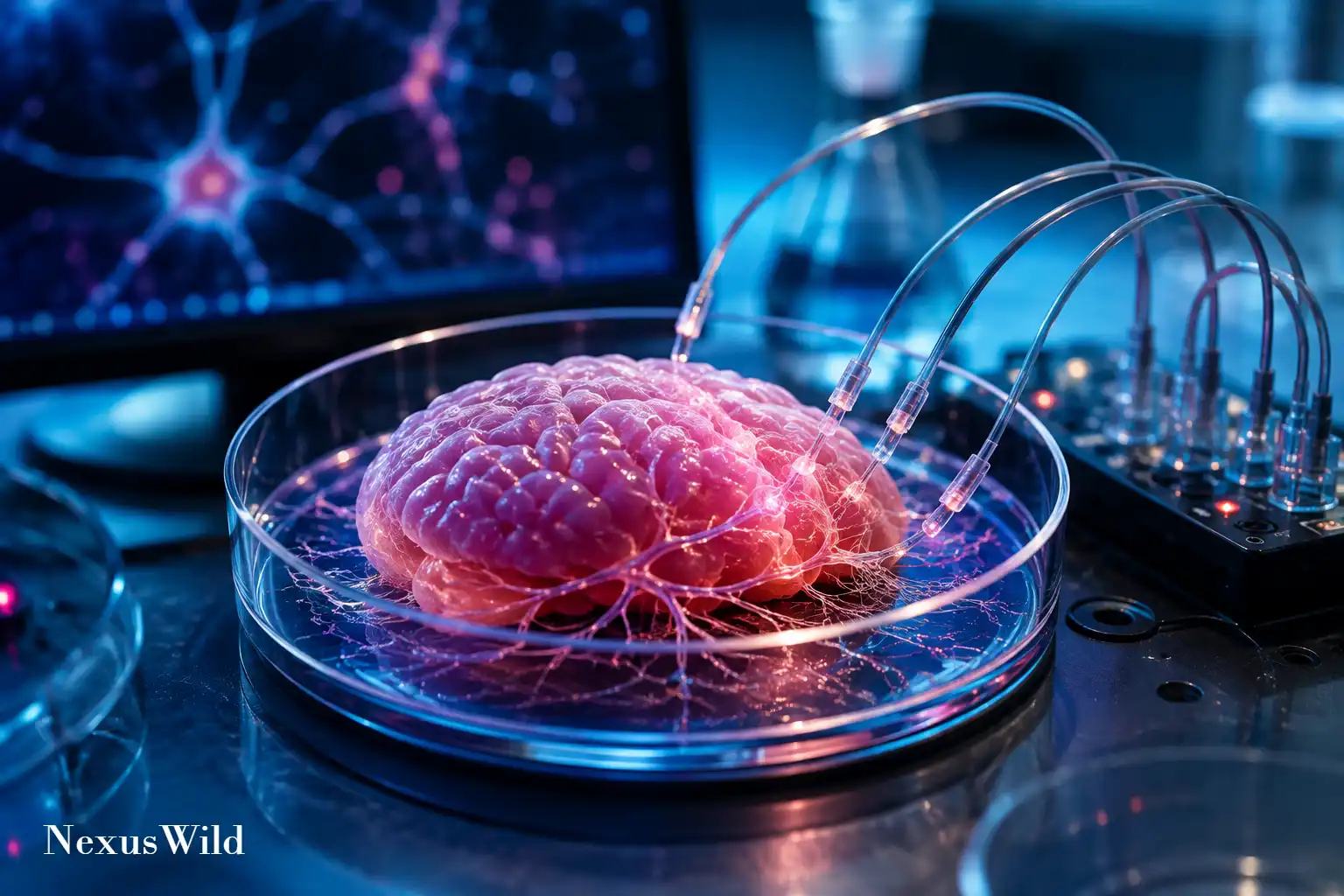
Biological computing, in the sense relevant here, means using living neurons, rather than silicon transistors, to process information. The neurons are either grown as flat two-dimensional cultures on a dish or grown into three-dimensional clusters called brain organoids: lab-grown tissue derived from human stem cells that self-organizes into structures resembling parts of a developing brain.
To get information in and out of this living tissue, researchers place it on a multielectrode array (MEA), a small chip covered in dozens to thousands of tiny electrodes. The MEA can both record the electrical activity of the neurons and deliver small electrical pulses to stimulate them. By converting an input, such as an image, sound, or the state of a video game, into a pattern of electrical stimulation, and by reading the neurons' resulting electrical activity as an output, researchers can use the network as a computing substrate. When the connections between neurons are reshaped by their own activity, a form of learning called synaptic plasticity, the system can be trained to perform simple tasks.
The scientific interest is largely about efficiency. The human brain performs its functions on a small power budget compared with digital computers running large AI models, and it stores and processes information in the same physical location: the synapse. Conventional computers keep memory and processing separate and have to shuttle data between them, a limitation known as the von Neumann bottleneck. Biological neurons do not have this separation, which is the central reason researchers are interested in whether living tissue could eventually offer a more energy-efficient way to compute.
Origins and Development of the Field
Interest in interfacing living neurons with electronics predates the current wave of activity, with earlier "hybrot" (hybrid robot) experiments connecting cultured neurons to simple robots. The modern phase of the field, however, traces to a specific sequence of publications.
- In October 2022, a team at Cortical Labs in Melbourne, working with researchers from several other institutions, published a study in the journal Neuron titled "In vitro neurons learn and exhibit sentience when embodied in a simulated game-world," commonly known by the system's nickname, DishBrain. This was the experiment that brought wide public attention to the idea of neurons performing computation in a game environment.
- In February 2023, a group led by Thomas Hartung and Lena Smirnova at Johns Hopkins University published a paper in the inaugural issue of Frontiers in Science titled "Organoid intelligence (OI): the new frontier in biocomputing and intelligence-in-a-dish." This is the paper that coined the term "organoid intelligence" and proposed it as the name for a new multidisciplinary field. It was accompanied by a companion editorial, "The Baltimore declaration toward the exploration of organoid intelligence," co-authored by dozens of researchers across neuroscience, bioengineering, and ethics.
- Later in 2023, a team led by Feng Guo at Indiana University Bloomington, with lead author Hongwei Cai, published "Brain organoid reservoir computing for artificial intelligence" in the journal *Nature Electronics*. This work, nicknamed Brainoware, was the first demonstration of this kind of computing using a three-dimensional brain organoid rather than a flat neuron culture.
- In May 2024, the Swiss company FinalSpark published a peer-reviewed paper in Frontiers in Artificial Intelligence describing its Neuroplatform, a remotely accessible system that lets outside researchers run experiments on living brain organoids over the internet.
- In March 2025, Cortical Labs launched the CL1, which it markets as the first commercially available, code-deployable biological computer, moving the field from pure research demonstrations toward an actual product.
Organoid Intelligence, Biohybrid Computing, and Related Terms
These terms overlap but are not identical. "Organoid intelligence" specifically refers to computing built from three-dimensional brain organoids, the approach pursued by the Johns Hopkins group and by Indiana University's Brainoware system. "Biohybrid computing" and "wetware computing" are broader terms covering any system that combines living biological tissue, whether 2D neuron cultures or 3D organoids, with electronic hardware; FinalSpark uses "wetware computing" as its preferred term. "Synthetic Biological Intelligence" is Cortical Labs' own branded term for its neuron-silicon hybrid systems, including both DishBrain and the commercial CL1. "Biocomputing" is the oldest and most general term, used across the field to describe any computation performed using biological materials.
How Living Neurons Interface With Computers
The core hardware connecting biology to electronics is the multielectrode array (MEA). Standard MEAs are flat, which works for 2D neuron cultures but poorly for round, three-dimensional organoids, since only the outer layer of cells touches the electrodes. To address this, David Gracias' lab at Johns Hopkins developed "shell microelectrode arrays," flexible electrode structures that can wrap around or fold into a 3D organoid, published in Science Advances in 2022, improving how much of the organoid's activity can actually be recorded.
Around the MEA, a life-support system keeps the tissue alive: a supply of nutrient-rich culture medium, temperature control near normal body temperature, gas exchange, and waste removal, usually delivered through microfluidic channels. FinalSpark's Neuroplatform, for example, includes pumps, cameras, and even ultraviolet lighting for a technique called molecule uncaging, which releases chemical compounds on demand to influence the neurons. Software then closes the loop: it converts task inputs into stimulation patterns, reads the resulting electrical signals, and applies machine learning methods to interpret or reinforce that activity. FinalSpark's system exposes this as a Python API researchers can use directly, including from Jupyter notebooks, while Cortical Labs describes the CL1 as running through layered firmware that allows sub-millisecond read and write cycles with the cell culture.
Key Technologies and Components
The building blocks recurring across every serious project in this field are: stem-cell-derived neurons or brain organoids as the computing substrate; high-density multielectrode arrays for input and output; microfluidic perfusion systems that keep tissue alive for weeks or months; and software layers, ranging from custom APIs to reservoir-computing algorithms, that translate between digital data and biological electrical activity. Reservoir computing, the specific machine learning framework used in Brainoware and referenced in other organoid systems, treats the neural network as a fixed, complex "reservoir" that transforms input signals in useful, nonlinear ways; a simpler external algorithm then just has to learn how to read the reservoir's output, rather than training the biological network directly in the way a digital neural network is trained.
Important University and Laboratory Research
Johns Hopkins University is the institutional center of the organoid intelligence field. Thomas Hartung and Lena Smirnova lead the group that coined the term and authored the Baltimore Declaration, while David Gracias' lab develops the shell MEA hardware used to interface with organoids. Indiana University Bloomington, through Feng Guo's Department of Intelligent Systems Engineering, developed Brainoware and continues applying organoid computing to disease research, including Alzheimer's studies comparing organoids derived from healthy and affected individuals. The DishBrain work originated at Cortical Labs but was a multi-institutional collaboration; Karl Friston, a theoretical neuroscientist at University College London, contributed the theoretical framework (the free energy principle) used to interpret the neurons' behavior as goal-directed. The University of Pisa's Arti Ahluwalia and Chiara Magliaro have contributed peer review and critical commentary on organoid modeling standards across several of these papers.
Major Experiments and What They Actually Demonstrated
- DishBrain (2022). Roughly 800,000 neurons, derived from either human induced pluripotent stem cells or mouse embryonic tissue, were placed on a high-density MEA and embedded in a simulated version of the video game *Pong*. Electrical stimulation indicated the ball's position; the neurons' electrical output moved the paddle. The system demonstrated a measurable change in neural activity consistent with learning within about five minutes of gameplay, and human-derived neurons sustained longer rallies than mouse-derived neurons. This showed that a living neural culture could adapt its behavior based on structured feedback in a real-time, closed-loop system. It did not demonstrate general intelligence or prove the neurons were conscious. The paper's use of the word "sentience" drew substantial criticism from other scientists; a formal rebuttal by Fuat Balci and colleagues was published in Neuron in March 2023, arguing the observed behavior did not meet an established scientific bar for that term.
- Brainoware (2023). A single brain organoid on an MEA was used as a reservoir-computing substrate and tested on a speech recognition task: identifying which of eight speakers had produced one of 240 recorded Japanese vowel sounds. The system reached 78 percent accuracy, a result the researchers and outside commentators, including Lena Smirnova, described as confirming that a 3D organoid, not just flat neuron cultures, could perform this kind of computation. That accuracy is well below what a standard digital artificial neural network achieves on comparable classification tasks, and outside coverage of the study, including in Nature's own news division, noted the result as proof of concept rather than a competitive benchmark.
- FinalSpark's Neuroplatform (2024, ongoing). This is best understood as research infrastructure rather than a single experiment. The published paper describes a system that gave outside researchers 24/7 remote access to human brain organoids for closed-loop electrophysiology experiments. According to FinalSpark's own later reporting, the platform has since been used with more than 1,000 organoids and generated over 18 terabytes of data across roughly three years of operation. It demonstrates that organoid computing experiments can be run remotely and at a meaningful research scale, not that any specific computing task has been solved.
Companies Developing Relevant Technologies
- Cortical Labs (Melbourne, Australia, founded 2019) built DishBrain and, in March 2025, launched the CL1, which it describes as the first commercially available, code-deployable biological computer. Each unit contains roughly 800,000 neurons grown from reprogrammed adult donor cells and integrated with a silicon chip.
- FinalSpark (Vevey, Switzerland, founded 2014) developed the Neuroplatform and coined its use of "wetware computing" to describe the approach. It sells research access rather than a standalone hardware product.
- Koniku (San Rafael, California, founded 2015) takes a different approach, engineering neurons to express specific odor receptors and interfacing them with silicon in a product called the Konikore, aimed at detecting chemical signatures and explosives for security and defense applications. Koniku has partnered with Airbus since 2017 on aviation threat detection and became a founding member of Oracle's Defense Ecosystem in 2025. It is the one company in this space with a longer track record of selling a defined commercial biosensing product, distinct from general-purpose biological computing.
- The Biological Computing (San Francisco, founded 2022) is an early-stage startup developing an algorithm discovery platform built around living neuron networks, reported to have raised a $25 million seed round. Public technical detail on its approach is limited compared with the peer-reviewed work from Cortical Labs, FinalSpark, and the university labs above.
Current Capabilities and Limitations
What has been demonstrated: living neural cultures and organoids can be made to respond differently to different inputs, can show electrophysiological changes consistent with learning in closed-loop tasks, and can perform basic reservoir-computing functions such as pattern classification and short-term signal prediction.
What has not been demonstrated: any organoid-based system outperforming conventional digital computers or trained artificial neural networks on accuracy for a shared task. The 78 percent speech-recognition accuracy in Brainoware, for instance, falls short of typical digital benchmarks on similar classification problems. Current systems also operate at a scale of hundreds of thousands of neurons, compared with the roughly 86 billion neurons in a human brain and the billions to trillions of parameters in large digital AI models, a gap of many orders of magnitude that no current organoid system is close to closing.
Biological Computing vs. Conventional and Neuromorphic Computing
It helps to separate three distinct categories that are sometimes conflated in casual coverage.
- Conventional computing uses silicon transistors with memory and processing physically separated, connected by a data bus, the von Neumann architecture that underlies essentially all commercial computers and AI accelerators today.
- Neuromorphic computing also uses silicon, but the chip's architecture is designed to mimic how biological neurons communicate, typically using discrete electrical spikes rather than continuous digital signals. Intel's Loihi 2, introduced in 2021, and IBM's earlier TrueNorth chip are the best-known examples; both are entirely non-biological, built from ordinary semiconductor manufacturing processes, but structured to behave more like a brain.
- Biological computing, or organoid intelligence, is different again: it uses actual living neurons as the computing substrate, not a silicon imitation of one. Neuromorphic chips are commercially available research and edge-computing products today; biological computing systems are not, beyond the small-scale commercial offerings described above.
Performance and Energy-Efficiency Evidence
The energy-efficiency case for biological computing rests mostly on company statements rather than independent, peer-reviewed benchmarks measured against digital systems on identical tasks. FinalSpark states its bioprocessors consume "a million times less power" than traditional digital processors; this is a company claim, not an independently verified measurement. Cortical Labs states that a single CL1 unit draws as little as 30 watts, and a 30-unit server rack draws 850 to 1,000 watts total, compared with roughly 6,000 watts for a single high-end Nvidia data center GPU; this is also a company-stated comparison rather than a third-party benchmark.
On the neuromorphic silicon side, independent academic evidence is stronger, though it concerns brain-inspired chips, not living tissue. One peer-reviewed study evaluating Intel's Loihi 2 on a sensor-fusion task measured roughly 104 giga-operations per second per watt, compared with about 3.8 for an Nvidia RTX 3060 GPU and 0.3 for an Intel Core i9 CPU on the same workload, a roughly 27-fold efficiency advantage over the GPU in that specific test. IBM has separately claimed its older TrueNorth chip achieved up to 176,000 times better energy efficiency than a conventional Intel i7 processor on certain specialized applications, though TrueNorth also runs at a comparatively slow operating frequency. No equivalent independent, head-to-head benchmark currently exists comparing a living organoid-based system against a digital AI system on the same real-world task.
Scalability and Reliability Challenges
Biological tissue is perishable in a way silicon is not. FinalSpark's published methodology describes organoids with a usable lifetime of over 100 days; Cortical Labs states CL1 neurons remain viable for up to six months. Both require continuous, automated life support, precise temperature, nutrient supply, gas exchange, and waste removal, that a conventional computer chip simply does not need. Manufacturing consistency is also an open research problem rather than a solved one: the Johns Hopkins group's own 2023 paper describes the ability to produce "standardized" organoids as a current research goal, and both the Brainoware and Neuroplatform papers describe organoid generation and maintenance as ongoing technical challenges rather than settled engineering. Scaling beyond the current range of roughly hundreds of thousands of neurons per system, toward anything approaching the complexity of a human brain or a large digital AI model, has not been demonstrated and is not close on any published roadmap reviewed for this article.
Ethical and Regulatory Issues
The central ethical question is whether sufficiently complex brain organoids could develop some form of consciousness or morally relevant experience, and if so, what obligations that would create for researchers. This is not a settled scientific question. Some researchers have applied frameworks like Integrated Information Theory to argue that organoids capable of memory formation or environmental responsiveness might warrant moral consideration; this remains a contested theoretical position, not an empirical finding. The DishBrain paper's own use of "sentience" to describe its neurons' behavior was directly disputed by other researchers in the same journal, illustrating how unsettled this question is even among specialists.
Separate from the consciousness question, researchers in the field have identified concrete governance gaps. Existing stem cell research guidelines, including those from the International Society for Stem Cell Research, do not specifically address the moral status of brain organoids, since organoids lack the developmental potential that triggers oversight of human embryo research. Informed consent is another live issue: donors who provided the stem cells used to grow research organoids may not have been informed their cells could be used in organoid intelligence research specifically. The Johns Hopkins group's 2023 Baltimore Declaration was explicitly written as a proactive call for the research community to address these questions before the technology matures further, rather than after problems emerge, and Hartung's group has published follow-up work specifically on the ethical, legal, and social dimensions of the field.
Potential Applications
The nearer-term, better-supported application area is biomedical research: using organoids derived from patients with specific conditions, such as Alzheimer's disease, to study how disease affects information processing at the cellular level, an approach Feng Guo's lab at Indiana University is actively pursuing. Drug screening and toxicity testing are also frequently cited by researchers in the field as plausible uses, since organoids can model human tissue responses in ways standard cell cultures cannot. Longer-term and more speculative is the idea of energy-efficient computing hardware built from living tissue, the goal explicitly stated by FinalSpark and Cortical Labs, though current accuracy and scale limitations mean this remains aspirational rather than demonstrated. A distinct, already-commercial application is biosensing, exemplified by Koniku's use of engineered neurons for chemical and explosive detection.
Current Commercial Development
Commercial activity in this space is real but small in scale. Cortical Labs sells the CL1 unit for approximately $35,000, or $20,000 per unit when purchased in 30-unit server racks, and offers remote cloud access through a "wetware-as-a-service" model priced at $300 per week. FinalSpark offers research institutions access to its Neuroplatform for $500 per month, with some free access granted to research partners. Koniku has the longest-running commercial product, the Konikore biosensor, sold since 2017 through partnerships including Airbus.
On the funding side, the U.S. National Science Foundation's Emerging Frontiers in Research and Innovation program ran a dedicated solicitation, "Biocomputing through EnGINeering Organoid Intelligence" (BEGIN OI), across the 2024 and 2025 fiscal years, planning up to eight awards per competition cycle at up to $2 million per team over four years, an official government commitment to fund foundational research in this area. No independently verified, credible market-size or growth-rate figures for this industry were found in the course of this research; widely circulated statistics claiming specific multi-billion-dollar market sizes for "BIA computing" or similar terms could not be traced to a credible research firm, government body, or peer-reviewed source and should be treated as unverified.
Industry Outlook and Future Potential
This is an early-stage field by any reasonable measure. The term "organoid intelligence" was coined in 2023, the foundational DishBrain experiment was published in 2022, and the first general-purpose commercial hardware product, Cortical Labs' CL1, only shipped in 2025. Government funding through NSF's BEGIN OI program signals that federal research agencies view the field as scientifically promising enough to merit dedicated, multi-year grants, which is a meaningful institutional vote of confidence distinct from any company's own marketing claims. At the same time, every independently verifiable performance result published so far, DishBrain's Pong-paddle control, Brainoware's 78 percent speech classification accuracy, falls well short of conventional digital computing on the same kind of task, and the field's own leading researchers describe organoid standardization, lifespan, and data handling as unresolved engineering problems rather than solved ones.
The most credible near-term path for the field is biomedical: organoid-based disease modeling and drug screening, where the goal is understanding biology rather than competing with silicon on computing speed. The more ambitious vision, of organoid or neuron-based systems eventually offering competitive, energy-efficient computing at scale, remains a stated goal of companies like FinalSpark and Cortical Labs rather than a demonstrated outcome, and it depends on solving basic problems of tissue longevity, manufacturing consistency, and accuracy that are still active areas of research rather than closed questions.
This article draws on peer-reviewed papers published in Neuron, Nature Electronics, Frontiers in Science, Frontiers in Artificial Intelligence, and Science Advances, official documentation from the U.S. National Science Foundation, and named statements from Cortical Labs, FinalSpark, and Koniku. Company statements about performance and energy efficiency are identified as such throughout and have not been independently verified through third-party testing.
Further reading and useful links
Reader questions
Frequently asked questions
What is Organoid Intelligence?
Organoid intelligence (OI) is a multidisciplinary field that uses 3D lab-grown brain tissue (brain organoids) interfaced with electronic sensors to process information, acting as a form of biological computing.
How is biological computing different from neuromorphic computing?
Neuromorphic computing uses traditional silicon chips designed to mimic how the brain works. Biological computing uses actual living neurons grown in a lab as the computing substrate.
Is 'BIA Computing' a real scientific term?
No. 'BIA Computing' is not recognized in peer-reviewed science or by leading institutions. The recognized terms are biological computing, biocomputing, organoid intelligence, and wetware computing.
Are these biological computers conscious?
There is no scientific consensus or definitive proof that these small neural clusters are conscious. While one 2022 paper used the term 'sentience' to describe neurons learning to play Pong, many scientists strongly disputed the use of that word.
Nexuswild welcomes factual corrections. Email contact@nexuswild.com with evidence and the article URL.