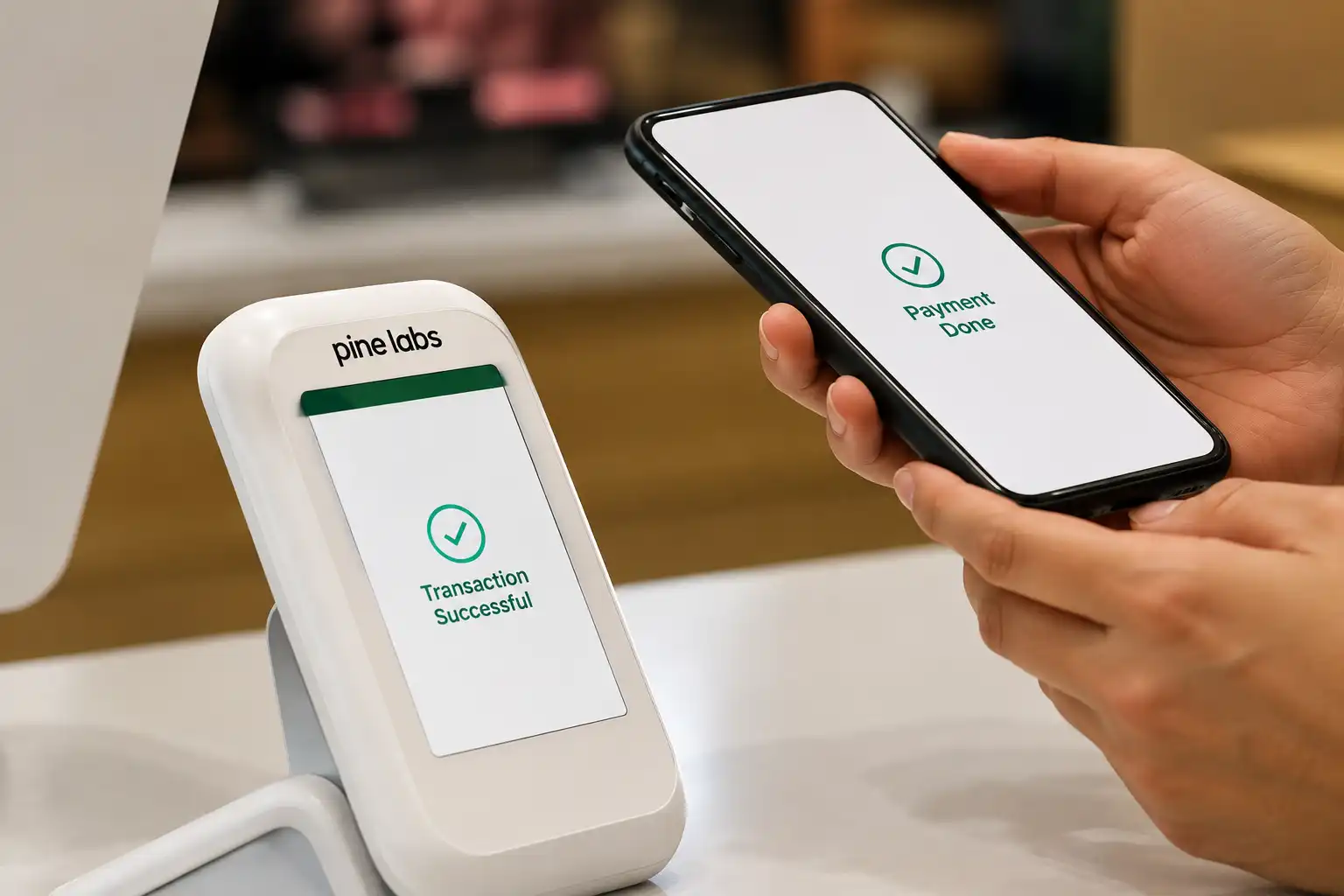

Pine Labs has evolved from a domestic point-of-sale technology company into a broader commerce and financial technology platform spanning physical payments, online checkout, UPI, merchant financing, prepaid products, issuing technology and financial infrastructure.
Its scale is large, but understanding the company requires separating several numbers that can easily be confused. Pine Labs processed ₹17.15 lakh crore of platform gross transaction value, or GTV, in FY2026, but that was not its revenue. Revenue from operations for the year was ₹2,711 crore. Similarly, the company served 11 lakh merchants at the end of FY2026 through 20.3 lakh digital checkout points, which means checkout points and merchants are not the same metric.
1. What Is Pine Labs?
Pine Labs Limited is a fintech and commerce technology company that provides payment acceptance, checkout, affordability, prepaid and financial infrastructure services to merchants, brands, banks and other financial institutions.
The company was incorporated on May 18, 1998. Its original corporate records show Rajul Garg and Tarun Upadhyay as the initial subscribers, each taking 100 shares when the company was formed. Lokvir Kapoor later became an important early executive and shareholder in Pine Labs' development.
Pine Labs initially built payment infrastructure for merchants. A major step came in 2005 with Plutus, which expanded card acceptance terminals beyond basic payment processing by supporting services such as EMI, loyalty programs and promotional offers. The company subsequently expanded into merchant financing, prepaid products and international markets.
Acquisitions accelerated that transformation. Pine Labs acquired prepaid and gift-card technology company Qwikcilver in 2019, acquired fintech infrastructure company Setu in 2022, and acquired online-checkout company Shopflo in 2026. Qwikcilver expanded Pine Labs into stored-value and gift-card infrastructure, Setu added API-based financial services technology, and Shopflo strengthened its online checkout capabilities.
Amrish Rau has been CEO since 2020 and is now Pine Labs' Chairman, Managing Director and Chief Executive Officer. The company's corporate office is in Noida, Uttar Pradesh, while its registered office is in Gurugram, Haryana.
2. What Does Pine Labs Do?
POS and merchant payments Pine Labs is best known for payment technology used at physical stores. Its digital checkout points allow merchants to accept cards and other digital payment methods while also supporting software functions such as EMI offers, currency conversion and commerce services.
Pine Labs calls these installations digital checkout points, or DCPs. A merchant may operate more than one checkout point, which explains why the company reported 21.7 lakh DCPs but 11.5 lakh merchants in Q1 FY2027.
Online payments Pine Labs has expanded from physical terminals into online payment infrastructure. Its products include payment gateway services, payment links, subscriptions, payouts, tokenisation, UPI acceptance, cross-border payments and integrations for e-commerce platforms.
Shopflo adds another layer. Rather than simply processing a transaction, Shopflo focuses on improving the checkout experience and reducing customer drop-off before payment. Pine Labs completed its Shopflo acquisition in 2026 as part of its push toward integrated online commerce.
UPI and QR payments Pine Labs supports UPI acceptance through merchant checkout infrastructure, QR-based payments, acquiring technology, UPI switching and other payment-processing products.
NPCI has previously included Pine Labs among payment aggregators supporting merchant transactions using RuPay credit cards linked to UPI, illustrating Pine Labs' position within the wider UPI acquiring ecosystem.
UPI is becoming increasingly important inside Pine Labs' existing merchant network. In Q1 FY2027, the company said more than 70% of transactions at its digital checkout points were UPI transactions, while UPI GTV grew about 80% year over year.
EMI and affordability Affordability is one of Pine Labs' important differentiators. At checkout, Pine Labs can connect eligible purchases with credit-card issuers, lenders, brands and other financing partners. A consumer buying a phone or appliance, for example, may be able to convert the transaction into instalments or receive a brand-funded financing offer. Pine Labs therefore participates not only in processing the payment but also in enabling the financing arrangement around the purchase.
Gift cards and prepaid solutions Through Qwikcilver, Pine Labs operates infrastructure for gift cards, prepaid products, stored-value wallets, rewards and related programs for brands and enterprises. Pine Labs is also authorised by the Reserve Bank of India in relation to prepaid payment instruments. RBI records show an authorisation for Pine Labs dating to March 2017, with Qwikcilver's PPI business subsequently transferred into Pine Labs.
Issuing and payment technology Pine Labs also sells technology to banks, fintech companies and other financial institutions. This includes card-management systems, payment switches, merchant management, clearing and settlement technology, UPI issuing and acquiring infrastructure, Bharat Connect integrations and credit-processing products. Setu extends this business further into API-based financial infrastructure, including payment collections, account aggregation, identity services and embedded financial products. Taken together, Pine Labs increasingly resembles a commerce infrastructure company rather than simply a POS-terminal operator.
3. How Does Pine Labs Make Money?
Pine Labs earns revenue primarily by charging for the technology and services running around payments. Its monetisation includes subscriptions and platform charges from merchants, transaction-processing fees on eligible payment flows, fees connected to affordability products, payment gateway services, prepaid issuance and distribution, and infrastructure charges paid by banks and other financial institutions.
This makes the distinction between GTV and revenue critical. During FY2026, Pine Labs' platform processed approximately ₹17.15 lakh crore in GTV. Revenue from operations was only ₹2,711 crore. Pine Labs therefore does not record the entire value of a purchase passing through its technology as revenue. It records the fees, subscriptions and other amounts it earns for enabling or servicing those transactions.
The same distinction applies to UPI. A rapidly rising amount of UPI traffic across Pine Labs' infrastructure may improve engagement and create opportunities to sell additional services, but UPI transaction value itself is not Pine Labs revenue. That distinction is particularly important when comparing payments businesses because enormous payment volumes do not automatically translate into equally large revenue.
4. Financial Performance and Scale
Pine Labs produced a significant improvement in FY2026. Revenue from operations increased 19% to ₹2,711 crore, compared with ₹2,274 crore in FY2025. Adjusted EBITDA rose to ₹559 crore from ₹357 crore, giving the company an adjusted EBITDA margin of about 21%. Reported EBITDA was approximately ₹492 crore.
Most significantly, Pine Labs reported profit after tax of ₹113 crore, compared with a loss of ₹145 crore in FY2025. The platform processed ₹17.15 lakh crore of GTV during FY2026, up from about ₹11.43 lakh crore a year earlier. Total transactions increased to roughly 740 crore, compared with 569 crore in FY2025. By March 2026, Pine Labs had approximately 20.3 lakh digital checkout points and 11 lakh merchants. It had also issued approximately 87 crore prepaid cards cumulatively according to its operating KPI disclosure.
Growth continued into Q1 FY2027, covering the quarter ended June 2026. Revenue increased 20% year over year to ₹737 crore. Adjusted EBITDA was ₹126 crore, up about 5%, although its adjusted EBITDA margin declined to 17.1% as Pine Labs increased spending on sales, technology and AI initiatives. Profit after tax rose from ₹5 crore to ₹20 crore. Platform GTV reached approximately ₹4.22 lakh crore, with 201 crore transactions during the quarter.
International revenue reached ₹114 crore, up 21% year over year and representing approximately 16% of consolidated revenue. Pine Labs said it was generating international revenue across 22 countries. Its explicitly disclosed markets and expansion areas include Malaysia, Singapore, the UAE, the Philippines, Australia, the United States and parts of Africa, among others. Management has guided for FY2027 revenue growth of roughly 21% to 23.5%. That is a company target, not a completed financial result.
5. IPO, Valuation and Ownership
Pine Labs completed its stock-market listing in November 2025. The IPO comprised approximately ₹3,899.9 crore of shares at an issue price of ₹221 per share. This included a ₹2,080 crore fresh issue by Pine Labs and an approximately ₹1,819.9 crore offer for sale by existing shareholders.
After issue expenses, Pine Labs expected approximately ₹1,978 crore of net fresh proceeds. Its prospectus allocated approximately ₹532 crore toward repayment or prepayment of borrowings, ₹60 crore toward investments in overseas subsidiaries and around ₹760 crore toward technology, IT infrastructure, cloud capacity and digital checkout points. The balance was intended for general corporate purposes and potential acquisitions.
The IPO valued Pine Labs at roughly US$2.9 billion, below the approximately US$5 billion private valuation associated with its 2022 fundraising. These two figures should not be confused with its present stock-market value. Pine Labs listed on November 14, 2025. Its shares opened around ₹242 and rose as high as ₹284 during the initial trading session, well above the ₹221 IPO price.
By the close on September 3, 2026, Pine Labs shares were around ₹161.75 on the NSE. At that price, its market capitalisation was approximately ₹18,600 crore to ₹18,700 crore, substantially below both its IPO-day market value and its historical private-market valuation.
The latest June 2026 shareholding disclosures show Peak XV Partners as the largest identifiable shareholder at roughly 16.7%. Other significant institutional holders included SBI Mutual Fund, MacRitchie Investments, PayPal, Mastercard and Franklin India Mutual Fund. Pine Labs is professionally managed without a conventional controlling promoter holding a majority stake.
6. How Pine Labs Competes With Paytm, PhonePe and Razorpay
Pine Labs competes with different companies in different parts of its business. Paytm overlaps in merchant QR payments, POS devices, payment gateways and merchant financial services. Paytm, however, has historically built a much larger consumer-facing payments ecosystem. Pine Labs is more heavily oriented toward enterprise merchants, payment infrastructure, affordability and issuing technology.
PhonePe is particularly powerful in consumer UPI and merchant QR acceptance. As of July 2026, PhonePe reported more than 718 million lifetime registered users and over 50 million lifetime merchants. Pine Labs does not have a comparable consumer UPI franchise. Its strength is instead the infrastructure surrounding enterprise checkout, POS, affordability, issuing and financial platforms.
Razorpay competes closely with Pine Labs in online payment gateways and increasingly in physical payment acceptance. Razorpay has expanded its regulatory and product footprint across online, offline and cross-border payments, while Pine Labs entered the convergence from the opposite direction, starting with physical merchant infrastructure and moving aggressively online.
Pine Labs also competes with payment gateways, banks, acquiring companies, POS providers and prepaid specialists such as PayU, Cashfree, Worldline and others depending on the product. Its main differentiation is breadth. One enterprise can potentially use Pine Labs for physical checkout, online payments, EMI offers, gift cards, issuing infrastructure and financial APIs. That breadth can support cross-selling, but it also means Pine Labs competes simultaneously in several highly competitive markets.
7. Future Growth Opportunities and Risks
Online payments are one of Pine Labs' clearest growth opportunities. The company added more than 40 online merchants during Q1 FY2027, while Shopflo processed more than ₹400 crore of volume during the quarter. Combining payment processing with checkout optimisation gives Pine Labs an opportunity to extend existing enterprise relationships from stores into e-commerce.
UPI provides another large distribution opportunity. The challenge is monetisation. Pine Labs needs to translate rising UPI usage into subscription income, affordability services, credit products and other value-added revenue rather than relying simply on transaction volume.
International expansion is already contributing financially. With international revenue growing 21% in Q1 FY2027 and representing around 16% of total revenue, markets outside its home market could become increasingly important if Pine Labs can successfully replicate its enterprise payments and issuing model.
AI and agentic payments represent a more experimental opportunity. Pine Labs has introduced P3P, which it describes as an agentic payment protocol built around UPI. Separately, national working groups are developing broader standards intended to allow AI agents to participate in commerce and payment workflows. As of September 2026, this remains an emerging area rather than a proven large-scale revenue stream.
Embedded finance could be more immediate. Setu gives Pine Labs technology covering UPI, Bharat Connect, account aggregation, identity infrastructure and other financial APIs. Credit Line on UPI and similar products could allow payments, lending and commerce infrastructure to become more closely integrated.
The risks are equally significant. Payment infrastructure faces intense competition and continual pricing pressure. RBI and NPCI regulations can alter economics or operating requirements. Cybersecurity, fraud, data protection and platform reliability are especially important because Pine Labs sits inside payment flows involving merchants, consumers and financial institutions.
International expansion adds licensing, execution and currency risks. Acquisitions such as Shopflo and Setu also have to generate sufficient growth and integration benefits. Finally, Q1 FY2027 demonstrated that investment in technology, AI and sales can pressure margins even while revenue continues growing.
8. Where Pine Labs Stands Today
Pine Labs in 2026 is considerably broader than the POS-terminal company from which it developed. Its platform now connects physical payments, online checkout, UPI, instalment financing, gift cards, issuing technology and financial infrastructure. FY2026 was particularly important because revenue grew, adjusted EBITDA expanded and the company moved from an annual loss to a ₹113 crore profit.
Its next phase will depend less on simply adding payment volume and more on how effectively it monetises that infrastructure. Online commerce, international markets, embedded finance and AI-driven checkout could increase the amount of revenue Pine Labs generates from each merchant or financial-institution relationship. At the same time, its post-IPO valuation shows that public-market investors are demanding measurable growth, sustainable profitability and disciplined execution rather than valuing the company on payment volume alone.
That distinction is central to understanding Pine Labs today: ₹17 lakh crore of payments moving through a platform demonstrates scale, but the long-term value of the business will depend on how much durable, profitable revenue Pine Labs can build around that scale.
Further reading and useful links
Reader questions
Frequently asked questions
What is Pine Labs and what do they do?
Pine Labs is a fintech company that provides payment acceptance infrastructure, online checkout capabilities, UPI processing, merchant financing, and prepaid solutions to businesses and financial institutions.
How does Pine Labs make money?
Pine Labs generates revenue by charging transaction processing fees, merchant subscriptions, payment gateway fees, and technology infrastructure charges for the services running across its platform.
When was the Pine Labs IPO?
Pine Labs completed its initial public offering in November 2025, listing its shares on the National Stock Exchange and Bombay Stock Exchange on November 14, 2025.
Nexuswild welcomes factual corrections. Email contact@nexuswild.com with evidence and the article URL.