
Earbuds have spent the last few years quietly getting better at one job: sound. Better noise cancellation, better call quality, slightly longer battery life. This week in Maui, Qualcomm suggested that job is about to get a lot more complicated. At its Snapdragon Summit on September 23 and 24, 2026, the chipmaker introduced a new audio platform that can support cameras inside earbuds, not to take photos, but to help an AI assistant actually see what's going on around you.
Before going further, it's worth being precise about what was and wasn't announced. Qualcomm didn't unveil a pair of camera earbuds you can buy. What it revealed is a chip platform, called Snapdragon Sound Elite Gen 2, that's capable of supporting camera-equipped earbuds among several other device types. Audio brand Cleer showed a concept device built on that platform at the event. No commercial product has been confirmed by Qualcomm or any of its partners.
Qualcomm's Camera-Earbud Development
Qualcomm doesn't make earbuds itself. It licenses audio technology to companies like Bose and Bowers & Wilkins, who then decide what to actually build and sell. So this week's announcement is really about the plumbing, not the product. The Snapdragon Sound Elite Gen 2 platform is what Qualcomm calls its "first premium audio platform purpose-built for personal AI," and the company says it's designed to work across a wide range of device types: standard earbuds, headphones, open-ear buds, audio glasses, and, notably, camera-equipped earbuds.
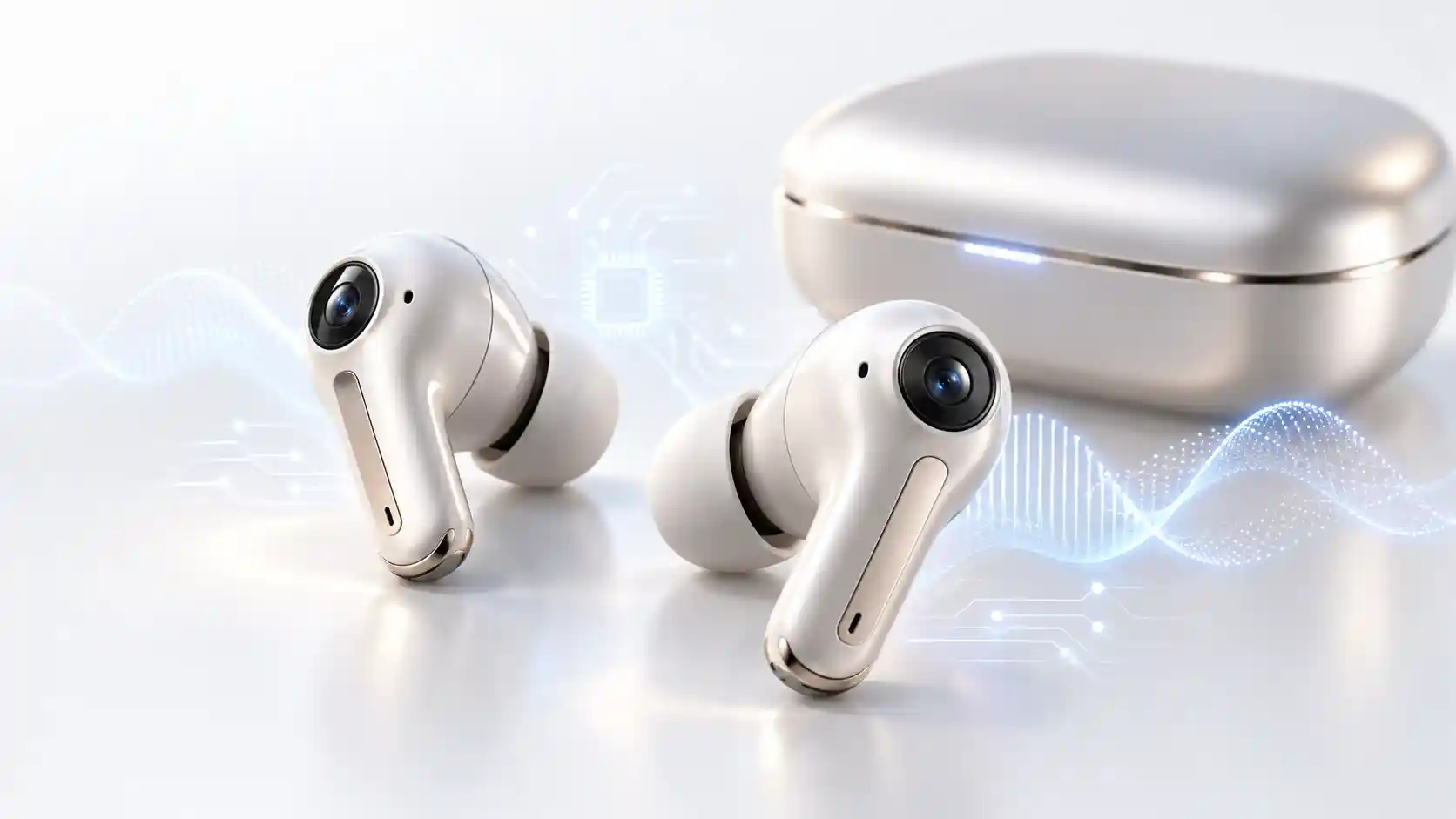
The camera-earbud concept isn't a Qualcomm product demo so much as a proof of what the chip can support. Cleer's concept device, shown on the summit floor, combined audio hardware with a small camera and on-device AI. Qualcomm has been clear that this is early-stage. As one report on the announcement put it, it typically takes several months to a year before a new chip platform like this actually shows up in products people can purchase.
How Camera-Equipped Earbuds Could Work
The camera in this concept isn't there to shoot photos or video. Qualcomm has repeatedly emphasized that these are context sensors, not cameras in the traditional sense. The idea is that a small visual sensor built into an earbud could feed an AI assistant information about your surroundings, similar to how camera-equipped smart glasses already work, just without a screen or a visible lens sitting on your face.
Paired with a microphone picking up what you say, and Qualcomm's on-device AI processing both streams together, the earbud becomes what's sometimes called a multimodal input device. Instead of typing a question or holding up your phone camera, you could theoretically just ask your earbuds about something in front of you, and the AI would have both your voice and a sense of what you're looking at to work with.
AI and Smart Audio Features
The chip itself is a real, technical step forward, separate from the camera question. Qualcomm says Snapdragon Sound Elite Gen 2 delivers up to twice the on-device AI processing power of its predecessor, the Snapdragon S7 Gen 1 Sound Platform, while using up to 40% less power and shrinking the physical footprint by about 30%. Those are Qualcomm's own figures, based on its own disclosed test conditions, so they're best read as platform claims rather than independently verified benchmarks.
Maybe the more practical change is built-in Wi-Fi 6E. Most earbuds today lean entirely on a phone to reach the internet, passing everything through a Bluetooth connection first. With Wi-Fi 6E built directly into the chip, earbuds could connect to the cloud on their own, which matters for AI features like real-time translation or transcription that benefit from more processing power than a tiny earbud chip can handle alone. The platform also supports Qualcomm's aptX Lossless audio codec and a technology it calls XPAN connectivity, alongside updated noise cancellation and voice processing.
Potential Uses and Benefits
Assuming camera-equipped earbuds eventually reach the market, the use cases Qualcomm and reporters covering the announcement have floated include real-time translation of spoken conversation, more personalized listening experiences that adjust based on context, and AI assistants that understand not just what you're saying but where you are and what you're doing. There's also an accessibility angle worth noting, since a device that can describe your surroundings verbally has fairly obvious value for anyone with low vision, though Qualcomm didn't detail specific accessibility features tied to this platform.
It's worth being direct that these are potential applications tied to a concept demonstration, not features confirmed for any shipping product.
Privacy, Battery and Design Challenges
A camera built into something people wear in their ears, all day, everywhere, raises the same privacy questions that have already followed camera-equipped smart glasses. Unlike glasses, where at least the lens is visible on someone's face, a camera in an earbud could be considerably less obvious to the people around the wearer, which is likely to be a real point of scrutiny if any company moves this from concept to product.
Battery life is the other obvious constraint. Earbuds already run on some of the smallest batteries in consumer electronics, and adding a camera plus the AI processing needed to make sense of what it sees is a meaningful additional power draw, even with Qualcomm's claimed efficiency gains. Comfort and physical space are related concerns: fitting a camera, sensor, microphone array, Bluetooth and Wi-Fi radios, and a battery into something that still sits comfortably in an ear canal is a genuinely hard industrial design problem, and Qualcomm's announcement doesn't resolve it, it just makes the electronics smaller.
Qualcomm's Broader Wearable Technology Strategy
This fits into a pattern at Qualcomm of pushing AI processing further out to the edge, away from the phone and onto the device you're actually wearing. Alongside the audio platform, Qualcomm used the summit to talk about wearables playing a bigger role in healthcare more broadly, suggesting the company sees earbuds and similar devices as part of a wider push into what it and others in the industry call ambient computing: AI that's available continuously through whatever you're already wearing, rather than something you have to pull out and look at.
Industry and Expert Views
Qualcomm's own framing at the summit was notably cautious about one thing in particular. As the company put it, "this isn't about putting a chatbot in your ear." It also said "AI interactions won't always happen through a screen," a line that captures the broader bet: that voice and ambient sensing, not another display, are where a chunk of everyday AI interaction is headed next. Separately, and outside of Qualcomm's own announcement, other reporting has suggested Apple is working on its own camera-equipped AirPods concept, though that project is unconfirmed by Apple and unrelated to Qualcomm's platform.
What Could Come Next
Because Snapdragon Sound Elite Gen 2 is a platform rather than a finished product, the next real signal to watch for is which audio brands, beyond Cleer's concept showing, choose to build actual consumer hardware around it, and whether any of them include a camera when they do. Given that Qualcomm itself pointed to a lag of several months to a year between a chip platform launch and real products hitting shelves, camera-equipped earbuds built on this specific platform are unlikely to appear as purchasable products imminently.
Conclusion
What Qualcomm actually announced in Maui is a new chip platform with real, measurable improvements in AI processing, power efficiency and connectivity, plus the technical ability to support a camera inside an earbud for context-gathering rather than photography. What it did not announce is a camera-equipped earbud you can buy. Cleer's concept device shows the idea is technically workable, but turning that into a comfortable, private, battery-friendly consumer product is a separate and much harder problem that remains unsolved, and unannounced, for now.
Further reading and useful links
Reader questions
Frequently asked questions
Did Qualcomm announce a commercial pair of camera-equipped earbuds?
No. Qualcomm announced a chip platform called Snapdragon Sound Elite Gen 2 that is capable of supporting camera-equipped earbuds, but no commercial product has been released or confirmed.
What is the purpose of a camera inside an earbud according to Qualcomm?
The camera is designed as a visual context sensor rather than for taking photos or videos, providing visual environmental data to an on-device AI assistant.
What key features does the Snapdragon Sound Elite Gen 2 platform offer?
It offers double the on-device AI processing power of its predecessor, 40% lower power consumption, built-in Wi-Fi 6E connectivity, and support for aptX Lossless audio.
When can consumers expect to buy camera-equipped earbuds based on this platform?
There is no confirmed release date. Industry timelines suggest it typically takes several months to a year for hardware partners to develop and ship commercial products on a new chip platform.
Nexuswild welcomes factual corrections. Email [email protected] with evidence and the article URL.