
As cities continue to expand, concrete buildings, roads and infrastructure are becoming increasingly dominant features of the urban environment. Although concrete remains essential to modern construction, the growing concentration of hard surfaces contributes to several environmental challenges, including urban heat accumulation, limited biodiversity and increasing pressure on air quality.
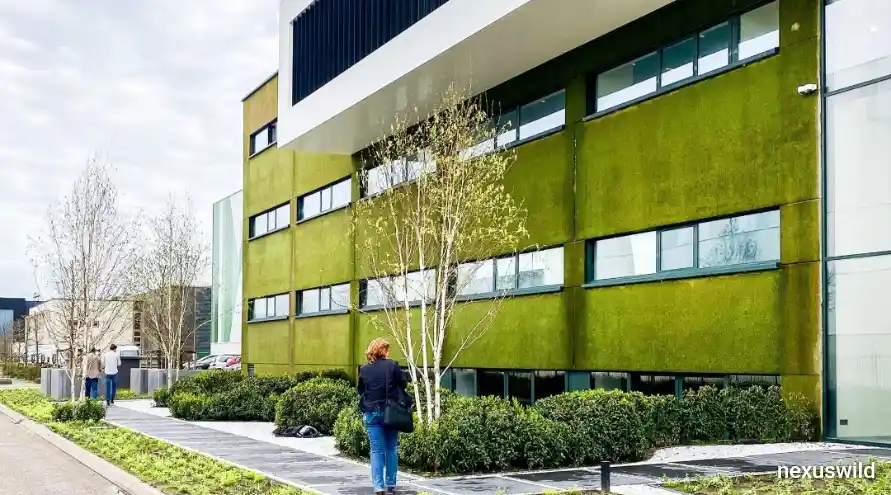
A Dutch climate-technology startup, Respyre, is exploring an innovative approach to these problems by transforming ordinary concrete surfaces into living green structures. Through its specially developed bioreceptive concrete technology, the company enables moss to grow directly on building facades and other urban infrastructure.
Rather than installing conventional vertical gardens that require separate planting systems, containers and regular maintenance, Respyre aims to make existing concrete surfaces suitable for natural moss growth. Its technology, marketed under the name MossCrete, combines material science and biological processes to create surfaces that support vegetation without requiring extensive structural modifications.
The concept offers a different perspective on sustainable construction. Instead of removing concrete from urban environments, Respyre wants to make the material more environmentally compatible by allowing nature to become part of the built environment.
The innovation is attracting interest because moss-covered surfaces could contribute to local cooling, particulate capture, water retention and urban biodiversity. However, the extent of these benefits depends on the location, moss species, environmental conditions and the scale of implementation.
How MossCrete Technology Works
The central innovation behind Respyre's approach is its bioreceptive concrete, a specially formulated surface material designed to encourage biological growth. Conventional concrete is generally not an ideal environment for moss because it may lack the necessary moisture retention, surface characteristics and biological conditions required for sustained growth.
Respyre addresses this limitation by developing a porous concrete coating that provides a suitable environment for moss to establish itself.
According to information shared by TU Delft, the company's material contains approximately 70% recycled concrete. It is designed to retain water while providing the surface conditions needed to support moss development. This allows the coating to be applied over existing concrete without replacing the building's structural material.
The process generally involves several stages.
First, the existing building surface is examined to ensure that it is stable and suitable for application. The bioreceptive material is then applied as a thin coating or incorporated into prefabricated facade components.
After the surface preparation, selected moss species are introduced through a specially developed biological coating. The moss gradually establishes itself on the surface, creating a natural green covering.
During the initial growth period, controlled irrigation helps maintain the moisture required for successful development. As the moss becomes established, watering can be reduced depending on the local climate and environmental conditions.
Respyre's current product approach includes plaster finishes, lightweight panels and prefabricated concrete elements. These different formats allow architects and construction companies to consider moss-based surfaces for both new developments and renovation projects.
The company describes its MossCrete application as a way to introduce greenery without requiring the extensive supporting infrastructure associated with conventional vertical gardens.
Fighting Urban Heat Through Natural Cooling
One of the most important potential applications of moss-covered concrete is reducing the impact of urban heat.
Cities often experience higher temperatures than surrounding rural areas because buildings, roads and other hard surfaces absorb and retain solar energy. This phenomenon, commonly known as the urban heat island effect, can make densely developed neighbourhoods particularly uncomfortable during hot weather.
Traditional concrete facades contribute to this challenge by absorbing heat during the day and releasing it into the surrounding environment.
Moss-covered surfaces could offer an alternative by retaining moisture and supporting evaporative cooling. When water evaporates from the moss and its supporting material, it absorbs heat from the surrounding environment.
This process can help lower surface temperatures and potentially improve the local thermal environment.
A 2026 presentation by the ROOTS Foundation, featuring Respyre's work, describes potential cooling effects of approximately 2 to 6 degrees Celsius. However, this should not be interpreted as a guaranteed reduction in the temperature of an entire city. Actual performance depends on factors such as sunlight exposure, moisture availability, surface orientation and local weather conditions.
If applied across suitable building facades, retaining walls and other infrastructure, moss-based materials could become one component of broader urban cooling strategies.
The technology is particularly relevant for densely populated areas where creating additional parks and ground-level green spaces is difficult because of limited land availability.
Can Moss Walls Help Reduce Urban Air Pollution?
Air pollution remains a major environmental concern in cities worldwide. Traffic emissions, industrial activities, construction dust and other sources release pollutants that affect human health and environmental quality.
Respyre's technology offers a nature-based approach to supporting urban air quality through the natural characteristics of moss.
Moss surfaces can capture and retain airborne particulate matter, including fine dust particles that settle on their leaves and surrounding structures. Their ability to hold moisture also makes them interesting for environmental applications.
The moss itself participates in photosynthesis, absorbing carbon dioxide and releasing oxygen while growing. These characteristics contribute to the environmental value of introducing more vegetation into built-up areas.
However, it is important to distinguish between capturing particles on a surface and significantly reducing pollution concentrations across an entire neighbourhood. The effectiveness of moss facades as air-cleaning infrastructure depends on their total coverage, exposure to polluted air, weather conditions and maintenance.
Respyre's approach should therefore be viewed as a complementary environmental measure rather than a replacement for conventional pollution-control policies.
Reducing vehicle emissions, improving public transport, controlling industrial pollution and expanding urban vegetation remain essential measures for improving air quality.
Nevertheless, turning otherwise unused building surfaces into biological systems could provide additional environmental benefits without requiring large amounts of urban land.
Supporting Biodiversity in Concrete-Dominated Cities
Urban development often reduces natural habitats by replacing vegetation with roads, buildings and paved surfaces. This creates challenges for insects, microorganisms and other small organisms that depend on suitable habitats.
Moss-covered structures could help address part of this problem by introducing additional biological surfaces into urban environments.
Moss provides shelter and microhabitats for small organisms, including insects and microorganisms. Its moisture-retaining characteristics can also create favourable conditions for certain forms of urban biodiversity.
Unlike many conventional vertical gardens, moss does not require traditional plant containers or extensive root systems. It attaches to surfaces through structures called rhizoids, which help it absorb water and nutrients without penetrating deeply into the supporting material.
This characteristic makes moss particularly interesting for architectural applications.
TU Delft's research and development work has also highlighted the importance of selecting suitable moss species for different environmental conditions. Species that grow successfully in controlled environments may not necessarily survive equally well after being transferred outdoors.
Therefore, biodiversity benefits will depend not only on installing moss-covered surfaces but also on selecting appropriate species and ensuring that the surrounding environment supports their long-term survival.
For urban planners, this creates an opportunity to consider building facades and infrastructure as additional spaces for supporting nature.
Recycling Materials and Promoting Sustainable Construction
Another important aspect of Respyre's technology is its use of recycled concrete.
Concrete production has a significant environmental footprint, particularly because cement manufacturing requires substantial energy and releases carbon dioxide through both fuel consumption and chemical processes.
At the same time, construction and demolition activities generate large quantities of waste materials. Reusing suitable waste streams can help reduce the demand for newly extracted resources and support circular construction practices.
Respyre's bioreceptive coating incorporates recycled concrete, giving previously difficult-to-process material another application.
The approach does not eliminate the environmental impact of concrete production. Instead, it attempts to improve the usefulness of existing construction materials by combining them with biological functionality.
This is particularly relevant because concrete will remain an important component of buildings, bridges, roads and urban infrastructure for the foreseeable future.
Rather than treating concrete and nature as opposing elements, Respyre is exploring how the two can work together.
The company's technology could also support renovation projects by allowing existing buildings to receive greener facades without requiring complete structural replacement.
Such applications could become attractive for property developers, municipalities and construction companies seeking practical ways to improve the environmental performance of existing infrastructure.
Research and Development: Turning an Idea Into a Practical Solution
Respyre's development is closely connected to research at Delft University of Technology in the Netherlands.
The company's origins are linked to the commercial development of research into bioreceptive concrete. Co-founder Auke Bleij became interested in the relationship between building surfaces, moisture retention and urban heat.
The idea was to develop a material that could support moss growth while making use of the existing built environment.
Early demonstration work at Amsterdam's Marineterrein Living Lab explored the potential of moss-covered walls as a response to urban heat, air pollution and limited biodiversity.
The project involved collaboration between Respyre, TU Delft, Wageningen University & Research and the Marineterrein Amsterdam Living Lab.
This research-oriented development approach is important because moss growth is influenced by several environmental factors. Water availability, sunlight, temperature and species selection can all determine whether a moss-covered facade develops successfully.
Academic research published in 2026 by Delft University of Technology further demonstrates the technical challenges involved.
The study examined a two-stage cultivation method in which moss is initially established indoors under controlled conditions before being transferred outdoors. Researchers found that light exposure, watering schedules and moss species selection significantly influenced growth and survival.
The findings also highlighted that moss species showing strong indoor growth do not necessarily perform best after outdoor transfer.
This research demonstrates why successful commercial applications require more than simply applying moss to concrete. The material and biological processes must be designed together.
Commercial Applications and Opportunities for the Construction Industry
Respyre's technology has potential applications across several areas of the construction and infrastructure sectors.
For residential buildings, moss-based facades could introduce natural greenery into apartment complexes and other developments where traditional landscaping opportunities are limited.
Commercial buildings could use the material as part of sustainability-focused renovation programmes, while industrial properties could explore its use on large exterior walls.
Infrastructure represents another potential market. Retaining walls, bridge structures, roadside barriers and other concrete installations provide extensive surfaces that could support moss growth.
The company's different application formats also create opportunities for manufacturers and contractors. Lightweight panels and prefabricated components can be considered during the building design stage, while plaster-based applications can be used in suitable renovation projects.
Respyre's official product information indicates that MossCrete is commercially available in the Netherlands and Belgium. Its wider business strategy is focused on making nature-inclusive construction more accessible to architects, developers and construction companies.
However, broader adoption will depend on commercial pricing, installation requirements, material durability, local climate suitability and the ability to demonstrate environmental benefits over time.
For the construction industry, the technology represents an opportunity to incorporate biological functionality into conventional building materials rather than treating greenery as a separate architectural feature.
Challenges That Could Affect Wider Adoption
Despite its environmental potential, moss-based concrete technology faces several practical challenges.
The first is climate suitability. Moss species have different environmental requirements, and some may struggle in areas with intense sunlight, prolonged heat or insufficient moisture.
Water management is another important consideration. Although moss can survive periods of dryness, active growth generally requires adequate moisture. Newly established surfaces may therefore need additional watering before becoming sufficiently resilient.
Long-term performance also requires further evaluation. Building facades are exposed to changing temperatures, rainfall, wind and other environmental stresses. The ability of moss to remain attached and healthy over many years is an important factor for developers considering large-scale installations.
There are also questions surrounding the measurable environmental impact of these surfaces. Although moss can capture particulate matter and contribute to cooling, its effectiveness at city scale must be evaluated through real-world monitoring.
Finally, construction companies will need clear information about installation costs, expected maintenance requirements, durability and potential savings compared with conventional green-wall systems.
Addressing these issues will be essential if the technology is to move beyond demonstration projects and become a widely adopted construction solution.
Conclusion
Dutch startup Respyre is exploring a different approach to sustainable urban development by transforming ordinary concrete surfaces into living moss-covered structures.
Its MossCrete technology combines recycled materials, specialised concrete formulations and biological growth to create facades that can support moss without conventional planting containers or extensive structural systems.
The potential benefits extend beyond appearance. Moss-covered surfaces could contribute to local cooling, particulate capture, water retention, noise absorption and urban biodiversity while making better use of existing infrastructure.
Nevertheless, the technology should be considered a complementary solution rather than a standalone answer to urban pollution or climate change. Its long-term effectiveness will depend on scientific validation, suitable environmental conditions and successful commercial deployment.
As cities search for more sustainable ways to manage urban expansion, innovations such as Respyre's bioreceptive concrete demonstrate how construction materials could evolve to support natural ecosystems.
The broader opportunity is to rethink the role of buildings in urban environments. Instead of remaining passive concrete structures, future buildings could incorporate living surfaces that contribute to greener, more climate-resilient cities.
Nexuswild welcomes factual corrections. Email contact@nexuswild.com with evidence and the article URL.