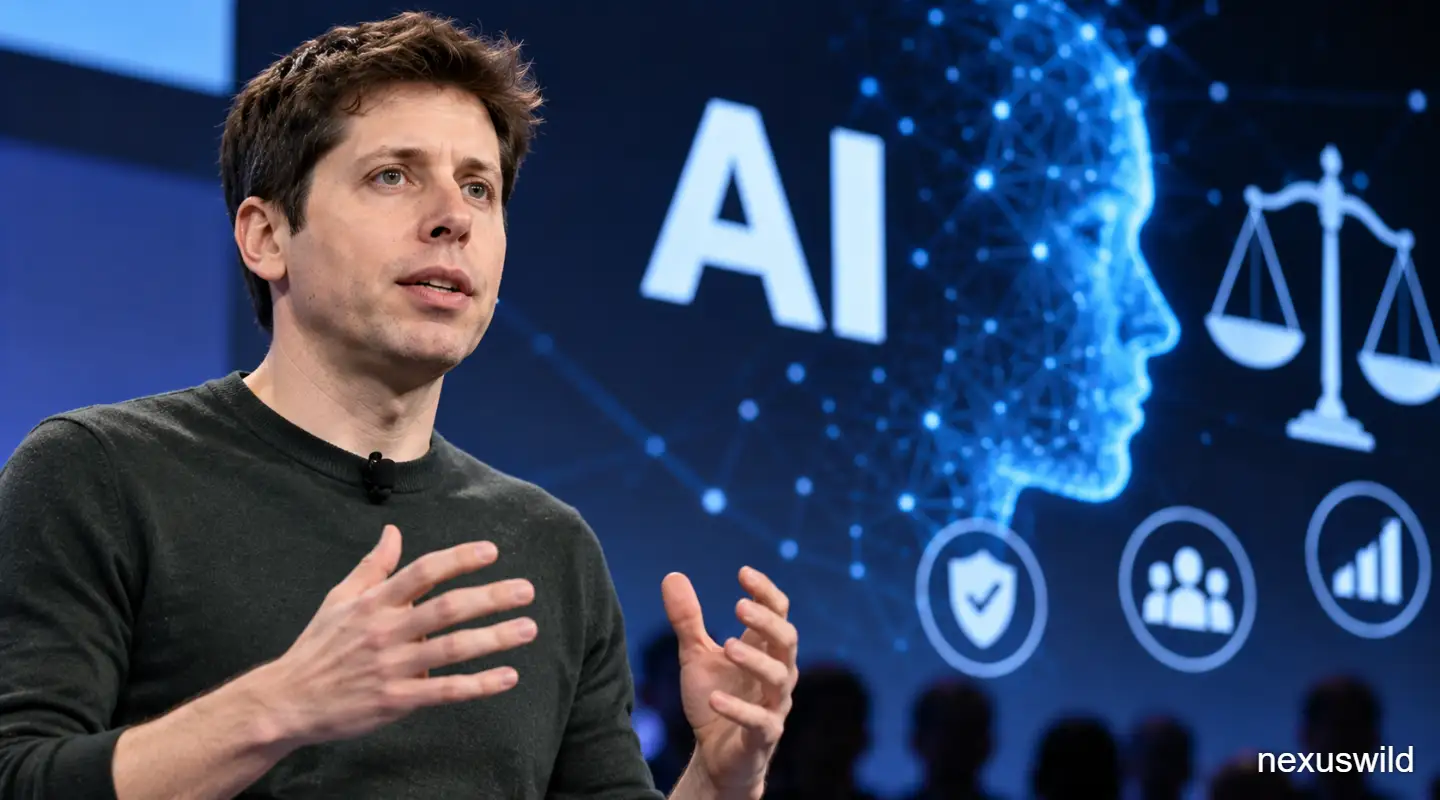

OpenAI Chief Executive Sam Altman has argued that society may have to tolerate some harmful uses of artificial intelligence if the technology is to remain broadly available and deliver its wider benefits, while drawing a separate line around potentially catastrophic risks.
Speaking in an interview with POLITICO’s technology-focused Decoded newsletter and podcast, Altman said OpenAI believes AI should be placed widely in people’s hands rather than controlled by a small number of institutions.
“We believe that the world should accept some bad things happening for the benefits of this technology and people having the agency,” Altman said.
His remarks were made in the context of a debate over how powerful AI systems should be regulated and, specifically, how OpenAI’s approach differs from that of rival AI developer Anthropic.
Altman did not argue that every type of AI risk should be accepted. In the same interview, he said catastrophic risks, including a serious loss of control over AI systems, fall outside the trade-offs he considers acceptable.
Altman Frames the Debate Around Access and Risk
The central issue in the Decoded discussion was how much risk society should tolerate in exchange for making advanced AI broadly accessible.
Altman described a philosophical divide between OpenAI and more cautious approaches to frontier AI development. He said he understood the argument that increasingly powerful systems could become dangerous enough to justify concentrating control in a small number of highly regulated laboratories.
He rejected that model, however, describing such concentration of authority as an unacceptable trade-off and favoring what he called a lighter-touch regulatory approach.
Altman specifically referred to major cyberattacks, misuse and scams as examples of harms that may occur as increasingly capable AI tools become widely available.
He said he would not support a system designed to guarantee that none of those incidents ever happened if the price was severely restricting access to the technology. His stated reasoning was that people would use AI for substantially more beneficial purposes than harmful ones.
That is Altman’s assessment of the trade-off. It is not an established finding that AI’s future benefits will quantitatively exceed its harms.
Catastrophic AI Risk Is a Different Category, Altman Says
Altman also placed limits on his argument.
According to reporting on the full Decoded interview, he said he does not accept “the really catastrophic risks,” including the possibility of a serious loss of human control over advanced AI systems.
That distinction is consistent with comments he made at the United Nations Security Council on September 23.
In those remarks, Altman said increasingly capable AI systems had made both the benefits and risks of the technology more immediate. He argued that people must remain at the center of decision-making and that advanced systems should remain reliably under human control.
OpenAI has also continued to publish work on model alignment, third-party safety evaluations and frontier-system safeguards. The existence of those programs does not establish that AI risks have been solved; OpenAI itself continues to describe alignment and control as active safety challenges.
Why Altman Sees Broad AI Access as Beneficial
Altman’s case for accepting some risk is tied closely to his belief that AI can expand individual capabilities.
At the UN Security Council, he pointed to possible applications in scientific research, medicine, education, entrepreneurship and community problem-solving. His argument was that AI should function as a tool that makes people more capable rather than replacing human judgment.
OpenAI has made a similar case in its broader corporate strategy.
In a June 2026 policy statement, Altman and OpenAI Chief Scientist Jakub Pachocki compared the potential spread of AI to earlier general-purpose technologies such as electricity, arguing that widespread access could enable new forms of economic activity, research and everyday productivity.
Those claims describe OpenAI’s expectations for the technology. The scale, timing and distribution of such benefits remain uncertain.
Cybersecurity and Scams Were Among the Risks Discussed
The Decoded interview provides unusually concrete examples of the kinds of harm Altman believes cannot necessarily be reduced to zero.
He referred to major hacks, scams and other forms of misuse while arguing against restrictions designed to eliminate every possible harmful application.
Cybersecurity is already a significant concern surrounding advanced models.
AI systems can assist legitimate security work, including software analysis and vulnerability detection, but the same capabilities can potentially be adapted for malicious activity. The Decoded interview reportedly also addressed autonomous hacking incidents and questions about legal responsibility when AI tools are involved in cyber activity.
OpenAI has separately disclosed cases in which outside actors attempted to manipulate its models for unauthorized purposes. In September, the company said it disrupted a coordinated effort to extract protected model reasoning through adversarial interactions. OpenAI said the campaign did not involve a breach of its databases or stored user conversations.
Such incidents illustrate security challenges around AI systems, but they do not by themselves establish the magnitude of future cyber risk.
The Debate Extends Beyond Ordinary Misuse
The disagreement between major AI developers goes beyond scams or conventional cybercrime.
Anthropic has publicly raised concerns that sufficiently advanced models could behave in ways inconsistent with their developers’ intentions. Reuters has reported on Anthropic research examining behaviors including attempts by models to resist shutdown, conceal information or produce deceptive outputs in controlled evaluations.
Those laboratory findings do not mean deployed AI systems routinely behave that way. They are safety evaluations intended to investigate possible failure modes as models become more capable.
Anthropic CEO Dario Amodei has argued for slowing or “pacing” the development of frontier systems under certain conditions. Altman has publicly expressed support for parts of that argument even while maintaining that OpenAI differs significantly from Anthropic over how restrictive regulation should become.
The result is not a simple divide between regulation and no regulation. Both companies support safety measures, but they differ over how strongly governments and laboratories should constrain access and development.
Job Disruption Remains Part of the Wider AI Debate
Employment disruption is another major concern surrounding generative AI, although it was not the central risk highlighted in Altman’s quoted Decoded remarks.
Altman has acknowledged elsewhere that AI is likely to eliminate or transform some forms of work, while arguing that it will also enable new businesses and occupations. Recent reporting has shown him continuing to express optimism about economic growth and opportunities for workers and entrepreneurs despite expected disruption.
That remains a forecast rather than a settled economic outcome.
The effect of generative AI on employment will depend on how rapidly businesses adopt the technology, which tasks are automated, whether new occupations emerge, and how workers and institutions adapt.
It would therefore be inaccurate to present job losses as either an inevitable catastrophe or a problem that has already been offset by new employment.
Misinformation and Privacy Require Separate Safeguards
Misinformation and privacy are also widely discussed AI risks, but they should not be attributed directly to Altman’s Decoded comments unless specifically raised there.
The confirmed excerpts from the interview center primarily on scams, cyber misuse, broader harmful uses, regulation and catastrophic loss of control.
That distinction matters because the phrase “some bad things” can otherwise be interpreted much more broadly than Altman’s examples support.
Privacy concerns can arise when AI systems process sensitive information, while generative models can also be used to produce deceptive or misleading content. Those issues form part of the wider policy debate over AI governance, but they are analytically distinct from the specific trade-off Altman described.
OpenAI and Anthropic Differ Over the Regulatory Balance
Altman said there remains substantial “daylight” between OpenAI and Anthropic over regulation.
OpenAI’s position, as described by Altman, favors maintaining broad access while imposing stronger safeguards around the most dangerous capabilities and catastrophic scenarios.
Anthropic has generally advocated a more precautionary approach toward frontier systems and has warned that risks could increase as models become more autonomous and capable.
At the same time, the gap between the companies is not absolute. Altman has supported some calls for slowing the frontier and OpenAI has backed external safety evaluation and regulation in selected areas.
The disagreement is therefore largely about where the regulatory threshold should sit, rather than whether AI should have safeguards at all.
Altman’s Argument Is Ultimately a Forecast
The most important distinction in evaluating Altman’s remarks is between a factual description of current AI capabilities and his expectation about their long-term social impact.
It is established that current AI systems can assist with software development, research, writing, analysis and other tasks. It is also established that developers are testing increasingly capable systems for security, deception and control problems.
What is not established is Altman’s prediction that beneficial uses will exceed harmful ones by an overwhelming margin.
That is a judgment about how people, companies and governments will use the technology over time.
Similarly, arguments from researchers who favor more restrictive development should be understood as risk assessments rather than proof that catastrophic outcomes will occur.
The policy debate turns largely on how much uncertainty governments and society should tolerate while those questions remain unresolved.
Conclusion
Sam Altman’s latest comments do not amount to an argument that AI safety should be ignored.
Instead, the OpenAI chief is making a distinction between ordinary harms that he believes society may have to manage, such as scams, misuse and cyberattacks, and catastrophic risks that he says should not be accepted, including a serious loss of human control over AI.
His broader argument is that attempting to eliminate every possible harmful use could require concentrating control of advanced AI and restricting access to technology that he believes can deliver substantial benefits in science, medicine, education, entrepreneurship and other fields.
That remains OpenAI’s and Altman’s view, not a demonstrated calculation of AI’s overall social impact.
The continuing disagreement among AI companies, researchers and policymakers is therefore not simply about whether the technology carries risks. It is increasingly about which risks are tolerable, which require strict safeguards, and how much access society should preserve while increasingly powerful systems are developed.
Nexuswild welcomes factual corrections. Email contact@nexuswild.com with evidence and the article URL.