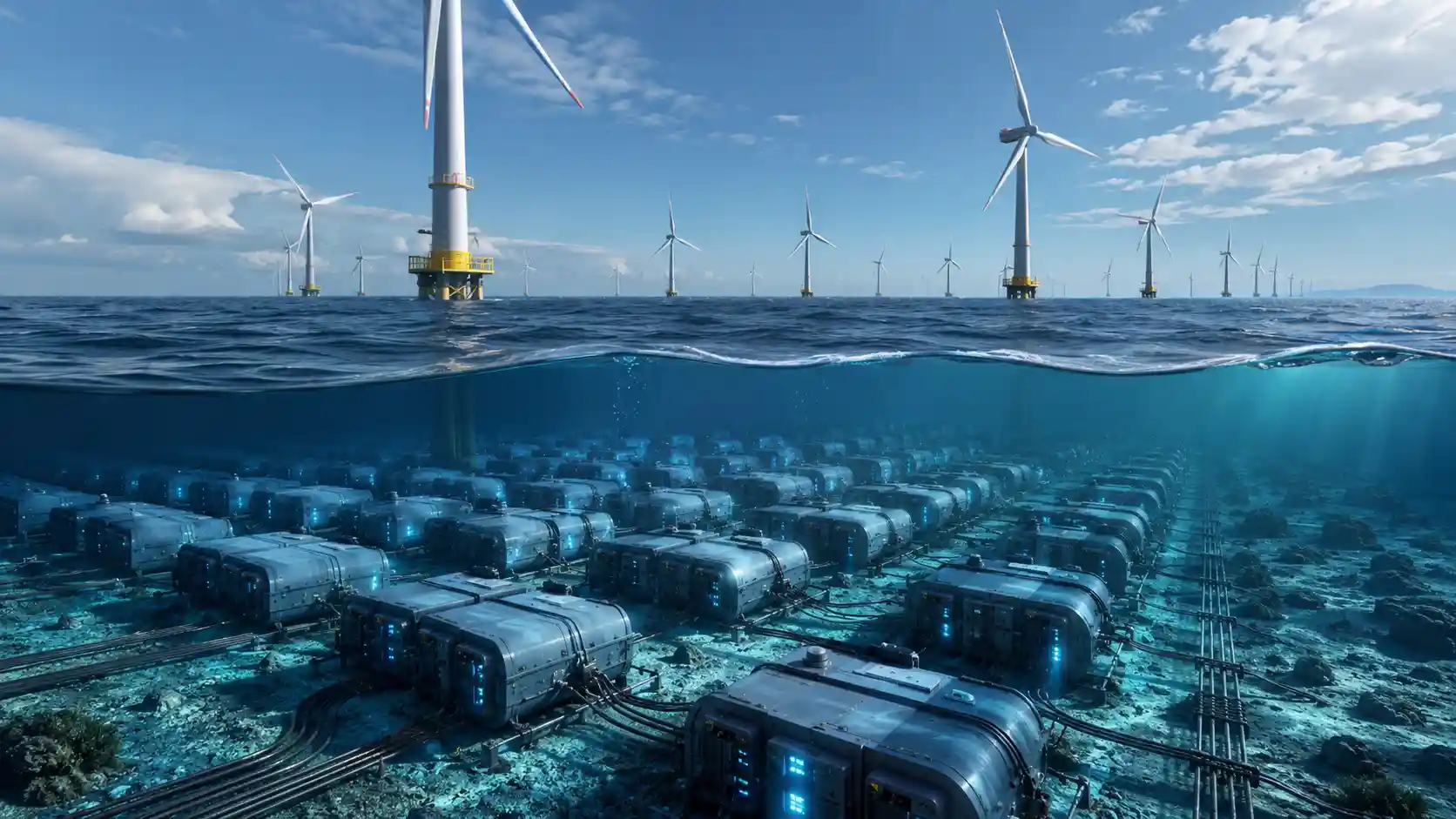

SHANGHAI — Off the coast of Shanghai, near the Lingang New Area, a data center is running on the seabed instead of inside a building. Developed by the Chinese company commonly referred to in state and industry media as Shanghai Hailanyun (also reported internationally as Highlander Data Center Technology), the facility places sealed, pressure-resistant modules underwater rather than housing servers in a conventional data hall. It is important to be precise about what this means: engineers did not submerge ordinary computers. The roughly 2,000 servers reported by the company sit inside custom-built, watertight steel and composite enclosures designed to withstand deep-sea pressure and corrosion, similar in concept to a submarine hull.
Why Put Servers Underwater
Data centers generate enormous heat, and cooling them on land typically requires large volumes of electricity and fresh water for air conditioning or evaporative cooling systems. By placing sealed server modules on the seabed, operators can use the surrounding seawater as a natural heat sink. Seawater never touches the electronics directly. Instead, it flows around the outside of the sealed pods, absorbing heat through the module's casing via heat-exchange systems, similar to how a car radiator works, before dispersing that heat into the ocean. The company has said this approach can significantly cut reliance on freshwater and reduce the electricity normally spent on active cooling equipment, though independent, peer-reviewed verification of the exact percentage savings claimed by the company is not publicly available.
Capacity and Wind Power Integration
Chinese state media and company statements describe the initial phase of the project as having a capacity of about 24 megawatts, reportedly enough computing capacity to be compared to tens of thousands of standard desktop computers running simultaneously. A key claim distinguishing this project is its direct connection to a nearby offshore wind farm, allowing the data center to draw a significant share of its electricity straight from wind generation rather than the regional grid. This is the specific record the project claims: not being the world's first underwater data center, since earlier pilot projects already existed, but reportedly one of the first commercial-scale underwater data centers with a direct offshore wind power tie-in.
The AI Demand Problem
Interest in projects like this has grown alongside the rapid expansion of AI. Training and running large AI models requires clusters of power-hungry processors that generate far more heat than traditional web-hosting servers. As AI adoption accelerates in China and elsewhere, data center operators face rising pressure on electricity grids and local water supplies for cooling. Underwater and offshore-powered designs are one of several approaches, alongside liquid cooling and nuclear-adjacent power deals, that companies are exploring to meet this demand without straining local infrastructure.
Protection, Maintenance, and Repairs
Keeping servers dry and functional at depth requires sealed pressure vessels, corrosion-resistant coatings, and monitoring systems to detect leaks or structural stress. However, this design creates a real trade-off: routine maintenance, part swaps, and hardware upgrades are far harder than in a land-based facility. Technicians generally cannot simply walk in and replace a failed drive. Instead, operators typically design modules to be sealed for extended periods, sometimes years, and may need specialized vessels or remote-operated equipment to retrieve or service a pod, which adds cost and complexity compared to conventional data centers.
Building on Earlier Pilots
This is not China's first attempt at subsea computing. The same company piloted a smaller underwater data center off Hainan's Lingshui coast starting around 2023, which it described at the time as a milestone for commercial underwater data storage in China. The Shanghai Lingang project is widely reported as a larger, follow-on deployment that builds on lessons from that earlier site.
Comparison to Microsoft's Project Natick
Microsoft ran a well-known underwater data center experiment called Project Natick, which placed a single sealed container of servers off Scotland's Orkney Islands between 2018 and 2020. That project was explicitly a research trial: Microsoft studied reliability and cooling performance, then retrieved and decommissioned the container rather than operating it commercially long-term. China's Lingang project differs by aiming for ongoing commercial operation at a larger scale, with direct grid-level renewable power integration, rather than serving purely as a proof-of-concept study.
Could This Become Standard AI Infrastructure
Whether underwater data centers become a mainstream part of AI infrastructure remains genuinely uncertain. The cooling and land-footprint advantages are real in principle, but underwater deployment introduces higher upfront engineering costs, harder maintenance logistics, and unresolved questions about long-term corrosion resistance and environmental impact on marine ecosystems. For now, projects like Lingang should be viewed as a promising but still-experimental niche rather than a proven replacement for conventional data centers.
Further reading and useful links
Reader questions
Frequently asked questions
Where is the Shanghai underwater data center located?
The underwater data center is located on the seabed off the coast of Shanghai, near the Lingang New Area.
How are the underwater servers powered?
The project is notable for its direct connection to a nearby offshore wind farm, allowing it to draw a significant portion of its electricity directly from wind generation rather than the regional grid.
How do underwater data centers stay cool?
Sealed server modules are cooled by the surrounding seawater acting as a natural heat sink. The water absorbs heat via a heat-exchange system built into the module's casing, eliminating the need for freshwater cooling.
Nexuswild welcomes factual corrections. Email contact@nexuswild.com with evidence and the article URL.