
The Android IDE that tried to put app development inside a phone
Before no-code app builders became a mainstream category, a small Korean startup was already pursuing a more radical idea: what if the phone itself could be the development machine?
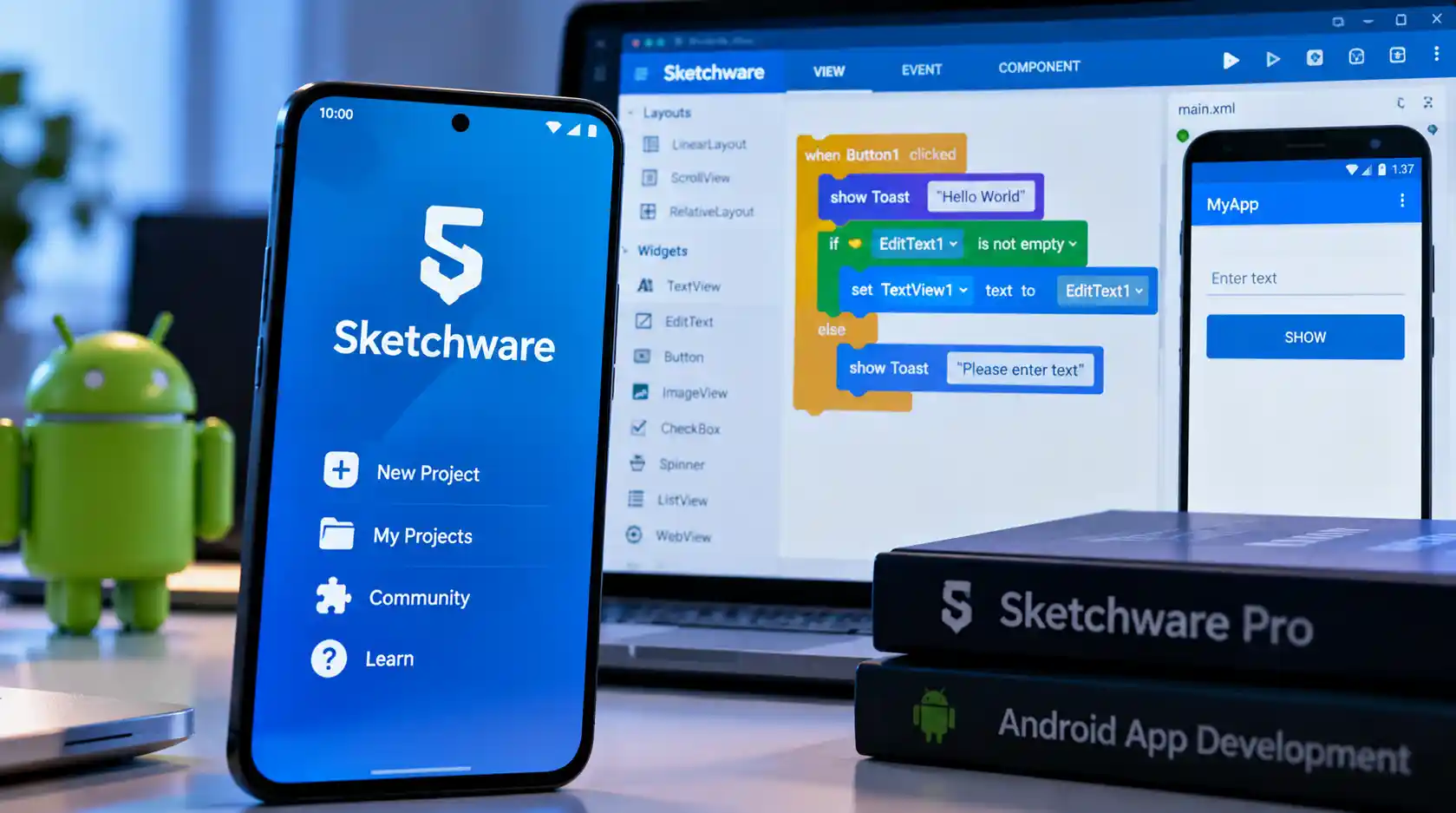
That idea became Sketchware, an Android application that allowed people to design, program, compile and run Android apps directly on an Android smartphone. Instead of requiring beginners to set up Android Studio, learn Java syntax and work from a desktop computer, Sketchware combined a visual interface with Scratch-inspired programming blocks. Users could drag interface components onto a screen, connect logic blocks, build an APK and test the result on the same device.
For a generation of young developers, students and people who did not own powerful computers, that was more than a convenience. It lowered one of the biggest barriers to Android development: access to the tools themselves.
Sketchware's original commercial product is no longer being actively developed by its founding company. Yet the idea did not disappear. A community-led descendant, Sketchware Pro, has become the most visible continuation of the ecosystem and was still receiving development activity in 2026.
The story of Sketchware is therefore not simply the story of an app that shut down. It is the story of a startup, a funding problem, a product that outlived its original company and a developer community that refused to let the concept vanish.
Who founded Sketchware?
Sketchware was created by the South Korean startup Besome.
Sung Woo Park is the name most frequently identified in English-language startup databases and Sketchware's own historical material. On the project's Patreon page, Park described himself as one of the creators of Sketchware. A biographical page from the Human Rights Watch Student Task Force also records Park describing Sketchware as a startup he co-founded and saying that he worked on mobile development, UI and UX while also meeting investors.
However, Sketchware was not a one-person project.
A March 2017 interview published by ZDNet Korea identified three founding members of Besome: Kihong Kim, the company's chief executive; Sung Woo Park, its chief marketing officer; and Moonseok Oh, its chief technology officer. The article described the group as the founders and developers behind Sketchware.
That distinction matters. Park became the most internationally visible public face of the product, but the available contemporary Korean reporting points to a broader founding team.
The original idea
Besome's thesis was simple but unusually ambitious for 2016.
Smartphones were already replacing PCs for communication, media, photography and many everyday tasks. Programming was different. Android app development still assumed that the developer had a computer, a development environment and enough technical knowledge to navigate the Android toolchain.
Besome believed programming would eventually move onto mobile devices too.
Sketchware was designed around that belief. The product used a block-based programming model inspired by Scratch, the educational programming language developed at MIT. Instead of requiring a user to type every statement, the app represented logic as visual blocks that could be connected together.
Its interface also included a visual layout editor. A user could add buttons, text fields, images and other Android interface elements, configure their properties and then define behavior through blocks.
Underneath that simplified interface, Sketchware translated projects into Android code and resources. Historical product descriptions say it generated Java and XML, compiled applications directly on the phone and allowed projects to be exported for continued work in Android Studio.
The important point was not that Sketchware eliminated programming. It changed how a beginner encountered it.
Events, variables, conditions, strings, files, intents and later services such as Firebase could be learned through a visual system before a user had to become comfortable with the full Android development stack.
From educational tool to real app builder
The earliest Sketchware material presented the app as both a learning environment and a practical development tool.
Its tutorials were designed to teach programming concepts through small projects. At the same time, users could build APK files that ran as normal Android applications. They could install the apps on their own phones, share them with others or continue working on exported projects using desktop tools.
That combination helped Sketchware find an audience far beyond traditional programming education.
By December 2017, historical Google Play tracking compiled by AndroidRank recorded the app as having crossed one million installs. Sketchware's own community features also encouraged users to share projects so that others could install them, inspect how they worked and reuse ideas.
The result was an ecosystem of tutorials, project exchanges, YouTube channels, blogs and eventually third-party repositories built around Sketchware.
This community became one of the product's most important assets. It would later become the reason the software survived after the original company stopped maintaining it.
The startup behind the app
Sketchware was not created as a hobby project forever. Besome was a startup trying to turn the tool into a sustainable business.
Park later wrote that the founders had spent roughly two years working on the project without monetary compensation before receiving outside funding. In a separate biographical account, he said the project had begun as a side project before interest from investors encouraged him to take time away from university and focus on the company.
Public startup databases identify Strong Ventures as an investor in Sketchware. Park's own retrospective account also named Primer, Strong Ventures and angel investors.
The company experimented with monetization. Sketchware at various points included paid features, advertising and subscription access. In an August 2018 post titled 'Sketchware is about to close,' Park said the product had a $1.99-per-month subscription at the time.
The post also exposed the central problem facing the company.
The team wanted Sketchware to remain broadly accessible, but the revenue being generated was not enough to support the developers, office expenses and servers. Park wrote that the company needed roughly 3,500 Patreon supporters to sustain the existing team and continue development.
It was a direct admission that user growth and product enthusiasm had not yet produced a durable business model.
The warning came years before the shutdown
The 2018 funding appeal is an important part of the Sketchware story because it shows that the later shutdown did not come without warning.
Besome had built a product that was useful to a global beginner-development community, but developer tools can be difficult businesses. Many users expect learning tools and coding utilities to be free, while the cost of maintaining Android compatibility, cloud services, documentation, support and new features continues to grow.
Sketchware also faced an unusually difficult technical challenge. Android itself does not stand still. Google changes target SDK requirements, build systems, libraries, permissions and publishing rules. A mobile IDE has to keep pace with those changes while also maintaining its own compiler, visual editor and abstraction layer.
The more powerful Sketchware became, the more maintenance it required.
Historical releases show the team adding Firebase support, JSON blocks, library management, runtime permission handling and other capabilities. Those features made the tool more useful, but also pushed it beyond a simple educational toy.
How the original Sketchware ended
The final period of the original project is not documented as cleanly as its launch.
Community-maintained Sketchware Pro documentation says the original Sketchware shut down in 2021 because of funding problems and that its final official update had arrived earlier. Archived APK catalogues show official Sketchware builds continuing into the 2019 to 2020 period, including version 3.10.0.
A 2021 repost of a Sketchware closure notice said the service was being ended for internal reasons and that the team was working on an updated version planned for 2022. Community documentation later referred to that promised successor as Sketchware 2.
That successor never became the new official platform users had been expecting.
By then, however, Sketchware had already created something Besome could no longer fully control: a technically capable and highly motivated user community.
The community builds Sketchware Pro
During Sketchware's decline, independent developers began modifying the app.
One of those efforts evolved into Sketchware Pro.
The Sketchware Pro project describes itself as a community effort created to keep Sketchware alive. It retained the basic idea of building Android applications through a visual interface and block-based logic, while adding features sought by more advanced users.
Over time, Sketchware Pro added capabilities such as custom blocks, local libraries, additional Android components, direct source-oriented features, Kotlin support in some builds and other improvements that pushed the project beyond the boundaries of the original consumer app.
Its development also moved to GitHub, making collaboration much more visible. The repository includes thousands of commits and hundreds of forks, and the project was still receiving updates in September 2026.
The current Sketchware Pro website provides APK downloads, including stable and nightly options, and describes the software as free to use. Its documentation continues to position the project as a way to build native Android applications directly from a smartphone.
For users who search for Sketchware today, Sketchware Pro is effectively the living center of the ecosystem.
But Sketchware Pro is not simply the old company reborn
There is an important legal and historical distinction.
Sketchware Pro is a community mod, not a formally announced continuation of Besome's original company.
The project's own license page explicitly describes the situation as complicated. It says Sketchware Pro is not open source by official definition, characterizing it instead as source-available and warning that parts of the code may remain subject to the original Sketchware copyright.
That is why it is more accurate to describe Sketchware Pro as a community-maintained continuation of the technology and user culture, rather than as the official successor company.
The community can inspect, modify and contribute to the code through GitHub, but the project itself cautions users against assuming that the visible source code gives unrestricted ownership or redistribution rights.
What happened to sketchware.io?
The original domain, sketchware.io, was historically the home of Besome's Sketchware product.
It no longer appears to function as the active home of the ecosystem. A direct check on September 26, 2026 did not return the original site, and independent uptime monitors had also reported the domain offline during 2026.
The active community project uses sketchware.pro instead.
That difference is useful for anyone discovering the name today. Sketchware.io belongs to the history of the original startup. Sketchware Pro represents the active community development branch.
What happened to Sung Woo Park?
Park's role in the early company is well documented. Contemporary sources identify him as a co-founder and Besome executive, and his own writing made him the most visible English-speaking representative of Sketchware.
Reliable, first-party information about the present-day careers of all three original Besome founders is much thinner.
A third-party professional profile aggregator updated in June 2026 lists Sung Woo Park as a co-founder of VOXYS, after a period as co-founder of Hunt Town, and lists his Sketchware role as ending in 2019. NexusWild could not independently confirm those current positions through a first-party biography, so they should be treated as profile data rather than as a fully verified company announcement.
What can be said with greater confidence is that Park's public identity is no longer centered on operating the original Sketchware service. The product's active development has shifted to a separate community.
Why Sketchware still matters
Sketchware arrived before the current wave of AI coding assistants and modern no-code platforms, but it addressed a problem that remains relevant: powerful development tools are often designed for people who already have powerful computers and established technical knowledge.
Sketchware inverted that assumption.
A student with an Android phone could open an app, build an interface, connect logic blocks, compile an APK and see a real application running without ever touching a desktop computer.
That approach had limitations. Large projects could become difficult to manage. Advanced Android functionality often required workarounds or custom code. Google Play requirements continued to become stricter. Visual programming did not remove the need to understand software architecture, security, performance or maintenance.
But Sketchware's value was never that it made every aspect of software development easy.
Its value was that it made the first step dramatically easier.
For many users, that first successful APK was an introduction to programming, Android development and software creation. Some later moved to Java, Kotlin, Android Studio or other development environments. Others stayed inside the Sketchware ecosystem and pushed the tool far beyond what a beginner-oriented block editor might suggest.
From startup product to community infrastructure
The most unusual part of Sketchware's story is what happened after the company could no longer sustain the original service.
Many discontinued developer tools disappear because the users have no access to the internals or no community large enough to rebuild them.
Sketchware was different.
The community had already learned not only how to use the product, but how to modify it, exchange projects and teach one another. When official development faded, that culture became a form of infrastructure.
Sketchware Pro is the clearest result.
As of September 2026, its GitHub repository remained active, with roughly 1,800 stars and more than 700 forks visible on GitHub. Recent issues and commits show that users are still asking for Android compatibility fixes, components and new development features.
The original commercial Sketchware may be gone, but the core proposition is still alive: Android development from an Android phone, with visual tools that lower the barrier to entry.
The legacy of Sketchware
Sketchware did not become Android Studio, and Besome did not grow into a dominant developer-platform company.
Its influence is easier to understand at the level of individual developers.
It gave people with limited hardware a practical way to experiment with real Android apps. It connected visual programming with a production mobile platform. It created a global community around the idea that a phone could be both the device on which software runs and the device on which software is made.
The founding company struggled to turn that idea into a sustainable business. The original service eventually disappeared. The promised next official version did not become the future of the platform.
But the community built another future.
That may be the most important part of Sketchware's story. The startup did not survive in its original form, but the behavior it taught its users did: build, modify, share and keep experimenting.
Reader questions
Frequently asked questions
Who founded Sketchware?
Sketchware was created by the South Korean startup Besome. Sung Woo Park is widely listed as a founder and co-creator, while a 2017 ZDNet Korea interview identified Besome's founding team as CEO Kihong Kim, CMO Sung Woo Park and CTO Moonseok Oh.
When was Sketchware launched?
Sketchware was launched in 2016. It was designed to let users create Android applications directly on an Android smartphone without requiring a desktop development environment.
What did Sketchware do?
Sketchware combined a visual Android interface designer with Scratch-inspired programming blocks. It could generate Android project code, compile APKs on the phone and allow projects to be exported for further development.
Why did Sketchware shut down?
The company had publicly disclosed sustainability problems as early as 2018. Community documentation later attributed the 2021 shutdown to funding problems, while a reposted closure notice referred more broadly to internal reasons.
What was Sketchware 2?
Sketchware 2 was the name later associated with a planned updated version of the original service that was expected after the 2021 shutdown. According to Sketchware Pro's historical documentation, the promised successor did not ultimately launch.
What is Sketchware Pro?
Sketchware Pro is a community-maintained mod and continuation of the Sketchware ecosystem. It adds newer features and remains actively developed through a public GitHub repository.
Is Sketchware Pro the official successor to Sketchware?
No. Sketchware Pro is a separate community project rather than a formally announced successor operated by Besome. Its own documentation describes it as a mod created to keep Sketchware alive.
Is Sketchware Pro open source?
Its source code is publicly viewable and contributions are accepted, but the project's own license page says it is not open source by official definition and describes the copyright situation as complicated.
Is sketchware.io still active?
The original sketchware.io domain did not respond during a September 26, 2026 check, and independent uptime monitors reported it unavailable during 2026. The active community project is hosted at sketchware.pro.
Nexuswild welcomes factual corrections. Email [email protected] with evidence and the article URL.