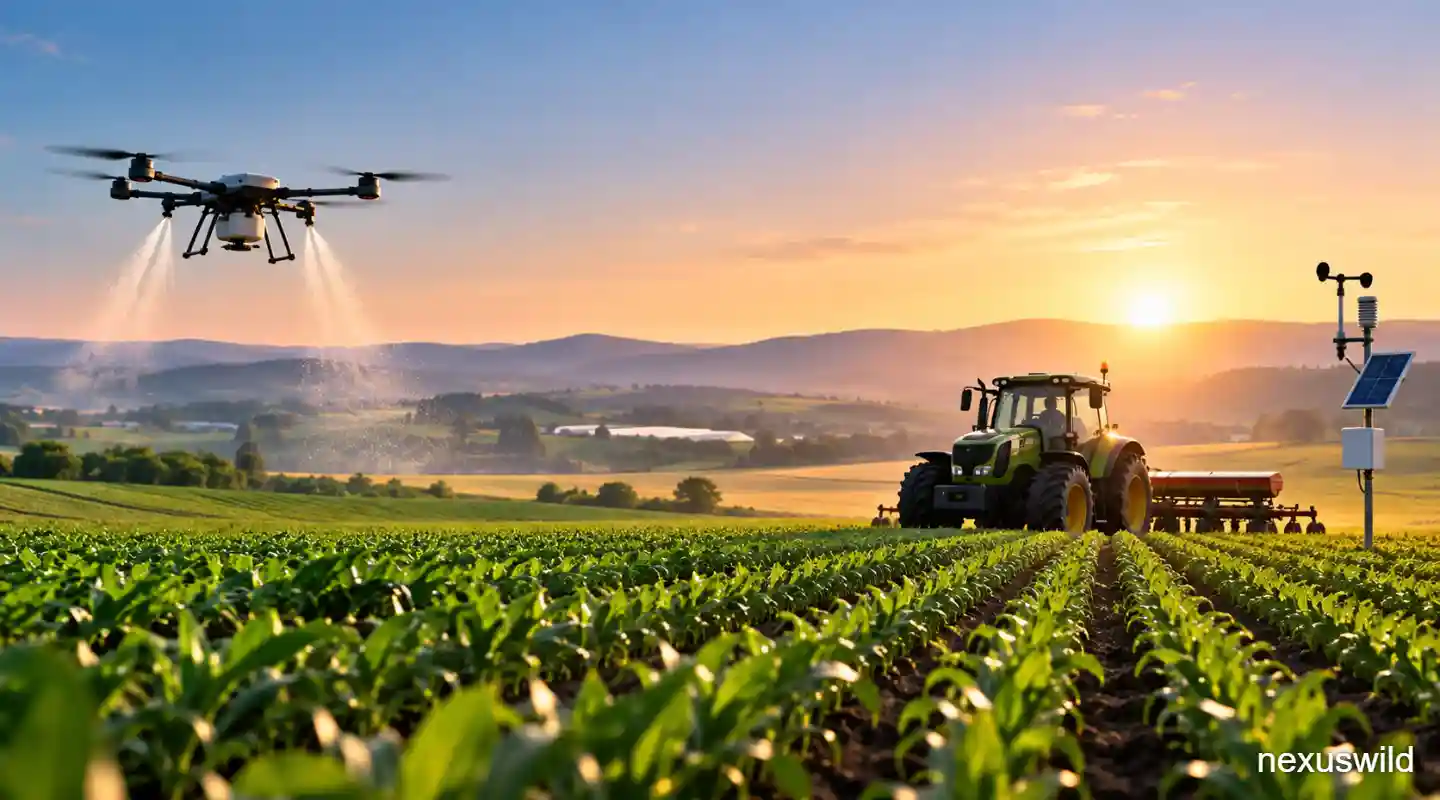

Mechanisation changed how fields were planted and harvested. Improved seeds changed what farmers could grow. Irrigation transformed entire regions. Today, another transition is taking place, but much of the machinery is less visible: sensors buried in soil, algorithms reading satellite images, cameras identifying weeds, software deciding where water is needed and autonomous equipment learning how to move through fields.
This is what increasingly falls under the broad label of smart agriculture.
The term covers everything from relatively mature technologies such as GPS-guided tractors and variable-rate application systems to newer uses of artificial intelligence, agricultural robots and generative-AI advisory services.
What makes the current period different is not one breakthrough. It is the convergence of cheaper sensors, Earth-observation data, cloud computing, mobile connectivity, artificial intelligence and increasingly automated farm equipment.
The pressure to make better use of those tools is also growing.
Agriculture accounts for about 72% of global freshwater withdrawals, according to the United Nations Food and Agriculture Organization. FAO's 2025 assessment also found that more than 60% of human-induced land degradation occurs on agricultural land. Climate variability, rising input costs and labour constraints add another layer of difficulty.
Technology cannot remove those problems. But it is increasingly being asked to help farmers make more precise decisions about them.
Precision Farming Is Moving From Maps to Decisions
Precision agriculture begins with a simple idea: a field is not uniform.
One part may contain more moisture. Another may need nitrogen. Weeds may be concentrated in specific patches. Soil structure, elevation and plant health can vary within the same farm.
Traditional farming often treats a field as one unit. Precision systems try to measure those differences and respond accordingly.
That can involve GPS-guided machinery, yield maps, soil mapping, variable-rate fertilizer application, crop cameras and connected weather stations.
Some of these technologies are already well established on large farms.
US Department of Agriculture data for 2023 showed that guidance and autosteering systems were used by 70% of large-scale crop-producing farms in the United States, while yield monitors, yield maps or soil maps were used by 68%. Adoption was considerably lower among smaller farms, illustrating both the progress and the economic divide surrounding precision agriculture.
The important shift now is from collecting data to acting on it.
A soil-moisture sensor is useful. A system that combines soil moisture with weather forecasts, crop growth and irrigation capacity to recommend when and how much to water is potentially much more useful.
That decision layer is where AI is increasingly entering agriculture.
Satellites and Drones Are Giving Farmers a Different View of the Field
Farmers have relied on satellite imagery for decades, but the quality, frequency and accessibility of Earth-observation data continue to improve.
One of the most significant recent developments is NISAR, the joint NASA-ISRO Synthetic Aperture Radar mission.
The satellite launched on July 30, 2025 and entered routine science operations in January 2026. Its radar instruments are designed to observe nearly all of Earth's land and ice surfaces twice every 12 days. Unlike ordinary optical cameras, radar can gather information through cloud cover, an important advantage during rainy agricultural seasons.
For agriculture, NISAR can contribute information about crop structure, plant and soil moisture and changes during the growing season. Its S-band radar is particularly suited to observing crops.
That does not mean a satellite will tell an individual farmer exactly what to do.
Its value comes when Earth-observation data is combined with field measurements, weather information and agronomic models.
Drones offer a more local version of the same idea.
Equipped with conventional or multispectral cameras, they can inspect fields for crop stress, weeds or uneven development. Spray drones can also apply fertilizers and crop-protection products to specific areas.
Their use is already moving beyond experimentation.
India, for example, has been building a service model around agricultural drones through its Namo Drone Didi programme. Government data published in February 2026 said 1,094 drones had been distributed through lead fertilizer companies, including 500 supplied under the formal scheme. The drones are intended largely for agricultural spraying services rather than requiring each individual farmer to own one.
Regulation still matters. In the United States, agricultural drone spraying falls under Federal Aviation Administration rules for dispensing agricultural products, with certification and operational requirements applying to operators.
In other words, agricultural drones are real tools, but they are not simply consumer gadgets that can be flown and sprayed without operational or regulatory constraints.
Water Management May Be One of Smart Agriculture's Most Important Uses
Few areas show the potential and limitations of agricultural technology as clearly as irrigation.
Because farming dominates global freshwater withdrawals, even modest improvements in how water is applied can matter.
Connected irrigation systems can combine soil-moisture probes, local weather stations, crop models and automated valves. Instead of irrigating purely according to a fixed calendar, the system can respond to what the crop and soil actually need.
Researchers are pushing sensing even closer to the plant.
In February 2026, the US Department of Agriculture's National Institute of Food and Agriculture highlighted research into ultra-thin "plant tattoo" sensors capable of measuring crop water use directly. The project combines sensors with software and machine learning and remains a research effort rather than a widely deployed commercial farming system.
Other approaches are already being tested at field scale.
The World Bank reported in March 2026 that projects in Uttar Pradesh were combining satellite imagery, soil-health information and real-time weather forecasts to provide tailored recommendations on irrigation, fertilizer and pest management.
The broader point is not that software can create more water.
It cannot.
Digital irrigation can help farmers use available supplies more intelligently, but groundwater depletion, inadequate infrastructure and severe drought still impose physical limits that no algorithm can bypass.
AI Is Becoming the Advisory Layer
Artificial intelligence in agriculture is often discussed in terms of robots, but one of its more immediately accessible uses may be advice.
A farmer taking a photograph of a diseased leaf and receiving guidance in a local language requires far less capital than buying an autonomous tractor.
That makes mobile AI potentially relevant to smaller farms as well.
In Kerala, the state-backed KATHIR digital agriculture platform is being developed with World Bank support using satellite imagery, remote sensing and AI-assisted analytics. As of August 2026, the platform contained data covering more than 3 million farmers and over 1.1 million hectares of crops, according to the World Bank. It is intended to support weather alerts, crop mapping, disease identification and agricultural advice.
Maharashtra's MahaVISTAAR system takes another approach. Its generative-AI assistant lets farmers ask questions through voice or text in local languages and draws on agricultural and government information. The World Bank said the application had been downloaded more than 3 million times within several months.
Such numbers measure reach rather than agricultural outcomes. Downloads do not by themselves demonstrate higher yields or incomes.
That distinction is essential.
AI can make agricultural knowledge easier to access, but the quality of the advice depends on reliable local data, sound agronomy and systems that know when uncertainty is too high for an automated answer.
FAO has consequently emphasised responsible, inclusive and locally appropriate AI rather than simply deploying the most technically advanced models.
Crop Intelligence Is Becoming More Predictive
AI is also being used farther upstream in agricultural research.
In April 2026, CGIAR announced work with Google on an AI-supported system intended to analyse field-trial data and help crop breeders identify promising varieties more efficiently. The project is aimed particularly at crops important to the Global South. It remains a research and development initiative, not evidence that AI has already shortened every crop-breeding cycle.
FAO has meanwhile moved some decision-support tools directly into public use.
Its CropSuit application, launched in July 2026, combines soil, climate, topography, land cover and related environmental information to assess which crops may be suitable for particular locations.
These systems illustrate an important direction for agricultural AI.
Rather than trying to replace agronomists, many of the most practical applications are designed to organise complex data so that farmers, researchers and policymakers can make better decisions.
Weather intelligence fits the same pattern.
Satellite observations, local sensors and forecasting models can help estimate drought risk, planting windows or pest conditions. But predictions remain probabilities, particularly in a climate where historical patterns may become less dependable.
Robots Are Moving Into the Field, but Autonomy Is Still Uneven
Automation is another major frontier.
Agricultural equipment makers are developing machines that can operate with less direct human control, while researchers are working on smaller robots designed for tasks such as weed identification and targeted treatment.
John Deere, for example, introduced its second-generation autonomy technology at CES in January 2025. The system uses cameras, computer vision and AI to help agricultural machinery navigate and perform specific operations autonomously.
That is an example of commercial development, not evidence that driverless tractors have become normal on farms worldwide.
There are also narrower robotic systems under development.
A USDA Agricultural Research Service project running through early 2026 has been field-testing computer vision and sensor systems to map weed density in soybean production. The project uses cameras along with multispectral, LiDAR and ultrasonic sensors, with drones included in parts of the research.
The attraction is clear.
If machinery can identify a weed and treat only that plant, farmers may be able to reduce unnecessary chemical application. If autonomous machines can work safely for longer hours, they could also ease some labour constraints.
The hard part is operating reliably in mud, dust, rain, changing light and fields filled with plants that rarely grow in perfectly predictable patterns.
Agriculture is a much less controlled environment than a factory.
Vertical Farming Shows Both the Promise and the Economics Problem
Smart agriculture also extends beyond traditional fields.
Controlled-environment agriculture includes greenhouses, hydroponic farms and highly automated indoor vertical farms where temperature, humidity, nutrients and lighting can be closely managed.
These systems can reduce exposure to weather and allow production near urban markets.
But vertical farming offers a useful warning against assuming that technical possibility automatically creates a viable business.
USDA research notes that controlled-environment systems can offer tighter control over water, nutrients and growing conditions, but sophisticated indoor farms also face high construction, energy and operating costs.
FAO's 2025 review of modern indoor farming similarly found potential advantages while stressing that enclosed farming does not eliminate food-safety risks.
The technology is therefore better viewed as one part of agriculture, particularly suitable for certain high-value crops and locations, rather than a replacement for conventional farming.
The Biggest Barrier May Not Be Technology
Smart farming often looks easiest in demonstrations.
Scaling it is harder.
A 2026 European Commission study found that more than four in five surveyed end-users considered field connectivity highly important, and about two-thirds said they already relied daily on connected tools. Yet more than a third of respondents rated existing coverage as poor or very poor. The study involved 147 stakeholders, so its findings should not be treated as a census of European farms, but they clearly illustrate the infrastructure problem.
The World Bank identifies similar barriers internationally: broadband availability, electricity, digital literacy, language, device costs, subscriptions and access to finance can all widen the gap between large farms and smallholders.
The USDA's adoption numbers tell much the same story from another angle. Large US farms use advanced precision equipment at substantially higher rates than small family farms.
This is why the future of agricultural technology may depend as much on business models as on engineering.
A farmer may not need to own a drone if a cooperative can provide spraying as a service. Satellite information can be delivered through a mobile application rather than expensive hardware. Shared weather stations can spread costs across villages.
For smaller farms, smart agriculture may look less like a field full of robots and more like better information arriving on an affordable phone at the right moment.
Data Creates Another Set of Questions
More connected farms also generate more data.
Soil conditions, land boundaries, planting history, yields, machinery movements and financial information can all become part of digital agricultural systems.
That creates obvious value for crop management, insurance, credit and research.
It also raises questions about ownership and control.
Who owns data generated by a tractor? Can a farmer transfer years of farm records between competing platforms? Who can use crop information collected through a government registry? Can an algorithm disadvantage farmers because its training data represents another region or crop?
FAO has warned that concentration in cloud infrastructure, data platforms and AI systems could create new dependencies within food systems.
Those issues make interoperability, privacy and transparent governance part of agricultural innovation, not side questions.
Why Agriculture Really Is a Technology Frontier
The strongest case for smart agriculture is not that farms will suddenly become fully autonomous.
It is that agriculture contains exactly the kind of problems modern digital technology is increasingly good at addressing: enormous amounts of data, decisions that vary by location, scarce resources, unpredictable conditions and tasks that must be repeated across very large physical areas.
A satellite can identify changes no farmer could see from the ground across an entire region.
A sensor can measure moisture continuously rather than occasionally.
A camera can potentially distinguish a weed from a crop.
An algorithm can combine weather, soil and plant information faster than a person working with separate spreadsheets.
Yet farming retains something technology companies occasionally underestimate: biology and weather do not behave like software.
A model can recommend irrigation, but it cannot make rain fall. A robot may reduce labour requirements but still be too expensive for a small farm. An AI adviser can make information easier to reach while still giving a poor answer when local data is incomplete.
That is why the most credible future for smart agriculture is not technology replacing farming knowledge. It is technology becoming another layer of that knowledge.
FAO's decision to hold its first Global Conference on Smart Farming in July 2026 reflects how seriously governments and agricultural institutions now view that transition. The organisation describes smart farming as the combination of digital technologies, AI, IoT and precision systems with established agricultural practices rather than as a technology-only solution.
The opportunity is substantial because the problems are substantial.
Water must be managed more carefully. Crops face more variable weather. Labour is becoming harder to secure in some agricultural economies. Input costs matter on every hectare. Farmers need information earlier, not after the damage has already occurred.
Smart agriculture cannot guarantee higher yields, lower costs or climate resilience.
But it can make farming more observable, more measurable and, in the right circumstances, more precise.
That is why fields, greenhouses and irrigation networks are becoming an increasingly important testing ground for AI, robotics, satellites, sensors and connected infrastructure.
Nexuswild welcomes factual corrections. Email contact@nexuswild.com with evidence and the article URL.