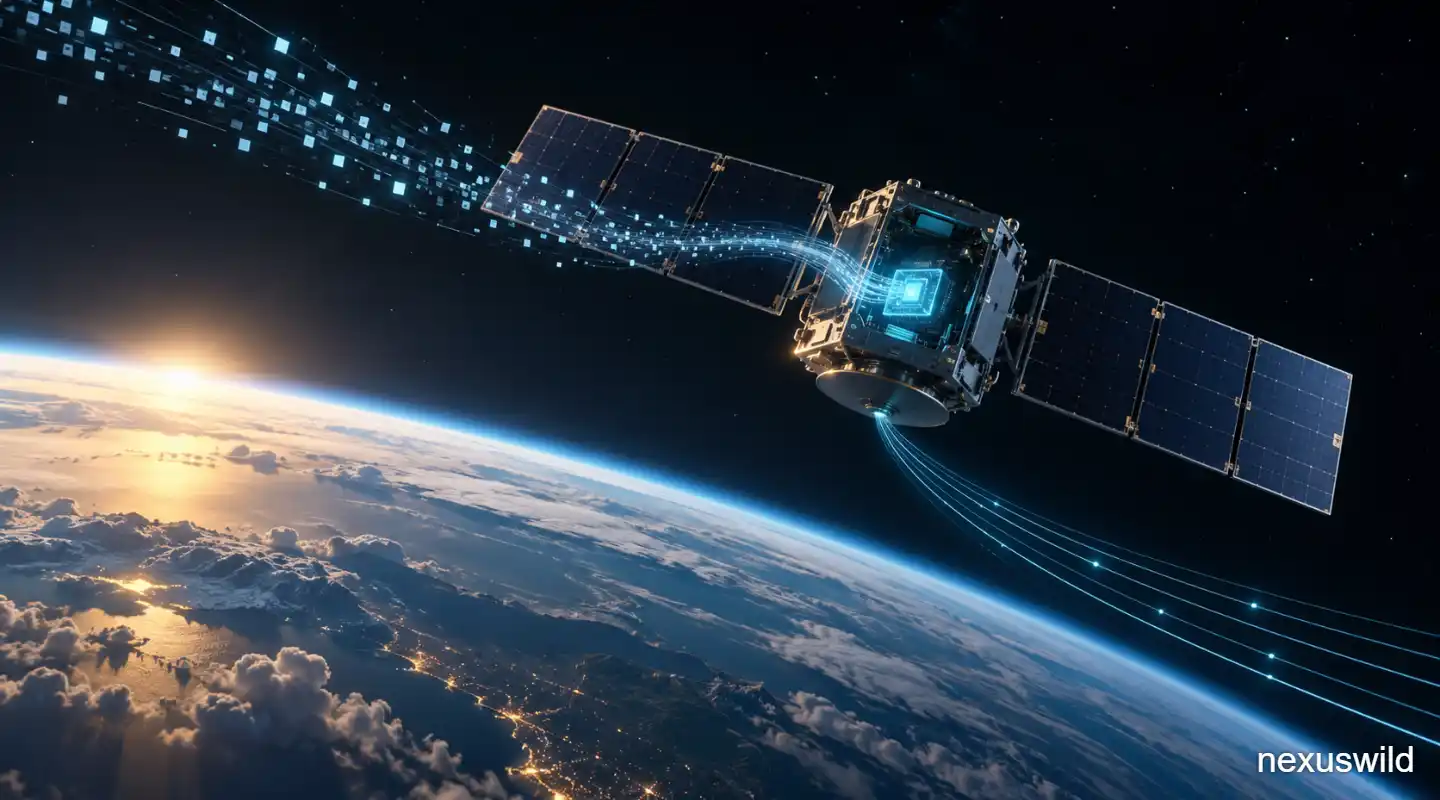

Satellites have traditionally behaved more like sophisticated cameras and radios than computers in the modern sense. They collect images, measurements or communications traffic, store much of that information temporarily and send it back to Earth, where powerful computers perform the heavy analysis. That architecture has worked for decades, but it is becoming increasingly awkward as modern instruments generate far more data and satellite constellations grow larger.
A different model is now moving from laboratory demonstrations into orbit.
Instead of transmitting everything first and deciding what matters later, spacecraft are beginning to process data where it is generated. Artificial-intelligence models can reject cloud-covered imagery, identify ships or wildfires, compress useful images, recognise unusual events and potentially decide what an instrument should observe next.
The idea is usually described as onboard processing, edge computing in space or, in more ambitious projects, orbital computing.
NASA's latest assessment of small-spacecraft technology describes the direction plainly: rather than sending vast amounts of unfiltered data to Earth, a spacecraft can increasingly filter, analyse and interpret information directly in orbit and transmit the useful results.
The change does not eliminate ground computing. Nor does it mean satellites are about to become autonomous data centres.
But it could alter one of the fundamental assumptions of satellite operations: that most intelligence has to wait until the data reaches Earth.
The Downlink Problem Is Becoming a Computing Problem
A satellite can often collect information faster than it can transmit it.
High-resolution optical cameras, hyperspectral instruments, synthetic-aperture radar and other modern sensors can produce large datasets. Sending those datasets home requires radio spectrum, power, ground-station access and time.
Those resources are limited.
A low-Earth-orbit satellite may see a ground station only during particular portions of its orbit. Higher-rate communications systems improve the situation, but transmission capacity still has to compete with rapidly increasing sensor capability.
NASA notes that data-intensive payloads have sharply increased demand for onboard computing, particularly on small satellites. Processing information before transmission can reduce dependence on downlink bandwidth while also reducing the delay between observation and useful information.
Imagine an Earth-observation satellite taking 1,000 images while crossing a region.
If 700 are heavily obscured by cloud, transmitting every image wastes bandwidth. A sufficiently capable onboard system can identify the cloudy scenes first and prioritise the remaining images.
The principle becomes more valuable when the spacecraft is looking for a rare event.
Instead of returning a huge stream of images for people or computers on Earth to inspect later, the satellite could potentially say: a wildfire is here, a vessel has appeared in this zone, or this storm formation deserves another observation.
That turns the spacecraft from a passive collector into a limited decision-making system.
ESA Has Already Demonstrated AI Filtering in Orbit
One of the clearest early demonstrations came from the European Space Agency's Φsat-1 mission.
Launched in September 2020, Φsat-1 used an onboard neural network to analyse hyperspectral Earth imagery and identify clouds. The experiment successfully produced cloud masks in orbit, allowing unusable regions to be rejected before the data was transmitted to Earth.
That may sound like a narrow task, but it demonstrated an important principle.
The satellite did not have to transmit an image to Earth merely so a ground computer could decide the image was useless.
ESA expanded the idea with Φsat-2, a 6U CubeSat launched on August 16, 2024. The spacecraft carries a multispectral imager and six onboard AI applications designed for jobs including cloud detection, street-map generation, ship detection, image compression, wildfire detection and marine-anomaly detection.
Φsat-2 entered its science phase in July 2025 after commissioning. ESA said the spacecraft was using its onboard algorithms to process and compress imagery and analyse phenomena including wildfires, ships and marine pollution.
Its cloud-detection application can discard obscured imagery before downlink. Another application can turn satellite imagery into street maps that may help emergency teams identify usable roads after floods or earthquakes.
These are operational flight demonstrations rather than evidence that every Earth-observation satellite now works this way.
But they show that onboard AI has moved beyond simulation.
NASA Is Testing Satellites That Decide What to Observe
Filtering existing imagery is one step. Changing what the satellite does next is more ambitious.
NASA's Jet Propulsion Laboratory tested a system called Dynamic Targeting aboard the commercial CogniSAT-6 CubeSat in July 2025.
The experiment allowed a spacecraft to look ahead along its orbital path, analyse imagery onboard and decide where to direct its main observation instrument. NASA said the entire process took less than 90 seconds without human intervention.
One goal is simple: avoid wasting valuable observations on clouds.
A more sophisticated use would be detecting a short-lived event, such as a wildfire, volcanic eruption or unusual storm, and automatically changing the observation plan while the spacecraft is still in position to examine it.
NASA is also developing a broader project called Federated Autonomous MEasurement, or FAME, that aims to combine onboard analysis, automated scheduling, satellite communications and cross-tasking between spacecraft.
The project began in 2025 and was planned to expand across multiple commercial spacecraft, with demonstrations of systems in which one satellite's onboard analysis could trigger observations by another.
That kind of architecture is still experimental.
If it works reliably at scale, however, constellations could become less like independent cameras and more like coordinated sensor networks.
AI Models Themselves Are Getting More Capable in Orbit
Another shift became visible in 2026.
Researchers successfully deployed a compressed version of Prithvi, the geospatial foundation model developed by NASA and IBM, onto two orbiting platforms: South Australia's Kanyini satellite and the IMAGIN-e payload aboard the International Space Station.
NASA described it as the first geospatial AI foundation model demonstrated in orbit.
That matters because early onboard AI systems generally rely on small, specialised models.
One model might identify clouds. Another might classify ships.
Foundation models are designed to support a broader range of tasks from a common underlying architecture.
In the Prithvi experiment, researchers tested flood and cloud detection in orbit. NASA noted that active satellites can be difficult to update with large software packages because uplink bandwidth is limited. A more flexible base model could potentially remain onboard while much smaller task-specific components are uploaded later.
This remains a research demonstration, not a production service running across commercial fleets.
But it points toward a different future for spacecraft software: satellites whose capabilities can evolve after launch without replacing the entire onboard intelligence stack.
Space-Based Computing Could Speed Earth Observation
Earth observation is the most obvious application because satellites often generate large images and many of those images contain information that is time-sensitive.
For disaster response, hours matter.
If a spacecraft can recognise a wildfire or flood onboard, it may be able to transmit a small alert, coordinates or processed map before the full-resolution dataset is available on the ground.
That does not remove the need for the original data.
Scientists, emergency agencies and commercial users may still require complete imagery for verification and deeper analysis.
The difference is priority.
Onboard computing can potentially send what requires attention first, followed by larger datasets later.
This is particularly useful when communication capacity is limited or when multiple satellites are producing more data than ground systems can immediately absorb.
Weather Monitoring Could Become More Adaptive
Weather satellites already depend heavily on ground processing, and sophisticated forecasting will continue to require enormous terrestrial computing systems.
Space-based AI is not replacing numerical weather prediction.
Its potential role is narrower but still useful.
Onboard systems could identify cloud structures, rapidly developing storms or other atmospheric features and decide that certain observations deserve priority.
NASA's Dynamic Targeting programme specifically includes the ability to search autonomously for rare storms and other short-lived phenomena.
In future constellations, one satellite might identify an evolving system and ask another spacecraft with a different sensor to look at the same area.
That would make satellite observation more responsive instead of depending entirely on fixed schedules prepared before the spacecraft reaches the target.
Such systems are still being tested. They should not be confused with operational weather-forecasting infrastructure.
Communications Satellites Are Becoming Computers Too
The move toward onboard processing is not limited to imagery.
Traditional communications satellites have often operated as "bent pipes": receiving a signal, amplifying or shifting it and sending it back toward Earth.
Modern digital payloads can do considerably more.
They can demodulate signals, switch traffic, allocate bandwidth, change beam patterns and route data onboard.
ESA's JoeySat, launched in May 2023, demonstrated a digitally regenerative processor and software-defined beam-hopping system. The satellite passed its initial in-orbit tests that July. Its payload can dynamically change coverage and signal allocation rather than relying on an entirely fixed communications pattern.
A new generation of software-defined telecommunications satellites is extending that concept further.
The OneSat platform being developed through ESA and Airbus is designed to be reprogrammable in orbit, with digital processing allowing operators to alter coverage, capacity and frequency use after launch. It is a commercial programme with multiple customer orders, but the wider fleet should be distinguished from systems already operating today.
In low-Earth orbit, planned networks are also combining onboard processing with optical links between satellites.
NASA has described Telesat's developing Lightspeed system as using optical inter-satellite connections and advanced onboard processing so traffic can be routed through a space-based mesh before reaching a ground station. Those deployments were still planned rather than operational at the time of NASA's 2026 description.
The distinction is important: communications satellites have already demonstrated sophisticated onboard digital processing, while fully autonomous orbital networks remain a developing architecture.
India Is Testing an Orbital-Computing Model
A more recent example comes from India.
TakeMe2Space has been developing satellites intended specifically to let customers upload AI workloads, process Earth-observation data in orbit and return results rather than the full raw dataset.
Its earlier MOI-TD technology demonstrator flew as a payload on ISRO's POEM-4 platform. ISRO said the experiment was designed to demonstrate uploading machine-learning models from the ground, performing computation in orbit and sending the inference results back.
The company's newer MOI-1A spacecraft was booked on SpaceX's Transporter-18 mission on October 1, 2026. SpaceX lists Transporter-18 among its completed missions, while the spacecraft was designed around Nvidia Orin NX edge-computing processors.
The launch does not by itself prove that MOI-1A's commercial computing service is operational. Commissioning and in-orbit validation still have to follow deployment.
That distinction makes the mission useful as an example of how quickly the field is moving while also illustrating how carefully "launched", "demonstrated" and "operational" need to be separated.
The International Space Station Has Served as a Computing Testbed
Not all space-based computing experiments are on free-flying satellites.
The International Space Station has provided a useful environment for testing commercial hardware.
Hewlett Packard Enterprise's Spaceborne Computer-2 programme has examined whether high-performance commercial computers can run data processing, AI and machine-learning workloads in orbit rather than sending experimental data back to Earth first.
A third iteration of the system was sent to the ISS in 2024 with expanded storage and computing capability.
NASA describes the purpose as testing whether computing can take place near where space data is generated, including workloads that would traditionally be processed on Earth.
The ISS is a much more benign computing environment than an independent small satellite in several respects, particularly because of its power, infrastructure and shielding.
Even so, these experiments have helped validate commercial processors and AI hardware for future spacecraft.
Scientific Missions May Need Onboard Intelligence Even More
The case for space computing becomes stronger as missions travel farther from Earth.
A low-Earth-orbit satellite can communicate with Earth frequently.
A spacecraft near another planet cannot rely on continuous interaction. Communications take longer, contact opportunities are constrained and bandwidth is precious.
Onboard analysis could allow a science mission to identify unusual measurements, select the highest-value observations and respond without waiting for scientists on Earth to review everything first.
NASA has been experimenting with versions of this idea for decades. Its Autonomous Sciencecraft Experiment on the Earth Observing-1 mission used onboard planning and pattern recognition to select valuable science data and autonomously retarget observations.
Modern processors and machine-learning systems make the approach far more capable, but the underlying reason has not changed.
When communication is expensive, slow or intermittent, intelligence near the instrument becomes more valuable.
Computing in Space Comes With Hard Constraints
Moving computation into orbit creates new problems.
Processors consume electricity, and every watt matters on a satellite powered by limited solar arrays.
Computation generates heat, which is unusually difficult to manage in vacuum.
Radiation can corrupt memory and damage conventional electronics.
More complicated software also creates more opportunities for bugs, cybersecurity failures or incorrect autonomous decisions.
NASA's current small-spacecraft guidance highlights power, thermal management and radiation tolerance as important constraints on high-performance onboard computing.
AI adds another issue: false conclusions.
A cloud-detection algorithm that occasionally rejects a useful image may be acceptable in some missions. A system making autonomous decisions for emergency response or spacecraft navigation may require a much higher standard of verification.
That is why many current missions use AI to filter, prioritise or recommend rather than giving it unrestricted control.
Conclusion
Space-based computing is not about replacing terrestrial data centres with satellites.
Its most immediate value is much more practical.
Satellites can increasingly decide which data is useful before spending scarce bandwidth transmitting it. They can compress images, identify clouds, detect ships or fires, prioritise observations and, in experimental systems, change what they observe next.
Projects such as Φsat-1 and Φsat-2 have demonstrated onboard AI for Earth observation. NASA's Dynamic Targeting work is testing autonomous observation decisions. Prithvi has shown that a geospatial foundation model can be deployed in orbit. Communications experiments such as JoeySat show how digital processing can make satellite networks more flexible.
Other ideas, including large coordinated orbital-computing networks and increasingly autonomous constellations, remain developmental.
The technical limits are real: radiation, energy, heat, reliability and communications constraints do not disappear simply because more powerful processors are available.
Nexuswild welcomes factual corrections. Email contact@nexuswild.com with evidence and the article URL.