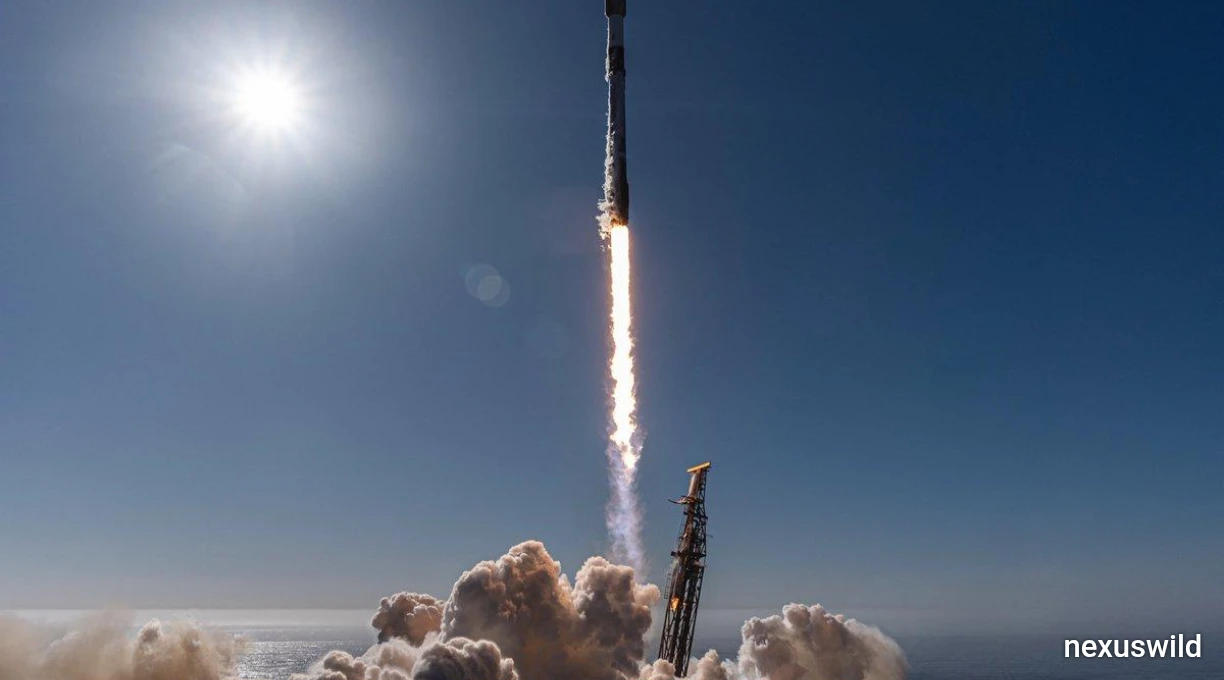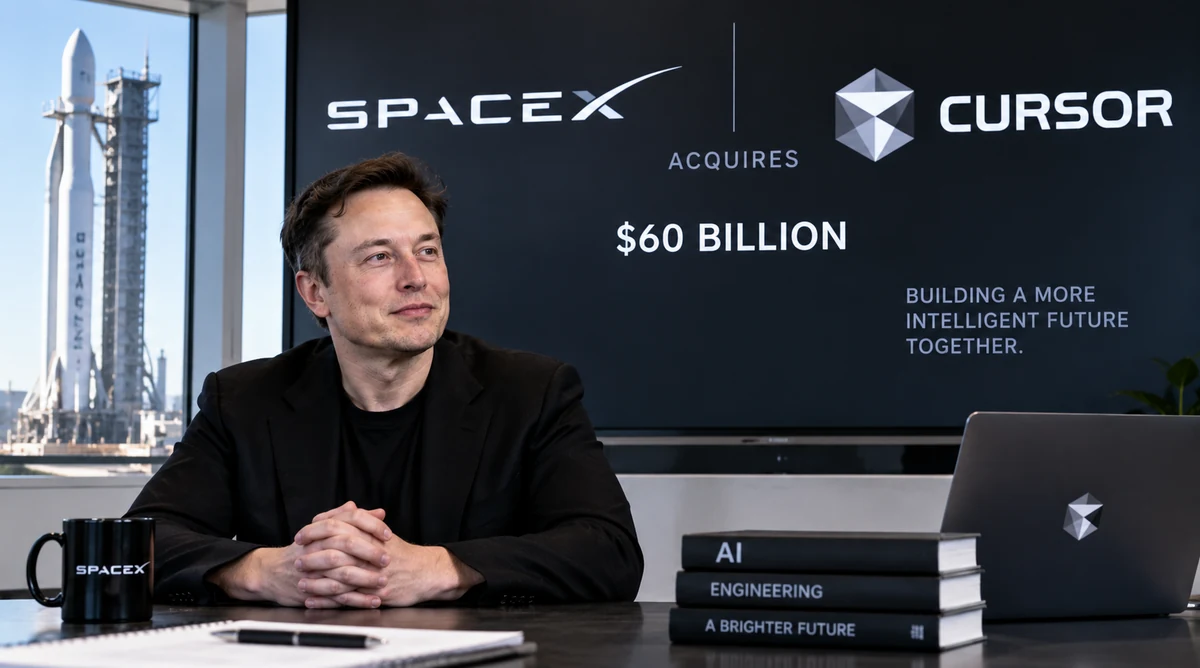

SpaceX has completed its $60 billion acquisition of Cursor, the AI coding platform built by San Francisco startup Anysphere, in one of the largest technology acquisitions ever involving a venture-backed software company.
Cursor confirmed on August 14, 2026 that it had officially become part of SpaceX, completing a process that began with an unusual strategic partnership in April and evolved into a full acquisition agreement in June. The transaction values Cursor at $60 billion and was structured primarily as an all-stock deal.
The deal is striking for two reasons. First, Cursor was only founded in 2022. Second, SpaceX is no longer behaving like a company focused only on rockets and satellites.
After bringing xAI into the broader SpaceX organization earlier in 2026, the company is now assembling computing infrastructure, AI models and one of the most widely used AI coding products under the same corporate roof.
For Elon Musk, Cursor provides something difficult to build quickly: a product already used by millions of software developers.
What exactly did SpaceX buy?
SpaceX acquired Anysphere, the company behind Cursor.
Cursor is an AI-native coding environment built on top of the open-source foundation of Microsoft’s Visual Studio Code. It can understand large software repositories, generate and modify code, answer questions about a codebase, identify bugs and increasingly operate as an autonomous software-development agent rather than a simple autocomplete tool.
The company was founded by four MIT friends: Michael Truell, Aman Sanger, Sualeh Asif and Arvid Lunnemark.
They started Anysphere in 2022 with the broader goal of creating a better programming environment for a world in which AI would increasingly participate in software development.
That bet became extraordinarily valuable in less than four years.
In November 2025, Anysphere raised $2.3 billion at a $29.3 billion valuation. By the time SpaceX moved to acquire the business in 2026, the agreed valuation had more than doubled to $60 billion.
The deal started as a partnership
SpaceX did not initially announce that it was simply buying Cursor.
In April, SpaceX and Cursor disclosed a partnership centered on AI model training and what they described as the future of coding and knowledge-work AI.
The agreement also gave SpaceX an option to acquire Anysphere for $60 billion.
At the same time, Cursor was reportedly considering a new private financing round that could have valued it around $50 billion. SpaceX’s offer effectively overtook that fundraising process.
SpaceX formally exercised the option in June.
Its SEC filing said Anysphere shareholders would receive SpaceX Class A shares based on an implied Cursor equity value of $60 billion, with the number of shares determined using SpaceX’s average market price before closing.
The acquisition then officially closed in August.
Why would a rocket company buy an AI coding startup?
The answer is that SpaceX in 2026 is no longer just a rocket company.
Its business increasingly spans launch infrastructure, Starlink, large-scale computing and artificial intelligence.
Cursor gives that ecosystem a major software product directly connected to developers.
SpaceX provides something Cursor had been struggling to secure cheaply enough on its own: massive amounts of computing power.
Cursor said after the acquisition that joining SpaceX would give it access to what it described as the largest fleet of GPUs in the world, allowing the team to train stronger models while potentially lowering inference costs.
That combination matters because AI coding is extremely compute-intensive.
A modern coding agent may have to read thousands of files, reason over a repository, execute code, inspect errors, rewrite multiple files and repeat the process before completing a task.
Every step consumes computing resources.
Owning or controlling enormous GPU infrastructure can therefore become a meaningful economic advantage.
Cursor became one of AI’s fastest-growing businesses
SpaceX is paying $60 billion because Cursor is not merely a promising research project.
It already built a large commercial business.
Reuters reported in June that Cursor had approximately $2.6 billion in annualized business revenue, while other reporting around the acquisition placed its annualized revenue above $3 billion by the spring of 2026.
The exact revenue figure depends on the measurement date and methodology, but the direction is clear: Cursor went from startup to multibillion-dollar annualized revenue business extraordinarily quickly.
Its customers include developers and employees at companies such as Nvidia, Adobe, Uber, Shopify and PayPal.
That makes the $60 billion acquisition expensive, but not purely speculative.
SpaceX is buying an existing distribution channel into professional software development.
Cursor is becoming more than an editor
Early AI coding products focused heavily on autocomplete.
A developer typed part of a line, and the AI predicted what came next.
Cursor is moving toward something much larger.
Its current product includes agents capable of taking a higher-level task, examining a codebase and modifying several parts of a project.
Cursor itself describes the evolution as moving from completing the next few lines of code toward creating AI teammates that can be given real work.
That direction explains why the company is strategically important to SpaceX.
An AI coding system that can autonomously write, test and maintain software becomes useful not only to external developers but inside SpaceX, xAI, Tesla-related ecosystems and other Musk-controlled engineering operations.
Software development is one of the first professional categories where AI agents are already generating substantial revenue.
Grok enters the Cursor story
The acquisition also gives Musk a powerful distribution channel for xAI models.
Shortly before confirming the acquisition, Cursor introduced Grok 4.6, pointing to it as an early example of what the companies could build together.
That could help xAI compete against OpenAI and Anthropic in coding.
But there is a complication.
Cursor historically relied on models from multiple providers rather than forcing users onto one AI system.
Developers could choose between models from OpenAI, Anthropic and others.
That neutrality was part of Cursor’s appeal.
After the SpaceX acquisition, OpenAI decided to wind down its relationship with Cursor and plans to block access to its models by mid-November, according to recent reporting. Cursor CEO Michael Truell said OpenAI models represented only around 5% of Cursor traffic, suggesting the immediate operational impact could be limited.
Anthropic, meanwhile, has continued supplying Claude models.
The acquisition therefore creates a strategic question: can Cursor remain a neutral AI coding platform while being owned by the company behind Grok?
The founders created extraordinary value in four years
The transaction also represents one of the fastest wealth-creation stories of the generative-AI era.
Forbes estimates that the four Cursor founders each received SpaceX shares worth around $2.4 billion when the deal closed, although their personal net worth can fluctuate with SpaceX’s stock price and other holdings.
That outcome is remarkable given how young the company is.
The founders met at MIT, began experimenting with developer tools, and built Cursor at a time when AI coding was still dominated by simpler completion products.
Their central insight was that AI would eventually need to understand an entire software project rather than merely predict the next line.
That thesis now sits inside SpaceX.
Why $60 billion can still be risky
A $60 billion purchase creates enormous expectations.
AI coding is one of the most competitive areas in technology.
Anthropic has Claude Code.
OpenAI has Codex.
Microsoft has GitHub Copilot.
Google is pushing Gemini deeper into developer workflows.
Amazon has its own developer tools.
Numerous startups are also competing for the same engineers.
Cursor must therefore continue growing fast enough to justify a price roughly twice its late-2025 valuation.
It must also avoid losing users who prefer a model-neutral coding platform rather than one increasingly tied to Musk’s AI ecosystem.
The biggest long-term risk is commoditization.
If every major model becomes excellent at coding, the value may migrate from the underlying model to the interface, developer workflow and agent infrastructure.
That could benefit Cursor.
But if model providers build equally capable coding environments themselves, Cursor could face much stronger pressure.
What SpaceX is really buying
SpaceX is not paying $60 billion for a better text editor.
It is buying a position in the future of software creation.
If AI agents eventually perform a substantial share of routine programming, the company controlling one of the dominant coding environments gains access to an enormous professional market.
Cursor also gives SpaceX a place to deploy its own AI models, train them on real software-development workflows and potentially integrate them with vast computing infrastructure.
That is why the acquisition makes more strategic sense when viewed alongside xAI rather than Falcon 9.
SpaceX has rockets.
It has satellites.
It increasingly has enormous computing capacity.
It has AI models through xAI.
Now it owns one of the fastest-growing interfaces through which developers actually use AI.
Bottom line
The company is Cursor, not “Cursos AI,” and the $60 billion acquisition is real.
SpaceX formally agreed to acquire Cursor’s parent Anysphere in June and completed the transaction on August 14, 2026. Cursor is now officially part of SpaceX.
The price reflects how quickly AI coding has moved from an experimental feature into a serious enterprise business.
But the more important story is what Elon Musk is assembling.
SpaceX is increasingly connecting compute infrastructure, xAI models and Cursor’s developer distribution into one vertically integrated AI system.
For Cursor, the deal provides access to enormous computing resources.
For SpaceX, it provides millions of developers and a proven AI software product.
The $60 billion question is whether those pieces become substantially more valuable together than they were apart.
Reader questions
Frequently asked questions
Did SpaceX buy Cursor?
Yes. SpaceX acquired Anysphere, the company behind Cursor, in a transaction valuing the AI coding startup at $60 billion.
When did SpaceX complete the Cursor acquisition?
Cursor said the transaction officially closed on August 14, 2026.
Who founded Cursor?
Cursor was founded by Michael Truell, Aman Sanger, Sualeh Asif and Arvid Lunnemark, who met at MIT.
How much was Cursor worth before the SpaceX deal?
Anysphere was valued at approximately $29.3 billion in a November 2025 financing before the $60 billion SpaceX acquisition.
Why did SpaceX buy Cursor?
The acquisition gives SpaceX a major developer-facing AI platform while giving Cursor access to large-scale computing resources. It also creates tighter links between Cursor, xAI and Grok.
How much revenue does Cursor generate?
Reuters reported roughly $2.6 billion in annualized business revenue in June 2026, while other reporting around the deal placed annualized revenue above $3 billion at different measurement dates.
Nexuswild welcomes factual corrections. Email contact@nexuswild.com with evidence and the article URL.