
Satellites have spent decades collecting vast amounts of information above Earth. The difficult part has often come afterward: getting all that data back to the ground quickly enough to make it useful.
Indian space-tech startup TakeMe2Space believes some of that work should happen before the data ever leaves orbit.
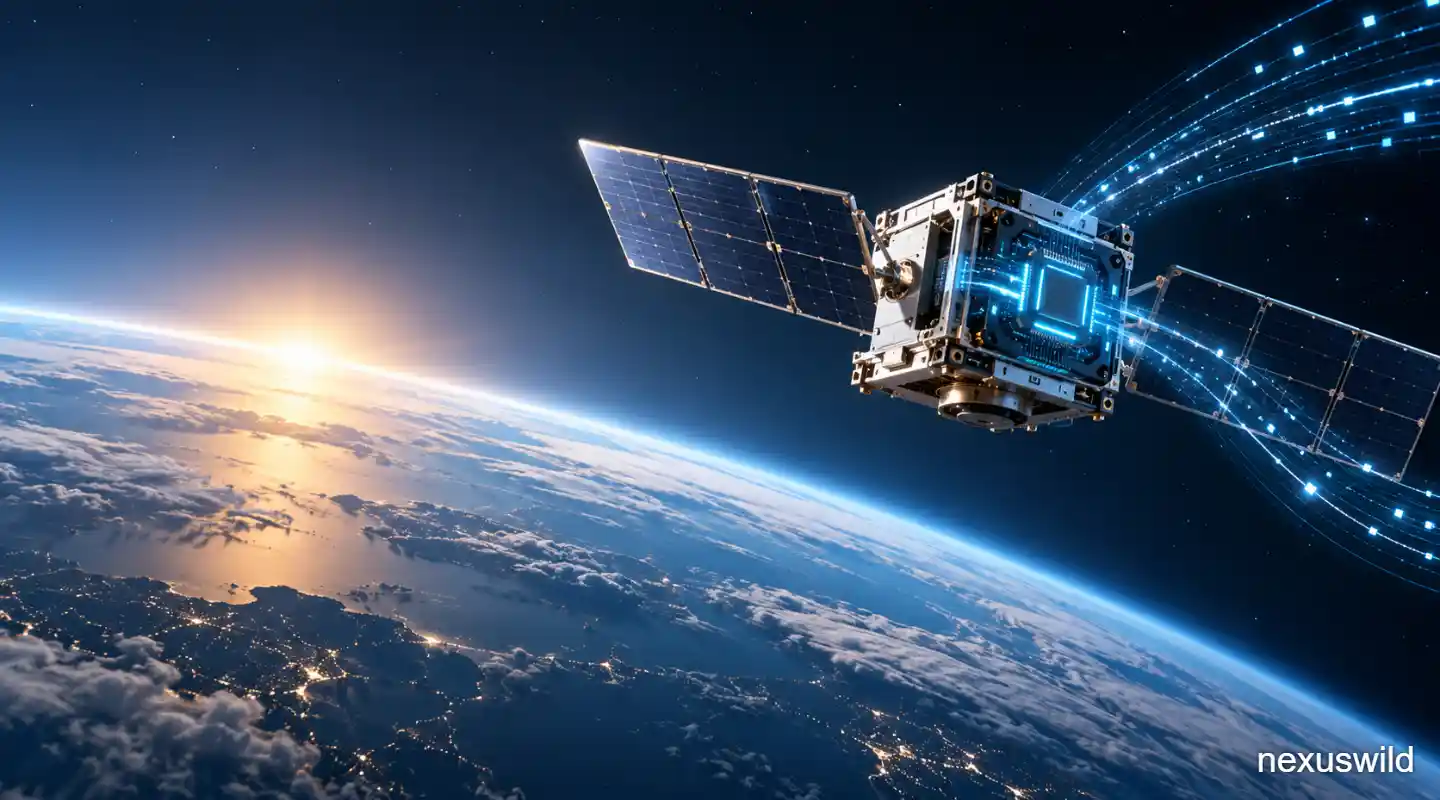
The Hyderabad-based company is preparing to launch MOI-1A, an orbital-computing satellite designed to run artificial intelligence models and process Earth-observation data directly in space. The satellite is scheduled to fly aboard SpaceX's Transporter-18 rideshare mission on October 1, 2026.
The idea sounds simple, but it represents a significant change in the way satellite data infrastructure has traditionally worked.
Instead of continuously transmitting large volumes of raw imagery to terrestrial stations, a satellite equipped with sufficient computing power can analyse what it sees, identify useful information and send a much smaller set of results back to Earth.
For industries that depend on timely satellite intelligence, that could make a meaningful difference.
Moving the computer closer to the data
MOI-1A is designed as more than an imaging satellite.
TakeMe2Space says the spacecraft carries 117 TOPS of onboard computing capability, powered by Nvidia Jetson Orin NX hardware, alongside 16GB of memory, 2TB of storage and a nine-band multispectral imaging system.
Those resources allow AI models to operate directly on information captured in orbit.
A model could, for example, analyse imagery for changes in agricultural land, identify vessels, detect new construction or flag unusual activity. Instead of sending every raw image to Earth for analysis, the satellite can transmit the resulting insight.
TakeMe2Space describes this workflow as an orbital processing pipeline: capture an image, process it with AI, filter the output and downlink the information that matters. The company claims the approach could reduce transmission and processing costs significantly compared with conventional workflows.
That business model is also accessible through its OrbitLab platform, which lets customers upload AI workloads and task the satellite for specific areas of interest.
Why satellite data has a bottleneck
Modern Earth-observation satellites can collect extraordinary quantities of information.
But communications capacity between satellites and ground stations is limited. A spacecraft may only have certain windows in which it can establish contact, while bandwidth, power and ground infrastructure determine how much data can be transmitted during those periods.
The result is an unusual problem: a satellite can sometimes collect information faster than it can send it home.
Processing data in orbit changes that equation.
Rather than treating a satellite as essentially a camera connected to a radio, orbital computing turns it into something closer to an edge-computing device flying hundreds of kilometres above Earth.
The principle is similar to edge computing on the ground. A factory, car or smartphone can process information locally rather than sending everything to a distant cloud data centre. In orbit, the same concept could reduce the amount of unnecessary data travelling through satellite communication networks.
An idea already tested in space
MOI-1A is not TakeMe2Space's first attempt to prove the technology.
The company previously flew its MOI-TD technology demonstration aboard India's PSLV-C60 mission in December 2024. TakeMe2Space later said the demonstration successfully tested several spacecraft subsystems and showed that externally supplied AI applications could be uploaded, executed in orbit and their results returned to Earth.
That mission provided an early validation of the company's broader thesis: general-purpose computing hardware could perform useful AI workloads in low Earth orbit.
The next satellite pushes the concept further.
Reuters reported that TakeMe2Space had secured 23 customers across industries including agriculture, mining, insurance and supply chains ahead of the MOI-1A mission.
These industries increasingly rely on Earth-observation data but do not necessarily need every pixel a satellite captures. What they need is timely information: whether crops are stressed, a mine has changed, an asset has moved or a specific event has occurred.
From one satellite to an orbital data centre
TakeMe2Space's ambitions extend beyond individual spacecraft.
The company says it plans to build a constellation of six satellites capable of providing onboard computing and more frequent Earth coverage. Its website currently targets a six-satellite constellation by the fourth quarter of 2027.
It is also planning a larger step.
The company has outlined a 2028 mission involving two approximately 100-kilogram satellites that would demonstrate networked computing in orbit, effectively moving closer to what could be described as an orbital data centre.
TakeMe2Space is not alone in exploring the idea.
Google is testing its own approach to space-based AI infrastructure through Project Suncatcher, including experiments involving Tensor Processing Units in orbit. The broader interest reflects growing questions about whether some future computing workloads could eventually move beyond terrestrial data centres.
Space computing still has difficult economics
The technology also faces significant constraints.
Launching hardware remains expensive. Electronics must survive radiation, temperature changes and the absence of conventional cooling. A failed server on Earth can be replaced relatively easily; repairing computing infrastructure in orbit is far more difficult.
Communication links between satellites will also become increasingly important if future orbital data centres are expected to operate as distributed computing clusters rather than isolated machines.
These challenges mean orbital computing is unlikely to replace conventional cloud infrastructure anytime soon.
But that may not be the immediate opportunity.
The stronger near-term case is processing information where it is generated.
For Earth-observation satellites, that could mean sending fewer raw images and more useful answers.
TakeMe2Space's MOI-1A mission will therefore test more than another small satellite. It will test whether computing can become a core part of spacecraft architecture rather than something that happens almost exclusively after satellite data reaches the ground.
If that model scales, the next generation of satellites may not simply observe Earth.
They may increasingly understand what they are seeing before anyone on Earth receives the data.
Nexuswild welcomes factual corrections. Email contact@nexuswild.com with evidence and the article URL.