
India’s IT giants are becoming the distribution layer for enterprise AI
OpenAI, Anthropic and Google may build some of the world’s most powerful artificial-intelligence models, but getting those models inside a multinational bank, telecom network, manufacturer or government department requires something different.
It requires consulting teams, systems integration, cybersecurity, regulatory knowledge, legacy-system modernization, cloud infrastructure, data engineering and tens of thousands of people capable of deploying AI inside existing businesses.
That is where India’s technology-services giants are moving aggressively.
Tata Consultancy Services, Infosys, HCLTech, Wipro, Tech Mahindra and LTIMindtree are rapidly reshaping their businesses around generative and agentic AI. They are partnering with frontier-model companies including OpenAI and Anthropic, hyperscalers such as Google Cloud and AWS, semiconductor companies including NVIDIA and AMD, and increasingly with Indian sovereign-AI developers.
The important point is that the largest Indian IT firms are generally not choosing one AI model.
They are building multi-model platforms.
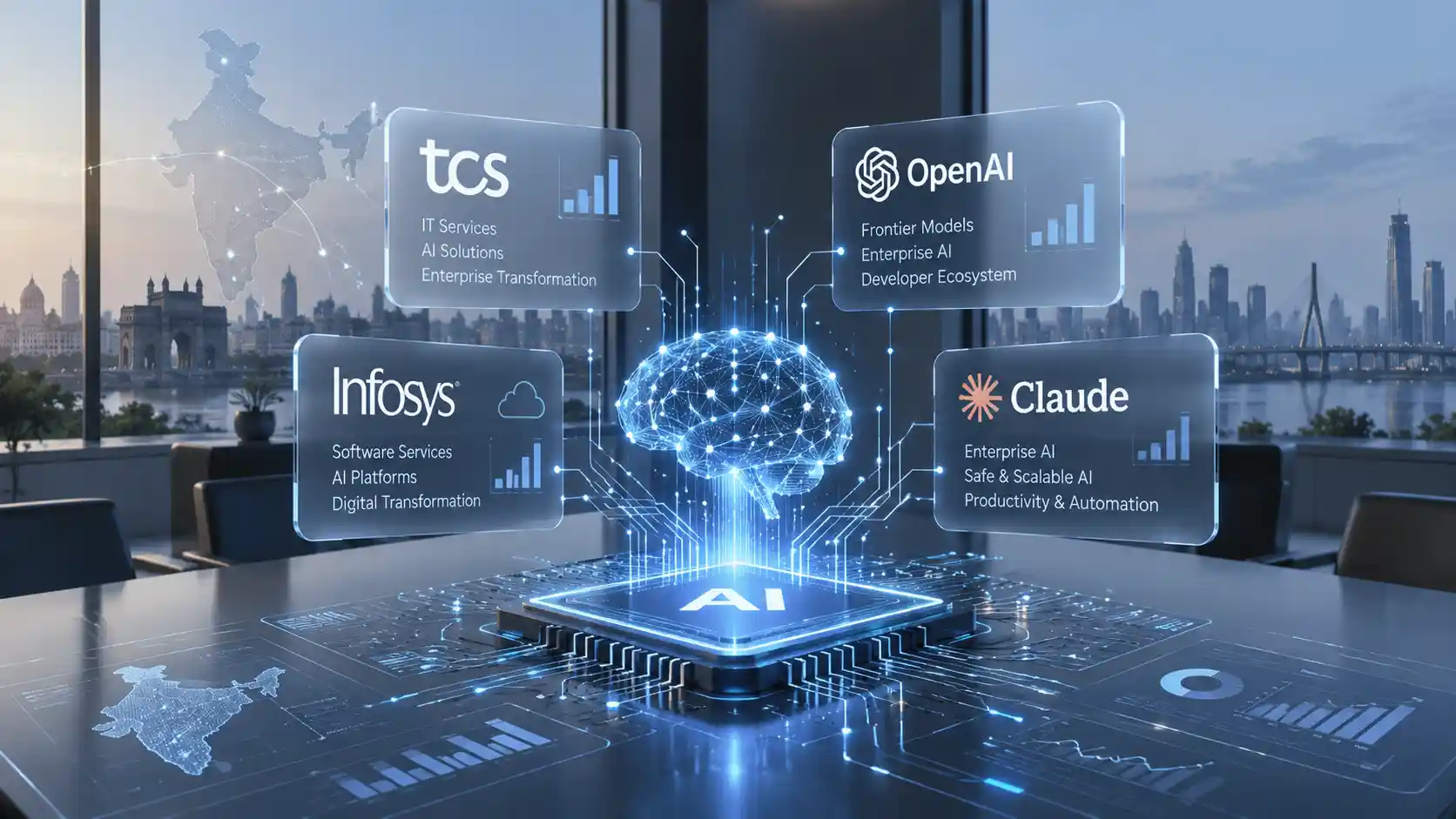
TCS works with OpenAI and Anthropic and has also expanded its broader model ecosystem. Infosys has strategic collaborations with both Anthropic and OpenAI. HCLTech works deeply with Google Gemini while also holding OpenAI Advanced Partner status. Wipro has created a dedicated Claude center while building AI infrastructure around NVIDIA. Tech Mahindra is deploying Gemini while simultaneously partnering with Perplexity and Indian AI developers. LTIMindtree has built alliances across Google Cloud, AWS and NVIDIA.
The emerging business model is not simply 'sell ChatGPT to corporate customers.'
It is to become the layer that connects models, data, infrastructure, applications, agents and business processes together.
Which AI companies are India’s biggest IT firms working with?
The simplified map looks like this:
- TCS: OpenAI, Anthropic Claude, Google Cloud, AMD and other AI infrastructure and model partners.
- Infosys: Anthropic Claude, OpenAI, AWS, Cognition and Intel through Infosys Topaz and Topaz Fabric.
- HCLTech: OpenAI, Google Gemini, Google Cloud, Microsoft and sovereign-AI initiatives including Sarvam.
- Wipro: Anthropic Claude, NVIDIA, ServiceNow and its own Wipro Intelligence platform.
- Tech Mahindra: Google Gemini, Google Cloud, Perplexity, AWS, CoRover.ai and its India-focused Project Indus work.
- LTIMindtree: Google Gemini, Google Cloud, AWS Bedrock, NVIDIA and its BlueVerse AI ecosystem.
The actual competitive battle is therefore not OpenAI versus Claude inside India’s IT industry.
It is a race to build the best orchestration layer across all of them.
TCS and OpenAI: from consulting partnership to AI infrastructure
TCS has one of the broadest AI strategies among Indian technology-services companies.
Its OpenAI relationship extends across enterprise software, coding, industry solutions and infrastructure.
In February 2026, Tata Group, TCS and OpenAI announced a multi-dimensional strategic partnership intended to accelerate AI adoption across Tata companies and global enterprises.
The agreement included access to ChatGPT Enterprise across Tata organizations, use of OpenAI Codex in software engineering and joint development of industry-specific AI solutions.
But the infrastructure component may ultimately be even more important.
OpenAI agreed to become the first customer of TCS's HyperVault AI-data-center business. The initial infrastructure is planned around 100 megawatts of capacity in India, with an option that could scale the relationship toward one gigawatt over time.
This shifts TCS beyond the conventional systems-integrator role.
Instead of merely deploying AI software created elsewhere, the company is positioning itself across a stack running from physical AI infrastructure to models, enterprise integration and business processes.
OpenAI's partner directory currently lists TCS as an Elite Partner.
But TCS is also working with Claude
Calling TCS an 'OpenAI company' would be misleading.
In June 2026, TCS and Anthropic announced a major global partnership centered on Claude.
TCS said it would make Claude available to 50,000 employees across 56 countries and establish a dedicated business unit focused on Anthropic technologies.
The partnership is especially targeted at regulated sectors where AI output may need stronger controls, auditability and human oversight.
Planned areas include financial services, healthcare, life sciences, aviation, telecom, medical technology and public-sector applications.
TCS-owned Diligenta is using Claude-related capabilities across a business serving more than 22 million UK life and pension policyholders, while TCS banking teams are integrating Claude Code into software engineering and technology operations.
TCS is therefore doing something strategically important.
It is avoiding dependence on a single frontier-model company.
TCS already has a multibillion-dollar AI business
The financial numbers show why these partnerships matter.
For the quarter ended June 30, 2026, TCS reported that its annualized AI revenue run rate had reached $2.6 billion, an increase of 13.6% sequentially.
Total quarterly revenue was $7.62 billion.
TCS also reported multiple AI-led transformation wins and said it was expanding partnerships across the AI ecosystem.
Enterprise AI is therefore no longer a side experiment inside TCS.
It has become a measurable multibillion-dollar business line.
Infosys and Claude: Anthropic enters the enterprise through Topaz
Infosys made its Anthropic strategy explicit in February 2026.
The Bengaluru-headquartered company announced a strategic collaboration with Anthropic to combine Claude models, Claude Code and the Infosys Topaz ecosystem.
The initial focus is telecommunications, with a dedicated Anthropic Center of Excellence, followed by financial services, manufacturing and software engineering.
The collaboration targets agentic AI rather than only chatbot functionality.
That includes systems capable of carrying out multi-step processes such as software modernization, compliance work, customer operations and complex engineering workflows.
Anthropic also disclosed an important detail about India itself.
India had become Claude.ai's second-largest market, and Anthropic said nearly half of Claude usage in India involved activities such as building applications, modernizing systems and shipping production software.
That helps explain why Indian technology-service companies are strategically important distribution partners for Anthropic.
Infosys is also an OpenAI partner
Two months after announcing the Anthropic collaboration, Infosys announced a strategic collaboration with OpenAI.
The April 2026 agreement connected OpenAI frontier models and Codex with Infosys Topaz Fabric.
Early areas include software engineering, legacy modernization, DevOps automation, e-commerce and other engineering-heavy workloads.
OpenAI's partner network lists Infosys as an Advanced Partner.
That means Infosys is not attempting to predict whether Claude or OpenAI ultimately dominates the enterprise market.
Its architecture is designed to sit above the model layer.
That is strategically important because large corporate clients increasingly want flexibility.
A bank may prefer one model for coding, another for document analysis and a private or sovereign model for sensitive internal workloads.
The systems integrator that can govern all three may be more valuable than the company that simply resells one model.
Infosys Topaz is becoming the orchestration layer
Infosys describes Topaz Fabric as a composable AI services layer connecting infrastructure, models, enterprise data, applications and workflows.
The word 'models' is important.
The platform is intended to allow different AI technologies to operate inside a broader enterprise architecture rather than forcing the customer into one provider.
Infosys has also expanded relationships with AWS around Amazon Q Developer, with Cognition around the Devin autonomous software-engineering agent and with Intel around compute infrastructure.
By February 2026, Infosys said it was working with 90% of its top 200 clients on their AI journeys and had more than 4,600 AI projects underway.
The company estimated that AI-first services could represent an incremental $300 billion to $400 billion market opportunity by 2030, citing a Nasscom-McKinsey report.
Infosys is now separately reporting AI revenue
The shift became even clearer in its June-quarter results.
For Q1 FY27, Infosys reported $5.08 billion in total revenue and said AI revenues represented 8.2% of the quarter.
It also reported $3.6 billion of large-deal wins, with 61% classified as net new.
That makes AI a visible part of the company's revenue mix rather than only a technology narrative.
HCLTech is building one of the widest full-stack AI plays
HCLTech is approaching the market from several directions at once.
The company has a deep strategic relationship with Google Cloud and in April 2026 created a dedicated Gemini Enterprise Business Unit.
Its goal is to use Gemini Enterprise and Google Cloud infrastructure to build industry-specific AI agents and automate enterprise workflows.
HCLTech followed that with an AI Innovation Zone in Santa Clara in June, again in partnership with Google Cloud.
The facility is focused not only on conventional generative AI but also agentic, kinetic and physical AI, including robotics-related applications.
At the same time, HCLTech is increasingly tied into OpenAI.
In August 2026 it achieved OpenAI Advanced Partner status, positioning its consulting and engineering teams to build and deploy enterprise applications using OpenAI technology.
Once again, the strategy is multi-model rather than exclusive.
HCLTech is also putting money into AI data centers
HCLTech has gone further down the infrastructure stack.
In July 2026, the company announced plans to invest up to ₹3,500 crore in AI data centers with potential capacity of approximately 50 MW.
The investment is part of what HCLTech calls a full-stack AI offering spanning infrastructure, cloud operations, AI engineering, software and services.
The company is also participating in sovereign AI initiatives in India, including infrastructure tied to Sarvam.
This means HCLTech increasingly competes across three layers simultaneously: AI infrastructure, AI platforms and enterprise implementation.
HCLTech is one of the few giants publishing a separate Advanced AI number
HCLTech reported $171 million in Advanced AI revenue for Q1 FY27.
That was up 62.1% year over year in constant-currency terms and 10.6% sequentially.
Its definition covers areas including AI factories, AI engineering, physical AI, robotics and custom silicon rather than classical analytics or ordinary AI embedded in traditional services.
During FY26, HCLTech said its Advanced AI business had reached an annualized revenue level of approximately $620 million.
The separate disclosure provides one of the clearer financial views into how quickly enterprise-AI revenue is becoming material for India's IT-services sector.
Wipro is making Claude a major part of its AI strategy
Wipro's most visible frontier-model move in 2026 has been around Anthropic.
In June it opened an Applied AI Center of Excellence for Claude models at its Bengaluru innovation hub.
The center integrates Claude into Wipro Intelligence, the company's broader AI stack, with applications across healthcare, mortgage services, airlines, manufacturing and consumer businesses.
Wipro is also building teams capable of deploying Claude directly inside client environments.
The company plans to certify 10,000 front-line delivery experts on Claude over an 18-month period.
This is significant because AI deployment is becoming a talent problem as much as a software problem.
A model company can release a more powerful model overnight. Training tens of thousands of enterprise engineers to implement it safely can take much longer.
Wipro is trying to turn services into software
In April 2026, Wipro created an AI-Native Business & Platforms Unit.
Management described the strategy as a shift toward a 'services as software' world.
The idea challenges the traditional Indian outsourcing model.
Historically, IT-services revenue often scaled by adding engineers to projects.
Agentic AI can automate portions of coding, testing, support, operations and back-office processing.
That creates a potential problem: if fewer human hours are required, companies cannot rely indefinitely on billing more people for more time.
Wipro's response is to package intellectual property, agents and automation into reusable platforms that can produce business outcomes without headcount increasing at the same rate.
Its March 2026 AI-Data Center offering also integrates NVIDIA AI Enterprise with Wipro Intelligence, adding an infrastructure layer beneath the agentic software strategy.
Tech Mahindra is taking a different route with Gemini and India-origin AI
Tech Mahindra has built one of the strongest Google Cloud and Gemini relationships among India's large IT firms.
Its expanded collaboration with Google Cloud uses Gemini models, Vertex AI and Google Cloud's data stack to create industry-specific solutions.
At Google Cloud Next 2026, Tech Mahindra showcased Gemini-powered workflows spanning telecom, manufacturing, financial services, healthcare and retail.
Google Cloud also named Tech Mahindra its 2026 Partner of the Year for Services and Industry Solutions in manufacturing.
The company said its manufacturing offerings combine Gemini, Vertex AI and BigQuery with industrial data and enterprise systems.
Tech Mahindra is not limiting itself to Gemini
During Q1 FY27, Tech Mahindra announced a partnership with Perplexity to embed AI intelligence across its sales organization.
In September 2026, it added another important dimension by partnering with CoRover.ai to accelerate India-origin AI solutions for global markets.
Tech Mahindra is also participating in India's sovereign-model push.
Its Project Indus work focuses on Indian languages, while its IndiaAI Mission activities include development work around an approximately 8-billion-parameter education-focused foundation model designed for Indian languages and dialects.
This gives Tech Mahindra a two-track strategy.
It can deploy frontier US-developed models such as Gemini where those are appropriate, while developing and integrating India-origin models where language, sovereignty, economics or data-control requirements create a different need.
Sovereign AI is becoming the next battlefield
The rise of sovereign AI explains why Indian IT companies are unlikely to simply hand their businesses to OpenAI, Anthropic or Google.
Large banks, governments, defense-related organizations, healthcare systems and regulated industries may require data residency, local infrastructure, private deployment or greater control over model behavior.
That creates room for Indian foundation models and private enterprise models alongside frontier systems.
TCS is building large-scale AI infrastructure through HyperVault.
HCLTech is investing in domestic AI data centers and working with Sarvam.
Tech Mahindra is developing Indian-language model capabilities.
Other Indian technology companies are investing in similar sovereign infrastructure and model orchestration.
The likely future is therefore heterogeneous.
An enterprise may use OpenAI for one task, Claude for another, Gemini for a third and a locally hosted model for sensitive workloads.
LTIMindtree shows how the hyperscaler route fits into the picture
LTIMindtree has followed another version of the multi-partner strategy.
Its expanded Google Cloud collaboration uses Gemini and Vertex AI for agentic and generative-AI solutions across banking, manufacturing, retail, consumer products and media.
The company also maintains strategic relationships with AWS, where Amazon Bedrock is part of its generative-AI strategy, and NVIDIA, whose technology is integrated into several LTIMindtree AI offerings.
Its BlueVerse ecosystem is intended to provide an enterprise AI layer combining agents, platforms and partner technologies.
LTIMindtree therefore reinforces the broader pattern: large IT-services firms want the orchestration layer, not dependence on one foundation model.
Why OpenAI and Anthropic need TCS and Infosys
At first glance, it may seem that companies as powerful as OpenAI or Anthropic do not need Indian outsourcing firms.
The reality of enterprise computing is more complicated.
A frontier model is only one component of an AI deployment.
A global bank may have thousands of applications written over decades in Java, COBOL, .NET, SAP and proprietary systems.
Its data may be distributed across on-premise infrastructure, multiple cloud providers and dozens of jurisdictions.
It must satisfy internal security controls, financial regulations, audit requirements and data-residency rules.
An AI agent cannot simply be connected to everything and allowed to operate.
Someone must redesign workflows, create permission systems, connect APIs, modernize applications, evaluate model outputs, monitor agents, manage identities and provide human escalation.
Indian IT firms already perform many of those tasks for the world's largest enterprises.
That makes them powerful distribution channels for AI-model companies.
Why Indian IT firms need OpenAI, Claude and Gemini
The dependency runs both ways.
Indian IT companies built much of their scale around labor-intensive application development, maintenance, business-process outsourcing and infrastructure management.
AI directly automates pieces of those businesses.
Coding agents can generate software.
AI systems can perform testing.
Agents can resolve support tickets.
Models can process documents and automate back-office workflows.
A services company that ignores this shift risks having its existing revenue model automated by someone else.
Partnering with frontier AI companies allows Indian IT firms to turn the disruption into a new category of consulting, integration and managed services.
The billing model could change dramatically
This may ultimately be the most important economic consequence.
Traditional outsourcing has often been connected to effort: teams, hours, seats and long-term staffing arrangements.
AI enables more work to be completed with fewer manual steps.
That pushes providers toward outcome-based pricing, platform subscriptions, AI consumption, reusable agents and managed autonomous operations.
Wipro's language around 'services as software' captures the transition clearly.
TCS is adding infrastructure revenue.
Infosys is building a reusable AI fabric.
HCLTech is separating Advanced AI revenue and investing in data centers.
Tech Mahindra is developing domain-specific and sovereign AI assets.
These are different responses to the same structural problem.
The biggest competition may be at the orchestration layer
The models themselves are changing too quickly for a systems integrator to assume today's leader will remain the best model for every workload.
Enterprise buyers also increasingly care about cost, latency, data residency, auditability and model portability.
That means the strategically valuable layer may be the control plane above individual models.
The company controlling that layer can determine which model receives a task, what enterprise data it may access, which tools an agent can execute, how output is evaluated and when a human must approve an action.
This explains the growing importance of platforms such as Infosys Topaz Fabric, Wipro Intelligence and the AI orchestration frameworks being developed across TCS, HCLTech, Tech Mahindra and LTIMindtree.
India is becoming a battlefield for frontier AI distribution
India combines several advantages that matter to AI companies.
It has a large developer base, enormous IT-services companies, fast-growing enterprise demand, major cloud infrastructure investment and one of the world's largest pools of software-engineering talent.
Anthropic has described India as its second-largest Claude.ai market.
OpenAI has expanded enterprise relationships and infrastructure plans in the country.
Google has decades-long connections with India's IT-services ecosystem through Google Cloud.
At the same time, India's sovereign-AI push is creating domestic alternatives.
That makes the country more than a customer market.
It is becoming a distribution, engineering, infrastructure and model-development hub.
Indian IT is no longer simply an outsourcing story
For decades, India's largest technology companies were often described through the language of outsourcing: lower-cost engineering, application maintenance and offshore delivery centers.
The AI era is forcing a different identity.
The industry's largest firms are increasingly becoming AI integrators, agent builders, model orchestrators, data-center operators and industry-platform companies.
The early financial evidence is already visible.
TCS has reported a $2.6 billion annualized AI revenue run rate.
Infosys says AI accounts for 8.2% of quarterly revenue.
HCLTech's Advanced AI revenue is growing above 60% year over year.
Meanwhile, Wipro has reorganized around AI-native platforms and Tech Mahindra is combining global frontier models with sovereign Indian AI.
The transformation is still early, and not every AI pilot will become a profitable production deployment.
But the direction is increasingly clear.
The real race is not TCS versus Infosys or OpenAI versus Claude
The enterprise AI market is unlikely to have one universal winner.
Different models will dominate different tasks, and those positions will change as new models arrive.
The more durable competitive advantage for Indian IT companies may be the ability to work with all of them.
That means connecting OpenAI, Claude, Gemini, sovereign models and enterprise data without locking the customer permanently into one technology provider.
TCS, Infosys, HCLTech, Wipro, Tech Mahindra and LTIMindtree are all moving toward versions of that strategy.
For India's technology-services industry, the question is no longer whether AI will disrupt outsourcing.
The disruption is already underway.
The more important question is whether India's IT giants can become the infrastructure and implementation layer through which the rest of the corporate world adopts AI.
Reader questions
Frequently asked questions
Is TCS partnered with OpenAI?
Yes. TCS and Tata Group have a strategic partnership with OpenAI covering enterprise adoption, Codex, industry solutions and AI infrastructure. OpenAI also lists TCS as an Elite Partner.
Does TCS also use Anthropic Claude?
Yes. TCS and Anthropic announced a major partnership in June 2026. TCS plans to provide Claude to 50,000 employees across 56 countries and build Claude-powered enterprise solutions for regulated industries.
Is Infosys partnered with Claude?
Yes. Infosys and Anthropic have a strategic collaboration that combines Claude and Claude Code with Infosys Topaz and includes a dedicated Anthropic Center of Excellence.
Is Infosys also partnered with OpenAI?
Yes. Infosys announced a separate OpenAI strategic collaboration in April 2026 focused on software engineering, application modernization, agentic AI and OpenAI Codex.
Which Indian IT company works with Google Gemini?
Several do. HCLTech operates a dedicated Gemini Enterprise Business Unit, while Tech Mahindra and LTIMindtree also have major Google Cloud collaborations using Gemini and Vertex AI.
Which Indian IT company has the biggest reported AI revenue?
The companies use different definitions, so direct comparison is difficult. TCS reported a $2.6 billion annualized AI revenue run rate in Q1 FY27, Infosys said AI represented 8.2% of quarterly revenue, and HCLTech reported $171 million of Advanced AI revenue for the quarter.
What is TCS HyperVault?
HyperVault is TCS's AI-infrastructure and data-center initiative. OpenAI is expected to become its first customer, beginning with planned capacity of 100 MW in India and an option for significantly greater scale.
What is Infosys Topaz?
Infosys Topaz is the company's AI ecosystem. Topaz Fabric is designed to connect AI infrastructure, multiple models, enterprise data, applications, agents and business workflows.
What is Wipro doing with Claude?
Wipro opened an Applied AI Center of Excellence for Claude models in Bengaluru in June 2026. It is embedding Claude into Wipro Intelligence and plans to certify 10,000 front-line delivery experts on Claude.
What is HCLTech doing with OpenAI and Gemini?
HCLTech has both an OpenAI Advanced Partner relationship and a dedicated Gemini Enterprise Business Unit with Google Cloud, reflecting a multi-model enterprise AI strategy.
What AI is Tech Mahindra using?
Tech Mahindra works extensively with Google Gemini and Google Cloud, has partnered with Perplexity and CoRover.ai, and is also developing India-origin AI through Project Indus and IndiaAI Mission initiatives.
Are Indian IT companies choosing OpenAI or Claude?
Most major firms are not making an exclusive choice. Their strategies increasingly support multiple models so customers can select technology based on workload, cost, security, regulatory requirements and data residency.
Why do OpenAI and Anthropic need Indian IT firms?
Large enterprises need far more than access to an AI model. Indian IT companies provide systems integration, legacy modernization, data engineering, cybersecurity, governance, cloud operations and global implementation capacity.
Will AI hurt Indian IT outsourcing?
AI can automate coding, testing, support and business processes that historically generated service revenue. Indian IT firms are responding by shifting toward agentic AI, reusable platforms, AI infrastructure and outcome-based services.
What is sovereign AI in India?
Sovereign AI generally refers to AI infrastructure and models that provide greater national or organizational control over data, computing, language support and deployment. Indian IT firms are increasingly investing in local AI infrastructure and India-focused models alongside global frontier systems.
Nexuswild welcomes factual corrections. Email [email protected] with evidence and the article URL.