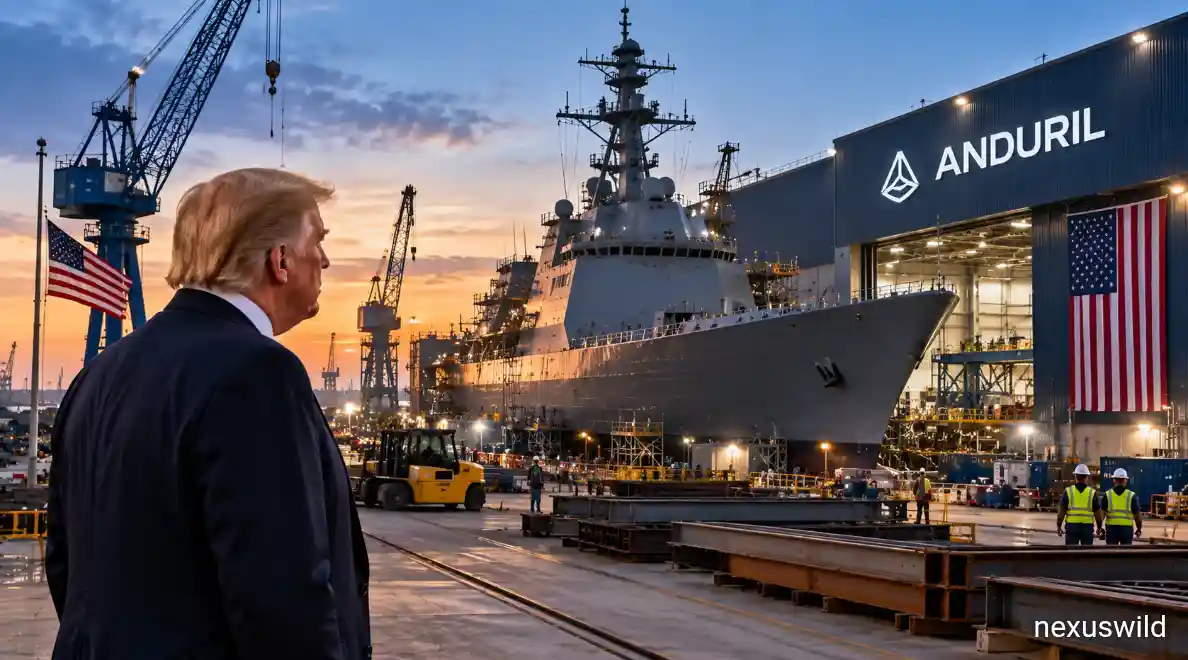

President Donald Trump has publicly backed a $6.6 billion expansion of the U.S. submarine industrial base involving defense technology company Anduril and the U.S. Navy, as Washington seeks to increase domestic capacity for building critical components used in Virginia-class nuclear-powered attack submarines.
The initiative centers on Arsenal-2, a new high-tech shipyard planned for Sparrows Point in Baltimore County, Maryland.
Anduril will invest $3.7 billion of private capital in the facility, while the Navy has awarded the company a contract worth up to $2.9 billion for submarine components. Together, those commitments total as much as $6.6 billion.
Trump attended the October 6 launch event and described the project as part of a broader effort to expand American shipbuilding and defense manufacturing.
Anduril Will Invest $3.7 Billion in Arsenal-2
The private portion of the project is a $3.7 billion investment by Anduril.
The company says Arsenal-2 will cover more than 2 million square feet on a 187-acre site and will be designed around advanced manufacturing, software-controlled production and automation.
The facility will not build complete Virginia-class submarines from start to finish.
Instead, it will manufacture complex components and large assemblies that will be sent to the two existing prime submarine builders, General Dynamics Electric Boat and Huntington Ingalls Industries' Newport News Shipbuilding, for final integration and assembly.
That distinction matters because Anduril is entering the submarine supply chain rather than replacing the Navy's established submarine shipyards.
Navy Contract Is Worth Up to $2.9 Billion
Alongside the private investment, the U.S. Navy awarded Anduril a contract worth up to $2.9 billion.
Anduril says payments under the contract will be tied directly to demonstrated production outcomes, with the company assuming much of the execution risk.
Reuters reported that the contract covers production of submarine components including torpedo tubes and doors.
The combined value of the Navy contract and Anduril's private investment is the source of the widely reported $6.6 billion figure.
It should therefore not be described as a single $6.6 billion government grant or a $6.6 billion investment by Anduril alone.
Trump Says the Project Will Support Next-Generation Submarines
At the launch event in Maryland, Trump said the Sparrows Point facility would help build the next generation of American submarines and produce critical components for Virginia-class attack submarines.
The project fits into the administration's broader policy of increasing competition and capacity within the U.S. maritime industrial base.
In August, Trump issued a presidential memorandum directing the government to expand investment and competition in domestic shipbuilding after citing delays, cost growth and capacity constraints across several Navy programs.
Anduril's Arsenal-2 project is one of the clearest examples yet of that effort moving into large-scale private manufacturing.
Facility Will Focus on Virginia-Class Submarine Components
Virginia-class submarines are among the U.S. Navy's most important attack-submarine programs.
They are built jointly by General Dynamics Electric Boat and Newport News Shipbuilding through a long-established production arrangement.
Anduril's new facility is intended to add another source of complex components and large assemblies so more work can occur in parallel across the industrial base.
A senior administration official told USNI News that Arsenal-2 could add approximately 9 million labor hours of annual capacity, equivalent to roughly a 15% increase for the Virginia-class industrial base.
That figure represents projected additional production capacity rather than completed output.
Torpedo Tubes Are a Key Bottleneck
One of the first areas of focus will be torpedo tubes.
Administration officials have described torpedo tubes as a gating component in current submarine production, meaning shortages or delays can slow progress on boats already under construction.
By adding a new supplier, the Navy hopes to reduce pressure on existing manufacturers and increase the number of submarine components available for final assembly.
Anduril says its earlier Orange County, California, facility will begin building and validating these production processes before Arsenal-2 comes online.
California Facility Gives Anduril a Head Start
Anduril is also establishing a 160,000-square-foot submarine-component facility in Orange County, California.
The company says that site will give it approximately a two-year head start in developing manufacturing methods, quality systems and workforce training before the Maryland facility reaches full production.
The California operation will work on test assets and maritime components including torpedo tubes.
Once Arsenal-2 opens, the California facility is expected to remain part of Anduril's broader maritime manufacturing network.
Arsenal-2 Is Expected to Begin Production Around 2030
The Maryland shipyard is not expected to become fully operational immediately.
Current reporting indicates production is targeted to begin around 2030.
That means the $6.6 billion commitment is a long-term industrial expansion rather than an immediate increase in submarine output.
Construction, workforce development, equipment installation and Navy qualification requirements will all need to be completed before the site contributes at full scale.
Around 3,100 Direct Jobs Are Expected
Anduril and government officials say the project could create approximately 3,100 direct jobs in Maryland.
The jobs are expected to include welders, pipefitters, electricians, shipfitters, inspectors and other skilled manufacturing roles.
Broader estimates cited by current reporting suggest the project could also support thousands of indirect jobs across suppliers, logistics and supporting industries.
Those employment figures are projections rather than current payroll numbers.
The Shipyard Will Use Anduril's ArsenalOS Platform
Anduril plans to organize the new shipyard around its ArsenalOS industrial software platform.
The company says the software will connect fabrication, assembly, materials movement, inspections, documentation and production planning in a single digital system.
Digital work instructions and embedded quality controls are intended to reduce bottlenecks and make production easier to monitor.
Anduril argues that the approach could help train new workers faster while preserving the quality requirements associated with nuclear-submarine construction.
Those efficiency claims are company expectations and will need to be demonstrated once the facility begins operating.
Anduril Is Moving Beyond Drones and Autonomous Systems
Anduril is best known for autonomous defense systems, sensors, drones and its Lattice command-and-control software.
The Arsenal-2 project represents a major expansion into traditional heavy industrial manufacturing.
The company already operates or is building facilities for drones, maritime systems and rocket motors in several U.S. states and allied countries.
Arsenal-2 extends that strategy into one of the most complex manufacturing sectors in U.S. defense.
U.S. Submarine Production Has Faced Capacity Problems
The Navy has struggled for years to achieve its desired production rate for Virginia-class submarines.
Supply-chain constraints, labor shortages and limited industrial capacity have contributed to delays.
The United States is also trying to expand submarine production to support both domestic fleet requirements and commitments under the AUKUS security partnership with Australia and the United Kingdom.
Those pressures have increased demand for new suppliers and additional manufacturing capacity.
The Existing Prime Shipbuilders Remain Central
Anduril's entry does not remove General Dynamics or Huntington Ingalls from the Virginia-class program.
Electric Boat and Newport News Shipbuilding will continue to build and assemble the submarines.
Newport News Shipbuilding said it welcomed efforts to expand industrial-base capacity for submarine component manufacturing.
The strategy is therefore designed around adding capacity to the existing production network rather than creating an entirely separate submarine program.
Trump Has Made Shipbuilding Expansion a Broader Policy Priority
The Anduril announcement follows the administration's August memorandum on rebuilding the Navy and domestic shipbuilding industrial base.
The White House said the U.S. maritime sector has suffered from insufficient capacity, limited competition and program delays.
The memorandum directed the government to pursue additional private and foreign investment in U.S. shipbuilding infrastructure where it serves national-security objectives.
Arsenal-2 aligns closely with that strategy by using private capital alongside a performance-based Navy contract.
$6.6 Billion Does Not Mean an Immediate Government Payment
One of the most important financial distinctions is how the headline number is structured.
The full $6.6 billion consists of:
$3.7 billion in private capital from Anduril.
Up to $2.9 billion under a U.S. Navy production contract.
The Navy portion is not necessarily paid upfront.
Anduril says payments are linked to actual production performance.
That means the eventual government expenditure depends on contract execution.
Questions Remain About Execution
The project is ambitious.
Nuclear-submarine manufacturing operates under some of the strictest quality and certification standards in U.S. industry.
Anduril does not have the decades of experience in crewed submarine construction held by Electric Boat or Newport News Shipbuilding.
That makes execution, workforce development, certification and production quality important areas to watch as Arsenal-2 moves toward operation.
The company is attempting to reduce that risk by beginning submarine-component production in California before the Maryland facility opens.
Conclusion
President Donald Trump has backed a $6.6 billion Anduril-U.S. Navy effort to expand America's submarine industrial base, centered on a new shipyard at Sparrows Point, Maryland.
The financial structure consists of $3.7 billion in private investment from Anduril and a Navy contract worth up to $2.9 billion.
The Arsenal-2 facility will manufacture torpedo tubes, large assemblies and other critical components for Virginia-class submarines before sending them to Electric Boat and Newport News Shipbuilding for final assembly.
The project is expected to create around 3,100 direct jobs, with production targeted around 2030.
Its strategic goal is to increase U.S. submarine production capacity by adding a new supplier and introducing Anduril's software-driven manufacturing approach.
The most accurate way to describe the project is therefore not as a $6.6 billion Anduril investment, but as a combined $6.6 billion private-investment and Navy-contract commitment to expand U.S. submarine manufacturing.
Nexuswild welcomes factual corrections. Email contact@nexuswild.com with evidence and the article URL.