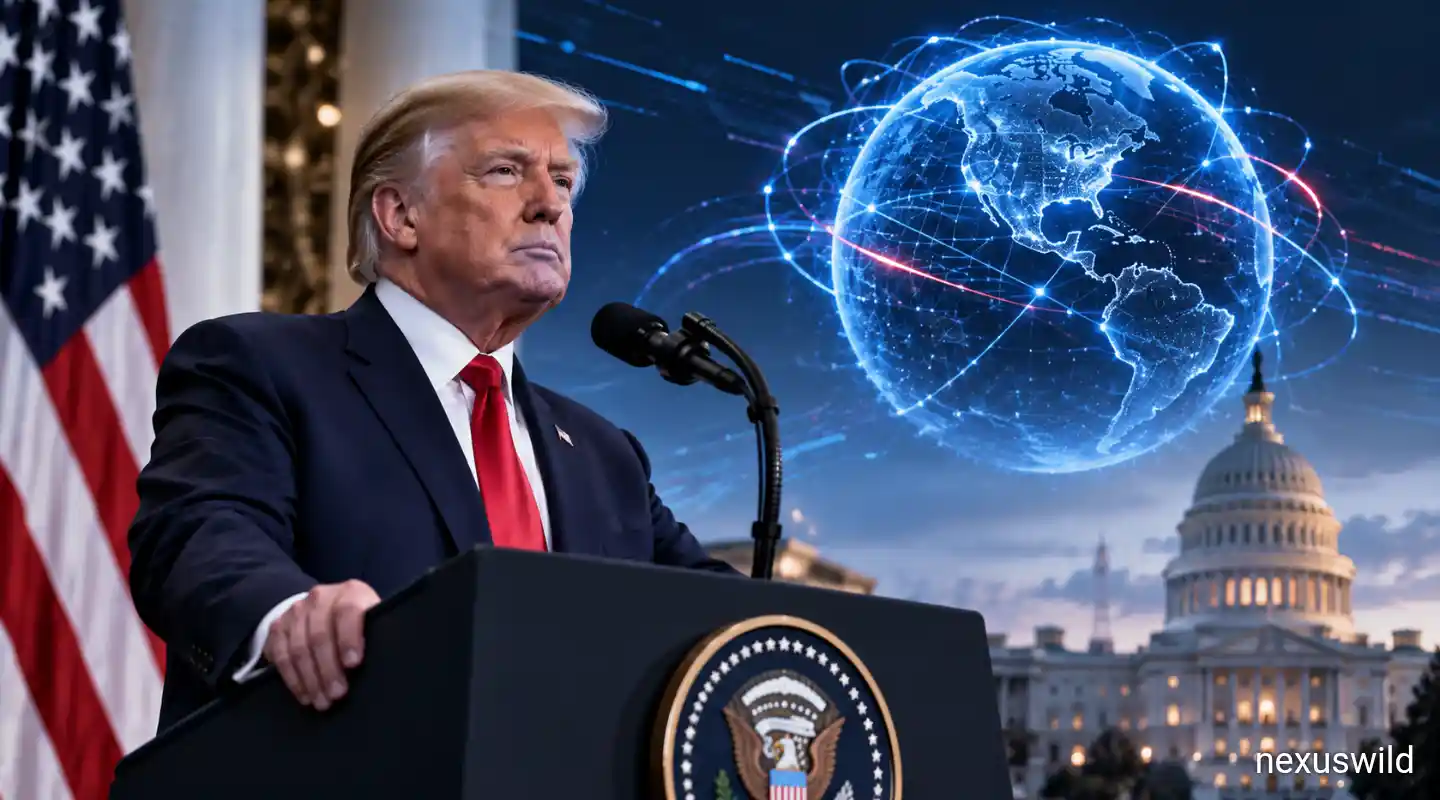

U.S. President Donald Trump has created a new federal artificial intelligence task force called the Super Intelligence Force, bringing senior officials from the intelligence community, Pentagon, Federal Trade Commission and personnel office together to coordinate the government's approach to rapidly advancing AI.
Director of National Intelligence Jay Clayton will lead the new task force and serve as the administration's AI czar, according to reporting by Reuters and The Associated Press. The group has been given 120 days to examine the opportunities and risks created by advanced AI and consider what role the federal government should play as the technology develops.
The initiative comes as the United States seeks to maintain its position in advanced AI while officials, companies and researchers debate how quickly the technology should be developed and how much government oversight is needed.
Who Will Lead the Super Intelligence Force?
Clayton will chair the task force, which includes several senior administration officials.
Among them are Federal Trade Commission Chairman Andrew Ferguson, Scott Kupor, director of the Office of Personnel Management, and Emil Michael, the Pentagon's undersecretary responsible for research and engineering.
The group is expected to coordinate directly with the White House and engage with technology companies, infrastructure providers, consumer groups, public-interest organizations and other stakeholders.
Its initial work will focus on identifying major AI-related opportunities and risks and developing recommendations for the federal government's response.
The task force is not itself a new AI laboratory or military organization. Its primary role is policy coordination across different parts of the U.S. government.
Why Is It Called ‘Super Intelligence’?
The name reflects a broader change in terminology introduced by the Trump administration.
On September 29, 2026, Trump signed Executive Order 14434 directing executive agencies to use the terms “Super Intelligence” and “SI” instead of “Artificial Intelligence” and “AI” in official communications and non-statutory policy documents.
For now, the executive order defines “Super Intelligence” using the existing federal legal definition of artificial intelligence.
That means the phrase should not be interpreted as an official determination that today's systems have achieved superhuman intelligence.
The White House has also instructed its science and technology adviser to propose a federal definition of “Super Intelligence” and recommend whether existing law should eventually be updated.
U.S. AI Leadership Is a Central Goal
The new task force fits into a broader administration strategy focused on accelerating AI development and adoption in the United States.
In June, Trump signed a national security memorandum directing defense and intelligence agencies to speed up the adoption of advanced AI systems, expand access to commercial models and build secure computing infrastructure for national-security use.
The administration has also expanded the Genesis Mission, a federal initiative using AI for scientific research. In July, the White House announced more than $5 billion in federal commitments connected to that effort across more than 15 agencies.
The Super Intelligence Force adds another layer by attempting to coordinate policy across agencies rather than focusing on one specific scientific or defense program.
Task Force Will Also Examine AI Risks
The administration's emphasis on innovation does not mean the task force will focus only on accelerating development.
According to Reuters, the group will also examine risks associated with advanced AI and consider how the government should respond to possible threats.
Concerns under discussion include cybersecurity, the misuse of increasingly capable AI systems and their potential role in military applications.
At the same time, Trump has generally argued against regulatory approaches that he believes could slow American technology companies and weaken the United States relative to international competitors.
That leaves the task force with a difficult balancing act: encouraging rapid technological development while deciding whether additional safeguards or government coordination are necessary.
The First Report Is Due in 120 Days
The new group has an initial 120-day mandate to produce recommendations.
The report is expected to examine both the risks and opportunities of AI and provide a clearer definition of the federal government's role.
The structure could later be extended or made more permanent, but its long-term status has not yet been established.
It is therefore too early to know whether the Super Intelligence Force will become a major permanent institution or primarily serve as a short-term policy review body.
Part of a Broader Shift in Federal AI Policy
Trump's creation of the task force follows several moves aimed at making advanced AI a larger part of U.S. government strategy.
The administration has pushed for faster adoption inside national-security agencies, greater collaboration with private technology companies and expanded use of AI for scientific research.
The September executive order also marked an unusual change in government terminology by formally replacing “AI” with “Super Intelligence” across much of the executive branch's public communication.
Together, those measures show that AI is moving beyond a technology-policy issue and becoming part of broader U.S. economic, scientific and national-security planning.
Conclusion
President Trump's new Super Intelligence Force brings senior U.S. officials together to coordinate federal policy on one of the fastest-moving areas of technology.
Led by Director of National Intelligence Jay Clayton, the task force has 120 days to assess AI's opportunities and risks and recommend how the government should respond.
Its creation does not mean the United States has developed “superintelligent” AI. The name follows the Trump administration's recent decision to officially use “Super Intelligence” as its preferred term for technologies still legally defined as artificial intelligence.
The more significant development is organizational: Washington is creating a dedicated cross-government group to deal with AI as an economic, security and policy issue at the same time.
Whether that approach leads to new regulation, faster government adoption or additional federal programs will depend on the task force's recommendations over the coming months.
Nexuswild welcomes factual corrections. Email contact@nexuswild.com with evidence and the article URL.