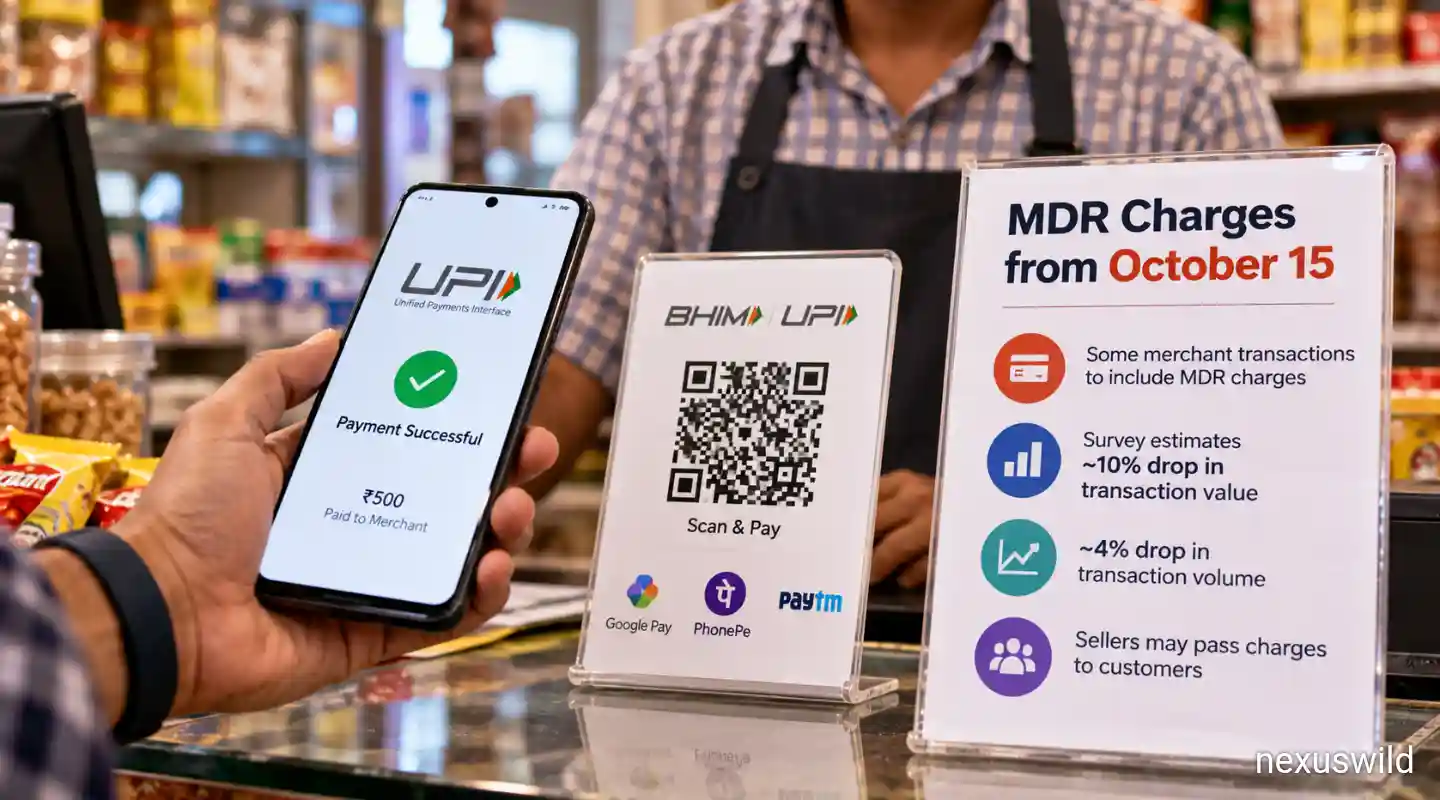

India’s Unified Payments Interface could see some users shift away from larger digital payments after a new merchant discount rate takes effect on October 15, according to a nationwide consumer survey.
LocalCircles estimates that monthly UPI transaction value could decline by around 10% and transaction volume by about 4% if merchants pass the additional cost on to customers. The estimate is based on separate surveys of consumers and merchants conducted ahead of the new MDR framework.
The numbers are survey-based projections, not an official forecast from the Reserve Bank of India or the National Payments Corporation of India.
What Changes From October 15?
From October 15, 2026, eligible person-to-merchant UPI payments above ₹2,000 will attract a 0.4% merchant discount rate, or MDR.
The charge is payable by merchants to the financial institutions and payment companies involved in processing the transaction. It is capped at ₹300 per transaction.
Person-to-person transfers remain unaffected, while UPI payments to small merchants receiving up to ₹1 lakh per month through QR codes are exempt.
Payments up to ₹2,000 also continue to remain outside the new MDR structure.
Survey Suggests Consumers May Change Payment Habits
The bigger question is what happens if merchants try to recover the cost from customers.
A LocalCircles survey involving more than 67,000 responses from UPI users across 291 districts found that only 14% of respondents said they would continue using UPI for payments above ₹2,000 if the merchant added the MDR amount to their bill.
Around 27% said they would switch to cash, while 26% said they would prefer credit cards and 14% would move to debit cards, according to the survey.
Overall, LocalCircles said 76% of respondents indicated that they could shift larger transactions toward cards, cash or bank transfers if UPI became more expensive for them.
Based on those responses and UPI transaction patterns, LocalCircles CEO Sachin Taparia estimated that UPI’s monthly transaction value could fall by about 10%, while volume could decline around 4%.
Those estimates should be viewed as potential behavioural effects rather than guaranteed outcomes.
Government Says Consumers Should Not Pay MDR
The new MDR is intended to be borne by merchants, not customers.
The government has said that merchants should not add the MDR directly to customers’ bills, and banks and payment providers are expected to monitor implementation once the system becomes effective.
Finance Minister Nirmala Sitharaman has also said that the responsibility for the charge does not lie with consumers.
The government has argued that most UPI usage will remain unaffected because payments below ₹2,000 and transactions involving qualifying small merchants continue to attract zero MDR.
According to government estimates cited by *Mint*, more than 95% of person-to-merchant UPI transactions by volume fall below the threshold covered by the new fee.
Merchants Are Also Reluctant to Absorb the Cost
The LocalCircles surveys suggest resistance is not limited to consumers.
An earlier survey involving more than 32,000 responses from businesses across 242 districts found that 41% of merchants surveyed were unwilling to absorb any MDR on UPI transactions above ₹2,000.
Only 17% said they were willing to bear the full 0.4% charge.
That creates a potential friction point: the rules say the merchant should pay, but some businesses may try to encourage customers toward alternative payment methods if they consider the cost too high.
UPI Has Reached Massive Scale
Any change in payment behaviour matters because UPI has become central to India’s retail payments system.
In August 2026, UPI processed 24.51 billion transactions worth about ₹29.82 trillion, according to figures cited by *Business Standard*. Merchant payments alone accounted for 15.51 billion transactions worth ₹8.95 trillion.
Payments above ₹2,000 represented a substantial share of merchant transaction value, even though smaller payments dominate transaction volumes.
That means the new MDR could have a greater effect on the value of UPI payments than on the number of transactions, which is consistent with the LocalCircles projection.
Conclusion
The introduction of a 0.4% MDR on larger merchant UPI payments from October 15 does not mean ordinary UPI users will automatically start paying a fee.
The policy places the charge on eligible merchants, and most low-value transactions remain exempt.
However, the LocalCircles survey suggests consumer behaviour could change if merchants indirectly or directly pass those costs on. Its estimate points to a possible 10% decline in transaction value and a 4% reduction in volume, but those figures remain projections rather than confirmed outcomes.
The real impact will become clearer only after the new framework is implemented and consumers and merchants decide whether UPI remains their preferred option for larger purchases.
Nexuswild welcomes factual corrections. Email contact@nexuswild.com with evidence and the article URL.