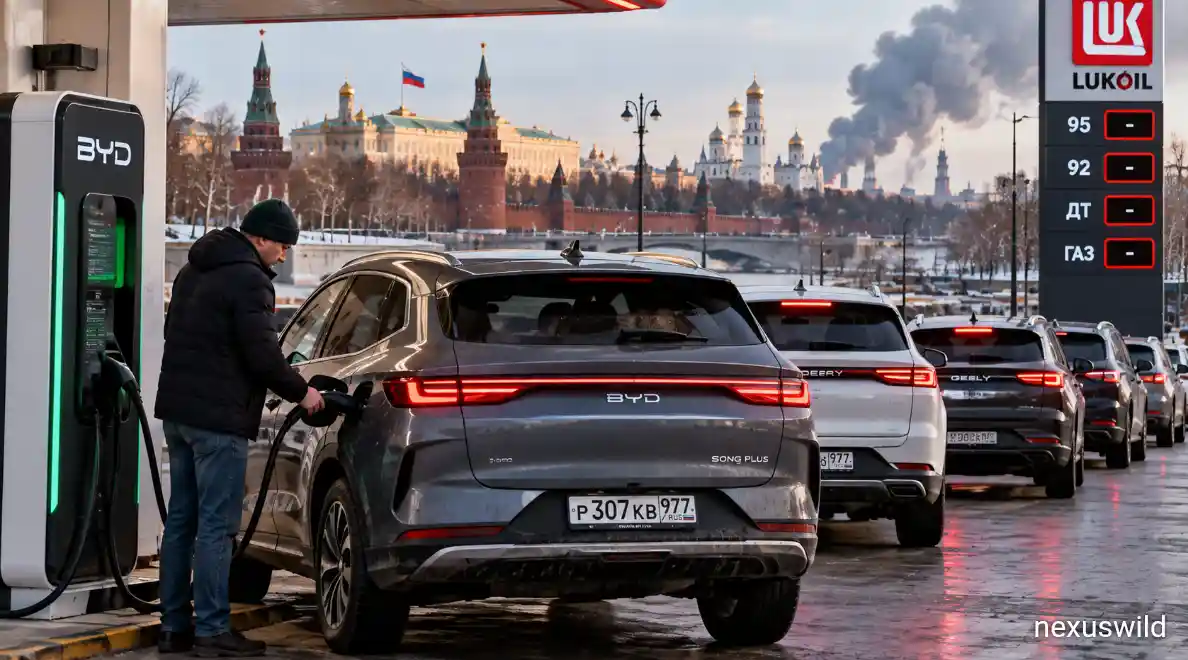

Electric vehicle sales in Russia have more than doubled as fuel shortages caused by repeated Ukrainian attacks on oil refineries push some motorists to look for alternatives to gasoline-powered cars.
Sales of new battery-electric and plug-in hybrid passenger vehicles reached 26,543 units between June and August 2026, compared with 12,187 during the same period last year, according to data from Russian automotive research agency Autostat provided to Reuters.
Most of the electric and plug-in hybrid vehicles sold in Russia are manufactured in China, making Chinese automakers and China-linked models major beneficiaries of the unexpected change in consumer demand.
The shift comes as Russia struggles with disruptions to domestic fuel production following an intensified Ukrainian campaign against refineries and other oil infrastructure.
Refinery Attacks Tighten Russia's Fuel Supply
Ukraine has increasingly targeted Russian refining infrastructure with long-range drones.
The International Energy Agency said Russian refinery throughput fell to around 3.8 million barrels per day in June 2026, the lowest level in more than two decades and roughly 30% below the level recorded a year earlier. Reported gasoline output was around 20% lower than in 2025, according to the IEA.
By the end of August, Russian gasoline production had fallen to roughly 70% of domestic consumption, Reuters reported, citing market data.
The supply disruption has resulted in fuel shortages, queues at filling stations and restrictions in a number of regions.
Russia has responded by restricting fuel exports in an effort to preserve supplies for the domestic market. The government extended restrictions on diesel exports through October as refinery disruptions continued.
Drivers Begin Looking at Electric Cars
The fuel crisis has changed the calculation for some Russian drivers.
Electric vehicles have historically represented only a small part of the country's automotive market. Russia's long distances, harsh winters and relatively limited charging infrastructure have all slowed adoption.
But difficulty finding gasoline has given some consumers a practical reason to reconsider.
Reuters reported in July that one Moscow dealership specialising in Chinese electric vehicles had seen an unusually sharp increase in sales. Its owner said the business had moved from selling roughly 10 to 15 EVs a month a year earlier to selling two or three vehicles a day during the fuel disruption.
Some drivers have also explored converting conventional vehicles to run on natural gas rather than purchasing a new electric car.
Chinese Models Fill Much of the Market
Russia's growing EV demand is closely tied to the country's changing automotive supply chain.
Many European, Japanese and other international automakers reduced or ended their Russian operations following Russia's full-scale invasion of Ukraine in 2022 and the sanctions that followed.
Chinese manufacturers subsequently expanded their presence.
Chinese brands and China-developed vehicles now account for a large share of the EVs and plug-in hybrids available to Russian buyers. Reuters has highlighted brands including Geely, Dongfeng, GAC and Chery among companies active in the market.
Some vehicles sold under Russian names are also based on Chinese platforms or assembled using Chinese components.
That existing supply network has put Chinese manufacturers in a strong position to respond as Russian consumers suddenly show greater interest in electric driving.
EV Sales Remain Small Overall
The rapid percentage increase does not mean Russia has become a major electric-car market.
EVs and plug-in hybrids accounted for only about 4.3% of total Russian car sales last year, according to Autostat data cited by Reuters.
The recent demand surge has also exposed supply constraints.
Manufacturers and importers had not prepared for such a sudden increase in interest, meaning dealerships have faced difficulty securing enough vehicles in some categories.
Charging availability remains another major obstacle, particularly outside large cities such as Moscow and St. Petersburg.
Russia's geography presents an additional challenge. Long journeys between cities can require reliable fast-charging infrastructure that remains unevenly developed.
Fuel Pressure Could Continue
Russia's refining network continues to face attacks.
In September, the Moscow oil refinery suspended crude processing after a drone strike damaged major processing units, according to industry sources cited by Reuters. Repairs were expected to take several weeks.
The IEA said that during the first eight months of 2026, a major Russian refinery was hit on average about once every three days.
Ukraine has described attacks on Russian energy infrastructure as part of its effort to reduce resources available for Moscow's war effort. Russia has condemned the strikes and has intensified attacks on Ukrainian infrastructure in response.
The continued damage means domestic fuel availability could remain sensitive to further disruptions.
Conclusion
Russia's gasoline shortages are producing an unexpected change in its automotive market.
New electric and plug-in hybrid vehicle sales more than doubled during the summer of 2026 as refinery disruptions made traditional fuel less reliable in parts of the country.
Chinese-made vehicles dominate much of the available EV supply, putting Chinese automakers in a particularly strong position to capture this new demand.
The change should not yet be described as a nationwide transition away from gasoline. Electric vehicles remain a small share of Russia's overall car market, and charging infrastructure remains limited.
For some motorists, however, the decision to consider an EV is becoming less about environmental policy and more about a basic practical question: whether they can reliably fill their car with fuel.
Nexuswild welcomes factual corrections. Email contact@nexuswild.com with evidence and the article URL.