
Astronomers have assembled an unusually complete record of a star swallowing its companion, using NASA's James Webb Space Telescope to fill in the final chapter of a merger in the Andromeda galaxy. The system, formally catalogued as AT 2025abao and nicknamed Bao, began as a binary pair: a swollen supergiant and a smaller, Sun-like star. When the companion brushed the giant's outer atmosphere, drag inside a shared cloud of gas stripped orbital energy and drew the two stars together. Webb observed the aftermath only 47 days after the eruption peaked, the earliest follow-up of its kind, and its mid-infrared measurements allowed the team to measure dust shed over centuries. Reporting in Nature, a NASA-led collaboration reconstructs the warning signs, the rapid final fall and the unresolved outcome. The result is not simply a dramatic collision story. It is a rare, real-time test of common-envelope evolution, the short-lived phase that helps determine whether two stars merge or emerge as a tight pair capable of producing neutron stars, black holes and gravitational waves. Because the encounter was followed across multiple wavelengths and over many years, the system offers a chance to connect theory with observation in a way that most stellar mergers do not allow.
A Binary System Worth Watching
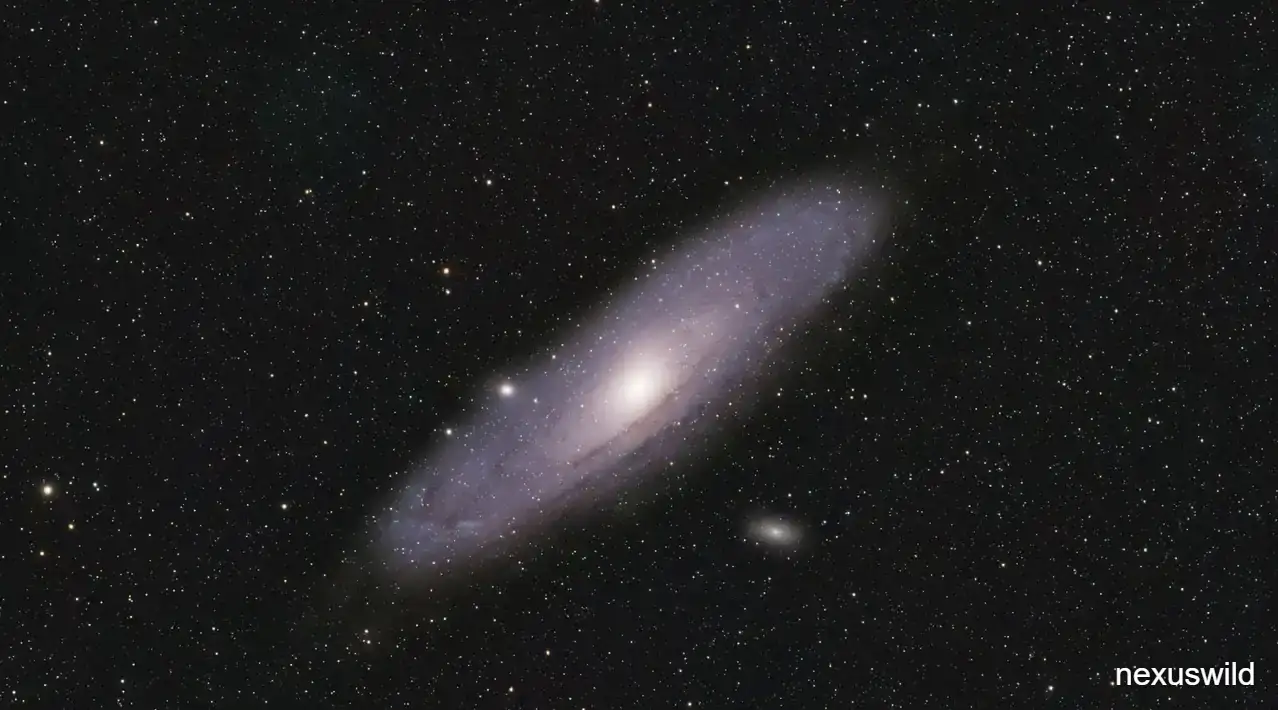
The story began long before the eruption. Bao lies near the outer edge of Andromeda, the nearest large spiral galaxy to the Milky Way, and for thousands of years the two stars orbited one another as an ordinary binary system. Their quiet phase ended when the larger star expanded into a supergiant and the smaller companion began to interact with its enormous outer atmosphere. The team first noticed something unusual in February 2023, while examining data from NASA's retired NEOWISE infrared mission. Records showed that the object had maintained a consistent luminosity before 2018, so the later variation stood out. Ground-based observations from the Wide-field Infrared Transient Explorer, or WINTER, in September 2024 added evidence that the system was brightening and shedding dust. Because the researchers continued monitoring instead of treating the object as another variable star, they were positioned to follow a merger as it unfolded rather than reconstruct one long after the fact. The archival record also helped separate different stages of the process. A steady light curve before 2018, a slow infrared change by 2023 and clearer dust production in 2024 each mark a distinct step in the giant's expansion and the companion's growing influence. Such a timeline is difficult to obtain for transients discovered only after they brighten, which is why the early data give this system unusual value for testing models of binary evolution.
The Approach to Contact
The two stars did not merge the moment they began to interact. For millennia they followed separate orbits, and only when the companion came into contact with the supergiant's surface did the final sequence accelerate. Co-author Kishalay De described the first stage as a subtle effect: as the smaller star touched the outer surface, it produced a slow brightening that appeared clearly in the data. As the companion continued around its orbit, it peeled away layers of the primary star, sending gas flowing into surrounding space. That material is central to the story. The giant's extended atmosphere supplied the shared reservoir that eventually engulfed both objects, and its loss carried information about how the orbit changed. The observations show a gradual build-up followed by a surprisingly fast collapse, a combination that challenged the team's expectations for such an extended star. The slow brightening recorded before contact is consistent with material being disturbed and stripped from the giant's outer layers. Once drag began to remove orbital energy, however, the companion had little room to recover. Each pass through the envelope brought it deeper into denser gas, increasing the braking effect. The researchers therefore treat the long approach and the final seven orbits as two connected but very different regimes, with the first setting the stage for a rapid and irreversible decline.
What a Common Envelope Is
Astronomers call this phase common-envelope evolution. It occurs when one star grows so large that it envelops its companion, leaving the pair embedded in a shared outer layer of gas. As the smaller star moves through that gas, resistance slows its orbit and drains orbital energy. The companion can spiral progressively inward, while the ejected envelope carries mass and angular momentum away from the system. The process is brief by astronomical standards but decisive. In some systems, both stars survive, losing substantial material yet remaining separate in much tighter orbits. Those survivors can later become neutron stars or black holes, explode as supernovae, produce gravitational waves or form millisecond pulsars. In other cases, including Bao according to the new analysis, the companion is dragged all the way into the primary. Understanding which path a system takes is one of the central problems in binary-star evolution. The shared envelope acts both as a brake and as a reservoir: energy taken from the orbit can heat and expel the gas, but whether that happens quickly enough to save the companion depends on the structure of the giant and the mass of the intruder. Bao's extended primary and relatively light companion created conditions in which the braking was efficient. The observed ejection of material and the final merger let the team test how those competing effects played out in one real system.
The Eruption Arrives Quickly
The final brightening was faster than the researchers had anticipated. The Zwicky Transient Facility detected the eruption on 17 October 2025, recording a rapid rise in brightness and a dramatic increase in temperature. Co-author Nadia Blagorodnova of the University of Barcelona noted that the team had expected an outburst from such an extended star to take years. Instead, its brightness began rising one day and peaked within a week. That speed matters because the brief event would have been easy to miss without wide-field surveys that repeatedly scan the sky. It also gave the team a clear marker for counting orbits: once contact began, the two stars completed their unification after about seven additional orbits, roughly seven years. Other known mergers involving pairs of smaller stars have required thousands of orbits to reach a similar endpoint. That comparison helps explain why Bao is being presented as a first of its kind rather than simply another transient. The primary's enormous radius meant the companion encountered gas far from the stellar core, yet the subsequent plunge happened on a short timescale. The week-long rise also placed practical demands on the observing community. Telescopes had to respond while the system was still hot and changing, and the resulting measurements now anchor models of how quickly a common envelope can be removed when a low-mass companion spirals through a highly extended giant.
A Rapid Observing Campaign
The eruption triggered a coordinated follow-up effort across space and ground observatories. NASA's SPHEREx had already caught an important change during a routine survey in July 2025, seeing Bao fade rapidly in visible light while brightening in infrared light. In November, the team obtained fast-turn observations from NASA's now-retired Neil Gehrels Swift Observatory and from NOIRLab's Gemini North telescope in Hawaii, providing ultraviolet, visible and near-infrared measurements as the event evolved. Webb joined on 24 December 2025 through a Director's Discretionary Time programme, an urgently approved observing allocation that made the early mid-infrared view possible. The researchers had also published a first paper on the system just before the 2025 eruption, giving them a baseline. Together, these datasets span the years before contact, the warning signs and the immediate aftermath. No single observatory could have supplied that coverage. NEOWISE provided the long infrared baseline, WINTER tracked brightening and dust, SPHEREx recorded the unusual shift between visible and infrared light, and the transient facility caught the eruption itself. Swift and Gemini then measured the hot aftermath before Webb examined the dust distribution in detail. The coordination matters because models of common-envelope evolution depend on timing as well as brightness. Knowing when dust appeared, when visible light faded and when the eruption peaked gives the simulations multiple checkpoints rather than a single endpoint to match.
Why Webb's Timing Mattered
Webb's observation came just 47 days after the eruption peaked, described by the researchers as the earliest follow-up of an event of this kind. That timing was crucial because the system was still changing rapidly. The telescope's mid-infrared data revealed dust that the primary star had expelled over centuries, material that is difficult to study at visible wavelengths. By comparing that dust with the earlier and later brightness measurements, the team could measure how much mass was ejected and how efficiently the common-envelope interaction operated. Lead author Viraj Karambelkar, a NASA Hubble Fellow at Columbia University, said the data helped characterise what the system looked like before, during and immediately after the merger. Instead of relying on a single snapshot, the analysis links a long observational history to a short, violent transition. Mid-infrared light is especially useful for this purpose because dust that has cooled after being expelled emits strongly at those wavelengths. By mapping that emission, the researchers could infer the amount of material lost and compare it with the energy available from the shrinking orbit. The 47-day interval also meant the ejecta had not dispersed beyond recognition. The team could study a structure still closely related to the interaction that produced it, reducing some of the uncertainty that affects reconstructions of much older common-envelope systems.
Measuring the Two Stars
The simulations, led by Karel Temmink of Radboud University in the Netherlands, produced a detailed physical picture of the pair. Before the merger, the primary star was about seven times the mass of the Sun, 350 times its radius and 18,000 times brighter. Those proportions led the team to call it Big Bao; one researcher described it as an absolute beast that completely outshone its companion. The smaller star, dubbed Little Bao, was less massive than the Sun at roughly 0.7 solar masses, with a slightly smaller radius and lower brightness. This was the first mass estimate for the companion that has now been demolished. The contrast explains why the system was so hard to interpret from brightness alone: the giant dominated the light, while the smaller object revealed itself through its gravitational effect on the gas and through the energy released when it was swallowed. The estimates also constrain the simulations. A companion of roughly 0.7 solar masses has enough gravity to disturb the envelope but not enough, in the final analysis, to survive the plunge. The primary's 350-solar-radius scale explains why contact began so far out and why the nebular dust carries a record of centuries of prior interaction. Without firm masses for both objects, the team could not have distinguished between plausible endings with the same confidence.
An Escape That Did Not Happen
Once the team knew the masses of both stars, the models initially suggested an unexpected possibility. Little Bao might have retained enough energy to escape the interaction, leaving behind a surviving companion in a tight orbit rather than a single merged star. Further analysis changed that conclusion. The smaller star was dragged into the core of Big Bao, releasing an immense amount of energy as the two objects became one. De likened the final encounter to a bomb exploding inside a living star. This distinction is more than a detail of nomenclature. Whether a companion escapes or merges affects the kind of remnant the system leaves, the amount of material thrown into space and the future evolution of both stars. Webb's data, combined with modelling, provided the evidence needed to choose between those outcomes. The initial escape result shows how sensitive the answer can be to the assumed structure of the giant and the treatment of energy transport through the envelope. The researchers did not simply accept the first model that matched the dust; they tested the result further and found that the companion reached the core. That sequence illustrates how observational constraints narrow a range of theoretical possibilities.
The Mystery of the New Star
The merger has left astronomers with a new object whose future is not yet clear. The surviving star contains the legacy of both original stars and has been described as potentially rejuvenated, but its final structure and mass distribution remain uncertain. The team states that only future observations will show how its heft settles as the merged object evolves. That caution is important because a merger can change a star's surface composition, rotation and luminosity in ways that take time to become observable. Bao therefore remains an active target rather than a closed case. The identification of the merger tells researchers what happened to the system in physical terms, while continued monitoring will be needed to understand how a star formed from two others adjusts to its new state. Astronomers will want to see whether the object settles into a stable luminosity or continues to evolve as its internal layers redistribute. Measurements of its surface composition and rotation could eventually test predictions about how much of the companion was mixed into the primary. For now, the team uses careful language: the merged star contains the legacy of both objects, but its final appearance is a question for future observations rather than a result of this paper.
From Reconstruction to Measurement
Most studies of common-envelope systems have involved reverse-engineering events that happened hundreds, thousands or even millions of years ago. The companions and ejected gas may still be observable, but the crucial interaction is long over. In those cases, researchers must infer the original orbit and envelope structure from a surviving binary or a expanding nebula, often with limited information about the moment of ejection. Bao does not remove all such uncertainties, but it adds a measured timeline. The team knows when the system brightened, when the eruption was detected and when the mid-infrared dust was observed. Those anchors transform the modelling exercise from a search for any plausible history into a test against a particular observed sequence. Bao offered something different: years of monitoring, a detected eruption, rapid follow-up and an early infrared view of the aftermath. That sequence allowed the team to measure the efficiency of the common-envelope process, meaning how effectively orbital energy was used to expel the shared gas, rather than infer it from a distant endpoint. The work also demonstrates the value of maintaining long-term watch on odd variable stars. A system that looked merely unusual in 2023 became one of the few examples in which a merger could be followed from warning signs to result.
The Next Wave of Discoveries
The timing of the result is significant for another reason. NASA's Nancy Grace Roman Space Telescope is preparing large public surveys, including the Galactic Bulge Time-Domain Survey, which will repeatedly monitor many stars and identify changing objects. Astronomers expect a substantial increase in transient discoveries suitable for the same kind of coordinated analysis used on Bao. Karambelkar has said that a large influx of similar discoveries is likely. With more examples, researchers can test whether Bao's fast final orbits and efficient envelope removal are typical or unusual. A larger sample would also show how often a low-mass companion is swallowed rather than surviving as a tight binary, a distinction with consequences for the population of compact-object progenitors. Roman's surveys will be public, increasing the chance that unusual systems receive rapid follow-up from the wider community. The work was funded in part through NASA's Astrophysics Data Analysis Program. Webb itself is an international programme led by NASA with ESA and CSA. Together, the observatories are turning rare stellar encounters from retrospective puzzles into events that can be watched as they happen.
Nexuswild welcomes factual corrections. Email contact@nexuswild.com with evidence and the article URL.