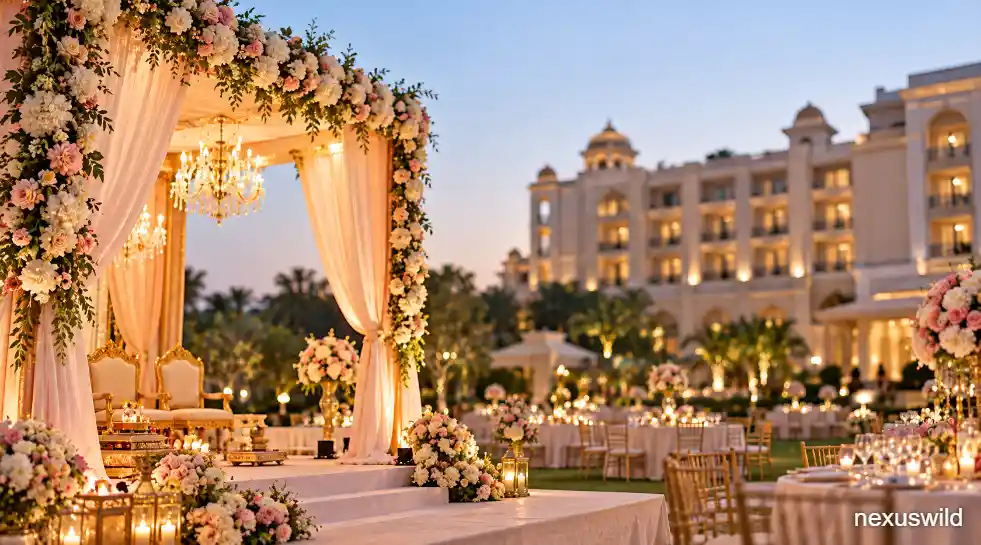

Weddings are becoming increasingly important to the hotel business because a large celebration can generate revenue across almost every part of a full-service property at the same time.
A wedding does not only fill a ballroom.
Guests need rooms. Families book suites and meeting spaces. Hotels sell food and beverages across several functions. Couples may pay for outdoor venues, catering, décor coordination, spa services, airport transfers and additional events before and after the ceremony.
Destination weddings can extend that effect across several days, converting what might otherwise be a single banquet booking into a combination of accommodation, dining and event revenue.
The impact is already visible in financial results from major hotel operators and in industry occupancy data, particularly in markets such as India where weddings can involve large guest lists and several separate celebrations.
In its results for the financial year ended March 2026, ITC Hotels said room revenue increased 10%, supported by retail, corporate, meetings and wedding demand. Its food-and-beverage revenue rose 8%, led primarily by banqueting, with the company specifically identifying weddings and corporate events as major sources of momentum.
The numbers help explain why weddings are increasingly being treated as a recurring hospitality business rather than simply a social event.
A Wedding Can Produce Several Hotel Revenue Streams at Once
Hotels have traditionally divided much of their business between rooms and food and beverage.
Weddings connect the two.
A hotel hosting a large celebration may earn revenue from guest rooms, banquet halls, catering, bars, restaurants, lawns, ballrooms and smaller function spaces.
Additional services can include bridal suites, spas, transportation, laundry, room service and private dining.
Multi-day weddings increase the opportunity further because events may include welcome dinners, ceremonies, receptions and post-wedding breakfasts rather than a single evening function.
For full-service and luxury hotels, that combination can make an event commercially different from an ordinary leisure stay.
Indian Hotels Company's FY2024-25 accounts illustrate the significance of non-room spending in the broader hotel model. The group reported approximately ₹3,392 crore in room revenue and ₹2,386 crore from food, beverages and banquets during the year. The latter number includes all F&B and banquet activity rather than weddings alone, but it demonstrates how important event-related and dining income can be beside accommodation revenue.
Hotel Performance Data Shows the Wedding Effect
The clearest evidence comes from periods when wedding activity coincides with stronger hotel demand.
Ratings agency ICRA estimated that India's premium hotels recorded occupancy of about 76% to 78% during the third quarter of FY2026, with weddings, long-weekend travel and business demand supporting bookings.
ICRA specifically noted that bulk reservations associated with the wedding season helped maintain hotel occupancy even during temporary aviation disruptions in December 2025.
HVS ANAROCK reported a similar pattern in February 2026.
Most major Indian hotel markets recorded occupancy above 75% during the month, with the research firm attributing the strength to a combination of weddings, corporate travel and meetings and events. Hotel room rates in many markets were also up by double-digit percentages from a year earlier.
That does not mean weddings alone caused the improvement. Corporate and leisure demand were also important.
But the data show that weddings can become a meaningful source of incremental demand during important parts of the hotel calendar.
Wedding Spending Creates a Large Addressable Market
Wedding expenditure varies enormously between countries and between individual couples.
There is no single authoritative global figure for wedding spending, so worldwide market estimates should be treated cautiously.
The United States provides one well-documented example.
The Knot's 2026 Real Weddings Study surveyed 10,474 US couples who married during 2025 and estimated the average wedding cost at approximately $34,200.
Its broader data showed an average guest count of 117 and spending of about $292 per guest.
These are survey findings rather than government statistics, and averages can be pushed upward by expensive weddings.
Even so, they demonstrate why hospitality businesses pay close attention to the category. Accommodation, venues and catering can account for a substantial part of a wedding budget.
Venue spending is particularly significant. The Knot's earlier research found that couples using venues with catering, alcohol and rentals commonly faced a much larger expense than couples paying for venue space alone.
For a hotel, that creates an opportunity to keep several parts of wedding expenditure within one property.
Destination Weddings Multiply Room Demand
Destination weddings make the relationship between weddings and hotels even stronger.
The Knot's latest US survey classified 17% of weddings in 2025 as destination weddings. That was lower than the 21% recorded in 2019 but still represented a significant share of couples in the study.
A destination wedding typically requires a larger proportion of guests to travel and stay overnight.
That can create room blocks extending beyond the couple and immediate family.
Guests may also spend money at hotel restaurants, nearby attractions, transportation providers and other local businesses before and after the ceremony.
India has made destination weddings an explicit part of its tourism strategy.
The Ministry of Tourism launched its India Says I Do campaign to promote the country as a wedding destination and has organised a Wed in India expo involving planners, tourism authorities and travel companies.
The government has highlighted destinations ranging from heritage properties to beaches, mountains and riverside locations.
This demonstrates how destination weddings can be viewed not only as hotel events but as a wider form of tourism.
Hotels Are Building More Space Around Social Events
Hotel investment decisions are beginning to reflect this demand.
Large ballrooms, lawns, pre-function areas and flexible meeting rooms can allow a property to serve weddings during weekends while using the same infrastructure for corporate meetings, exhibitions and conferences at other times.
Recent hotel development announcements in India provide clear examples.
A 125-room Gateway hotel planned in Sambalpur includes more than 10,000 square feet of banquet space, with the operator specifically citing growing demand for weddings and social events alongside business travel.
A planned Gateway hotel in Jaipur includes a banquet hall exceeding 9,000 square feet, while a new resort project in Bharatpur includes more than 4,000 square feet of banqueting space plus pre-function and meeting areas designed partly for destination weddings.
Another planned hotel in Bengaluru includes approximately 13,000 square feet of event space, including two large pillarless banquet halls.
These projects are not proof that every hotel should add a ballroom.
They show that operators in markets with strong social-event demand increasingly design properties so that rooms, restaurants and event spaces can generate revenue together.
Banqueting Can Support Food-and-Beverage Growth
Wedding demand is especially valuable for hotels with large food-and-beverage operations.
ITC Hotels reported that its FY2025-26 F&B revenue increased 8%, led primarily by banqueting and supported by weddings and corporate events.
During the third quarter alone, room revenue rose 12%, with the company citing corporate, wedding and meetings demand, while F&B revenue also increased 8%.
A wedding banquet can involve hundreds of meals within a relatively short period.
Hotels can also serve several different menus across multiple functions, increasing spending beyond a standard room-and-breakfast stay.
At the premium end of the market, customised menus, live cooking stations, beverage packages and private dining can further increase revenue per event.
These opportunities come with substantial costs, however. Food, staffing and event preparation all increase alongside revenue.
Weddings Can Increase Occupancy Without Adding New Rooms
Hotels cannot instantly expand their physical room inventory during periods of high demand.
Weddings can nevertheless improve how existing rooms are used.
A single wedding may result in dozens or hundreds of rooms being booked simultaneously, providing the hotel with a predictable block of occupancy.
For resort properties or hotels outside major business districts, this can be particularly useful on dates when corporate demand is weaker.
Destination weddings can also lengthen stays because guests often arrive before the main ceremony and leave afterward.
That combination can support occupancy as well as average room rates.
India's hotel market recorded approximately 64% occupancy during 2025, with average daily rates rising 8.6% to ₹8,624 and revenue per available room increasing 10.8%, according to Horwath HTL's market review.
The report identified travelling weddings as part of the country's wider high-yield hospitality demand mix.
Those nationwide results cannot be attributed to weddings alone, but they provide the wider operating environment in which social-event demand is expanding.
Customisation Is Becoming Part of the Competition
Wedding customers increasingly expect hotels to provide more than rooms and a standard banquet package.
Celebrations may require different venues for individual functions, specialised menus, outdoor ceremonies, customised lighting and décor, late-night events and dedicated planning staff.
Hotels can therefore compete partly on how many services they can combine under one contract.
Large properties may offer indoor ballrooms, lawns, poolsides and smaller meeting rooms at the same location, reducing the logistical burden of moving guests between venues.
This creates an incentive to invest in flexible infrastructure rather than spaces designed for only one type of event.
It also explains why wedding sales teams and dedicated event planners have become strategically important in some hotels.
Destination Weddings Can Spread Spending Beyond the Hotel
The economic effect of a destination wedding does not stop at the property boundary.
Guests may purchase flights or rail travel, taxis, local entertainment, shopping, photography, floral arrangements and other services.
A multi-day event can therefore function like a temporary tourism group arriving at the same destination.
India's Ministry of Tourism now formally promotes wedding tourism, while its 2026 skills policy describes weddings and wedding tourism as a significant employment generator across the hospitality ecosystem.
A government-cited skill-gap study estimates that the wider Indian hospitality sector could require nearly 3 million additional skilled workers by 2028, with event-based hospitality among the faster-growing areas in several tourism-heavy states.
That figure relates to the overall hospitality workforce and should not be interpreted as three million wedding-specific jobs.
It does show how event-led tourism contributes to broader demand for trained hospitality workers.
Weddings Also Bring Seasonality
The opportunity comes with a major limitation: weddings are not evenly distributed across the year.
Weather, school calendars, holidays, cultural traditions and religious calendars can concentrate ceremonies into particular periods.
A hotel may therefore experience very strong demand for a limited wedding season followed by much quieter periods.
This can create staffing and pricing challenges.
Properties must maintain enough culinary, banquet, housekeeping and event staff to handle peak events without carrying excessive labour costs during slower months.
Hotels frequently address this by using the same venues for conferences, corporate meetings and other social functions outside peak wedding dates.
A ballroom that earns revenue from both corporate events and weddings is generally easier to justify than a space dependent on one type of customer.
Staffing Can Limit How Much Wedding Business Hotels Accept
Large weddings are operationally demanding.
Rooms need to be prepared simultaneously, meals may have to be served to hundreds of guests, and several functions may take place during the same day.
Labour availability therefore matters.
A March 2026 survey by the American Hotel & Lodging Association found that more than half of participating US hotel operators considered their properties somewhat or severely understaffed.
Among 246 surveyed hoteliers, 65% cited labour costs as a significant financial pressure, while 71% identified the cost of goods and supplies and 59% cited fluctuating occupancy and demand.
Those are US survey results rather than global statistics, but they illustrate the cost pressures surrounding labour-intensive event businesses.
A fully booked wedding can generate high revenue while also requiring substantial spending on staff, food, utilities, security and temporary infrastructure.
Changing Preferences Can Alter the Economics
Weddings are also not moving uniformly toward larger celebrations.
Some couples prefer smaller guest lists, private ceremonies or spending more per guest rather than increasing attendance.
The latest US survey showed an average of 117 guests in 2025, only slightly above 116 in 2024 and still below the 131-person average recorded in 2019.
For hotels, this means growth may increasingly come from the value of the experience rather than simply bigger guest counts.
A smaller wedding that includes several days of accommodation, premium catering and private events may generate substantial revenue even with fewer attendees.
Changing consumer preferences therefore favour properties capable of serving celebrations at different scales.
Hotels Still Need to Balance Weddings With Other Demand
Weddings are becoming a valuable business segment, but they are not replacing corporate, leisure or meetings demand.
A hotel in a major financial district may depend mainly on business travel.
An airport hotel may rely on transient passengers and airline crews.
A resort could have much greater exposure to destination weddings and leisure travellers.
The most useful role of weddings is often diversification.
They give hotels another demand source that can fill rooms and event spaces when other segments are weaker.
In markets where corporate business is concentrated on weekdays, weekend weddings can also improve asset utilisation.
That is why weddings can become especially attractive for properties already equipped with kitchens, banquet halls and large room inventories.
Conclusion
Wedding celebrations are becoming an important growth driver for parts of the hotel industry because they combine several revenue streams that hotels are already equipped to provide.
A single event can generate accommodation, banquet, catering, beverage, venue and guest-service revenue. Destination weddings extend the effect by adding travel and multi-night stays.
Recent financial disclosures provide evidence of that impact.
ITC Hotels said weddings contributed to room-revenue growth during FY2025-26, while banqueting led its 8% increase in food-and-beverage revenue. Industry data also showed wedding demand helping Indian premium-hotel occupancy reach 76% to 78% during part of the 2025 wedding season.
At the same time, US survey data show that weddings continue to involve substantial consumer spending, with couples married in 2025 spending an average of about $34,200 and 17% holding destination weddings.
The opportunity is encouraging hotel developers to invest in larger and more flexible event spaces, particularly in markets where destination and multi-day celebrations are common.
But weddings are not guaranteed high-margin business.
They remain seasonal, labour intensive and sensitive to changing consumer preferences. Food, staffing and energy costs can be significant, while hotel demand still depends on a broader mix of leisure, corporate and group travel.
For hotels able to manage those constraints, however, weddings offer something unusually valuable: the ability to turn one celebration into room nights, dining, events and ancillary spending across an entire property.
Nexuswild welcomes factual corrections. Email contact@nexuswild.com with evidence and the article URL.