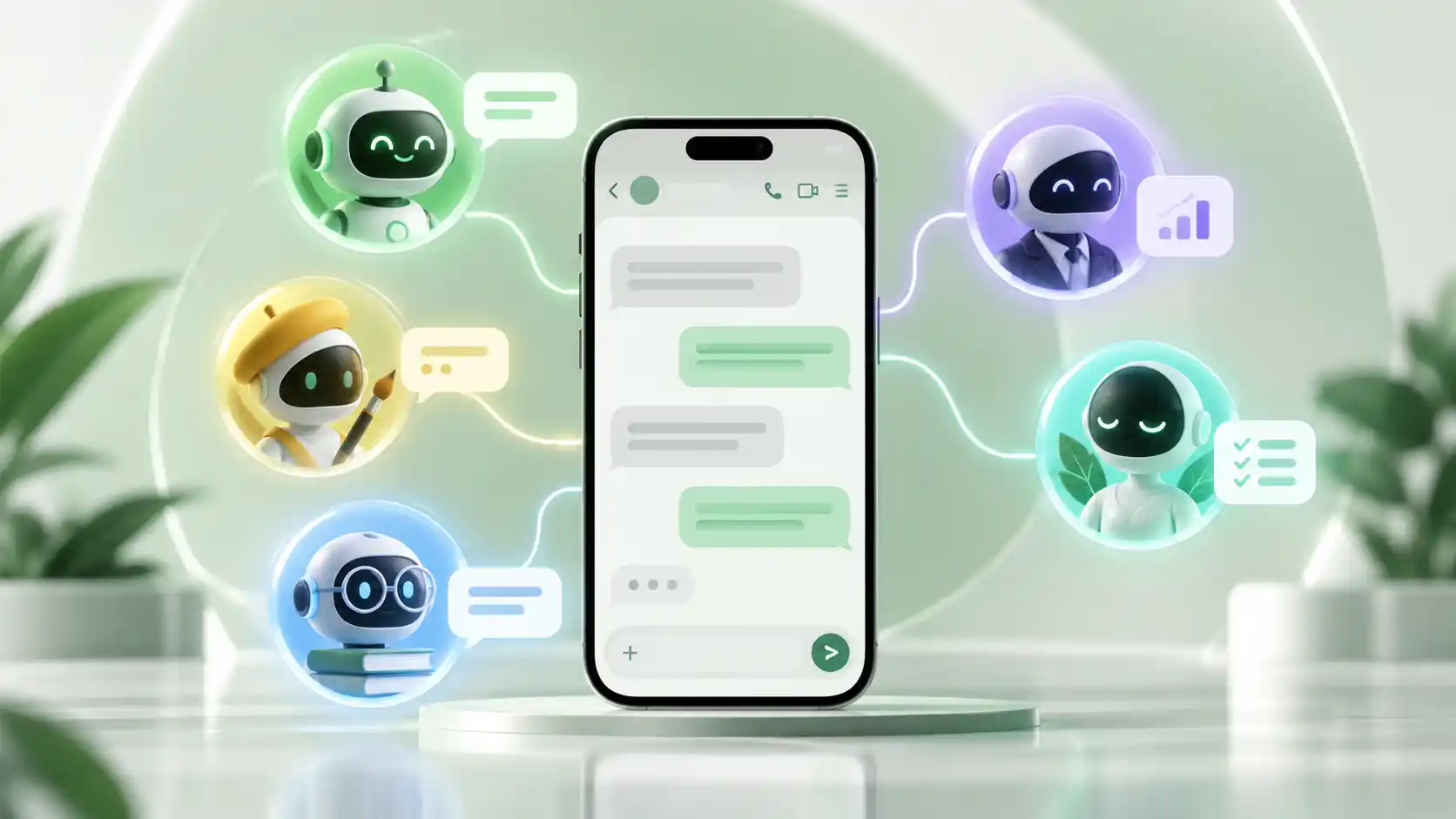

WhatsApp is testing a feature that lets users connect external, third-party AI agents directly into the app and chat with them the same way they would message a person. The functionality, spotted first on Android and now appearing in an iOS beta, allows an account to link up to five separate agents, each hosted on outside platforms rather than built by WhatsApp itself.
The feature has been documented by WABetaInfo, a site that tracks WhatsApp's beta builds, after it examined the app's Android and iOS test versions directly. Meta, WhatsApp's parent company, has not issued a separate public statement describing the feature, so what is known comes from the beta software itself rather than a formal product announcement.
How the Setup Works
Inside WhatsApp's settings, a new "Agents" section lets a user create an entry for an external AI agent. During setup, the app shows a short explanation of how agent chats work, then asks the user to give the agent a name and a profile photo so it is distinguishable in the chat list from regular contacts.
Once saved, WhatsApp opens a dedicated one-to-one conversation for that agent and generates an API key. The user then copies that key into the external platform where their agent actually runs, a step WABetaInfo notes varies slightly depending on which service is being connected. After the key is entered on the external side, the agent begins responding to messages inside the WhatsApp chat.
An account can connect up to five agents under the current beta implementation, though WhatsApp could adjust that limit later. Each agent operates in its own separate chat and can only see messages sent within that specific conversation. It cannot read a user's other chats, contacts or media stored elsewhere in WhatsApp. The feature currently works only in individual chats; group chats and WhatsApp Communities are not part of the current agent setup. If a key needs to be replaced, it can be reset from within the chat, and disconnecting an agent revokes its key while leaving the existing chat history in place.
Limited Beta, Not a Global Rollout
This is not a feature available to WhatsApp's full user base. It first appeared in an Android beta, version 2.26.35.3, and has since surfaced in an iOS beta, version 26.37.10.70, distributed through Apple's TestFlight program. Multiple outlets tracking the rollout describe access as limited to a small number of testers in select regions, with WABetaInfo reporting the iOS sighting on September 22. No broader Android release, no stable iOS release and no global launch date have been confirmed. WhatsApp has not named which countries currently have access.
Encryption and Privacy
The most significant caveat concerns encryption. WhatsApp's ordinary personal chats use its established Signal-protocol-based end-to-end encryption, meaning not even WhatsApp can read message content in transit. Chats with third-party agents do not carry that same protection. Because Meta's servers handle the routing of these messages to bridge a conversation with an external agent platform, WhatsApp does not consider agent chats end-to-end encrypted.
That distinction matters for what a user chooses to share with an agent. Since each agent runs on infrastructure operated by an outside developer, connected through an API key the user obtains and enters themselves, it is that third-party provider, not WhatsApp, that determines how the information sent to the agent is processed, stored or retained. WhatsApp's role in this setup is closer to a messaging pipe connecting the user to an external service than a host of the underlying AI system.
How This Differs From Meta AI
WhatsApp already includes Meta AI, the company's own built-in assistant integrated directly into the app. The third-party agent feature is a separate and distinct capability. Rather than offering a single assistant built and hosted by Meta, it gives users a generic connection point, via an API key, to plug in an agent that runs somewhere else entirely, whether that is a general-purpose conversational AI, a task-specific bot built to execute predefined commands, or a custom tool a developer has built independently. WhatsApp has not named specific AI companies or products as official partners for this feature; the connection method is built to work with any compatible external agent rather than a curated list of approved providers.
Possible Uses
Because the framework supports both general conversational agents and narrower, task-specific bots, it opens the door to agents handling things like research questions, reminders, scheduling, automated customer service responses or triggering actions in an external service, the kind of functions already common in AI agent platforms and developer tools elsewhere. Which of these an individual user can actually do depends entirely on the capabilities of the specific agent and platform they connect, since WhatsApp itself does not build or define what any given agent can do.
Positioning Against Other Messaging Platforms
The move places WhatsApp in territory that other messaging platforms have occupied for some time. Telegram, for instance, has long supported third-party bots through its own bot API, letting developers build automated services that users interact with inside Telegram chats. WhatsApp's agent framework points toward a similar direction, treating the chat window itself as a general interface through which a user can reach AI tools hosted elsewhere, rather than confining AI interaction to a single built-in assistant. Given WhatsApp's scale, extending that model, if it moves beyond beta, would be a notable step in the broader shift of messaging apps into entry points for AI agents rather than purely person-to-person communication tools.
What Is Confirmed, What Is Beta and What Depends on Third Parties
Three distinct layers are worth separating clearly. First, what is functioning in WhatsApp's own beta software, as documented by WABetaInfo's direct testing: the Agents settings tab, the five-agent limit, name and photo customization, API key generation and reset, one-to-one-only chat scope, and the lack of end-to-end encryption for these conversations. Second, what remains limited and unconfirmed: broad availability. This is currently restricted to select Android and iOS beta testers in unspecified regions, with no confirmed date for wider release on either platform. Third, what depends entirely on the external agent provider a user chooses to connect: the agent's actual capabilities, how well it performs, and how it processes and retains the information shared with it, none of which is determined or guaranteed by WhatsApp.
Further reading and useful links
Reader questions
Frequently asked questions
Is WhatsApp's third-party AI agent feature available to everyone?
No. It is currently limited to a small number of Android and iOS beta testers in select regions. There is no confirmed date for a broader or global rollout.
How many AI agents can I connect to WhatsApp?
The current beta implementation supports up to five connected agents per account, though WhatsApp could change this limit in the future.
Are chats with third-party AI agents private and encrypted like regular WhatsApp messages?
No. WhatsApp's standard personal chats use end-to-end encryption, but conversations with third-party agents are not end-to-end encrypted because Meta's servers route these messages to the external agent platform.
Is this the same as Meta AI?
No. Meta AI is WhatsApp's own built-in assistant. Third-party agents are separate tools built and hosted by outside developers, which users connect to their account individually using an API key.
Nexuswild welcomes factual corrections. Email [email protected] with evidence and the article URL.