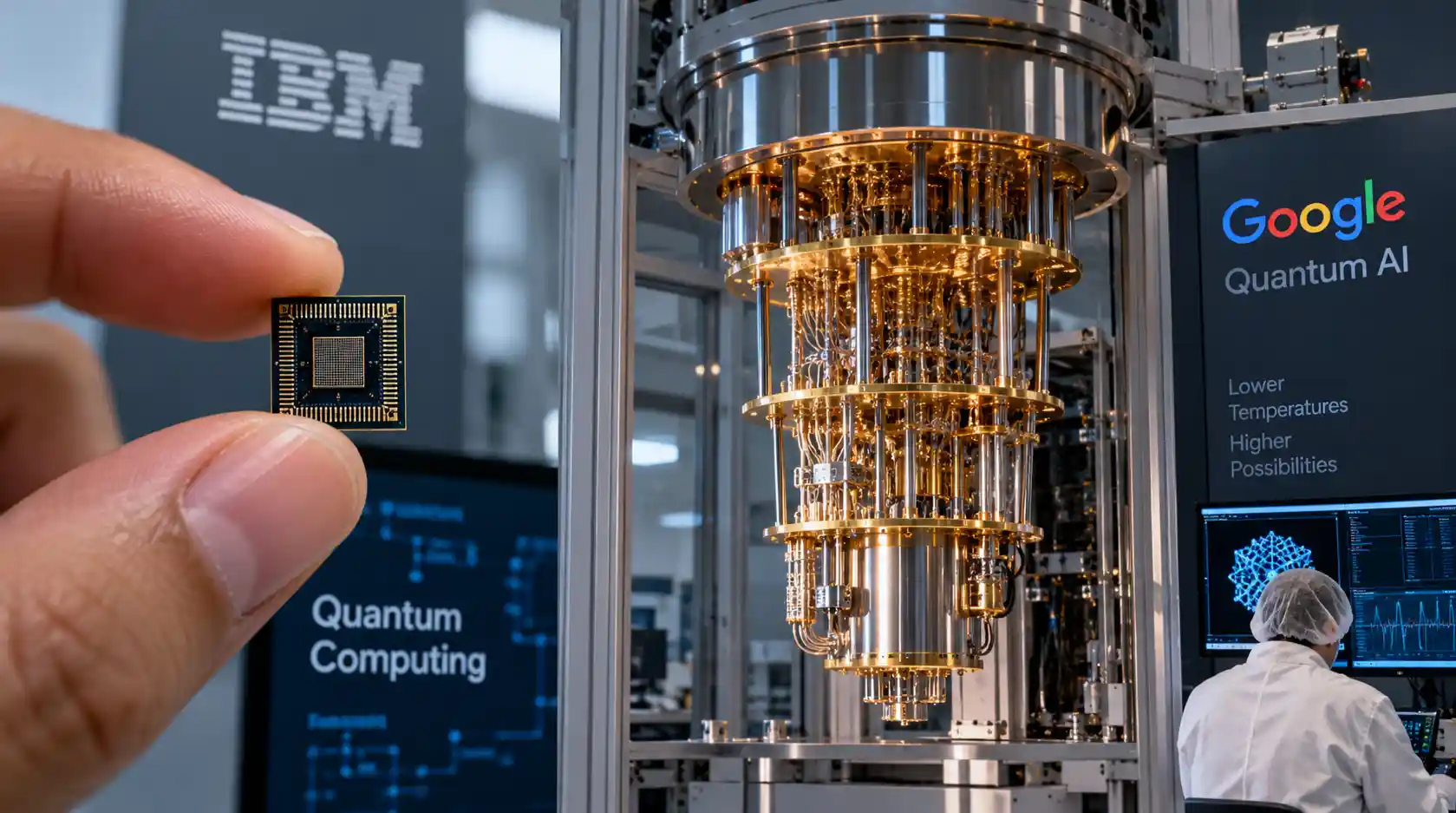

A quantum processor can fit in the palm of a hand. The machine required to make it work can be taller than a person, surrounded by racks of electronics and packed with cables, pumps, shields and cooling hardware.
That apparent mismatch is not because quantum computers need unusually large processors. It is because some of today’s leading quantum chips can operate only inside an extraordinarily controlled physical environment.
In superconducting quantum computers developed by companies such as IBM and Google, most of what people see in photographs is not the computer chip itself. It is the infrastructure required to keep a small quantum processor cold, isolated and precisely controlled.
A useful analogy is an astronaut inside a spacecraft. The astronaut is relatively small, but keeping that person alive in space requires a pressure vessel, oxygen, thermal control, communications, power and shielding. In a superconducting quantum computer, the chip is the astronaut. The refrigerator, wiring and electronics are its life-support system.
What is actually on the quantum chip?
A conventional processor stores information as bits representing either 0 or 1.
A quantum processor uses qubits. Depending on the technology, qubits can be built from superconducting electrical circuits, trapped ions, neutral atoms, photons or other physical systems.
IBM and Google primarily use superconducting qubits. In these systems, microscopic electrical circuits containing components called Josephson junctions behave quantum mechanically when cooled to extremely low temperatures. A qubit can be prepared in combinations of the quantum states associated with 0 and 1, and quantum gates manipulate those states to perform a computation.
The actual processor can therefore be surprisingly small. The challenge is not making the chip physically enormous. The challenge is keeping hundreds or eventually millions of extremely sensitive quantum components operating reliably.
Why does the chip need to be so cold?
Superconducting qubits operate using extremely small differences in energy.
At normal room temperature, thermal energy would overwhelm those delicate quantum states. Random energy from the environment can excite qubits when they are supposed to remain in their lowest state and introduce errors into calculations.
IBM says its superconducting processors are typically operated around 15 millikelvin, or 0.015 kelvin above absolute zero. Google similarly says its superconducting hardware requires specialized cryogenic environments.
That is much colder than ordinary outer space.
The purpose is not simply to make the metal superconducting. The deeper objective is to suppress thermal noise enough that researchers can control individual quantum states before information is lost.
Peer-reviewed research on superconducting qubits identifies multiple mechanisms that can reduce coherence, including material defects, electromagnetic fluctuations and unwanted electronic or vibrational excitations.
This loss of usable quantum information is called decoherence.
What is that giant gold chandelier?
One of the most famous images associated with quantum computing shows a large structure hanging downward in several gold-colored layers.
That is not the quantum processor.
It is the interior of a dilution refrigerator.
IBM describes the familiar golden chandelier as a multi-tiered dilution refrigerator, with the quantum processor mounted near the coldest section at the bottom.
Each level functions as a temperature stage. Cables and components travelling from the warm outside world toward the quantum chip pass through progressively colder regions.
The large structure provides mounting points for wiring, filters, amplifiers, thermal anchoring and shielding while preventing unwanted heat from reaching the processor.
So when a photograph appears to show a three-meter-tall quantum computer, the actual quantum processor may occupy only a tiny region near the bottom.
Most of the photograph is refrigeration and signal infrastructure.
How does a dilution refrigerator get that cold?
A household refrigerator removes heat using a circulating refrigerant.
A quantum dilution refrigerator takes the same broad idea to an extreme.
Modern systems commonly begin with mechanical pulse-tube coolers. These can reduce the temperature in stages, first to tens of kelvin and then to roughly 4 kelvin, close to the temperature of liquid helium.
The final cooling uses a circulating mixture of two helium isotopes, helium-3 and helium-4.
At extremely low temperatures, the quantum-mechanical properties of that mixture allow additional heat to be extracted as helium-3 moves between phases. By continuously circulating the mixture, the refrigerator can maintain temperatures around 10 to 20 millikelvin.
It is an elaborate machine because maintaining those temperatures continuously while sending electrical signals into and out of the refrigerator is difficult.
IBM’s modular cryogenic systems are designed to cool connected quantum hardware below about 15 millikelvin while giving engineers more room for wiring and multiple processors.
The chip remains tiny.
The environment around it is large because engineers are trying to control more qubits without letting heat leak into the system.
Why are there so many wires?
A quantum chip cannot calculate completely by itself.
It needs instructions from classical electronics.
For superconducting systems, those instructions often arrive as precisely shaped microwave pulses. Room-temperature electronics generate signals with carefully controlled frequency, amplitude and timing. Those signals travel through cables inside the refrigerator until they reach individual qubits.
The processor also has to return information.
Qubit readout signals are extremely weak, so the refrigerator contains low-noise and quantum-limited amplifiers to strengthen them before conventional electronics interpret the result.
IBM’s hardware stack includes flexible microwave cables, superconducting coaxial lines, HEMT amplifiers, quantum-limited amplifiers and magnetic shielding around the processor.
This explains another strange feature of quantum computers: increasing the number of qubits does not simply mean placing more qubits on the chip.
Engineers also need a scalable way to control and read them.
The wiring can become a larger engineering problem than the silicon itself.
Why noise is such a problem
A transistor in an ordinary computer is remarkably robust. Your laptop continues working while someone walks across the room, your phone receives radio signals and the processor heats up.
Quantum states are much less forgiving.
Heat can create unwanted excitations.
Electromagnetic radiation can interfere with qubit states.
Electrical noise can contaminate control pulses.
Vibration can couple into sensitive devices.
Even interactions with microscopic defects in materials can reduce the time a qubit retains its quantum information.
This is why the machine includes vacuum chambers, magnetic shielding, filters, vibration management and carefully designed cables.
The refrigerator is not merely keeping something cold.
It is creating a controlled physical bubble around the processor.
The computer is mostly support equipment
Seen this way, the enormous size becomes less mysterious.
The quantum processor performs the quantum calculation.
The rest of the system makes that calculation physically possible.
There are refrigeration compressors and pumps, microwave generators, digital-to-analog converters, amplifiers, servers, control electronics, power supplies and conventional computers used to compile instructions and interpret results.
NIST has pointed out that information generated by ultracold superconducting qubits still has to be controlled and stored using conventional electronics operating much closer to room temperature.
A quantum computer is therefore a hybrid machine.
A tiny quantum processor sits at the center of a much larger classical and cryogenic system.
Not every quantum computer needs this giant refrigerator
The gold chandelier is strongly associated with quantum computing, but it is not universal.
It mainly represents superconducting quantum computing.
Neutral-atom systems instead trap individual atoms using lasers inside vacuum chambers. The atoms themselves can be cooled to temperatures close to absolute zero using laser techniques, while much of the surrounding apparatus can remain near room temperature.
Trapped-ion quantum computers also rely heavily on lasers, electromagnetic traps and high vacuum rather than the same type of millikelvin dilution refrigerator used for superconducting processors. Some implementations still use cryogenic hardware.
Photonic quantum computers use yet another architecture and may require specialized optical equipment and, in some systems, cooled photon detectors.
There is therefore no single physical shape for a quantum computer.
Could quantum computers eventually become smaller?
Parts of them almost certainly will.
Engineers are already trying to move conventional electronics closer to the qubits using cryogenic CMOS, reducing the number of individual cables that must travel from room temperature to the chip.
Researchers are also developing denser cryogenic wiring, better packaging and more integrated control electronics.
As qubit counts grow, this work becomes essential because traditional coaxial cables consume space and carry unwanted heat into refrigerators.
But there is an apparent paradox.
Individual components may become smaller while useful quantum computers become larger overall.
Fault-tolerant quantum computing is expected to require many physical qubits to construct more reliable logical qubits. That means large systems may use multiple connected processors and larger modular cryogenic systems rather than one tiny self-contained device.
So the future quantum computer may not resemble a laptop containing a tiny quantum CPU.
It could look more like a data center built around compact quantum processors.
The tiny-chip paradox
The size difference ultimately comes down to one fact.
The difficult part is not fitting quantum information onto a small chip. It is protecting that information from the ordinary physical world.
A superconducting quantum processor can be only centimeters across because modern fabrication can place sophisticated circuits onto small pieces of material.
But keeping those circuits around 15 millikelvin, sending extremely precise microwave signals to them, extracting incredibly weak responses and shielding them from heat, vibration and electromagnetic noise requires a much larger machine.
The tiny chip is the computer’s quantum brain.
The refrigerator, wiring and electronics are everything required to keep that brain able to think.
Reader questions
Frequently asked questions
Why is a quantum chip so small but the computer so big?
The chip itself can be only a few centimeters across, but superconducting qubits need extreme cooling, shielding, microwave control lines, amplifiers and classical electronics. Most of the machine exists to create and maintain the environment the chip needs.
What is the gold chandelier inside a quantum computer?
It is the interior of a dilution refrigerator. Its multiple temperature stages cool the quantum processor and provide places to anchor wiring, filters, amplifiers and shielding.
How cold is a superconducting quantum computer?
Many superconducting quantum processors operate around 10 to 20 millikelvin, only a tiny fraction of a degree above absolute zero.
Do all quantum computers need giant refrigerators?
No. Superconducting systems commonly use dilution refrigerators, while trapped-ion, neutral-atom and photonic quantum computers use different combinations of lasers, vacuum systems, optics and sometimes cryogenic hardware.
Can quantum computers become smaller?
Some components can become smaller through integrated cryogenic electronics, denser wiring and improved packaging. However, fault-tolerant machines may still require many physical qubits and multiple processor modules, so complete systems could remain large.
Nexuswild welcomes factual corrections. Email contact@nexuswild.com with evidence and the article URL.