
XPeng Scales Up Humanoid Robot Manufacturing With New Guangzhou Production Line
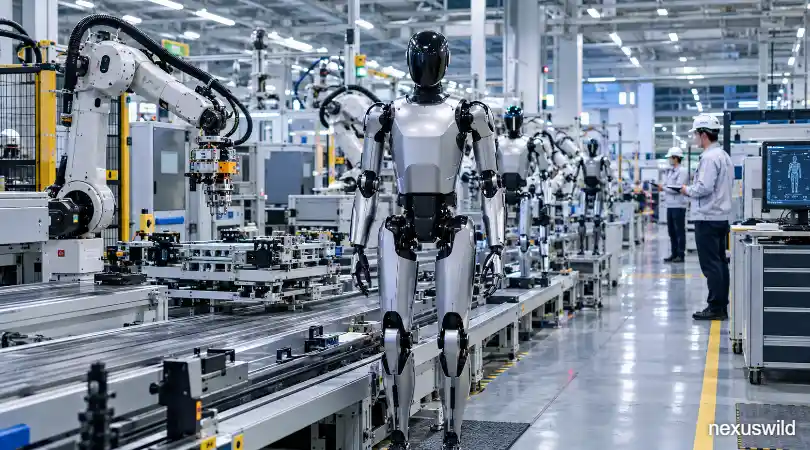
Chinese electric-vehicle maker XPeng has begun operating a dedicated production line for its IRON humanoid robot in Guangzhou, bringing automotive manufacturing methods into a field that is increasingly moving from research and demonstrations towards industrial production.
XPeng announced on September 8, 2026, that its humanoid robot manufacturing facility had been commissioned and that an IRON robot had completed assembly before autonomously walking off the production line. The company said more than 80% of core manufacturing processes are automated, with the facility designed to support production expansion. <Cite refs={["turn595796search0","turn595796search6"]}/>
XPeng's stated target is to reach a production capacity of 1,000 robots per month by the end of 2026. That is a manufacturing target, not evidence that the company has already achieved that output or secured orders for every unit it could produce.
The development illustrates a broader strategy among technology and automotive companies: using established expertise in electronics, sensors, computing, software and automated manufacturing to develop a new generation of physical AI systems.
From automotive manufacturing to humanoid robotics
XPeng's electric-vehicle business provides an existing industrial foundation for its robotics ambitions. Vehicle manufacturing requires tightly controlled assembly processes, quality inspection, electronics integration and coordination between hardware and software systems.
Many of these capabilities are relevant to humanoid robots, which combine mechanical structures, motors, sensors, controllers, computing hardware and AI software in a single system.
XPeng says its new production line incorporates automotive-grade quality systems and precision manufacturing methods. More than 80% of core processes are automated, according to the company, although the figure does not mean that 80% of the entire robot is manufactured without human involvement.
The distinction matters because humanoid robots have complex mechanical and control requirements. Automated assembly must be paired with testing, calibration and quality checks to ensure that components work together reliably.
Moving from prototypes to a repeatable production process is an important step, but manufacturing scale alone does not establish how well robots will perform across different commercial environments.
A $900 million funding round supports the robotics business
The production-line announcement follows a major funding milestone for XPeng's robotics division.
On August 24, 2026, XPeng announced that its robotics business had raised more than $900 million, at a post-money valuation exceeding $6.3 billion. The round was led by IDG Capital, with participation from Gaorong Ventures and strategic support from Tencent and Alibaba. <Cite refs={["turn595796search1","turn595796news37"]}/>
XPeng said the capital would support hardware and software research, Physical AI model development, data generation, mass-production facilities and international commercial expansion.
The company also said it would retain controlling ownership of the robotics business, which would remain consolidated into the wider group's financial statements.
The funding provides resources for a business that requires investment in both physical hardware and the AI systems that control it. However, a company's valuation and fundraising total should not be confused with operating revenue, customer demand or profitability.
Investors will need evidence that the funding can help XPeng develop products that customers are willing to purchase and deploy at scale.
What makes IRON part of the physical AI race?
Physical AI refers to AI systems that interact with and operate in the real world through machines such as robots, autonomous vehicles and industrial equipment.
According to XPeng's funding announcement, IRON uses three in-house Turing AI chips with up to 2,250 trillion operations per second of stated effective computing capacity. The company also describes a hardware and software platform spanning the robot's mechanical architecture, actuation systems, controllers, hands and AI systems. <Cite refs={["turn595796search1"]}/>
These capabilities are intended to support robot movement, perception and task execution. Yet processing capacity is only one part of a useful robot. Performance also depends on software reliability, training data, safety, battery life, dexterity and the ability to operate consistently in unfamiliar environments.
Humanoid robots are being developed for tasks that may be repetitive, physically demanding or difficult for people to perform safely. Commercial applications could eventually include logistics, manufacturing support, inspection and selected service activities.
The suitability of IRON for particular tasks will depend on real-world testing and deployment results. The launch of a production line does not, by itself, confirm that the robot is ready for widespread use across those settings.
The commercial test: production versus sales
XPeng's goal of reaching 1,000 units per month is an important benchmark for its manufacturing plans. However, production capacity and actual output are different measures, and neither guarantees long-term commercial demand.
The company has said it expects IRON to enter mass production by the end of 2026, with initial deployments at XPeng stores and campuses before official launches and deliveries in China and overseas markets in 2027. <Cite refs={["turn595796search1","turn595796search11"]}/>
These plans place the next phase of the programme around deployment, product refinement and customer adoption.
Businesses evaluating humanoid robots will need to consider purchase and operating costs, maintenance, task reliability, safety requirements and the measurable benefits compared with existing automation or human labour. For XPeng, repeat orders and successful deployments will be more informative indicators of commercial progress than headline production targets alone.
The company could also benefit from overlapping automotive supply chains, but that advantage will depend on how many components can be shared economically and how much additional engineering humanoid robots require.
What to watch next
The next milestones are whether XPeng reaches its planned year-end production scale, how IRON performs in initial deployments, and whether commercial deliveries begin on the stated 2027 timetable.
Investors and industry customers will also watch for disclosures about actual production volumes, confirmed orders, pricing, operating performance and the range of tasks the robot can perform reliably.
XPeng's Guangzhou facility marks a meaningful manufacturing step for its robotics programme. The longer-term test, however, will be whether automated production can support dependable robots that solve practical problems for customers and generate sustainable business returns.
Nexuswild welcomes factual corrections. Email contact@nexuswild.com with evidence and the article URL.